Attorney-Verified  Motor Vehicle Power of Attorney Document for California

Attorney-Verified Motor Vehicle Power of Attorney Document for California

The California Motor Vehicle Power of Attorney form allows an individual to designate another person to act on their behalf in matters related to motor vehicle transactions. This legal document is essential for ensuring that someone can handle tasks such as title transfers, registration, and other vehicle-related activities when the owner is unavailable. To facilitate these processes, consider filling out the form by clicking the button below.

Article Guide

The California Motor Vehicle Power of Attorney form is a crucial document for individuals who need to delegate authority regarding their vehicle transactions. This form allows a designated agent to handle various tasks on behalf of the vehicle owner, including signing documents related to the sale, transfer, or registration of a vehicle. By using this form, vehicle owners can ensure that their interests are protected even when they are unable to be present for these transactions. It is important to note that the form must be completed accurately and signed by the vehicle owner to be valid. Additionally, the agent must be someone the owner trusts, as they will have the legal authority to act in the owner's stead. Understanding the nuances of this form can simplify the process of managing vehicle-related matters, especially for those who may be out of state or otherwise unavailable. Whether dealing with a car sale, title transfer, or other motor vehicle issues, having a Power of Attorney in place can provide peace of mind and streamline what might otherwise be a complicated process.

California Motor Vehicle Power of Attorney Preview

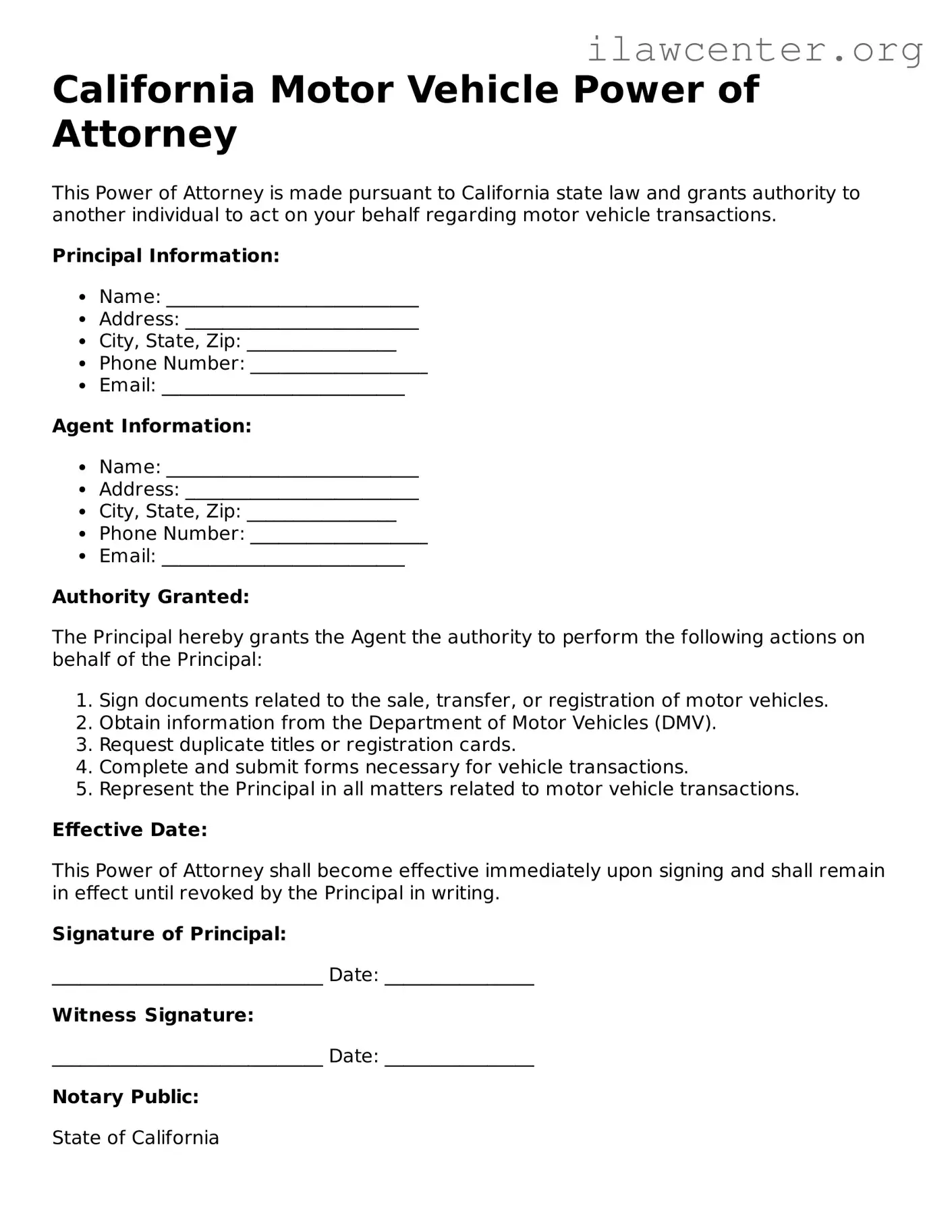
California Motor Vehicle Power of Attorney

This Power of Attorney is made pursuant to California state law and grants authority to another individual to act on your behalf regarding motor vehicle transactions.

Principal Information:

  • Name: ___________________________
  • Address: _________________________
  • City, State, Zip: ________________
  • Phone Number: ___________________
  • Email: __________________________

Agent Information:

  • Name: ___________________________
  • Address: _________________________
  • City, State, Zip: ________________
  • Phone Number: ___________________
  • Email: __________________________

Authority Granted:

The Principal hereby grants the Agent the authority to perform the following actions on behalf of the Principal:

  1. Sign documents related to the sale, transfer, or registration of motor vehicles.
  2. Obtain information from the Department of Motor Vehicles (DMV).
  3. Request duplicate titles or registration cards.
  4. Complete and submit forms necessary for vehicle transactions.
  5. Represent the Principal in all matters related to motor vehicle transactions.

Effective Date:

This Power of Attorney shall become effective immediately upon signing and shall remain in effect until revoked by the Principal in writing.

Signature of Principal:

_____________________________ Date: ________________

Witness Signature:

_____________________________ Date: ________________

Notary Public:

State of California

County of ______________________

On this ____ day of ___________, 20__, before me, a Notary Public, personally appeared ______________________, who proved to me on the basis of satisfactory evidence to be the person whose name is subscribed to this instrument and acknowledged that he/she executed it.

_____________________________

Notary Public Signature

My commission expires: ________________

PDF Form Characteristics

Fact Name Details
Purpose The California Motor Vehicle Power of Attorney form allows an individual to designate another person to handle vehicle-related transactions on their behalf.
Governing Law This form is governed by the California Vehicle Code, specifically sections related to powers of attorney for vehicle transactions.
Required Information The form typically requires the principal's name, the agent's name, vehicle details, and signatures of both parties.
Usage This form is commonly used for tasks such as transferring ownership, registering a vehicle, or obtaining a duplicate title.

Instructions on Utilizing California Motor Vehicle Power of Attorney

Filling out the California Motor Vehicle Power of Attorney form is a straightforward process. This form allows you to designate someone else to handle specific tasks related to your vehicle on your behalf. Follow the steps below to ensure that you complete the form correctly.

  1. Obtain the California Motor Vehicle Power of Attorney form. You can find it online or at your local Department of Motor Vehicles (DMV) office.
  2. Begin by entering your name and address in the designated fields at the top of the form. Make sure the information is accurate and up-to-date.
  3. Next, provide the name and address of the person you are appointing as your attorney-in-fact. This individual will act on your behalf regarding your vehicle.
  4. Specify the powers you are granting. You may need to check specific boxes that outline the tasks your attorney-in-fact can perform, such as signing documents or transferring ownership.
  5. Include details about the vehicle. This includes the make, model, year, and vehicle identification number (VIN). Accurate information is essential for the form to be valid.
  6. Sign and date the form. Your signature must match the name you provided at the beginning of the form. If you are unable to sign, you may need a witness or notary, depending on your situation.
  7. Finally, provide a copy of the completed form to your attorney-in-fact and keep a copy for your records.

Important Facts about California Motor Vehicle Power of Attorney

What is a California Motor Vehicle Power of Attorney form?

The California Motor Vehicle Power of Attorney form is a legal document that allows an individual (the principal) to designate another person (the agent) to act on their behalf regarding motor vehicle transactions. This can include tasks such as transferring ownership, registering a vehicle, or obtaining a title. By using this form, the principal grants the agent the authority to handle specific motor vehicle matters, making it easier to manage these processes without the principal's direct involvement.

Who can be appointed as an agent in the Motor Vehicle Power of Attorney?

Any competent adult can be appointed as an agent in the California Motor Vehicle Power of Attorney. This includes family members, friends, or even professionals like attorneys or auto dealers. It’s essential that the person you choose is trustworthy and understands the responsibilities involved in handling your motor vehicle affairs.

Do I need to have the Motor Vehicle Power of Attorney form notarized?

Yes, the California Motor Vehicle Power of Attorney form must be notarized to be valid. This means that a notary public must witness the signing of the document. Notarization helps verify the identity of the principal and ensures that the document is executed properly, providing an extra layer of protection against fraud.

How long is the Motor Vehicle Power of Attorney valid?

The Motor Vehicle Power of Attorney remains valid until it is revoked by the principal or until the specific task for which it was created is completed. If the principal becomes incapacitated or passes away, the power of attorney is automatically revoked. It’s important to keep track of any changes in your situation that might require updating or revoking the document.

Can I revoke the Motor Vehicle Power of Attorney once it is signed?

Yes, you can revoke the Motor Vehicle Power of Attorney at any time as long as you are competent to do so. To revoke the document, you must create a written notice of revocation and provide it to your agent. Additionally, it’s wise to inform any relevant parties, such as the Department of Motor Vehicles (DMV), to prevent any misunderstandings.

What if the agent misuses their authority?

If you believe that your agent has misused their authority, you have the right to take action. This may include revoking the power of attorney and notifying the authorities if necessary. It’s crucial to choose an agent you trust, but in case of misuse, be prepared to protect your interests and rights.

Can I use the Motor Vehicle Power of Attorney for multiple vehicles?

Yes, the California Motor Vehicle Power of Attorney can be used for multiple vehicles. When filling out the form, simply list all the vehicles for which you want the agent to have authority. This allows the agent to handle transactions for each specified vehicle without needing separate documents.

Where can I obtain the California Motor Vehicle Power of Attorney form?

You can obtain the California Motor Vehicle Power of Attorney form from the California Department of Motor Vehicles (DMV) website or at any local DMV office. It’s important to ensure you are using the most current version of the form to avoid any issues during the transaction process.
Common mistakes

When individuals complete the California Motor Vehicle Power of Attorney form, they often encounter several common mistakes that can lead to complications. One frequent error is failing to provide accurate and complete information about the vehicle. This includes the vehicle identification number (VIN), make, model, and year. Omitting any of these details can create confusion and may result in the form being rejected.

Another mistake involves not properly identifying the agent who will act on behalf of the vehicle owner. It is essential to include the full name and address of the agent. In some cases, individuals may use nicknames or incomplete names, which can lead to issues in verifying the agent's authority. The clarity of this information is crucial for the validity of the power of attorney.

Additionally, individuals sometimes overlook the need for signatures. Both the vehicle owner and the agent must sign the form for it to be valid. In situations where one party forgets to sign, the entire document may be rendered ineffective. Ensuring that both signatures are present and correctly dated is a vital step in the process.

Finally, people often neglect to check the form for any specific requirements set forth by the California Department of Motor Vehicles (DMV). Each state may have its own regulations regarding power of attorney forms, and California is no exception. Failing to adhere to these guidelines can result in delays or denial of the power of attorney. It is advisable to review the most current instructions from the DMV before submission.

Documents used along the form

When dealing with vehicle transactions in California, the Motor Vehicle Power of Attorney form is an essential document. However, it often works in conjunction with several other forms and documents to ensure a smooth process. Here’s a look at four important documents that you might need alongside the Power of Attorney.

  • California Vehicle Registration Application: This form is necessary for registering a vehicle with the California Department of Motor Vehicles (DMV). It collects essential information about the vehicle and the owner, ensuring that the vehicle is legally recognized and can be driven on public roads.
  • Bill of Sale: A Bill of Sale serves as a legal document that records the sale of a vehicle. It outlines the details of the transaction, including the purchase price, vehicle identification number (VIN), and the names of both the buyer and seller. This document is crucial for proving ownership transfer.
  • Title Transfer Form: When a vehicle changes ownership, a Title Transfer Form is required to update the DMV records. This form provides vital information about the vehicle and the new owner, ensuring that the title reflects the current owner’s information.
  • Smog Certification: In California, many vehicles must pass a smog check before they can be registered. A Smog Certification document proves that the vehicle meets state emissions standards. This is particularly important for older vehicles and can affect the registration process.

Understanding these accompanying documents is crucial for anyone navigating vehicle transactions in California. Each plays a significant role in ensuring compliance with state regulations and facilitating a hassle-free transfer of ownership. Be prepared and informed to streamline your vehicle dealings.

Similar forms

  • Durable Power of Attorney: This document allows a person to appoint someone else to make decisions on their behalf, especially in financial or legal matters. It remains effective even if the person becomes incapacitated.
  • General Power of Attorney: Similar to the durable version, this document grants authority to another individual to handle a variety of affairs. However, it becomes invalid if the principal becomes incapacitated.
  • Limited Power of Attorney: This form restricts the authority granted to specific tasks or time frames. It is often used for a particular transaction, such as selling a vehicle.
  • Health Care Power of Attorney: This document allows an individual to designate someone to make medical decisions on their behalf if they are unable to do so. It focuses on health care matters rather than vehicle transactions.
  • Financial Power of Attorney: This type of power of attorney gives someone the authority to manage financial matters, such as banking or property transactions, but does not extend to vehicle-specific issues.
  • Vehicle Title Transfer Form: While not a power of attorney, this form is used to officially transfer ownership of a vehicle. It requires signatures from both the seller and buyer, similar to how a power of attorney allows for the transfer of authority.
  • Release of Liability Form: This document protects the seller from future claims after selling a vehicle. It serves a different purpose but is related to vehicle transactions, similar to how a power of attorney facilitates actions regarding vehicle ownership.

Dos and Don'ts

When filling out the California Motor Vehicle Power of Attorney form, it's important to follow certain guidelines to ensure the process goes smoothly. Here’s a list of things you should and shouldn't do:

  • Do read the entire form carefully before starting.
  • Don't leave any required fields blank.
  • Do provide accurate information about the vehicle and the parties involved.
  • Don't use abbreviations or shorthand that could cause confusion.
  • Do sign and date the form where indicated.
  • Don't forget to have the signature notarized if required.
  • Do keep a copy of the completed form for your records.
  • Don't submit the form without verifying that all information is correct.

Following these guidelines will help you avoid potential delays or issues with your Power of Attorney form. Take your time, and ensure everything is in order before submission.

Misconceptions

The California Motor Vehicle Power of Attorney form is often misunderstood. Here are six common misconceptions regarding this legal document:

  1. It can only be used for selling vehicles.

    Many people believe that this form is solely for the purpose of selling a vehicle. In reality, it can also be used for various tasks, such as transferring title, registering a vehicle, and handling other motor vehicle-related matters.

  2. Only a lawyer can complete the form.

    This misconception suggests that a legal professional is necessary to fill out the form. However, individuals can complete the form themselves as long as they provide the required information accurately.

  3. It must be notarized to be valid.

    While notarization can add an extra layer of authenticity, it is not a strict requirement for the California Motor Vehicle Power of Attorney form. As long as the form is properly completed and signed, it is generally accepted.

  4. It expires after a short period.

    Some believe that the power of attorney is only valid for a limited time. In fact, it remains in effect until the specific task is completed or until the principal revokes it.

  5. It can be used for any type of vehicle.

    This form is specific to motor vehicles. It cannot be used for other types of property, such as boats or real estate, which may require different legal documents.

  6. Only the vehicle owner can create this form.

    While the owner typically initiates the process, an authorized representative can also create the form on behalf of the owner, provided they have the necessary permissions.

Key takeaways

When dealing with the California Motor Vehicle Power of Attorney form, it's essential to understand its purpose and how to use it effectively. Here are some key takeaways:

  • The form allows you to designate someone else to act on your behalf regarding motor vehicle transactions.
  • It can be useful for buying, selling, or registering a vehicle when you cannot be present.
  • Make sure to fill out the form completely and accurately to avoid any delays or issues.
  • Both you and the person you designate (the attorney-in-fact) must sign the document.
  • It's advisable to have the form notarized, although it may not be strictly required.
  • Keep a copy of the completed form for your records after submitting it.
  • The form is available online through the California Department of Motor Vehicles (DMV) website.
  • Consider the trustworthiness of the person you are designating, as they will have significant authority over your vehicle.
  • Be aware of any specific state requirements or additional documents that may be needed.
  • Review the form periodically to ensure it still meets your needs and reflects any changes in your circumstances.

By understanding these points, you can navigate the process of using the California Motor Vehicle Power of Attorney form with greater confidence.