Attorney-Verified  Non-disclosure Agreement Document for California

Attorney-Verified Non-disclosure Agreement Document for California

A California Non-disclosure Agreement (NDA) is a legal contract designed to protect sensitive information shared between parties. This form ensures that confidential data remains private and is not disclosed to unauthorized individuals. To safeguard your interests, consider filling out the NDA form by clicking the button below.

Article Guide

In the vibrant landscape of California's business environment, protecting sensitive information is paramount for companies and individuals alike. The California Non-disclosure Agreement (NDA) serves as a crucial tool in this endeavor, enabling parties to share confidential information while safeguarding their interests. This legally binding document outlines the terms under which sensitive information may be disclosed, ensuring that both parties understand their obligations. Typically, an NDA includes key elements such as the definition of confidential information, the duration of the agreement, and the permissible uses of the disclosed information. Additionally, it often specifies the consequences of breaching the agreement, providing a clear framework for accountability. By establishing trust and clarity, the California NDA fosters collaboration and innovation while minimizing the risk of information leaks that could jeopardize competitive advantages or personal privacy.

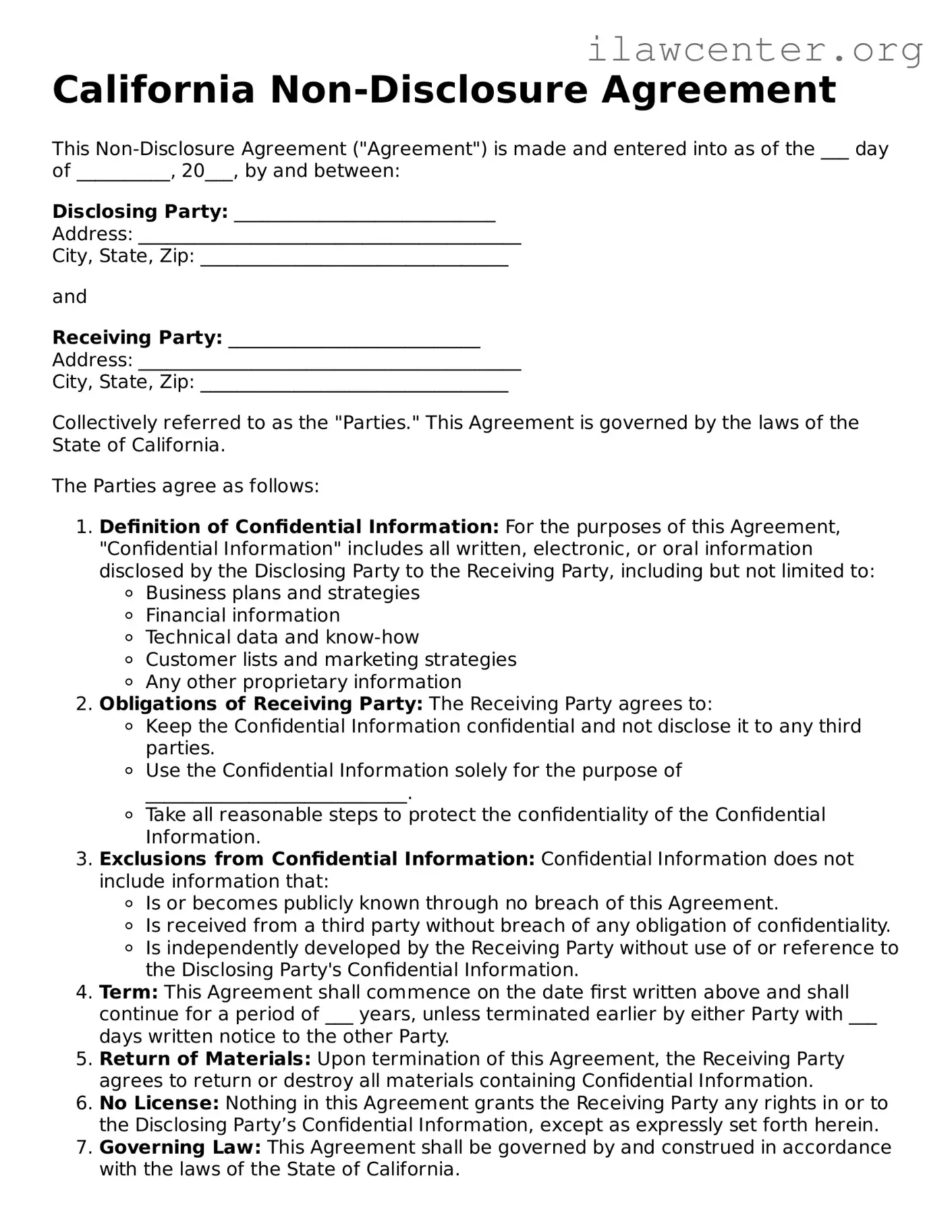
California Non-disclosure Agreement Preview

California Non-Disclosure Agreement

This Non-Disclosure Agreement ("Agreement") is made and entered into as of the ___ day of __________, 20___, by and between:

Disclosing Party: ____________________________
Address: _________________________________________
City, State, Zip: _________________________________

and

Receiving Party: ___________________________
Address: _________________________________________
City, State, Zip: _________________________________

Collectively referred to as the "Parties." This Agreement is governed by the laws of the State of California.

The Parties agree as follows:

  1. Definition of Confidential Information: For the purposes of this Agreement, "Confidential Information" includes all written, electronic, or oral information disclosed by the Disclosing Party to the Receiving Party, including but not limited to:
    • Business plans and strategies
    • Financial information
    • Technical data and know-how
    • Customer lists and marketing strategies
    • Any other proprietary information
  2. Obligations of Receiving Party: The Receiving Party agrees to:
    • Keep the Confidential Information confidential and not disclose it to any third parties.
    • Use the Confidential Information solely for the purpose of ____________________________.
    • Take all reasonable steps to protect the confidentiality of the Confidential Information.
  3. Exclusions from Confidential Information: Confidential Information does not include information that:
    • Is or becomes publicly known through no breach of this Agreement.
    • Is received from a third party without breach of any obligation of confidentiality.
    • Is independently developed by the Receiving Party without use of or reference to the Disclosing Party's Confidential Information.
  4. Term: This Agreement shall commence on the date first written above and shall continue for a period of ___ years, unless terminated earlier by either Party with ___ days written notice to the other Party.
  5. Return of Materials: Upon termination of this Agreement, the Receiving Party agrees to return or destroy all materials containing Confidential Information.
  6. No License: Nothing in this Agreement grants the Receiving Party any rights in or to the Disclosing Party’s Confidential Information, except as expressly set forth herein.
  7. Governing Law: This Agreement shall be governed by and construed in accordance with the laws of the State of California.

IN WITNESS WHEREOF, the Parties have executed this Non-Disclosure Agreement as of the date first above written.

Disclosing Party:
Signature: ____________________________
Name: ________________________________
Title: ________________________________

Receiving Party:
Signature: ____________________________
Name: ________________________________
Title: ________________________________

PDF Form Characteristics

Fact Name Description
Purpose The California Non-disclosure Agreement (NDA) is used to protect confidential information shared between parties.
Governing Law The NDA is governed by California state law.
Enforceability California courts generally uphold NDAs as long as they are reasonable in scope and duration.
Common Uses Businesses often use NDAs when discussing sensitive information with potential partners, employees, or contractors.

Instructions on Utilizing California Non-disclosure Agreement

Completing the California Non-disclosure Agreement form requires careful attention to detail to ensure all necessary information is accurately provided. Once the form is filled out, it will need to be signed by all parties involved, and copies should be distributed accordingly.

  1. Obtain the California Non-disclosure Agreement form from a reliable source.
  2. Read through the entire form to understand its requirements and sections.
  3. Fill in the date at the top of the form where indicated.
  4. Provide the names and contact information of all parties involved in the agreement.
  5. Clearly define the confidential information that will be protected under the agreement.
  6. Specify the duration of the confidentiality obligations in the designated section.
  7. Include any exceptions to confidentiality, if applicable.
  8. Review the terms and conditions outlined in the form for accuracy.
  9. Sign and date the form in the appropriate areas.
  10. Distribute copies of the signed agreement to all parties involved.

Important Facts about California Non-disclosure Agreement

What is a California Non-disclosure Agreement (NDA)?

A California Non-disclosure Agreement (NDA) is a legal contract designed to protect sensitive information shared between parties. It ensures that the receiving party does not disclose or misuse the confidential information provided by the disclosing party. NDAs are commonly used in business settings, especially when discussing trade secrets, proprietary information, or any data that could harm a business if leaked.

When should I use a Non-disclosure Agreement?

You should consider using an NDA whenever you plan to share confidential information with another party. This could be during business negotiations, partnerships, or when hiring employees who will have access to sensitive data. An NDA helps establish trust and sets clear boundaries regarding the handling of confidential information.

What types of information can be protected by an NDA?

NDAs can protect a wide range of information, including business plans, financial data, customer lists, marketing strategies, and proprietary technologies. Essentially, any information that provides a competitive advantage or is not publicly known can be covered under an NDA.

Are there different types of NDAs?

Yes, there are two main types of NDAs: unilateral and mutual. A unilateral NDA involves one party disclosing information to another, while a mutual NDA is where both parties exchange confidential information. The choice between the two depends on the nature of the relationship and the information being shared.

How long does the confidentiality obligation last?

The duration of the confidentiality obligation can vary based on the terms outlined in the NDA. Typically, it lasts for a specified period, often ranging from one to five years. However, certain types of information, like trade secrets, may remain protected indefinitely, even after the NDA expires.

What happens if someone breaches an NDA?

If a party breaches an NDA, the other party may seek legal remedies. This could include monetary damages, injunctive relief (a court order to stop the breach), or specific performance (forcing the breaching party to comply with the NDA). The exact consequences will depend on the terms of the agreement and the severity of the breach.

Can I modify a Non-disclosure Agreement?

Yes, NDAs can be customized to fit the specific needs of the parties involved. It's essential to clearly outline the terms, including the definition of confidential information, the obligations of both parties, and the duration of the agreement. However, both parties must agree to any modifications, and it’s wise to document these changes in writing.

Do I need a lawyer to draft an NDA?

While it’s possible to find templates online and draft your own NDA, consulting a lawyer is highly recommended. A legal professional can ensure that the agreement is tailored to your specific situation, complies with California laws, and adequately protects your interests. This investment can save you from potential legal issues down the road.
Common mistakes

When completing the California Non-disclosure Agreement form, individuals often overlook critical details that can lead to complications. One common mistake is failing to provide accurate identification information. It is essential to include full legal names and contact details. Inaccuracies can result in delays or disputes over the agreement's validity.

Another frequent error involves not specifying the scope of the confidential information. Parties must clearly define what constitutes confidential information within the agreement. Without this clarity, misunderstandings may arise, potentially undermining the purpose of the agreement.

Many individuals neglect to include a duration for the confidentiality obligations. It is important to state how long the information should remain confidential. Omitting this detail can lead to confusion regarding the responsibilities of each party after the agreement's termination.

Some people also make the mistake of not reviewing the entire agreement thoroughly. Skimming through the document may result in missing key clauses or provisions. Each section should be carefully examined to ensure all parties understand their rights and obligations.

Lastly, failing to sign the agreement properly is a critical oversight. Each party involved must sign and date the document to make it legally binding. Incomplete signatures can render the agreement unenforceable, negating the protections it was meant to provide.

Documents used along the form

In California, a Non-disclosure Agreement (NDA) is an important document that protects confidential information shared between parties. However, it is often accompanied by other forms and documents that help ensure clarity and legal protection. Below are four commonly used documents that may complement an NDA.

  • Mutual Non-disclosure Agreement: This document is similar to a standard NDA but is designed for situations where both parties will be sharing confidential information. It ensures that both sides are equally bound to protect each other's secrets.
  • Confidentiality Agreement: While often used interchangeably with an NDA, a confidentiality agreement may focus more broadly on the obligation to keep information private, covering various types of confidential information beyond just trade secrets.
  • Non-compete Agreement: This document restricts one party from engaging in business activities that directly compete with another party for a specified period and within a defined geographical area. It is often used in conjunction with an NDA to protect business interests.
  • Letter of Intent: A letter of intent outlines the preliminary understanding between parties before entering into a formal agreement. It often includes confidentiality clauses to protect sensitive information shared during negotiations.

Each of these documents serves a specific purpose and can enhance the protection offered by a Non-disclosure Agreement. When engaging in business relationships, it is essential to consider these additional forms to safeguard interests effectively.

Similar forms

A Non-disclosure Agreement (NDA) is an important legal document that protects sensitive information. Several other documents serve similar purposes in safeguarding information or outlining confidentiality. Here are seven documents that share similarities with an NDA:

  • Confidentiality Agreement: Like an NDA, a confidentiality agreement ensures that parties do not disclose information shared between them. It often covers similar terms and conditions regarding what constitutes confidential information.
  • Non-compete Agreement: This document restricts individuals from competing with a business for a certain period after leaving. While it focuses on competition, it often includes clauses about maintaining confidentiality regarding business practices and trade secrets.
  • Non-solicitation Agreement: This agreement prevents individuals from soliciting clients or employees from a business. It often contains confidentiality provisions to protect sensitive information about the business’s operations and relationships.
  • Employment Agreement: An employment contract typically includes confidentiality clauses to protect company secrets. This agreement outlines the expectations of both the employer and employee, including how confidential information should be handled.
  • Partnership Agreement: In a partnership, this document outlines the roles and responsibilities of each partner. It often includes confidentiality terms to protect shared business information and strategies from outside parties.
  • License Agreement: When one party licenses intellectual property to another, this agreement often includes confidentiality clauses. It protects sensitive information about the licensed material and the terms of use.
  • Settlement Agreement: In legal disputes, a settlement agreement may require parties to keep the terms confidential. This protects the interests of both parties and ensures that sensitive information remains private.

Dos and Don'ts

When filling out a California Non-disclosure Agreement (NDA) form, it's crucial to approach the task with care. Here are some essential dos and don'ts to keep in mind.

  • Do read the entire NDA carefully before signing.
  • Do clearly identify the parties involved in the agreement.
  • Do specify the information that is considered confidential.
  • Do outline the duration of the confidentiality obligation.
  • Do consult with a legal advisor if you have questions.
  • Don't sign the NDA without understanding all its terms.
  • Don't leave any sections blank; complete every part of the form.
  • Don't include vague language that could lead to confusion.
  • Don't share confidential information until the NDA is signed.

Taking these steps seriously can help protect your interests and ensure that the agreement serves its intended purpose. Act promptly to avoid any potential pitfalls.

Misconceptions

Understanding Non-disclosure Agreements (NDAs) is crucial for anyone involved in business or legal matters in California. However, several misconceptions often arise about these agreements. Here’s a list of ten common misconceptions and clarifications for each:

  1. All NDAs are the same.

    In reality, NDAs can vary significantly in terms of scope, duration, and specific terms. Each agreement should be tailored to the unique circumstances of the parties involved.

  2. NDAs are only for businesses.

    While businesses frequently use NDAs, individuals can also utilize them to protect personal information, such as in freelance work or personal projects.

  3. Signing an NDA means you cannot talk to anyone about the project.

    This is misleading. NDAs generally restrict the sharing of confidential information but may allow discussions with specific parties, such as employees or legal advisors, under certain conditions.

  4. Once signed, an NDA is permanent.

    Many NDAs have a specified duration for confidentiality. Once this period expires, the obligations under the NDA may no longer apply.

  5. Only written NDAs are enforceable.

    While written agreements are preferred for clarity, verbal NDAs can also be enforceable, provided there is sufficient evidence of the agreement and its terms.

  6. NDAs can protect any type of information.

    Not all information can be protected by an NDA. Generally, only proprietary or confidential information qualifies, and public knowledge or independently developed ideas are not covered.

  7. NDAs are only necessary for sensitive information.

    Even seemingly innocuous information can be critical to a business. Thus, it’s wise to consider an NDA for any information you want to keep private.

  8. Signing an NDA means you cannot work in the same industry again.

    NDAs do not typically impose a blanket ban on future employment. However, they may restrict sharing specific proprietary information learned during the engagement.

  9. Enforcement of NDAs is straightforward.

    While NDAs can be enforced in court, proving a breach can be complex and may require substantial evidence, making legal advice essential.

  10. Once an NDA is breached, there are no remedies.

    In case of a breach, remedies may include monetary damages, injunctive relief, or specific performance, depending on the situation and the terms of the NDA.

Being aware of these misconceptions can help individuals and businesses navigate the complexities of NDAs more effectively. Proper understanding can lead to better protection of valuable information and smoother business operations.

Key takeaways

When filling out and using the California Non-disclosure Agreement (NDA) form, it is essential to understand its components and implications. Here are key takeaways to consider:

  1. Purpose of the NDA: The primary goal of an NDA is to protect sensitive information shared between parties. It establishes legal obligations to maintain confidentiality.
  2. Parties Involved: Clearly identify all parties involved in the agreement. This typically includes the disclosing party and the receiving party.
  3. Definition of Confidential Information: Specify what constitutes confidential information. This can include trade secrets, business strategies, and proprietary data.
  4. Duration of Confidentiality: Determine how long the confidentiality obligation will last. This period can vary based on the nature of the information.
  5. Permitted Disclosures: Outline any circumstances under which the receiving party may disclose the confidential information, such as legal requirements.
  6. Consequences of Breach: Clearly state the repercussions for violating the NDA. This may include legal action or financial penalties.
  7. Governing Law: Specify that California law governs the NDA. This is important for resolving any disputes that may arise.

Understanding these elements can significantly enhance the effectiveness of a Non-disclosure Agreement in California.