Attorney-Verified  Notary Acknowledgement Document for California

Attorney-Verified Notary Acknowledgement Document for California

The California Notary Acknowledgement form is a legal document that verifies the identity of individuals signing a document. This form serves as proof that the signers appeared before a notary public and acknowledged their signatures. To ensure your documents are properly notarized, consider filling out the form by clicking the button below.

Article Guide

The California Notary Acknowledgement form plays a crucial role in the notarization process, serving as a vital tool to verify the identity of individuals signing important documents. This form is primarily used to confirm that the signer appeared before a notary public and acknowledged their signature on a specific document. By including essential details such as the date of the acknowledgment, the name of the signer, and the notary's official seal, this form helps to ensure the authenticity of the transaction. Furthermore, it provides legal protection by affirming that the signer acted willingly and with an understanding of the document’s content. In California, the proper completion of this form is essential for various legal processes, including real estate transactions, powers of attorney, and other agreements that require notarization. Understanding the nuances of the Notary Acknowledgement form can help individuals navigate their legal obligations with confidence and clarity.

California Notary Acknowledgement Preview

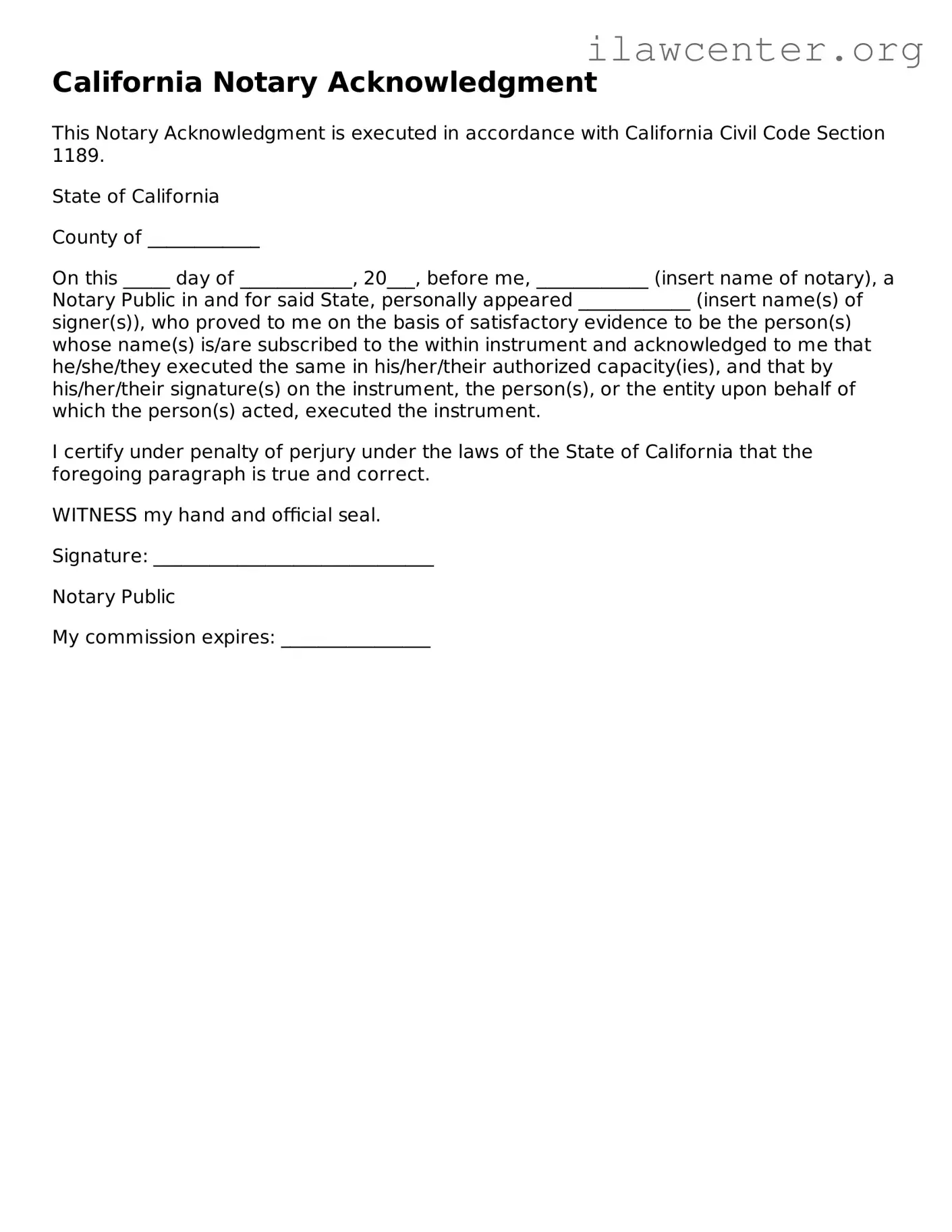
California Notary Acknowledgment

This Notary Acknowledgment is executed in accordance with California Civil Code Section 1189.

State of California

County of ____________

On this _____ day of ____________, 20___, before me, ____________ (insert name of notary), a Notary Public in and for said State, personally appeared ____________ (insert name(s) of signer(s)), who proved to me on the basis of satisfactory evidence to be the person(s) whose name(s) is/are subscribed to the within instrument and acknowledged to me that he/she/they executed the same in his/her/their authorized capacity(ies), and that by his/her/their signature(s) on the instrument, the person(s), or the entity upon behalf of which the person(s) acted, executed the instrument.

I certify under penalty of perjury under the laws of the State of California that the foregoing paragraph is true and correct.

WITNESS my hand and official seal.

Signature: ______________________________

Notary Public

My commission expires: ________________

PDF Form Characteristics

Fact Name Description
Purpose The California Notary Acknowledgement form is used to verify the identity of the signer and confirm that they signed the document willingly.
Governing Law This form is governed by California Civil Code Section 1185, which outlines the requirements for notarial acts.
Signature Requirement The signer must personally appear before the notary public at the time of signing the document.
Notary Seal A notary public must affix their official seal to the form, which serves as proof of the notarial act.

Instructions on Utilizing California Notary Acknowledgement

After gathering the necessary information, you are ready to complete the California Notary Acknowledgment form. This form is essential for verifying the identity of the signer and confirming that they signed a document willingly. Follow the steps below to ensure accurate completion.

  1. Begin by locating the section labeled "California Notary Acknowledgment." This is typically at the top of the form.
  2. Enter the date on which the acknowledgment is being made. This should be the date you are completing the form.
  3. Fill in the name of the person who is signing the document. This should be their full legal name as it appears on the document.
  4. Provide the title of the document being acknowledged. This helps identify what the acknowledgment pertains to.
  5. In the next section, indicate the county where the acknowledgment is taking place. This is important for jurisdiction purposes.
  6. Sign the form in the designated area. This signature should be your own, as the notary public.
  7. Print your name below your signature. This ensures clarity about who performed the acknowledgment.
  8. Include your commission number, if applicable. This number is often assigned by the state to identify notaries.
  9. Finally, provide the expiration date of your notary commission. This is the date when your notary status will need to be renewed.

Once you have completed these steps, the form is ready for use. Ensure that all information is accurate and legible before presenting it for any official purposes.

Important Facts about California Notary Acknowledgement

What is a California Notary Acknowledgment form?

The California Notary Acknowledgment form is a legal document that serves to verify the identity of the signer of a document. It is used by notaries public to confirm that the person signing a document is doing so willingly and understands the contents of the document. This form is often required for various legal documents, such as deeds, contracts, and affidavits.

When is a Notary Acknowledgment required?

A Notary Acknowledgment is typically required when you are signing documents that will be filed with a government agency or used in legal proceedings. Examples include property deeds, powers of attorney, and certain contracts. It provides assurance that the signature is genuine and that the signer was present at the time of signing.

Who can perform a Notary Acknowledgment in California?

In California, only a commissioned notary public can perform a Notary Acknowledgment. Notaries must complete specific training and pass an exam to receive their commission. They are authorized to perform notarial acts, including acknowledgments, within the state.

What information is included in a Notary Acknowledgment?

A Notary Acknowledgment typically includes the date of the acknowledgment, the name of the signer, the type of document being signed, and the notary’s details, including their name, signature, and seal. The form may also include a statement affirming that the signer appeared before the notary and acknowledged signing the document.

Do I need to sign the document in front of the notary?

Yes, you must sign the document in front of the notary public. The notary needs to witness your signature to complete the acknowledgment. If you have already signed the document before meeting the notary, they cannot provide the acknowledgment.

Can a notary charge a fee for their services?

Yes, notaries in California are allowed to charge a fee for their services. As of 2023, the maximum fee for a Notary Acknowledgment is $15 per signature. It's a good idea to confirm the fee with the notary beforehand to avoid any surprises.

What should I bring to the notary appointment?

When you visit a notary, bring the document you need to have acknowledged and a valid form of identification. Acceptable forms of ID include a driver's license, state ID, or passport. The ID must include your photograph and signature to verify your identity.

Can I have multiple documents acknowledged at once?

Yes, you can have multiple documents acknowledged in one appointment, but each document will require its own acknowledgment form. Each signature will be treated separately, and the notary will need to complete an acknowledgment for each document you present.

What if I need a Notary Acknowledgment but cannot be present?

If you cannot be present for the acknowledgment, you may consider alternatives such as granting someone else power of attorney to sign on your behalf. However, this person will also need to have their signature acknowledged. Always consult with a legal professional to ensure compliance with the law.

How long is a Notary Acknowledgment valid?

A Notary Acknowledgment does not have an expiration date; however, the document it accompanies may have its own validity period. It’s important to check the requirements for the specific document to ensure it is used within the appropriate time frame.
Common mistakes

Filling out the California Notary Acknowledgment form can seem straightforward, but many individuals make common mistakes that can lead to complications. Understanding these pitfalls can help ensure that your acknowledgment is valid and effective.

One frequent error is failing to include the correct date. The date of the acknowledgment is crucial, as it verifies when the document was signed. If the date is missing or incorrect, it could raise questions about the validity of the notarization.

Another common mistake is not providing the signer’s name accurately. The acknowledgment must clearly state the full name of the person signing the document. If there are discrepancies, such as typos or initials instead of full names, it can create confusion and may invalidate the notarization.

People often forget to check the identification of the signer. A notary must confirm the identity of the individual signing the document. If the notary fails to do this, it can lead to challenges regarding the authenticity of the signature.

In some cases, individuals neglect to include the notary’s signature and seal. Both elements are essential for a valid acknowledgment. Without them, the form lacks the necessary legal weight and may be deemed ineffective.

Another mistake is not using the correct form for the specific purpose. Different documents may require different types of acknowledgments. Using the wrong form can lead to legal issues down the line.

Some people overlook the importance of the venue. The acknowledgment must state where the notarization took place. Omitting this information can create ambiguity regarding the jurisdiction of the notarization.

Additionally, individuals sometimes fail to understand the difference between a jurat and an acknowledgment. A jurat requires the signer to swear or affirm the truth of the contents of a document, while an acknowledgment simply verifies that the signer appeared before the notary. Confusing these two can lead to improper notarization.

It’s also common for people to leave out the notary’s commission expiration date. This date is important because it indicates the period during which the notary is authorized to perform their duties. Not including it can raise questions about the legitimacy of the notarization.

Lastly, some individuals may not realize the importance of keeping a record of the notarization. Notaries are encouraged to maintain a journal of their notarial acts. Failing to do so can complicate matters if the notarization is ever questioned.

By being aware of these common mistakes, individuals can ensure that their California Notary Acknowledgment forms are filled out correctly, thereby avoiding potential legal complications.

Documents used along the form

When working with the California Notary Acknowledgement form, several other documents may be needed to complete various legal processes. These documents help ensure that transactions are valid and properly recorded. Here’s a list of some commonly used forms alongside the Notary Acknowledgement.

  • This document is used to verify a person's identity. It may include personal information such as the individual's name, address, and identification details.
  • A Power of Attorney allows someone to act on behalf of another person in legal matters. It often requires notarization to be valid.
  • A deed is a legal document that transfers ownership of property from one person to another. Notarization is often required to finalize the transfer.
  • Contracts are agreements between two or more parties. Some contracts require notarization to ensure their enforceability.
  • A will outlines how a person's assets should be distributed after their death. Notarizing a will can help prevent disputes later on.
  • An affidavit is a written statement confirmed by oath. It is often used in legal proceedings and may need to be notarized.
  • These include various forms related to borrowing money, such as promissory notes or mortgage agreements. Notarization is often required to finalize these documents.

Having these documents ready can streamline the process when you need a Notary Acknowledgement. Each plays a vital role in ensuring that legal matters are handled correctly and efficiently.

Similar forms

The Notary Acknowledgment form serves a specific purpose in confirming the identity of individuals signing documents. However, there are other documents that share similarities in function or intent. Here are four such documents:

  • Affidavit: An affidavit is a written statement made under oath. Like a Notary Acknowledgment, it verifies the identity of the person making the statement. Both documents often require a notary public's signature to affirm the authenticity of the signatures and the truthfulness of the content.
  • Power of Attorney: A Power of Attorney allows one person to act on behalf of another in legal matters. Similar to a Notary Acknowledgment, this document often requires notarization to ensure that the person granting the authority is indeed who they claim to be, protecting against fraud.
  • Deed: A deed is a legal document that conveys property ownership. Notarization is typically required for deeds, much like with Notary Acknowledgments. This process helps confirm that the signatures on the deed are genuine and that the parties involved understand the transaction.
  • Loan Agreement: A loan agreement outlines the terms of a loan between parties. Notarization may be necessary for these agreements to verify the identities of the parties involved, ensuring that they are entering into the contract willingly and with full understanding.

Each of these documents plays a critical role in legal transactions, and their similarities with the Notary Acknowledgment highlight the importance of verifying identities and intentions in legal matters.

Dos and Don'ts

When filling out the California Notary Acknowledgement form, there are important guidelines to follow. Here’s a helpful list of dos and don'ts to ensure that the process goes smoothly.

  • Do ensure that the signer is present when you complete the acknowledgment.
  • Do verify the identity of the signer using a valid photo ID.
  • Do fill out the form completely, including the date and location of the acknowledgment.
  • Do sign and stamp the form with your official notary seal.
  • Don't allow anyone to sign the document without proper identification.
  • Don't leave any blank spaces on the form that could be misused later.
  • Don't forget to keep a record of the notarization in your journal.

Following these guidelines will help ensure that your notarial acts are valid and legally sound.

Misconceptions

The California Notary Acknowledgment form is often misunderstood. Here are four common misconceptions about this form:

  • Notaries can certify documents. Many people believe that a notary can certify the accuracy of a document's content. In reality, a notary's role is to verify the identity of the signer and witness their signature, not to assess the document's validity.
  • A notary can refuse to notarize a document for any reason. While notaries do have discretion, they must adhere to specific guidelines. If a signer is present, competent, and willing, the notary typically cannot refuse service based solely on personal opinion.
  • Notary acknowledgments are the same as notarized signatures. A notary acknowledgment is a specific type of notarization that confirms a signer’s identity and willingness to sign. However, it does not guarantee the document's legality or enforceability.
  • All notary forms are interchangeable. Each state has its own requirements for notary forms. The California Notary Acknowledgment form is unique to California and may not be valid in other states, even if it appears similar.

Understanding these misconceptions can help individuals navigate the notarization process more effectively and ensure that documents are properly executed.

Key takeaways

When filling out and using the California Notary Acknowledgement form, keep the following key takeaways in mind:

  1. Understand the Purpose: The Notary Acknowledgement serves to verify the identity of the signer and their willingness to sign the document.
  2. Complete Information: Ensure that all required fields are filled out accurately, including the signer's name, the date of the acknowledgment, and the notary's details.
  3. Signature Requirement: The signer must personally appear before the notary and sign the document in their presence.
  4. Notary's Role: The notary public must confirm the identity of the signer through valid identification before completing the acknowledgment.
  5. Use of Seal: The notary must apply their official seal to the form, which authenticates the acknowledgment.
  6. Record Keeping: Notaries are required to keep a journal of all acknowledgments performed, including details of the transaction.
  7. Compliance with State Laws: Familiarize yourself with California laws regarding notarization to ensure compliance and avoid potential issues.

Following these guidelines will help ensure that the Notary Acknowledgement form is filled out correctly and used effectively.