California Preliminary 20 Day Notice PDF Template

California Preliminary 20 Day Notice PDF Template

The California Preliminary 20-Day Notice is a legal document used in construction projects, both private and public, to inform property owners about the provision of labor, services, equipment, or materials. This notice serves as a protective measure for contractors and suppliers, ensuring they receive payment for their contributions. To avoid potential issues, property owners should promptly fill out the form by clicking the button below.

Article Guide

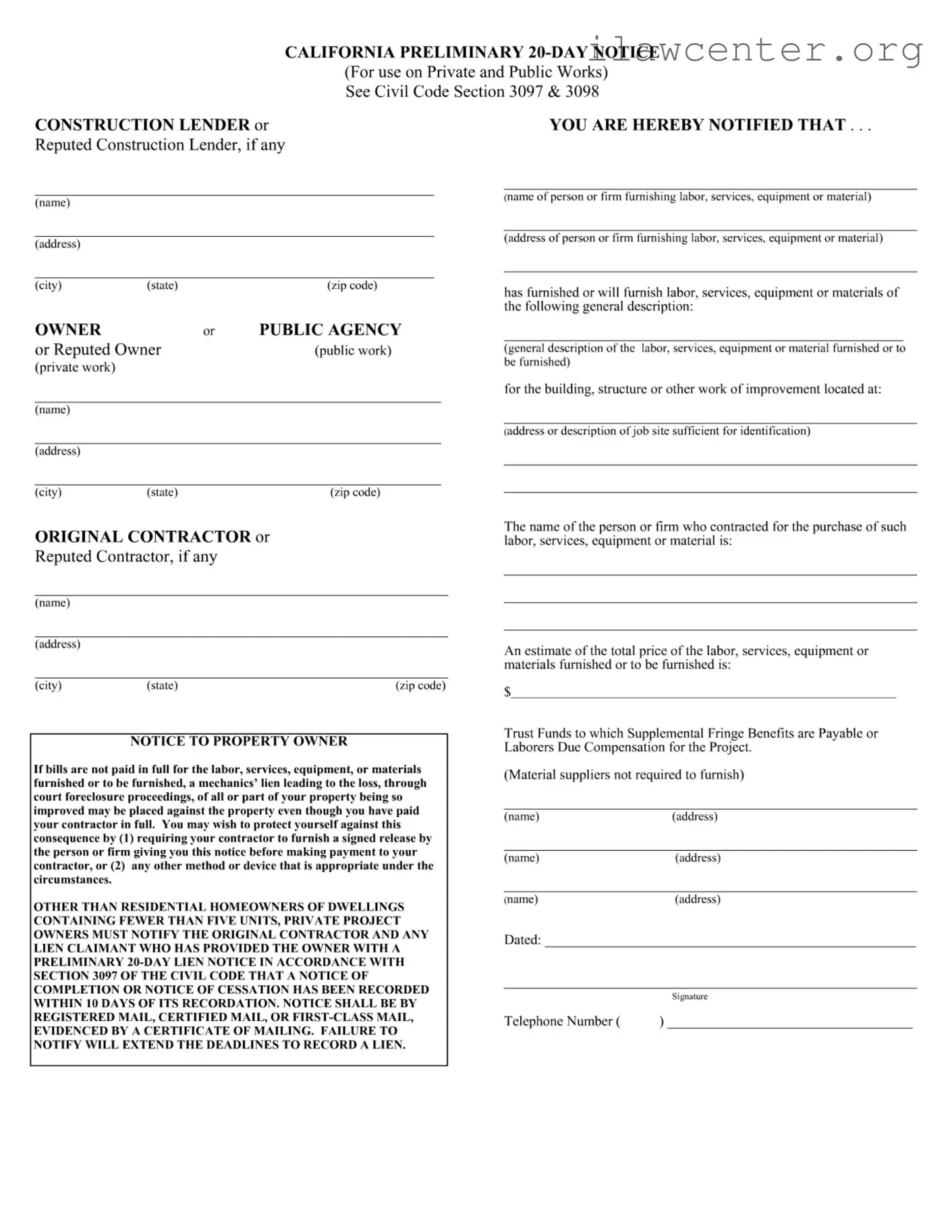
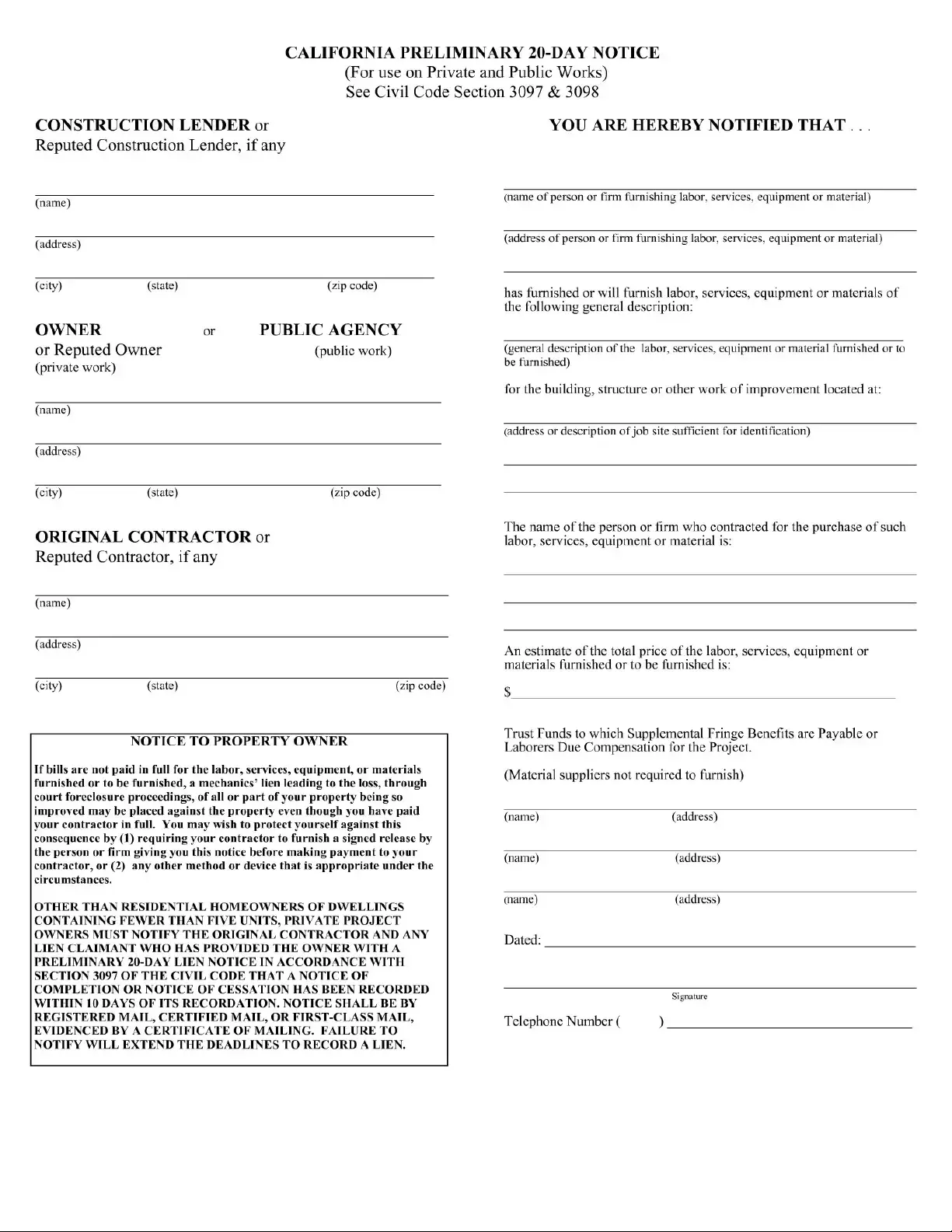
The California Preliminary 20-Day Notice form serves a crucial role in the construction industry, particularly for those involved in private and public works. This notice is a formal communication that informs property owners and relevant parties about the provision of labor, services, equipment, or materials related to a construction project. Essential details include the names and addresses of the construction lender, owner, and original contractor, as well as a description of the work being done and the job site location. The form also highlights the potential consequences of unpaid bills, such as the possibility of a mechanics' lien being placed against the property, which could lead to foreclosure proceedings. To mitigate this risk, property owners are advised to implement protective measures, such as requiring lien releases from contractors before making payments. Additionally, private project owners must comply with specific notification requirements concerning the recording of a notice of completion or cessation, ensuring that all parties are informed in a timely manner. This form is not only a safeguard for those providing labor and materials but also serves as a vital tool for property owners to understand their rights and responsibilities within the construction process.

California Preliminary 20 Day Notice Preview

File Properties

Fact Name Fact Description
Purpose The California Preliminary 20-Day Notice informs property owners and contractors about labor, services, or materials provided on a construction project.
Governing Law This notice is governed by California Civil Code Sections 3097 and 3098.
Notice Period The notice must be served within 20 days of the first furnishing of labor, services, equipment, or materials to preserve lien rights.
Recipient Requirements It must be sent to the property owner, original contractor, and any construction lender involved in the project.
Mechanics' Lien Warning The notice warns property owners that unpaid bills may lead to a mechanics' lien, potentially resulting in property loss.
Notification Method Private project owners must notify the original contractor and lien claimants of a recorded notice of completion or cessation within 10 days.
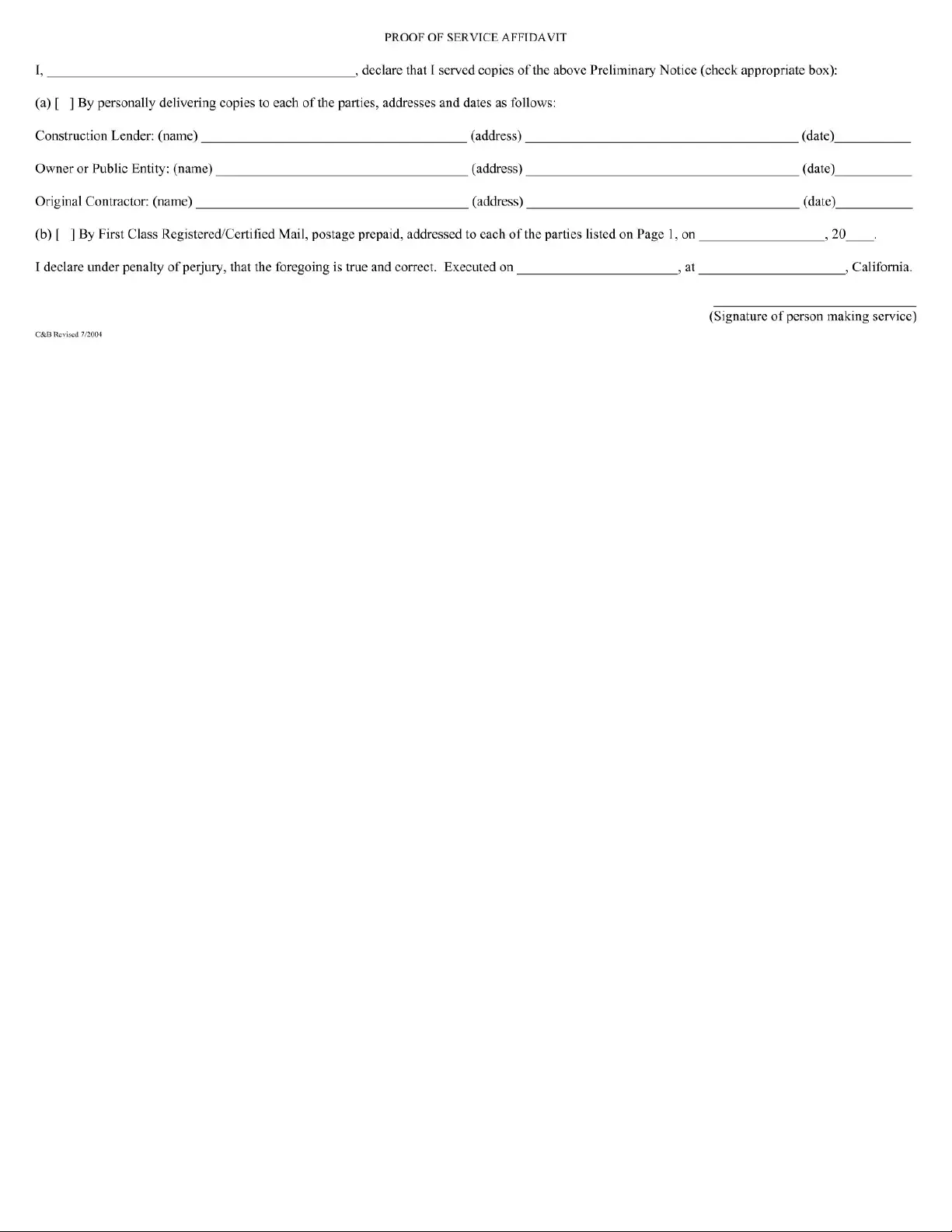
Service Proof A proof of service affidavit must be included, indicating how the notice was delivered, either personally or via mail.
Cost Estimate The form requires an estimate of the total price for the labor, services, equipment, or materials to be furnished.

Instructions on Utilizing California Preliminary 20 Day Notice

Completing the California Preliminary 20 Day Notice form is a crucial step in ensuring that all parties involved in a construction project are properly notified of the labor, services, equipment, or materials being provided. This process helps protect the rights of those who contribute to a project and ensures that property owners are aware of potential claims against their property. Below are the steps to fill out the form accurately.

  1. Begin by entering the name and address of the Construction Lender or Reputed Construction Lender, if applicable.
  2. In the section titled YOU ARE HEREBY NOTIFIED THAT, provide the name and address of the Owner or Reputed Owner for private work, or the name of the Public Agency for public work.
  3. Next, fill in the name and address of the person or firm furnishing labor, services, equipment, or materials.
  4. Describe the labor, services, equipment, or materials being furnished in the section labeled general description.
  5. Indicate the location of the job site by providing the address or a sufficient description for identification.
  6. List the name and address of the ORIGINAL CONTRACTOR or Reputed Contractor, if known.
  7. Identify the person or firm who contracted for the purchase of the labor, services, equipment, or materials, including their city, state, and zip code.
  8. Provide an estimate of the total price for the labor, services, equipment, or materials being furnished.
  9. If applicable, enter the names of any trust funds to which supplemental fringe benefits or laborers' due compensation is payable for the project.
  10. Date the form and include your address and telephone number.
  11. Complete the PROOF OF SERVICE AFFIDAVIT section by checking the appropriate box to indicate how copies of the notice were served.
  12. For personal delivery, list the names and addresses of the parties served. If sent by mail, indicate the date of mailing.
  13. Finally, sign and date the affidavit, declaring under penalty of perjury that the information provided is true and correct.

Important Facts about California Preliminary 20 Day Notice

What is the California Preliminary 20-Day Notice?

The California Preliminary 20-Day Notice is a legal document used in construction projects to inform property owners, contractors, and lenders that a party is providing labor, services, equipment, or materials for a construction project. This notice is essential for protecting the rights of those who contribute to a project, ensuring they can file a mechanics' lien if necessary.

Who should use the Preliminary 20-Day Notice?

This notice is primarily used by subcontractors, suppliers, and laborers who are providing services or materials for a construction project. It is applicable for both private and public works projects in California. By sending this notice, these parties can establish their right to file a lien if they are not paid for their contributions.

When should the Preliminary 20-Day Notice be sent?

The notice should be sent within 20 days of the first day that labor, services, equipment, or materials are provided. Sending it within this timeframe is crucial because it preserves the right to file a mechanics' lien against the property if payment is not received.

What information is required on the form?

The form requires several pieces of information, including the name and address of the property owner, the original contractor, and the party providing the labor or materials. Additionally, a description of the work being performed and the job site address must be included. An estimate of the total price for the services or materials is also necessary.

What happens if a property owner does not receive a Preliminary 20-Day Notice?

If a property owner does not receive this notice, they may not be aware of potential claims against their property. This lack of awareness can lead to financial issues if a contractor or supplier files a mechanics' lien due to non-payment. It is in the owner's best interest to ensure they receive this notice to protect their property rights.

How does the Preliminary 20-Day Notice protect property owners?

The notice informs property owners that they may be liable for unpaid bills, even if they have paid their contractor in full. To protect themselves, owners can require contractors to provide a signed release from the parties sending the notice before making payments. This step helps ensure that all parties are compensated and reduces the risk of a mechanics' lien being placed on the property.

What is a mechanics' lien?

A mechanics' lien is a legal claim against a property that can be filed by contractors, subcontractors, or suppliers who have not been paid for their work or materials. If a mechanics' lien is filed, it can lead to foreclosure proceedings, potentially resulting in the loss of the property. This makes the Preliminary 20-Day Notice an important document for all parties involved in a construction project.

What should a property owner do if they receive a Preliminary 20-Day Notice?

If a property owner receives this notice, they should take it seriously. They should review their payment records and ensure that all contractors and subcontractors have been paid. If there are any discrepancies, the owner should address them promptly. Additionally, they may want to consider consulting with a legal professional for further guidance.

What are the consequences of failing to send a Preliminary 20-Day Notice?

Failing to send the notice within the required timeframe can result in losing the right to file a mechanics' lien. This means that if payment is not received, the party providing the labor or materials may not have any legal recourse to claim payment from the property owner. It is crucial to adhere to the 20-day deadline to protect these rights.

How can a Preliminary 20-Day Notice be served?

The notice can be served in several ways, including personal delivery to the parties involved or by mailing it via registered, certified, or first-class mail. It is important to keep a record of how and when the notice was served, as this documentation may be necessary in the event of a dispute.

Common mistakes

Filling out the California Preliminary 20 Day Notice form can be tricky. Many people make mistakes that can lead to complications later. One common error is failing to include the correct name and address of the construction lender or reputed construction lender. This information is crucial, as it helps establish the chain of responsibility for payments.

Another frequent mistake is not providing a complete description of the labor, services, equipment, or materials that have been furnished or will be furnished. A vague description may cause confusion and could jeopardize the validity of the notice.

People also often forget to include the address of the job site. This address needs to be clear and sufficient for identification. Without it, there may be disputes over which property the notice pertains to.

Some individuals mistakenly leave out the name of the original contractor or reputed contractor. This omission can create problems when trying to enforce rights under the notice, as it may not be clear who is responsible for the work.

Another mistake is neglecting to provide an estimate of the total price for the labor, services, equipment, or materials. This estimate is important for both the property owner and the contractors involved, as it sets expectations for payment.

People sometimes fail to notify the original contractor and any lien claimant about the recording of a notice of completion or notice of cessation. This notification must occur within 10 days of recording, and failure to do so can extend deadlines for recording a lien.

Using the wrong method of service is another common issue. The form allows for personal delivery or mail, but some individuals overlook the requirement for certified or registered mail. Using first-class mail alone does not meet the legal requirements.

Additionally, it’s important to remember to include the signature of the person making the service. Omitting this can render the notice ineffective, as it may not be clear who is responsible for the information provided.

Lastly, some people forget to include their telephone number. Providing a contact number can facilitate communication and help resolve any questions that arise about the notice.

By avoiding these common mistakes, individuals can ensure their California Preliminary 20 Day Notice is filled out correctly, helping to protect their rights and interests in construction projects.

Documents used along the form

The California Preliminary 20-Day Notice is an essential document in the construction industry, particularly for those involved in private and public works. Alongside this notice, several other forms and documents play crucial roles in ensuring that all parties are informed and protected throughout the construction process. Below is a list of commonly used forms that complement the Preliminary 20-Day Notice.

  • Mechanics' Lien: This document allows contractors, subcontractors, and suppliers to claim a legal right against a property if they have not been paid for their work or materials. It serves as a powerful tool to secure payment and can lead to foreclosure if necessary.
  • Notice of Completion: Once a construction project is finished, this document is filed to officially declare the completion of work. It triggers various timelines for lien claims and helps protect property owners from unexpected claims.
  • Notice of Cessation: If work on a project is halted for a specific period, this notice informs all parties involved. It also affects the timeline for filing liens and can help clarify the status of the project.
  • Proof of Service Affidavit: This document provides evidence that the Preliminary 20-Day Notice was properly served to all relevant parties. It is crucial for establishing compliance with legal requirements.
  • Subcontractor Agreement: This agreement outlines the terms between a contractor and a subcontractor. It defines the scope of work, payment terms, and responsibilities, ensuring clarity and accountability.
  • Change Order: When modifications to the original contract are necessary, a change order documents these adjustments. It ensures that all parties agree to the new terms and conditions, including any changes in cost or timeline.
  • Payment Application: This form is used by contractors and subcontractors to request payment for completed work. It provides a detailed account of the work performed and the corresponding amounts due.
  • Release of Lien: After payment has been made, this document releases any lien rights that may have been claimed. It provides assurance to property owners that they are no longer at risk of a lien on their property.
  • Construction Contract: This foundational document outlines the agreement between the property owner and the contractor. It details the scope of work, timelines, payment terms, and other essential project details.

Understanding these documents and their purposes can significantly enhance the protection and clarity for all parties involved in construction projects. Proper use of these forms can help prevent disputes and ensure that everyone is on the same page throughout the construction process.

Similar forms

The California Preliminary 20-Day Notice form serves a specific purpose in the construction industry, particularly in notifying property owners and contractors about potential mechanics' liens. Several other documents share similar functions in the realm of construction law and property rights. Below is a list of six such documents:

  • Mechanics' Lien: This document is filed by contractors or suppliers when they have not been paid for their work or materials. It serves as a claim against the property, similar to the Preliminary 20-Day Notice, which warns property owners of potential liens.
  • Notice of Completion: This notice is filed by the property owner upon the completion of a construction project. It informs all parties involved that the work is finished, which can affect the time frame for filing liens, much like the Preliminary 20-Day Notice alerts parties of their rights.
  • Notice of Cessation: This document indicates that work on a project has stopped for a certain period. It serves to inform contractors and suppliers about the project's status, paralleling the Preliminary 20-Day Notice's role in notifying about potential payment issues.
  • Preliminary Notice for Public Works: Similar to the California Preliminary 20-Day Notice, this document is used specifically for public works projects. It ensures that parties involved are aware of their rights and obligations regarding payment and liens.
  • Subcontractor's Notice: This document is sent by subcontractors to the property owner and general contractor to assert their right to payment. It serves a similar purpose as the Preliminary 20-Day Notice by informing parties of potential claims against the property.
  • Release of Lien: This document is executed to formally release a mechanics' lien once payment has been received. It is related to the Preliminary 20-Day Notice in that both deal with the rights of parties involved in construction and payment issues.

Each of these documents plays a crucial role in the construction process, ensuring that all parties are informed of their rights and obligations. Understanding their similarities can help in navigating potential disputes and protecting property rights.

Dos and Don'ts

When filling out the California Preliminary 20 Day Notice form, it is important to follow specific guidelines to ensure accuracy and compliance. Below is a list of things to do and avoid during this process.

  • Do include the correct names and addresses of all parties involved, such as the construction lender, owner, and contractor.
  • Do provide a clear and detailed description of the labor, services, equipment, or materials that have been or will be furnished.
  • Do ensure that the job site address is complete and sufficient for identification purposes.
  • Do specify the total estimated price for the labor, services, equipment, or materials.
  • Don't omit any required information, as incomplete forms may lead to legal issues or delays.
  • Don't forget to notify the original contractor and lien claimants within 10 days if a notice of completion or cessation has been recorded.
  • Don't neglect to sign and date the form, as an unsigned form may be considered invalid.

Misconceptions

Understanding the California Preliminary 20 Day Notice form can be challenging. Here are five common misconceptions about this important document:

  1. It is only for residential projects. Many believe the Preliminary 20 Day Notice is limited to residential construction. In reality, it applies to both private and public works, making it relevant for a wide range of construction projects.
  2. It guarantees payment for services rendered. Some think that submitting this notice ensures they will get paid. However, while it serves as a warning to property owners about potential liens, it does not guarantee payment. It simply protects the right to file a lien if payment is not received.
  3. Only contractors need to file this notice. There is a misconception that only contractors are responsible for filing this form. In fact, subcontractors and suppliers who provide labor or materials also need to submit it to protect their rights.
  4. It is optional for property owners. Many property owners believe they can ignore the notice if they have paid their contractors. This is incorrect. If the notice is filed, the owner must be aware of the potential for a mechanics' lien, regardless of payments made to the contractor.
  5. The notice must be filed before work begins. Some people think they need to file the notice before any work starts. However, the notice can be filed within 20 days of the first work or delivery of materials. This timeframe is crucial for ensuring lien rights are preserved.

Being informed about these misconceptions can help you navigate the construction process more effectively. Always consider consulting a professional for guidance specific to your situation.

Key takeaways

Filling out and using the California Preliminary 20-Day Notice form is a critical step for those involved in construction projects. Here are four key takeaways to keep in mind:

  • Purpose of the Notice: This notice serves to inform property owners and other parties that labor, services, equipment, or materials have been provided or will be provided for a construction project. It establishes a record of potential claims against the property.
  • Importance of Timeliness: The notice must be served within 20 days of the first delivery of labor or materials. Failing to do so may limit your rights to file a mechanics' lien later.
  • Notification Requirements: Property owners, especially those involved in private projects, must notify the original contractor and any lien claimants about the recording of a notice of completion or cessation within 10 days. This notification must be sent via registered, certified, or first-class mail.
  • Mechanics' Lien Risk: If bills for labor or materials are not paid, a mechanics' lien can be placed on the property, even if the property owner has paid the contractor in full. It is advisable for owners to require a signed release from the provider of the notice before making any payments.

Understanding these points can help protect your interests and ensure compliance with California construction laws.