Attorney-Verified  Promissory Note Document for California

Attorney-Verified Promissory Note Document for California

A California Promissory Note is a legal document that outlines a borrower's promise to repay a specified amount of money to a lender under agreed-upon terms. This form serves as a crucial tool in financial transactions, ensuring that both parties have a clear understanding of their obligations. Ready to get started? Fill out the form by clicking the button below.

Article Guide

The California Promissory Note form serves as a crucial financial document that outlines the terms of a loan agreement between a borrower and a lender. This form details essential information, including the principal amount borrowed, the interest rate, and the repayment schedule. It specifies the consequences of default, ensuring both parties understand their rights and obligations. The note may also include provisions for prepayment and late fees, offering clarity on additional costs that may arise. By documenting the agreement in writing, the California Promissory Note provides legal protection for both the lender and the borrower, establishing a clear framework for the transaction. Understanding this form is vital for anyone involved in lending or borrowing money in California, as it lays the groundwork for financial accountability and transparency.

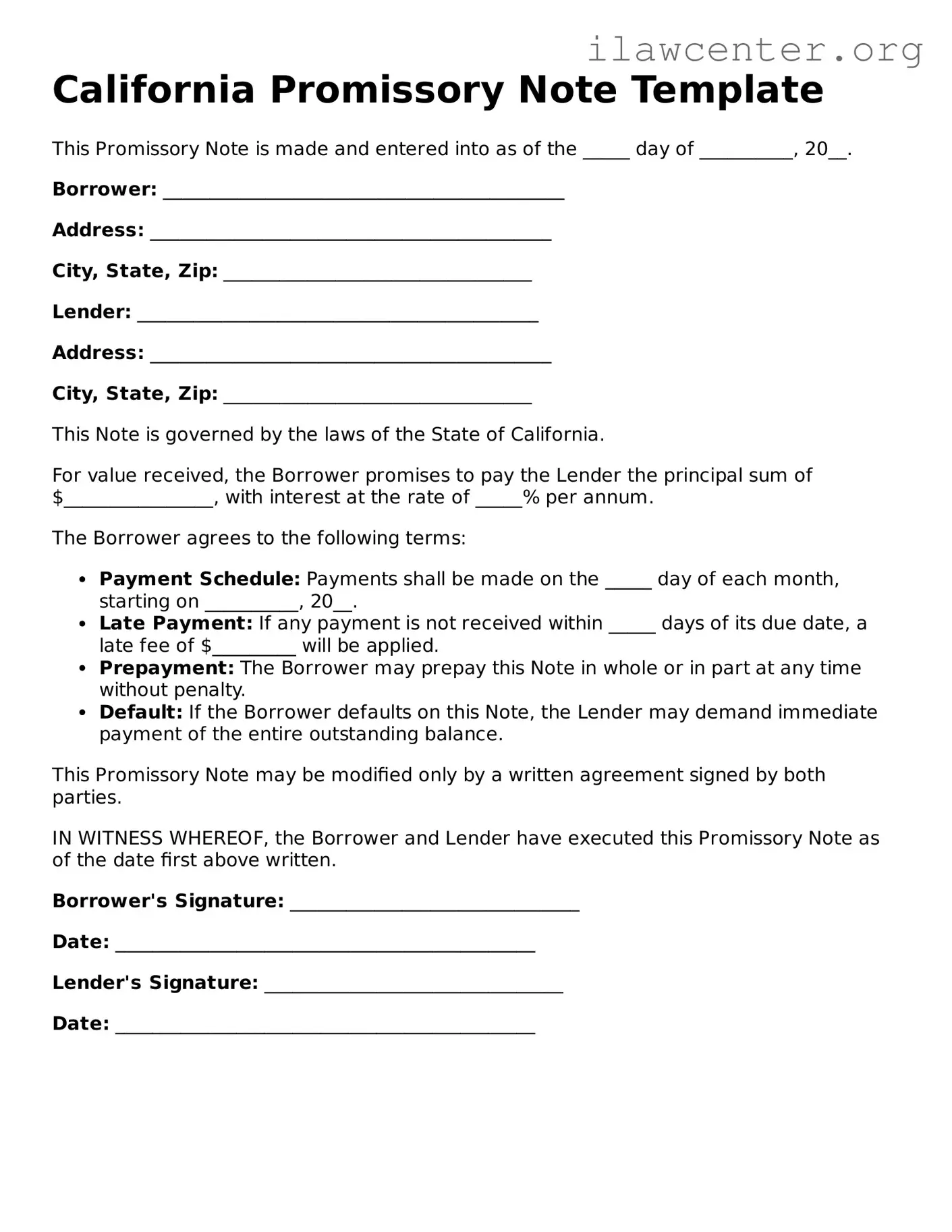
California Promissory Note Preview

California Promissory Note Template

This Promissory Note is made and entered into as of the _____ day of __________, 20__.

Borrower: ___________________________________________

Address: ___________________________________________

City, State, Zip: _________________________________

Lender: ___________________________________________

Address: ___________________________________________

City, State, Zip: _________________________________

This Note is governed by the laws of the State of California.

For value received, the Borrower promises to pay the Lender the principal sum of $________________, with interest at the rate of _____% per annum.

The Borrower agrees to the following terms:

  • Payment Schedule: Payments shall be made on the _____ day of each month, starting on __________, 20__.
  • Late Payment: If any payment is not received within _____ days of its due date, a late fee of $_________ will be applied.
  • Prepayment: The Borrower may prepay this Note in whole or in part at any time without penalty.
  • Default: If the Borrower defaults on this Note, the Lender may demand immediate payment of the entire outstanding balance.

This Promissory Note may be modified only by a written agreement signed by both parties.

IN WITNESS WHEREOF, the Borrower and Lender have executed this Promissory Note as of the date first above written.

Borrower's Signature: _______________________________

Date: _____________________________________________

Lender's Signature: ________________________________

Date: _____________________________________________

PDF Form Characteristics

Fact Name Description
Definition A California promissory note is a written promise to pay a specified amount of money to a designated person or entity at a future date.
Governing Law The California Civil Code governs promissory notes in the state, specifically Sections 3300 to 3355.
Essential Elements The note must include the principal amount, interest rate, payment schedule, and the signatures of the parties involved.
Types of Notes Promissory notes can be secured or unsecured. A secured note is backed by collateral, while an unsecured note is not.
Enforceability For a promissory note to be enforceable, it must be clear, complete, and signed by the borrower.

Instructions on Utilizing California Promissory Note

After obtaining the California Promissory Note form, you will need to complete it accurately to ensure that the agreement is clear and enforceable. Following the steps below will guide you through the process of filling out the form correctly.

  1. Begin by entering the date at the top of the form. This is the date when the note is executed.
  2. Next, fill in the name of the borrower. This is the individual or entity that will be borrowing the money.
  3. Provide the address of the borrower. This should be a complete address, including street, city, state, and zip code.
  4. Enter the name of the lender. This is the individual or entity providing the loan.
  5. Fill in the address of the lender, ensuring it is complete and accurate.
  6. Specify the principal amount of the loan. This is the total amount that the borrower is agreeing to repay.
  7. Indicate the interest rate applicable to the loan. This should be expressed as a percentage.
  8. State the repayment terms. This includes how often payments will be made (e.g., monthly, quarterly) and the duration of the loan.
  9. Include any late fees or penalties that may apply if payments are not made on time.
  10. Sign and date the form at the bottom. The borrower and lender should both sign to acknowledge the agreement.

Once the form is filled out and signed, it is advisable to keep copies for both parties. This ensures that everyone has a record of the terms agreed upon and can refer back to it if necessary.

Important Facts about California Promissory Note

What is a California Promissory Note?

A California Promissory Note is a written agreement where one party promises to pay a specific amount of money to another party at a defined time or on demand. This document outlines the terms of the loan, including the interest rate, repayment schedule, and any penalties for late payment. It serves as a legal record of the debt and protects both the lender and borrower.

Who can use a Promissory Note in California?

Anyone can use a Promissory Note in California, whether you're an individual, a business, or an organization. It's commonly used in personal loans, business loans, or even informal agreements between friends and family. As long as the terms are clear and both parties agree, a Promissory Note can be a useful tool for managing financial transactions.

What are the essential components of a California Promissory Note?

A well-drafted Promissory Note should include the names and addresses of both the borrower and lender, the principal amount borrowed, the interest rate, repayment terms, and any additional terms such as late fees or prepayment options. It’s also important to include a signature line for both parties to sign, indicating their agreement to the terms.

Is a Promissory Note legally binding?

Yes, a Promissory Note is legally binding as long as it meets the necessary requirements of a contract. This includes mutual agreement, consideration (something of value exchanged), and the capacity of both parties to enter into a contract. If either party fails to uphold their end of the agreement, the other party may seek legal recourse.

Do I need a lawyer to create a Promissory Note?

While it’s not required to have a lawyer draft your Promissory Note, consulting with one can be beneficial, especially for larger loans or complex agreements. Many templates are available online, but a legal professional can ensure that your document meets all legal requirements and adequately protects your interests.

Can a Promissory Note be modified after it’s signed?

Yes, a Promissory Note can be modified, but both parties must agree to the changes. It’s advisable to document any modifications in writing and have both parties sign the revised agreement. This helps avoid misunderstandings and ensures that everyone is on the same page regarding the new terms.

What happens if the borrower defaults on the Promissory Note?

If the borrower defaults, meaning they fail to make payments as agreed, the lender has several options. They can attempt to collect the debt through negotiation, hire a collection agency, or take legal action. The terms outlined in the Promissory Note will guide the lender on how to proceed in the event of a default.

Is a Promissory Note the same as a loan agreement?

While both documents serve similar purposes, they are not the same. A Promissory Note is a simple promise to pay back a loan, whereas a loan agreement is a more detailed contract that may include additional terms and conditions, such as collateral, warranties, and obligations of both parties. Depending on your needs, you may choose one over the other or use both together.
Common mistakes

Filling out a California Promissory Note form can seem straightforward, but many people make common mistakes that can lead to complications down the road. One frequent error is neglecting to include all necessary details about the borrower and lender. It is essential to clearly identify both parties by providing their full names and addresses. Omitting this information can create confusion and may lead to disputes later on.

Another mistake involves the amount of the loan. Some individuals mistakenly write the loan amount in words but forget to include it in numerical form, or vice versa. This inconsistency can create ambiguity. To avoid this issue, always ensure that the loan amount is clearly stated in both formats, leaving no room for misinterpretation.

People often overlook the importance of specifying the interest rate. Not stating an interest rate or leaving it blank can lead to misunderstandings about the terms of repayment. If the loan is interest-free, it should be explicitly noted. Clear terms help both parties understand their obligations and prevent potential conflicts.

Additionally, many individuals fail to outline the repayment schedule. A vague repayment plan can lead to confusion about when payments are due. It is crucial to detail the frequency of payments—whether they are monthly, quarterly, or otherwise—and the due dates for each installment. This clarity ensures that both parties are on the same page regarding the loan's terms.

Another common oversight is not including a default clause. A default clause outlines what happens if the borrower fails to make payments as agreed. Without this provision, the lender may find it challenging to enforce their rights in case of a default. Including a clear default clause protects both parties and provides a roadmap for resolving issues if they arise.

Finally, many people forget to sign and date the Promissory Note. A note without signatures lacks legal validity. Both the borrower and lender should sign the document and include the date of signing to confirm their agreement to the terms. This step is crucial for ensuring that the note is enforceable in a court of law.

Documents used along the form

When engaging in a financial transaction that involves a promissory note in California, several other forms and documents may accompany it. These documents help clarify the terms of the loan, protect the interests of both parties, and ensure compliance with state laws. Below is a list of commonly used forms that often accompany a California Promissory Note.

  • Loan Agreement: This document outlines the terms of the loan, including the amount borrowed, interest rates, repayment schedule, and any collateral involved. It serves as a comprehensive contract between the lender and borrower.
  • Security Agreement: If the loan is secured by collateral, this agreement specifies what the collateral is and the rights of the lender in the event of default. It provides legal backing for the lender to reclaim the collateral if necessary.
  • Disclosure Statement: This document provides borrowers with important information about the loan, such as total costs, interest rates, and any fees involved. It ensures transparency and helps borrowers make informed decisions.
  • Personal Guarantee: In cases where a business is borrowing money, a personal guarantee may be required. This document holds an individual personally responsible for repaying the loan if the business defaults.
  • Amortization Schedule: This schedule details each payment over the life of the loan, breaking down how much goes toward principal and interest. It helps borrowers understand their repayment obligations.
  • Default Notice: Should the borrower fail to meet the terms of the promissory note, this document serves as a formal notification of default. It outlines the consequences and next steps for the lender.
  • Loan Payoff Statement: When the loan is paid off, this statement provides a summary of the remaining balance and confirms that the debt has been satisfied. It is essential for both parties to have this document for their records.
  • Assignment of Note: If the lender decides to transfer the promissory note to another party, this document formalizes that transfer. It ensures that the new holder has the right to collect payments under the terms of the original note.

Each of these documents plays a vital role in the lending process, providing clarity and protection for all parties involved. Understanding their purpose can help borrowers and lenders navigate the complexities of financial agreements more effectively.

Similar forms

A Promissory Note is a financial document that outlines a promise to pay a specified amount of money to a designated party under agreed-upon terms. It shares similarities with several other documents in the financial and legal realm. Here’s a look at seven documents that are akin to a Promissory Note:

  • Loan Agreement: This document details the terms of a loan, including the amount, interest rate, and repayment schedule. Like a Promissory Note, it establishes the borrower's obligation to repay the lender.
  • Mortgage: A mortgage is a specific type of loan agreement where property is used as collateral. It includes a promise to repay, similar to a Promissory Note, but also involves the legal transfer of property rights.
  • IOU (I Owe You): An informal document acknowledging a debt. While less formal than a Promissory Note, it serves the same purpose of confirming that one party owes money to another.
  • Credit Agreement: This document outlines the terms under which credit is extended. It includes repayment obligations, much like a Promissory Note, but often covers broader financial arrangements.
  • Bond: A bond is a formal contract to repay borrowed money with interest. It shares the fundamental promise of repayment found in a Promissory Note, though it typically involves larger sums and is often issued by governments or corporations.
  • Lease Agreement: While primarily used for rental agreements, a lease can include a promise to pay rent over time, similar to how a Promissory Note outlines payment terms for borrowed funds.
  • Payment Plan Agreement: This document lays out the terms for repaying a debt in installments. Like a Promissory Note, it specifies the amount owed and the schedule for repayment.

Understanding these documents can help clarify the obligations and rights of all parties involved in financial transactions. Each serves a unique purpose but ultimately revolves around the core idea of a promise to pay.

Dos and Don'ts

When filling out the California Promissory Note form, it is important to approach the task with care and attention. Here are five things to consider doing and avoiding to ensure accuracy and clarity in your document.

  • Do: Clearly state the loan amount at the top of the form. This sets the foundation for the agreement.
  • Do: Include the names and addresses of both the borrower and lender. This information is crucial for identification.
  • Do: Specify the interest rate, if applicable. This detail helps both parties understand the cost of borrowing.
  • Do: Outline the repayment terms, including the due date and payment schedule. Clarity in these terms can prevent future misunderstandings.
  • Do: Sign and date the document. A signature validates the agreement and indicates acceptance of the terms.
  • Don't: Leave any fields blank. Incomplete information can lead to confusion or disputes later on.
  • Don't: Use ambiguous language. Be specific to ensure both parties understand their obligations.
  • Don't: Forget to keep a copy for your records. Having a personal copy can be helpful for future reference.
  • Don't: Rush through the process. Take your time to review the document thoroughly before finalizing it.
  • Don't: Ignore the legal requirements. Familiarize yourself with California laws regarding promissory notes to ensure compliance.

Misconceptions

Understanding the California Promissory Note form can be challenging due to several misconceptions. Below is a list of common misunderstandings and clarifications to help clarify these points.

  • Misconception 1: A promissory note must be notarized to be valid.
  • In California, a promissory note does not require notarization to be legally binding. While notarization can provide an extra layer of verification, it is not a legal requirement for the note to be enforceable.

  • Misconception 2: All promissory notes are the same.
  • Promissory notes can vary significantly based on the terms and conditions agreed upon by the parties involved. Each note should be tailored to reflect the specific agreement, including interest rates, repayment schedules, and any collateral involved.

  • Misconception 3: A verbal agreement is sufficient to create a promissory note.
  • While verbal agreements can be legally binding in some situations, a written promissory note is essential for clarity and enforceability. Written documentation helps prevent misunderstandings and provides clear evidence of the terms agreed upon.

  • Misconception 4: Promissory notes cannot include additional terms.
  • In fact, promissory notes can include various terms beyond the basic promise to pay. These can include late fees, prepayment penalties, and specific conditions under which the note may be considered in default.

  • Misconception 5: A promissory note is only for loans between individuals.
  • While many people think of promissory notes as personal loans, they are also commonly used in business transactions. Companies often use promissory notes for financing arrangements, making them versatile tools in various financial contexts.

Key takeaways

When filling out and using the California Promissory Note form, consider the following key takeaways:

  1. Identify the parties involved: Clearly state the names and addresses of both the borrower and the lender. This information is crucial for legal clarity.
  2. Specify the loan amount: Indicate the exact amount being borrowed. This figure should be precise to avoid any misunderstandings.
  3. Outline the interest rate: Include the interest rate applicable to the loan. Ensure that it complies with California's usury laws.
  4. Detail the repayment terms: Clearly define how and when the borrower will repay the loan. This can include monthly payments, due dates, and any grace periods.
  5. Include any collateral: If the loan is secured by collateral, describe the collateral in detail. This provides the lender with security in case of default.
  6. Signatures are essential: Both parties must sign the document for it to be legally binding. Ensure that signatures are dated.
  7. Keep copies: After signing, both the borrower and lender should retain copies of the signed Promissory Note for their records.

By following these key points, individuals can ensure that their Promissory Note is clear, comprehensive, and legally enforceable.