Attorney-Verified  Real Estate Purchase Agreement Document for California

Attorney-Verified Real Estate Purchase Agreement Document for California

The California Real Estate Purchase Agreement is a legal document that outlines the terms and conditions of a property sale in California. This form serves as a binding contract between the buyer and seller, detailing important aspects such as purchase price, contingencies, and closing dates. To initiate your real estate transaction, fill out the form by clicking the button below.

Article Guide

The California Real Estate Purchase Agreement form serves as a critical document in the home buying process, outlining the essential terms and conditions agreed upon by both the buyer and the seller. This comprehensive agreement typically includes key elements such as the purchase price, the property’s legal description, and the closing date, ensuring that both parties have a clear understanding of their obligations. Additionally, it addresses contingencies that may affect the sale, such as financing, inspections, and disclosures related to the property’s condition. By detailing the rights and responsibilities of each party, the form helps to mitigate potential disputes and facilitates a smoother transaction. It is important for both buyers and sellers to review the agreement carefully, as it serves not only as a binding contract but also as a roadmap for the entire real estate transaction. Understanding the nuances of this form can empower individuals to navigate the complexities of real estate deals in California effectively.

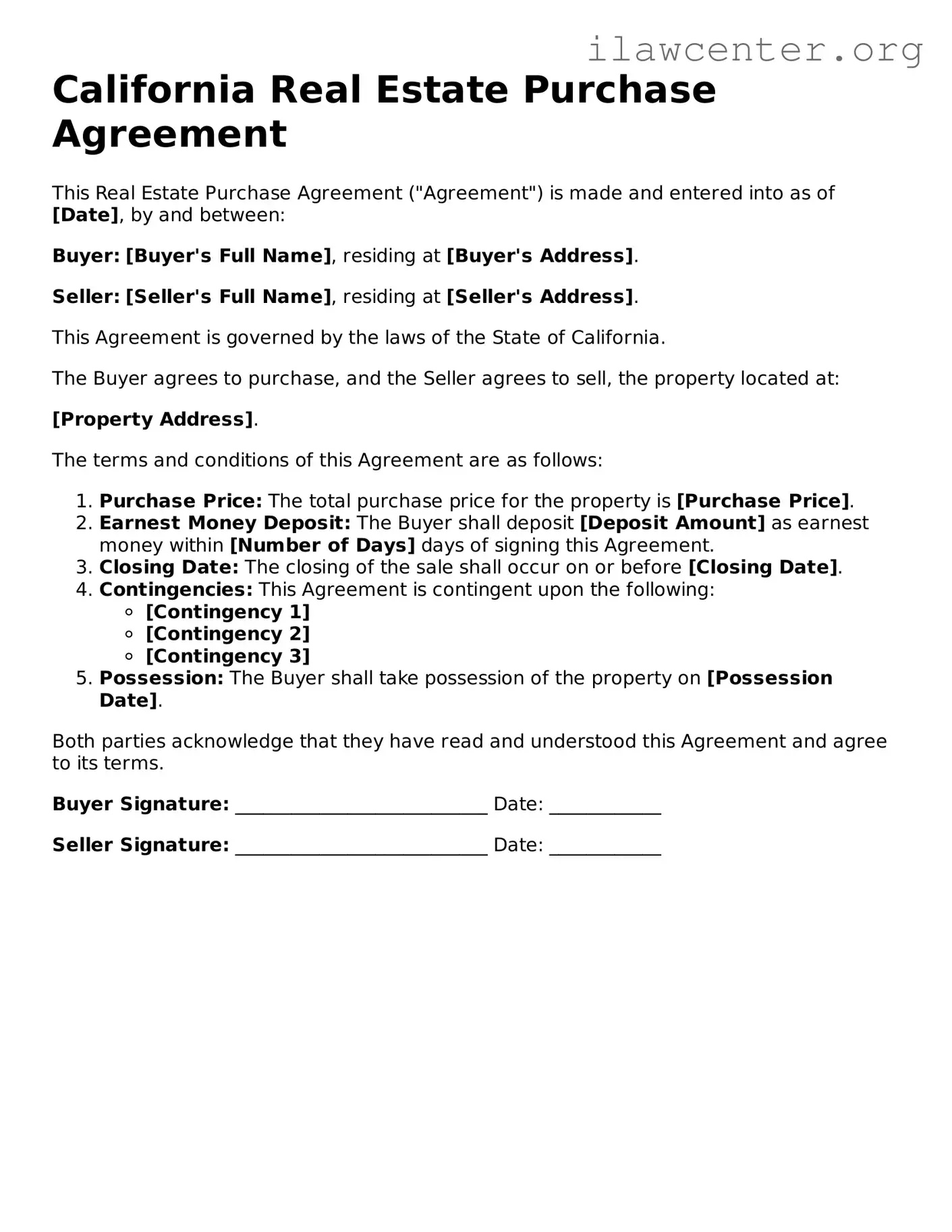
California Real Estate Purchase Agreement Preview

California Real Estate Purchase Agreement

This Real Estate Purchase Agreement ("Agreement") is made and entered into as of [Date], by and between:

Buyer: [Buyer's Full Name], residing at [Buyer's Address].

Seller: [Seller's Full Name], residing at [Seller's Address].

This Agreement is governed by the laws of the State of California.

The Buyer agrees to purchase, and the Seller agrees to sell, the property located at:

[Property Address].

The terms and conditions of this Agreement are as follows:

  1. Purchase Price: The total purchase price for the property is [Purchase Price].
  2. Earnest Money Deposit: The Buyer shall deposit [Deposit Amount] as earnest money within [Number of Days] days of signing this Agreement.
  3. Closing Date: The closing of the sale shall occur on or before [Closing Date].
  4. Contingencies: This Agreement is contingent upon the following:
    • [Contingency 1]
    • [Contingency 2]
    • [Contingency 3]
  5. Possession: The Buyer shall take possession of the property on [Possession Date].

Both parties acknowledge that they have read and understood this Agreement and agree to its terms.

Buyer Signature: ___________________________ Date: ____________

Seller Signature: ___________________________ Date: ____________

PDF Form Characteristics

Fact Name Description
Governing Law The California Real Estate Purchase Agreement is governed by California state law.
Form Purpose This form is used to outline the terms and conditions of a real estate transaction in California.
Parties Involved The agreement typically involves a buyer and a seller, each identified in the document.
Property Description A detailed description of the property being sold must be included in the agreement.
Purchase Price The total purchase price for the property is specified in the agreement.
Contingencies Buyers can include contingencies, such as financing or inspection, to protect their interests.
Signatures Required Both parties must sign the agreement for it to be legally binding.

Instructions on Utilizing California Real Estate Purchase Agreement

Filling out the California Real Estate Purchase Agreement form is an important step in the home buying process. Once you complete the form, you will be ready to move forward with your real estate transaction, which includes negotiations, inspections, and financing arrangements.

  1. Obtain the Form: Get a copy of the California Real Estate Purchase Agreement. You can find it online or through a real estate agent.
  2. Fill in Buyer Information: Enter the names and contact details of all buyers involved in the transaction.
  3. Fill in Seller Information: Provide the names and contact details of all sellers.
  4. Property Description: Describe the property being sold, including the address and any relevant details like parcel number.
  5. Purchase Price: State the agreed purchase price for the property.
  6. Deposit Amount: Indicate the amount of the deposit that the buyer will provide.
  7. Financing Terms: Specify how the buyer intends to finance the purchase, whether through a mortgage, cash, or other means.
  8. Contingencies: List any contingencies that must be met for the sale to proceed, such as inspections or financing approval.
  9. Closing Date: Set a proposed date for the closing of the sale.
  10. Signatures: Ensure all parties sign and date the agreement to make it legally binding.

Important Facts about California Real Estate Purchase Agreement

What is the California Real Estate Purchase Agreement form?

The California Real Estate Purchase Agreement form is a legal document used in real estate transactions within the state of California. It outlines the terms and conditions under which a buyer agrees to purchase a property from a seller. This form includes details such as the purchase price, financing arrangements, and contingencies that must be met for the sale to proceed.

Who should use the California Real Estate Purchase Agreement?

This form is primarily used by buyers and sellers of residential real estate in California. Real estate agents and brokers often assist in filling out the agreement to ensure that all necessary details are included. It is crucial for both parties to understand the terms outlined in the agreement before signing.

What key elements are included in the agreement?

The agreement typically includes the purchase price, property description, closing date, and any contingencies such as inspections or financing. Additionally, it may outline the responsibilities of both the buyer and seller, including disclosures and any agreements regarding repairs or improvements to the property.

Can the California Real Estate Purchase Agreement be modified?

Yes, the agreement can be modified, but any changes must be agreed upon by both parties and documented in writing. It's important to ensure that all modifications are clear and do not conflict with the original terms of the agreement. This helps to avoid misunderstandings later in the process.

What happens if a party does not fulfill their obligations?

If either the buyer or seller fails to meet their obligations as outlined in the agreement, it may lead to a breach of contract. The non-breaching party may have the right to seek remedies, which could include enforcing the contract, seeking damages, or terminating the agreement. It’s advisable to consult with a legal expert in such situations.

Is an attorney required to complete the agreement?

An attorney is not required to complete the California Real Estate Purchase Agreement, but it can be beneficial to have legal guidance. Real estate transactions can be complex, and an attorney can help ensure that your rights are protected and that the agreement complies with California law.

What are contingencies in the agreement?

Contingencies are specific conditions that must be met for the sale to proceed. Common contingencies include home inspections, financing approval, and appraisal conditions. These clauses protect the buyer by allowing them to back out of the agreement without penalty if the conditions are not satisfied.

How can I obtain a California Real Estate Purchase Agreement form?

You can obtain the California Real Estate Purchase Agreement form through various sources. Many real estate agents provide it as part of their services. Additionally, it is available online through legal document services and the California Association of Realtors. Always ensure you are using the most current version of the form to comply with state laws.
Common mistakes

Filling out the California Real Estate Purchase Agreement form can be a complex task, and many individuals make common mistakes that can lead to complications later on. One frequent error is neglecting to provide complete and accurate information about the property. Buyers and sellers may overlook essential details such as the property address, legal description, or even the correct names of the parties involved. This lack of precision can create confusion and potentially delay the transaction.

Another mistake often made is failing to specify the terms of the sale clearly. This includes not defining the purchase price, financing contingencies, and deadlines for inspections or closing. Vague language can lead to misunderstandings between the parties. When terms are not clearly articulated, it can result in disputes that may require legal intervention, which is both time-consuming and costly.

Additionally, individuals sometimes underestimate the importance of including contingencies. These are conditions that must be met for the sale to proceed. For instance, buyers may want to include a contingency for financing or home inspections. Omitting these clauses can leave a buyer vulnerable, as they may find themselves committed to a purchase without adequate protection should unexpected issues arise.

Lastly, many people fail to review the agreement thoroughly before signing. Rushing through the process can lead to overlooking critical details or clauses that could impact the sale. It is essential for both buyers and sellers to take the time to read the entire document carefully. Seeking guidance from a real estate professional or legal expert can provide clarity and ensure that all parties are fully informed and protected throughout the transaction.

Documents used along the form

When engaging in a real estate transaction in California, several forms and documents complement the Real Estate Purchase Agreement. Each document serves a specific purpose, ensuring that both buyers and sellers are protected throughout the process. Below is a list of commonly used forms that may be necessary.

  • Disclosure Statement: This document outlines any known issues with the property, such as structural problems or environmental hazards. Sellers must provide this to inform buyers of potential risks.
  • Pre-Approval Letter: Issued by a lender, this letter indicates that a buyer has been pre-approved for a mortgage. It demonstrates financial readiness and can strengthen a buyer's offer.
  • Counteroffer: If a seller does not accept the initial offer, they may issue a counteroffer. This document outlines new terms and conditions that the seller is willing to accept.
  • Escrow Instructions: This document provides detailed instructions to the escrow agent regarding how to handle the transaction. It includes information about the deposit, closing date, and any contingencies.
  • Title Report: A title report reveals the legal status of the property’s title, including ownership history and any liens or encumbrances. Buyers should review this to ensure clear ownership.
  • Home Inspection Report: Conducted by a professional inspector, this report assesses the condition of the property. It helps buyers identify any repairs needed before finalizing the sale.
  • Closing Statement: This document summarizes all financial transactions related to the sale, including fees, credits, and debits. It is reviewed and signed at the closing meeting.
  • Deed: The deed is the legal document that transfers ownership of the property from the seller to the buyer. It must be properly executed and recorded to finalize the transaction.

Understanding these documents is essential for a smooth real estate transaction. Each plays a vital role in protecting the interests of both parties and ensuring compliance with California laws.

Similar forms

  • Lease Agreement: Similar to a Real Estate Purchase Agreement, a Lease Agreement outlines the terms under which a tenant can occupy a property. It specifies rent, duration, and responsibilities of both parties.

  • Option to Purchase Agreement: This document gives a tenant the right to purchase the property at a later date. It details the purchase price and terms, similar to a Real Estate Purchase Agreement.

  • Seller's Disclosure Statement: This document requires the seller to disclose known issues with the property. It ensures that buyers are informed, paralleling the transparency expected in a Real Estate Purchase Agreement.

  • Purchase and Sale Agreement: Often used interchangeably with a Real Estate Purchase Agreement, this document also outlines the terms of a property sale, including price and conditions.

  • Escrow Agreement: This document defines the terms under which a neutral third party holds funds during a real estate transaction. It ensures that both buyer and seller meet their obligations, similar to the conditions laid out in a Real Estate Purchase Agreement.

Dos and Don'ts

When filling out the California Real Estate Purchase Agreement form, it’s essential to be thorough and accurate. Here are ten tips to guide you through the process:

  • Do read the entire agreement carefully before filling it out.
  • Don't leave any sections blank. Every part of the form should be completed.
  • Do provide accurate information about the property and the parties involved.
  • Don't use abbreviations or shorthand that could lead to confusion.
  • Do double-check all figures, especially the purchase price and deposit amounts.
  • Don't forget to include any contingencies that may affect the sale.
  • Do sign and date the agreement where required.
  • Don't assume that verbal agreements are binding; everything should be in writing.
  • Do consult with a real estate professional if you have questions.
  • Don't rush through the process; take your time to ensure accuracy.

By following these guidelines, you can help ensure a smoother transaction and avoid potential pitfalls.

Misconceptions

The California Real Estate Purchase Agreement (RPA) is a crucial document in real estate transactions, yet several misconceptions surround its use and implications. Understanding these misconceptions can help both buyers and sellers navigate the process more effectively.

  • The RPA is a one-size-fits-all document. Many believe that the RPA can be used universally for all transactions. In reality, while it provides a standard framework, it must be tailored to fit the specific needs and circumstances of each transaction.
  • Signing the RPA guarantees the sale. Some individuals assume that signing the RPA means the property is sold. However, the agreement is contingent upon various factors, such as inspections, financing, and other conditions that must be met before the sale is finalized.
  • Only real estate agents can complete the RPA. A common myth is that only licensed real estate professionals can fill out the RPA. In fact, buyers and sellers can complete the form themselves, though seeking professional guidance is often beneficial.
  • All contingencies are the same. It is a misconception that all contingencies included in the RPA are standard and cannot be modified. Each transaction may require different contingencies, and parties can negotiate these terms to suit their specific needs.

By dispelling these misconceptions, parties involved in real estate transactions can approach the California Real Estate Purchase Agreement with greater clarity and confidence.

Key takeaways

Filling out the California Real Estate Purchase Agreement form is a crucial step in the home buying process. Here are some key takeaways to keep in mind:

  • Understand the Parties Involved: Clearly identify the buyer and seller. Ensure that names are spelled correctly and match the names on legal documents.
  • Property Description: Provide a detailed description of the property, including the address and any included fixtures or personal property.
  • Purchase Price: Specify the agreed-upon purchase price and outline how the buyer will finance the purchase, whether through cash, loans, or other means.
  • Contingencies: Include any contingencies that must be met for the sale to proceed, such as home inspections, financing approval, or appraisal requirements.
  • Closing Date: Establish a timeline for the closing date. This is when the property officially changes hands and ownership is transferred.
  • Disclosures: Be aware of required disclosures. Sellers must provide information about the property’s condition, including any known defects or issues.
  • Signatures: Ensure that all parties sign the agreement. Without signatures, the contract is not legally binding.

By paying attention to these key aspects, both buyers and sellers can navigate the process more effectively and avoid common pitfalls.