Attorney-Verified  Release of Liability Document for California

Attorney-Verified Release of Liability Document for California

The California Release of Liability form is a legal document designed to protect businesses and individuals from liability for injuries or damages that may occur during an activity. By signing this form, participants acknowledge the risks involved and agree not to hold the provider responsible. To ensure your protection, fill out the form by clicking the button below.

Article Guide

The California Release of Liability form serves as a crucial document for individuals and organizations seeking to manage risk and protect themselves from potential legal claims. This form is commonly used in various contexts, including recreational activities, sports events, and other situations where participants may encounter inherent risks. By signing this form, participants acknowledge their understanding of the risks involved and agree to waive their right to sue for injuries or damages that may occur as a result of those activities. The form typically outlines the specific activities covered, the nature of the risks involved, and the rights being relinquished by the signer. It is important for both parties—the entity providing the activity and the participant—to fully comprehend the implications of the document. Properly executed, the Release of Liability can provide a layer of protection for organizers while promoting informed consent among participants. Understanding the nuances of this form is essential for anyone involved in activities that carry potential hazards.

California Release of Liability Preview

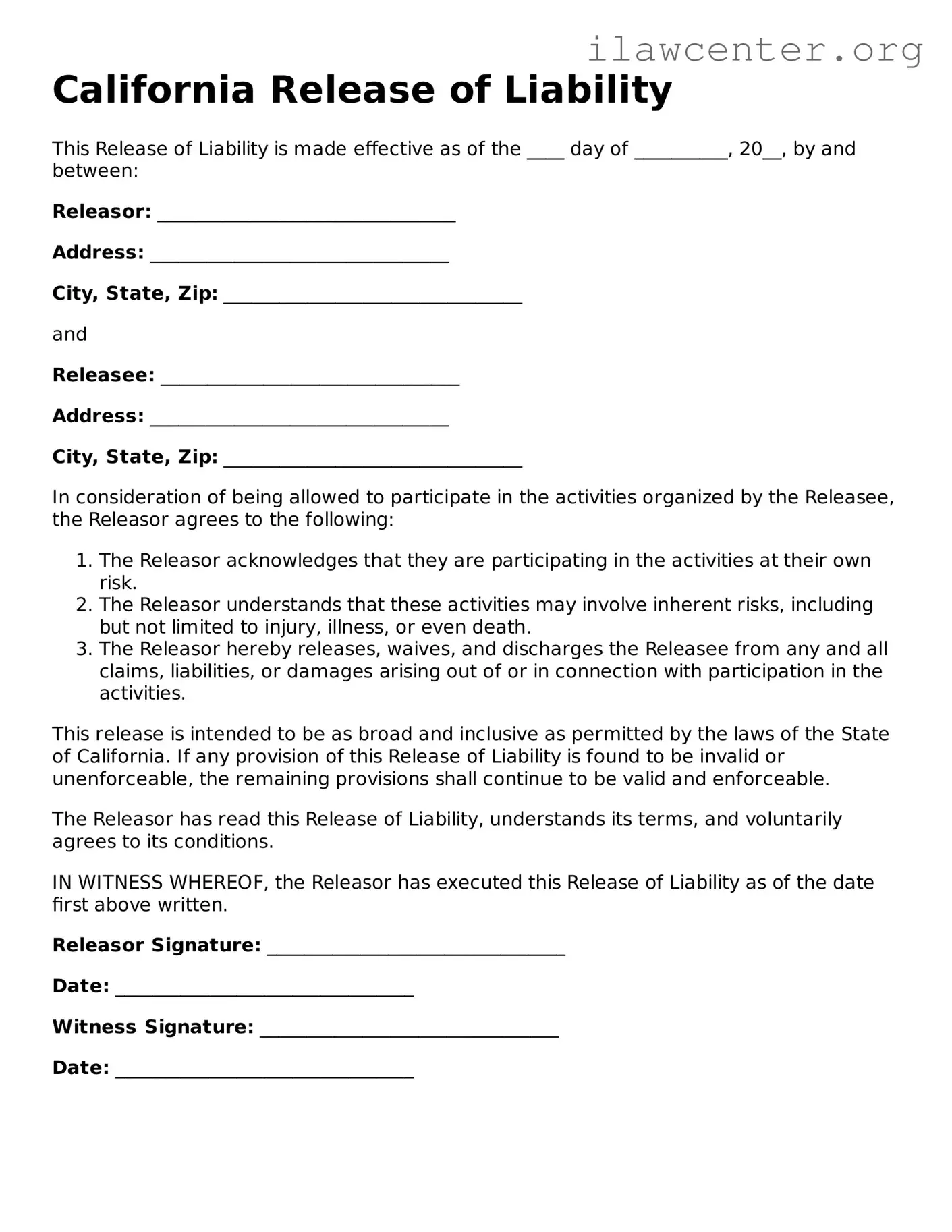
California Release of Liability

This Release of Liability is made effective as of the ____ day of __________, 20__, by and between:

Releasor: ________________________________

Address: ________________________________

City, State, Zip: ________________________________

and

Releasee: ________________________________

Address: ________________________________

City, State, Zip: ________________________________

In consideration of being allowed to participate in the activities organized by the Releasee, the Releasor agrees to the following:

  1. The Releasor acknowledges that they are participating in the activities at their own risk.
  2. The Releasor understands that these activities may involve inherent risks, including but not limited to injury, illness, or even death.
  3. The Releasor hereby releases, waives, and discharges the Releasee from any and all claims, liabilities, or damages arising out of or in connection with participation in the activities.

This release is intended to be as broad and inclusive as permitted by the laws of the State of California. If any provision of this Release of Liability is found to be invalid or unenforceable, the remaining provisions shall continue to be valid and enforceable.

The Releasor has read this Release of Liability, understands its terms, and voluntarily agrees to its conditions.

IN WITNESS WHEREOF, the Releasor has executed this Release of Liability as of the date first above written.

Releasor Signature: ________________________________

Date: ________________________________

Witness Signature: ________________________________

Date: ________________________________

PDF Form Characteristics

Fact Name Description
Purpose The California Release of Liability form is designed to protect individuals and organizations from legal claims arising from injuries or damages that may occur during an activity.
Governing Law This form is governed by California Civil Code Section 1668, which addresses the enforceability of liability waivers.
Scope of Use The form is commonly used in recreational activities, sports events, and other situations where participants may face risks.
Voluntary Agreement Participants must sign the form voluntarily, indicating their understanding of the risks involved and their agreement to waive liability.
Limitations The release may not be enforceable in cases of gross negligence or willful misconduct by the party seeking the release.

Instructions on Utilizing California Release of Liability

After obtaining the California Release of Liability form, you will need to complete it accurately. This form is essential for documenting the understanding between the parties involved. Follow the steps below to ensure that you fill out the form correctly.

  1. Begin by entering the date at the top of the form.
  2. Provide your full name in the designated space.
  3. Fill in your address, including street, city, state, and zip code.
  4. Clearly state the activity or event for which you are releasing liability.
  5. Include the name of the organization or individual that will be receiving the release.
  6. Read through the liability release statement carefully.
  7. Sign the form in the space provided to indicate your agreement.
  8. Print your name below your signature.
  9. Provide the date of your signature.

Once you have completed the form, make sure to keep a copy for your records. You may need to submit the original to the organization or individual specified in the document.

Important Facts about California Release of Liability

What is a California Release of Liability form?

The California Release of Liability form is a legal document that individuals may use to waive their right to hold another party accountable for any injuries or damages that may occur during a specific activity or event. This form is often utilized in situations where risks are inherent, such as sports events, recreational activities, or other potentially hazardous environments. By signing this document, participants acknowledge the risks involved and agree not to pursue legal action against the organizers or providers of the activity, should an injury occur. It is important to understand that this waiver does not protect against negligence or willful misconduct; it primarily addresses the assumption of known risks.

Who should use a Release of Liability form?

A Release of Liability form is commonly used by businesses, organizations, or individuals who host activities that carry inherent risks. This includes sports clubs, recreational facilities, adventure companies, and event organizers. Participants in activities such as hiking, biking, or team sports may also be asked to sign this form. It serves as a protective measure for the organizers, ensuring that they are not held liable for accidents that participants willingly engage in. However, it is essential for all parties involved to read and understand the terms of the release before signing.

Is a Release of Liability form enforceable in California?

In California, a Release of Liability form can be enforceable, provided it meets certain legal standards. The form must be clear and unambiguous, allowing participants to understand what rights they are waiving. It should also be signed voluntarily and without any coercion. Courts in California may scrutinize the language used in the form, particularly if it attempts to release a party from liability for gross negligence or intentional wrongdoing. Therefore, while a well-drafted Release of Liability can provide protection, it is advisable to consult with a legal professional to ensure that the document complies with applicable laws and effectively addresses the specific risks associated with the activity.

Can a participant revoke their consent after signing the Release of Liability?

Once a participant has signed a Release of Liability form, they generally cannot revoke their consent unilaterally. However, there are exceptions. If a participant feels that they were misled about the risks involved or if they were coerced into signing, they may have grounds to contest the validity of the release. Additionally, if circumstances change significantly after the signing, such as new risks being introduced, a participant may wish to discuss their concerns with the organizers. Open communication is vital, and it is always best to address any issues before the activity begins to ensure a safe and enjoyable experience for everyone involved.
Common mistakes

When completing the California Release of Liability form, many individuals inadvertently make mistakes that can undermine the document's effectiveness. One common error is failing to provide accurate personal information. This includes names, addresses, and contact details. Inaccurate information can lead to complications if a claim needs to be made or if communication is required.

Another frequent mistake involves overlooking the specific activities covered by the release. It is essential to clearly outline the activities for which the liability is being waived. If these activities are not explicitly stated, the release may not hold up in a legal context. Individuals should take the time to ensure that all relevant activities are included.

Additionally, many people neglect to read the entire form before signing. This oversight can result in misunderstandings about the terms and conditions. It is crucial to understand what rights are being waived and any potential risks involved. Ignorance of the content can lead to disputes later on.

Some individuals also fail to sign and date the form properly. A missing signature or date can render the document invalid. Always ensure that the form is signed by all parties involved, and that it is dated correctly. This simple step can prevent future complications.

Finally, another mistake is not keeping a copy of the signed release. After completing the form, it is vital to retain a copy for personal records. This ensures that all parties have access to the agreement if questions arise in the future. Without a copy, proving the terms of the release can become challenging.

Documents used along the form

The California Release of Liability form serves as an important document designed to protect individuals and organizations from claims arising from activities that may involve risk. However, it is often accompanied by other forms and documents that further clarify responsibilities, expectations, and legal standings. Below are some commonly used forms that complement the Release of Liability.

  • Waiver of Liability: This document explicitly states that participants understand the risks involved in an activity and agree to waive their right to sue for any injuries that may occur. It is similar to the Release of Liability but may contain additional clauses specific to the event or activity.
  • Informed Consent Form: This form is used to ensure that participants are fully aware of the risks and procedures associated with an activity. It often includes detailed descriptions of what participants can expect and requires their signature to confirm understanding.
  • Emergency Contact Form: This document collects vital information about participants’ emergency contacts. It is essential for organizers to have this information on hand in case of an emergency during the activity.
  • Participant Agreement: This form outlines the terms and conditions that participants must agree to before engaging in an activity. It may include rules of conduct, responsibilities, and consequences for non-compliance.

Incorporating these additional documents alongside the California Release of Liability can help ensure a comprehensive approach to risk management. By clearly communicating expectations and responsibilities, organizations can foster a safer environment for all participants.

Similar forms

A Release of Liability form is a crucial document often used in various contexts to protect individuals and organizations from legal claims. Several other documents serve similar purposes, providing varying degrees of protection and outlining responsibilities. Below are six documents that share similarities with a Release of Liability form:

  • Waiver of Liability: This document is often used in recreational activities. Participants agree to waive their right to sue for injuries sustained during the activity, much like in a Release of Liability form.
  • Indemnity Agreement: This agreement involves one party agreeing to compensate another for certain damages or losses. Similar to a Release of Liability, it aims to protect one party from legal claims arising from specific actions.
  • Assumption of Risk Form: Participants in activities like sports or adventure outings sign this form to acknowledge that they understand the risks involved. This is akin to a Release of Liability, as both documents aim to inform and protect the provider from claims.
  • Consent Form: Often used in medical or research contexts, a consent form ensures that individuals understand the procedures and potential risks. Like a Release of Liability, it requires acknowledgment of risk and acceptance of responsibility.
  • Contractual Agreement: In many business transactions, parties sign contracts that outline their responsibilities and liabilities. While broader in scope, these contracts can include clauses that limit liability, similar to a Release of Liability.
  • Event Participation Agreement: This document is used for events where participants agree to certain terms and conditions. It typically includes a liability waiver, paralleling the intent of a Release of Liability to minimize legal exposure.

Each of these documents serves to clarify responsibilities and protect against potential legal claims, ensuring that all parties involved understand their rights and obligations.

Dos and Don'ts

When filling out the California Release of Liability form, it’s important to approach the task with care. Here are nine essential do's and don'ts to keep in mind:

  • Do read the entire form carefully before filling it out.
  • Do provide accurate and complete information.
  • Do sign and date the form in the designated areas.
  • Do keep a copy of the completed form for your records.
  • Do consult with a legal professional if you have questions.
  • Don't rush through the form; take your time to ensure accuracy.
  • Don't leave any required fields blank.
  • Don't sign the form without fully understanding its implications.
  • Don't ignore any instructions provided on the form.

By following these guidelines, you can ensure that your Release of Liability form is filled out correctly and effectively.

Misconceptions

Understanding the California Release of Liability form is essential for anyone considering participating in activities that may involve risks. However, several misconceptions often arise regarding this document. Below is a list of common misunderstandings, along with explanations to clarify the truth.

  • Misconception 1: A Release of Liability form protects against all types of claims.
  • This is not entirely true. While the form can limit liability for certain activities, it does not cover gross negligence or willful misconduct. If an organization is found to have acted recklessly, the form may not provide protection.

  • Misconception 2: Signing the form means you cannot sue for any reason.
  • Signing the form does not eliminate all rights to sue. It generally limits claims related to the specific activities outlined in the document. If harm occurs due to negligence outside the scope of the release, a lawsuit may still be possible.

  • Misconception 3: All Release of Liability forms are the same.
  • Not all forms are created equal. Each form is tailored to the specific activity and risks involved. It is crucial to read and understand the terms of the particular form you are signing.

  • Misconception 4: Minors can sign the form themselves.
  • In California, minors cannot legally sign a Release of Liability form. A parent or guardian must sign on their behalf to ensure that the minor is protected and that the risks are understood.

  • Misconception 5: The form absolves all responsibility from the organization.
  • The form does not completely absolve an organization from responsibility. It may limit liability for certain risks, but organizations still have a duty to maintain a safe environment and follow safety regulations.

  • Misconception 6: You should sign the form without reading it.
  • This is a dangerous assumption. It is vital to read the entire document before signing. Understanding the risks and the rights you may be waiving is essential for making an informed decision.

  • Misconception 7: A Release of Liability form is only necessary for extreme sports.
  • While commonly associated with high-risk activities, Release of Liability forms can be used for a wide range of events, including recreational activities, workshops, and community events. They are a proactive measure to address potential risks.

By dispelling these misconceptions, individuals can make informed decisions about participating in activities that require a Release of Liability form. Understanding the nuances of this document can help protect your rights and clarify the responsibilities of all parties involved.

Key takeaways

Filling out and using the California Release of Liability form is an important step for individuals and organizations looking to protect themselves from potential legal claims. Here are some key takeaways:

  1. Understand the Purpose: The form is designed to waive the right to sue for injuries or damages that may occur during a specific activity.
  2. Identify the Parties: Clearly state the names of the parties involved, including the person or organization being released from liability.
  3. Be Specific: Describe the activity or event for which the release is being signed. This helps clarify the scope of the waiver.
  4. Include Risks: List potential risks associated with the activity. This informs participants about what they may encounter.
  5. Use Clear Language: Avoid complex legal terms. Use straightforward language to ensure that all parties understand the agreement.
  6. Consider Age: If the participant is a minor, a parent or guardian must sign the form on their behalf.
  7. Sign and Date: Ensure that all parties involved sign and date the form. This makes it legally binding.
  8. Keep Copies: Retain copies of the signed form for your records. This provides proof of the agreement if needed later.
  9. Consult Legal Advice: If unsure about any aspect of the form, seek legal advice to ensure it meets your needs.
  10. Review Regularly: Periodically review the form and update it as necessary, especially if the activity or risks change.

Using the California Release of Liability form correctly can help mitigate risks and protect against legal claims. Being thorough and clear in its completion is essential.