Attorney-Verified  Self-Proving Affidavit Document for California

Attorney-Verified Self-Proving Affidavit Document for California

The California Self-Proving Affidavit is a legal document that allows a testator's will to be validated without the need for witnesses to testify in court. This form simplifies the probate process by providing a written declaration from the witnesses affirming the authenticity of the will. For those interested in streamlining their estate planning, filling out this form can be a beneficial step; click the button below to get started.

Article Guide

The California Self-Proving Affidavit form serves an important function in the estate planning process, providing a streamlined way for individuals to validate their wills. This form allows testators, or the individuals creating the will, to affirm their intentions and the authenticity of their signatures in front of a notary public. By using this affidavit, the need for witnesses during the will's execution can be eliminated, simplifying the probate process. The form typically includes sections where the testator and witnesses can provide their names, addresses, and signatures, along with the notary's acknowledgment. This not only enhances the credibility of the will but also helps to expedite its acceptance in court, reducing potential disputes among heirs. Overall, the California Self-Proving Affidavit is a valuable tool for ensuring that a person’s final wishes are honored and respected, making it easier for loved ones to navigate the complexities of estate management after a passing.

California Self-Proving Affidavit Preview

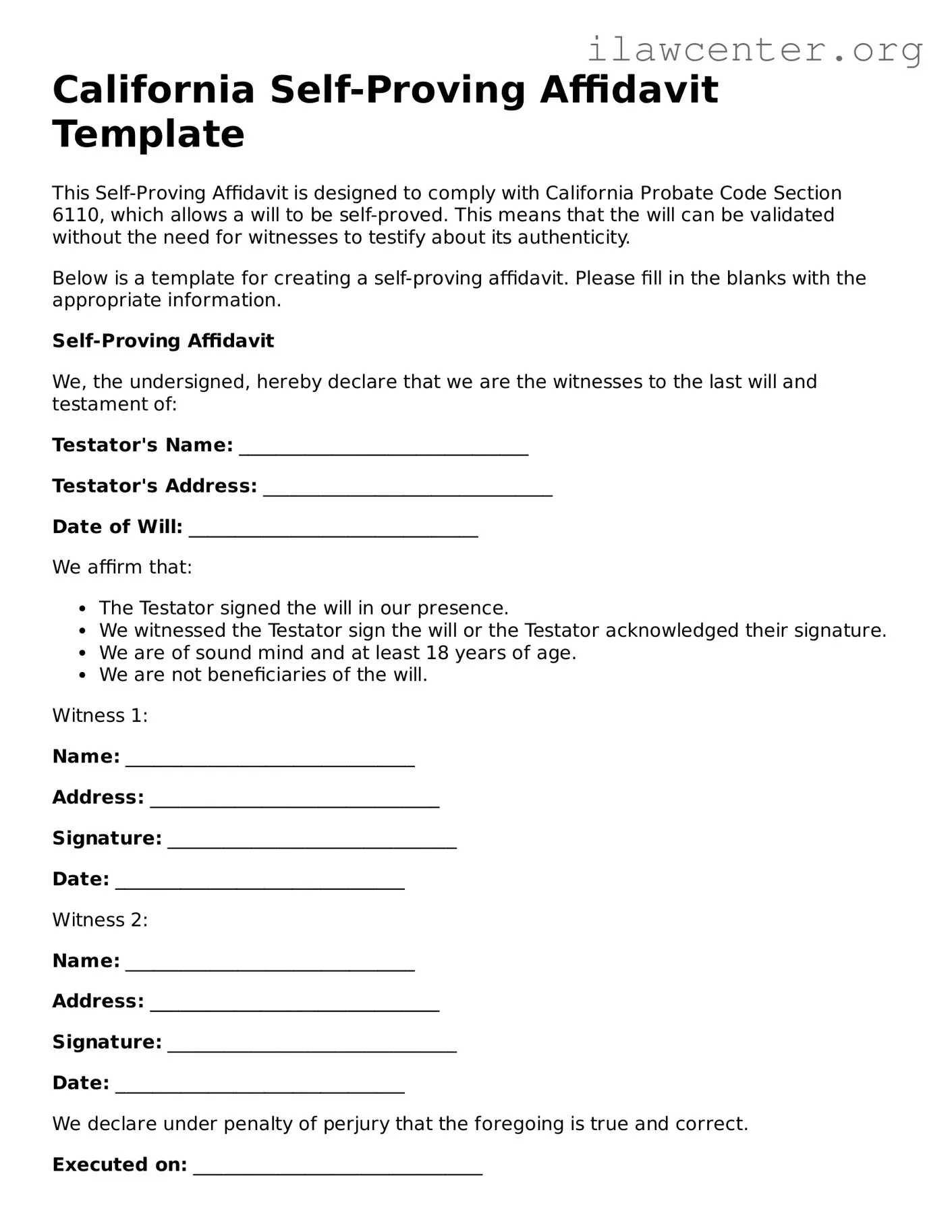
California Self-Proving Affidavit Template

This Self-Proving Affidavit is designed to comply with California Probate Code Section 6110, which allows a will to be self-proved. This means that the will can be validated without the need for witnesses to testify about its authenticity.

Below is a template for creating a self-proving affidavit. Please fill in the blanks with the appropriate information.

Self-Proving Affidavit

We, the undersigned, hereby declare that we are the witnesses to the last will and testament of:

Testator's Name: _______________________________

Testator's Address: _______________________________

Date of Will: _______________________________

We affirm that:

  • The Testator signed the will in our presence.
  • We witnessed the Testator sign the will or the Testator acknowledged their signature.
  • We are of sound mind and at least 18 years of age.
  • We are not beneficiaries of the will.

Witness 1:

Name: _______________________________

Address: _______________________________

Signature: _______________________________

Date: _______________________________

Witness 2:

Name: _______________________________

Address: _______________________________

Signature: _______________________________

Date: _______________________________

We declare under penalty of perjury that the foregoing is true and correct.

Executed on: _______________________________

Location: _______________________________

_______________________________

Testator's Signature

PDF Form Characteristics

Fact Name Description
Purpose The California Self-Proving Affidavit allows a will to be validated without the need for witnesses to testify in court.
Governing Law This form is governed by California Probate Code Section 8220.
Signature Requirement The testator and witnesses must sign the affidavit in front of a notary public.
Use It is used to simplify the probate process by proving the authenticity of the will.
Optional Using this affidavit is optional but highly recommended for ease in probate proceedings.
Validity The affidavit must be executed at the same time as the will to ensure its validity.

Instructions on Utilizing California Self-Proving Affidavit

Completing the California Self-Proving Affidavit form is an important step in ensuring your will is recognized without the need for witnesses in probate court. After filling out the form, it will need to be signed and notarized to be valid.

  1. Obtain the California Self-Proving Affidavit form. You can find it online or through legal resources.
  2. Fill in the name of the testator (the person who made the will) at the top of the form.
  3. Provide the date the will was executed. This is the date when the will was signed.
  4. List the names and addresses of the witnesses who were present when the will was signed.
  5. Each witness must sign the affidavit in the designated area. They should do this in the presence of a notary public.
  6. Find a notary public. The notary will verify the identities of the witnesses and the testator.
  7. Sign the affidavit in front of the notary. The notary will then complete their section of the form.
  8. Make copies of the signed and notarized affidavit for your records and for the probate process.

Important Facts about California Self-Proving Affidavit

What is a California Self-Proving Affidavit?

A California Self-Proving Affidavit is a legal document that helps to simplify the probate process. It allows the testator (the person who created the will) and witnesses to affirm that the will was executed properly. This affidavit can be attached to the will, making it easier to validate the will in court without requiring the witnesses to testify later on.

Who can use a Self-Proving Affidavit?

Any individual who is creating a will in California can use a Self-Proving Affidavit. This includes anyone over the age of 18 who is of sound mind. It’s particularly useful for those who want to ensure their will is accepted without complications during probate. However, the affidavit must be signed by the testator and at least two witnesses at the same time to be valid.

How do I complete a Self-Proving Affidavit?

To complete a Self-Proving Affidavit, you’ll need to fill out the form with the required information, which typically includes the names of the testator and witnesses, the date of signing, and a statement affirming the will's execution. All parties must sign the affidavit in front of a notary public. Once notarized, it can be attached to the will. Make sure all details are accurate to avoid any issues later on.

Is a Self-Proving Affidavit necessary for my will?

Common mistakes

When filling out the California Self-Proving Affidavit form, many individuals inadvertently make mistakes that can lead to complications down the line. One common error is failing to include all necessary signatures. This form requires the signatures of both the testator and the witnesses. If any signature is missing, the affidavit may not be considered valid.

Another frequent mistake is not properly identifying the testator. The testator is the person who created the will, and it’s essential to provide their full legal name. Omitting middle names or using nicknames can create confusion and may even invalidate the document.

Many people overlook the date of execution. It is crucial to include the date when the affidavit was signed. Without this information, the affidavit may lack the necessary context regarding when the will was executed, which could lead to disputes in the future.

Additionally, some individuals fail to ensure that the witnesses meet the required criteria. In California, witnesses must be at least 18 years old and of sound mind. If a witness does not meet these qualifications, their signature may not hold up in court.

Another common error involves the notary section. If the affidavit is notarized, it’s important to ensure that the notary public has completed their section correctly. Any discrepancies or missing information from the notary can render the affidavit ineffective.

Some people neglect to keep copies of the completed affidavit. It’s vital to retain copies for personal records and to provide them to relevant parties, such as the executor of the estate. Without a copy, it may be challenging to prove the existence of the affidavit later on.

Another mistake is not reviewing the affidavit thoroughly before submission. Errors in spelling, grammar, or factual inaccuracies can lead to misunderstandings or disputes. Taking the time to review the document carefully can prevent these issues.

Lastly, individuals often forget to consult legal advice when needed. While the affidavit is a straightforward document, having a legal professional review it can provide peace of mind and ensure that everything is in order. Seeking guidance can help avoid pitfalls that could complicate the probate process later on.
Documents used along the form

The California Self-Proving Affidavit is an important document used in the estate planning process. It helps validate a will by confirming the authenticity of the testator's signature and the presence of witnesses. Along with this form, several other documents may be utilized to ensure a comprehensive estate plan. Below is a list of related forms and documents that are often used in conjunction with the Self-Proving Affidavit.

  • Last Will and Testament: This is the primary document outlining how a person's assets and affairs should be handled after their death. It specifies beneficiaries and can include instructions for guardianship of minors.
  • Trust Document: A trust document establishes a trust, which allows for the management and distribution of assets during a person's lifetime and after death. It can help avoid probate and provide privacy.
  • Durable Power of Attorney: This document grants another person the authority to make financial and legal decisions on behalf of an individual if they become incapacitated. It is crucial for managing affairs when one cannot do so themselves.
  • Advance Healthcare Directive: This document allows individuals to outline their healthcare preferences and appoint someone to make medical decisions on their behalf if they are unable to communicate their wishes.
  • Beneficiary Designations: These forms specify who will receive certain assets, such as life insurance policies and retirement accounts, directly upon the account holder's death, bypassing probate.
  • Revocation of Will: This document is used to formally revoke any previous wills, ensuring that only the most current will is considered valid after the testator's passing.

Using these documents in conjunction with the California Self-Proving Affidavit can create a more robust estate plan. Each serves a distinct purpose and can help ensure that an individual's wishes are honored and that their loved ones are taken care of after their passing.

Similar forms

The Self-Proving Affidavit is a valuable legal document used primarily in the context of wills. It serves to simplify the probate process by affirming the validity of a will through the signatures of witnesses. Several other documents share similar purposes or functions. Here’s a look at eight documents that are comparable to the Self-Proving Affidavit:

  • Last Will and Testament: This document outlines an individual's wishes regarding the distribution of their assets after death. Like the Self-Proving Affidavit, it requires signatures from witnesses to ensure authenticity.
  • Living Will: A living will expresses an individual's healthcare preferences in case they become unable to communicate. It can be executed with witnesses to confirm the individual's intentions, similar to how a Self-Proving Affidavit supports a will.
  • Durable Power of Attorney: This document allows an individual to designate someone to make decisions on their behalf. Witness signatures may be required, much like the Self-Proving Affidavit, to validate the authority granted.
  • Health Care Proxy: A health care proxy designates a person to make medical decisions for someone who is incapacitated. Witnesses often sign to affirm the proxy's validity, paralleling the role of witnesses in a Self-Proving Affidavit.
  • Trust Document: A trust outlines how an individual's assets will be managed and distributed. Witnesses may be required to sign, ensuring the trust's legitimacy, similar to the process for a Self-Proving Affidavit.
  • Affidavit of Death: This document is used to confirm an individual's death and may require witness signatures. It serves a similar purpose of validating information through sworn statements.
  • Codicil: A codicil is an amendment to an existing will. It must be executed with the same formalities as the original will, including witness signatures, akin to the Self-Proving Affidavit's function.
  • Declaration of Trust: This document outlines the terms of a trust agreement. Witness signatures may be necessary to validate the declaration, mirroring the affirmation process found in a Self-Proving Affidavit.

Each of these documents plays a crucial role in ensuring that an individual’s wishes are respected and legally recognized. Understanding their similarities can help individuals navigate the complexities of estate planning more effectively.

Dos and Don'ts

When filling out the California Self-Proving Affidavit form, it's important to follow certain guidelines. Here are five things you should do and five things you should avoid.

  • Do ensure that all information is accurate and complete.
  • Do have the affidavit signed in front of a notary public.
  • Do include the date and location of the signing.
  • Do keep a copy of the signed affidavit for your records.
  • Do check for any specific state requirements that may apply.
  • Don't leave any fields blank unless instructed.
  • Don't sign the affidavit before meeting with a notary.
  • Don't use white-out or make alterations on the form.
  • Don't forget to review the form for errors before submission.
  • Don't assume that all notaries have the same requirements; confirm with your notary.

Misconceptions

Understanding the California Self-Proving Affidavit form is crucial for anyone involved in estate planning or the probate process. However, several misconceptions surround this legal document. Below is a list that clarifies these common misunderstandings.

  1. It is mandatory for all wills in California. Many people believe that a self-proving affidavit is required for every will. In reality, it is not mandatory; it simply makes the probate process easier.
  2. Only lawyers can create a self-proving affidavit. While legal assistance can be beneficial, individuals can draft a self-proving affidavit themselves, provided they follow the necessary guidelines.
  3. It eliminates the need for witnesses. A self-proving affidavit does not replace the need for witnesses when signing a will. It simply provides a way to validate the will's authenticity later.
  4. It must be filed with the court immediately. Some assume that the affidavit must be submitted to the court right away. In fact, it is typically presented during the probate process when the will is filed.
  5. It is only useful for simple estates. Many think that self-proving affidavits are only applicable for uncomplicated estates. However, they can be beneficial for estates of any size, simplifying the verification process.
  6. Once signed, it cannot be changed. People often believe that signing a self-proving affidavit locks them into their current will. Changes can be made to the will, but a new affidavit may be necessary.
  7. It can be used in any state. Some individuals think that a California self-proving affidavit is valid in other states. Each state has its own laws regarding wills and affidavits, so it may not be recognized elsewhere.
  8. It guarantees the will's validity. A common misconception is that a self-proving affidavit guarantees that a will will be accepted by the court. While it aids in proving the will's authenticity, it does not ensure that the will is free from challenges.
  9. It is a substitute for a will. Some people mistakenly believe that a self-proving affidavit can replace a will. The affidavit serves only as a tool to support the will, not as a standalone document.
  10. It can be signed after the testator's death. Lastly, many think that a self-proving affidavit can be executed posthumously. This is incorrect; the affidavit must be signed while the testator is alive.

By dispelling these misconceptions, individuals can better understand the role of the California Self-Proving Affidavit and its importance in the estate planning process.

Key takeaways

Filling out and using the California Self-Proving Affidavit form can be a straightforward process, but there are several important points to keep in mind. Here are key takeaways that can help you navigate this important legal document:

  • Understand the Purpose: The Self-Proving Affidavit serves to validate a will by confirming that the testator and witnesses signed it in each other's presence.
  • Know Who Can Sign: The testator (the person making the will) and at least two witnesses must sign the affidavit to ensure its validity.
  • Timing Matters: It is best to complete the Self-Proving Affidavit at the same time the will is executed, although it can be done later if necessary.
  • Be Aware of Notarization: The affidavit must be notarized to be considered valid, which adds an extra layer of authenticity.
  • Keep It with the Will: Store the Self-Proving Affidavit alongside the original will to ensure that it is readily available when needed.
  • Check State Requirements: Familiarize yourself with California laws regarding wills and self-proving affidavits, as these can vary from state to state.
  • Review for Accuracy: Double-check all names, dates, and signatures to avoid any potential challenges to the will's validity.
  • Consult a Professional: If you have questions or concerns, seeking legal advice can help clarify the process and ensure compliance with all legal requirements.

By keeping these key points in mind, you can effectively utilize the California Self-Proving Affidavit form to strengthen the legal standing of your will.