Attorney-Verified  Small Estate Affidavit Document for California

Attorney-Verified Small Estate Affidavit Document for California

The California Small Estate Affidavit form is a legal document that allows individuals to claim assets from a deceased person's estate without going through the lengthy probate process, provided the estate meets certain criteria. This streamlined process can save time and reduce costs for heirs who are navigating the often complex world of estate management. If you believe you qualify, consider filling out the form by clicking the button below.

Article Guide

The California Small Estate Affidavit is a helpful tool for individuals dealing with the estate of someone who has passed away, particularly when the estate is relatively small. This form allows heirs to claim assets without the need for a lengthy probate process, which can be both time-consuming and costly. To qualify, the total value of the deceased's assets must be below a specific threshold, which is adjusted periodically. The form requires the affiant, typically an heir or a personal representative, to provide information about the deceased, the assets involved, and any debts owed. By submitting this affidavit, heirs can gain access to bank accounts, personal property, and other assets, making it easier to settle the estate efficiently. Understanding how to properly complete and file this form can save families from unnecessary stress during an already challenging time.

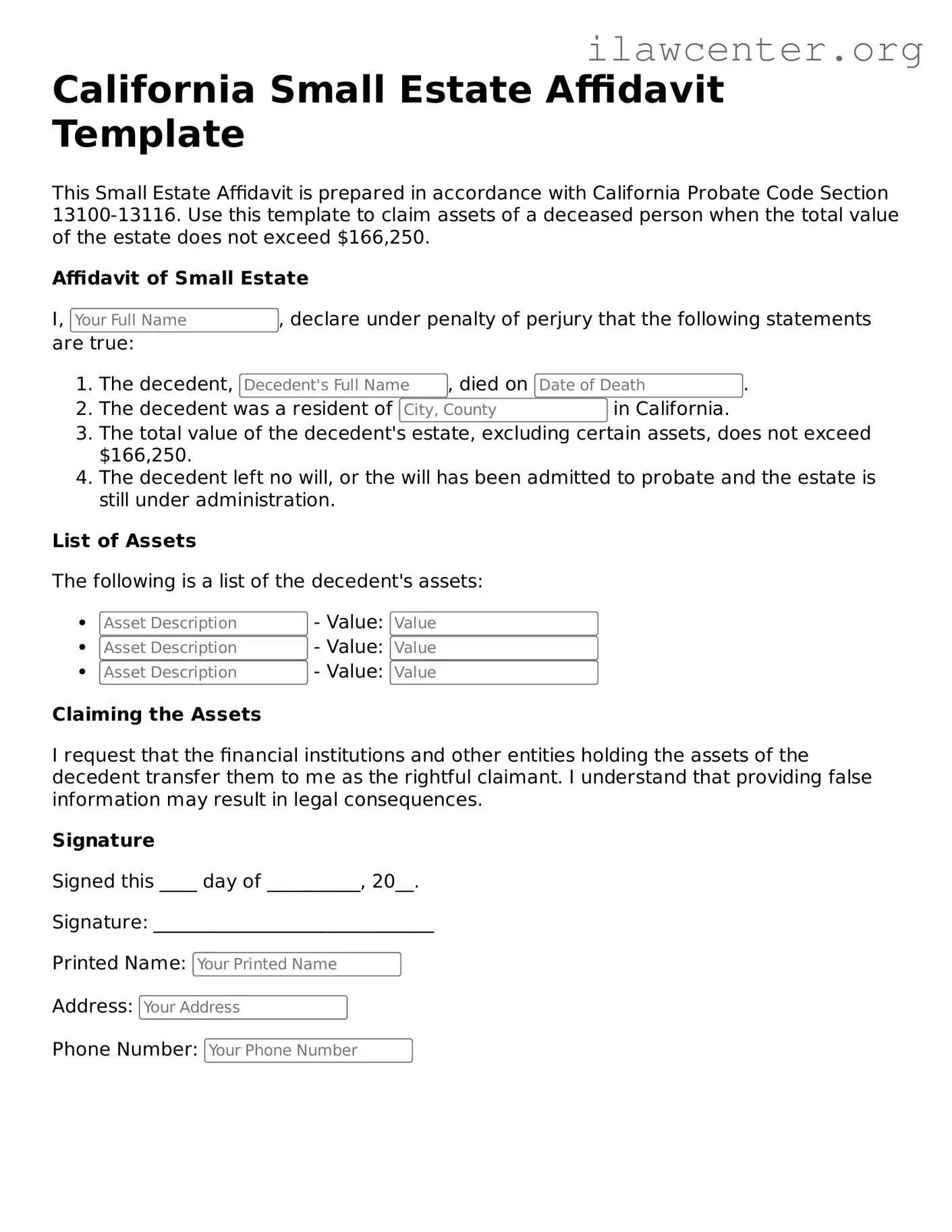
California Small Estate Affidavit Preview

California Small Estate Affidavit Template

This Small Estate Affidavit is prepared in accordance with California Probate Code Section 13100-13116. Use this template to claim assets of a deceased person when the total value of the estate does not exceed $166,250.

Affidavit of Small Estate

I, , declare under penalty of perjury that the following statements are true:

  1. The decedent, , died on .
  2. The decedent was a resident of in California.
  3. The total value of the decedent's estate, excluding certain assets, does not exceed $166,250.
  4. The decedent left no will, or the will has been admitted to probate and the estate is still under administration.

List of Assets

The following is a list of the decedent's assets:

  • - Value:
  • - Value:
  • - Value:

Claiming the Assets

I request that the financial institutions and other entities holding the assets of the decedent transfer them to me as the rightful claimant. I understand that providing false information may result in legal consequences.

Signature

Signed this ____ day of __________, 20__.

Signature: ______________________________

Printed Name:

Address:

Phone Number:

PDF Form Characteristics

Fact Name Description
Purpose The California Small Estate Affidavit allows heirs to claim assets of a deceased person without going through probate if the estate meets certain criteria.
Eligibility The total value of the estate must not exceed $166,250, excluding certain assets like real estate.
Governing Law The use of the Small Estate Affidavit is governed by California Probate Code Sections 13000-13009.
Required Information The affidavit must include details such as the decedent's name, date of death, and a description of the assets.
Filing Process The completed affidavit is presented to the financial institution or entity holding the assets to facilitate transfer.
Signature Requirement The affidavit must be signed under penalty of perjury, affirming that the information provided is true.
Time Limit There is no specific time limit for filing the Small Estate Affidavit, but it is advisable to do so promptly after the decedent's death.

Instructions on Utilizing California Small Estate Affidavit

After obtaining the California Small Estate Affidavit form, it is important to complete it accurately to ensure the proper transfer of assets. This process involves providing specific information about the deceased, their estate, and the affiant. Following these steps will help in filling out the form correctly.

  1. Obtain the California Small Estate Affidavit form from a reliable source, such as a government website or legal office.
  2. Begin by entering the name of the deceased person in the designated section.
  3. Provide the date of death of the deceased. This information is typically found on the death certificate.
  4. List the names and addresses of all heirs or beneficiaries entitled to inherit from the estate.
  5. Detail the assets of the estate, including bank accounts, real estate, and personal property, ensuring to include estimated values.
  6. Indicate whether the total value of the estate falls below the California small estate limit, which is currently set at $166,250.
  7. Sign the affidavit in front of a notary public to validate the document.
  8. Make copies of the completed affidavit for your records and for submission to the appropriate institutions.

Once the form is filled out and notarized, it can be submitted to the relevant institutions, such as banks or courts, to facilitate the transfer of assets as specified in the affidavit.

Important Facts about California Small Estate Affidavit

What is a California Small Estate Affidavit?

The California Small Estate Affidavit is a legal document that allows individuals to transfer property from a deceased person's estate without going through the formal probate process. This form is particularly useful for small estates, typically those valued at $166,250 or less, excluding certain types of property. By using this affidavit, heirs can claim assets such as bank accounts, personal property, and real estate, making the process more efficient and less costly.

Who is eligible to use the Small Estate Affidavit?

To use the Small Estate Affidavit, you must be an heir or a beneficiary of the deceased's estate. The law specifies that you should be entitled to receive property under the will or, if there is no will, under California's intestate succession laws. Additionally, the estate must meet the value limit mentioned earlier. If the estate exceeds this limit, the heirs will need to go through the formal probate process.

How do I complete the Small Estate Affidavit?

Completing the Small Estate Affidavit involves filling out a specific form, which can typically be obtained from the court or online. You will need to provide details about the deceased, including their name, date of death, and a description of the property you wish to claim. It's essential to ensure that all information is accurate and complete. Once filled out, the affidavit must be signed under penalty of perjury, affirming that the information provided is true.

What happens after I submit the Small Estate Affidavit?

After submitting the Small Estate Affidavit to the relevant financial institutions or property holders, they will review the document. If everything is in order, they will release the assets to you. It's important to keep copies of the affidavit and any correspondence for your records. In some cases, institutions may have their own requirements or additional forms, so be prepared for possible follow-up steps.

Can the Small Estate Affidavit be contested?

Common mistakes

Filling out the California Small Estate Affidavit can be a straightforward process, but many people make common mistakes that can delay or complicate the handling of an estate. One frequent error is failing to accurately identify the decedent. It’s crucial to provide the full legal name and date of death. Omitting any part of this information can lead to confusion and may even result in the affidavit being rejected.

Another mistake often seen is not including all required assets. The Small Estate Affidavit is designed for estates valued at $166,250 or less, but some individuals overlook certain assets or underestimate their value. This can lead to significant issues down the line. Every asset, from bank accounts to personal property, should be accounted for to ensure compliance with California law.

People also tend to misinterpret the signature requirements. The affidavit must be signed by the person claiming the estate, and it may also require the signatures of other heirs or beneficiaries. Failing to gather the necessary signatures can cause delays. It’s essential to double-check who needs to sign and ensure that all signatures are present before submitting the form.

Finally, many overlook the importance of notarization. The Small Estate Affidavit must be notarized to be legally valid. Skipping this step can render the document ineffective, forcing you to start the process over again. Always ensure that you have the affidavit notarized to avoid unnecessary setbacks.

Documents used along the form

When navigating the process of settling a small estate in California, several forms and documents are often utilized alongside the California Small Estate Affidavit. Each of these documents serves a specific purpose and can help streamline the estate settlement process. Below is a list of commonly used forms.

  • Death Certificate: This official document verifies the death of the individual whose estate is being settled. It is required to initiate the probate process and is essential for various legal proceedings.
  • Will: If a will exists, it outlines the deceased's wishes regarding the distribution of their assets. It can provide guidance on how to handle the estate, even in small estate situations.
  • Trust Documents: If the deceased had a trust, these documents detail the assets held in the trust and the instructions for their distribution. They are crucial for understanding the estate's overall management.
  • Inventory of Assets: This document lists all assets owned by the deceased at the time of death. It helps in assessing the total value of the estate and determining eligibility for the small estate process.
  • Affidavit of Identity: This form may be required to confirm the identity of the affiant or other parties involved. It ensures that all legal actions are taken by the appropriate individuals.
  • Notice to Creditors: This document informs creditors of the deceased's passing and provides them an opportunity to make claims against the estate. It is an important step in settling any debts.
  • Claim Forms: Creditors may submit claim forms to assert their rights to payment from the estate. These forms detail the nature and amount of the claims being made.
  • Court Filing Fee Waiver: If applicable, this form allows individuals to request a waiver of court fees associated with filing documents in probate court, making the process more accessible.
  • Petition for Letters of Administration: In cases where no will exists, this petition is filed to appoint an administrator for the estate. It is an essential step in the probate process.
  • Final Accounting: This document summarizes the financial activities of the estate, detailing income, expenses, and distributions made to beneficiaries. It provides transparency and accountability.

Each of these documents plays a vital role in ensuring that the estate settlement process is conducted smoothly and in accordance with legal requirements. By preparing and organizing these forms, individuals can better navigate the complexities of settling a small estate in California.

Similar forms

The Small Estate Affidavit is a useful legal document for settling the estates of individuals who have passed away, particularly when the estate's value is below a certain threshold. Several other documents serve similar purposes in estate management. Here are six such documents:

  • Last Will and Testament: This document outlines how a person's assets should be distributed after their death. It provides clear instructions and can name an executor to manage the estate, contrasting with the Small Estate Affidavit, which is often used when there is no will.
  • Letters of Administration: Issued by a court, this document appoints an administrator to manage the estate of someone who has died without a will. Unlike the Small Estate Affidavit, which can often be completed without court involvement, Letters of Administration require judicial oversight.
  • Probate Petition: This is a formal request to a court to validate a will and begin the probate process. While the Small Estate Affidavit simplifies the process for smaller estates, a probate petition is necessary for larger estates requiring judicial approval.
  • Trust Document: A trust allows for the management and distribution of assets during a person's lifetime and after death. Unlike the Small Estate Affidavit, which is generally a one-time declaration, a trust can be an ongoing arrangement that provides more detailed control over asset distribution.
  • Affidavit of Heirship: This document establishes the heirs of a deceased person and can be used to transfer property without a will. Similar to the Small Estate Affidavit, it can facilitate the transfer of assets but does not address the entirety of the estate.
  • Deed of Distribution: This document is used to transfer property from an estate to heirs or beneficiaries after the estate has been settled. While the Small Estate Affidavit can initiate asset distribution, a Deed of Distribution formalizes the transfer of specific properties.

Dos and Don'ts

When filling out the California Small Estate Affidavit form, it’s crucial to approach the task with care. Here are six important dos and don’ts to keep in mind:

  • Do ensure you meet the eligibility requirements for using the Small Estate Affidavit.
  • Do provide accurate information about the deceased and their assets.
  • Do sign the affidavit in front of a notary public to validate your claim.
  • Do keep copies of all documents submitted for your records.
  • Don't omit any required information; incomplete forms can lead to delays.
  • Don't forget to check for any updates to the form or requirements before submission.

Misconceptions

Many people have misunderstandings about the California Small Estate Affidavit. Here are some common misconceptions:

  1. Only wealthy individuals can use the Small Estate Affidavit. This is false. The Small Estate Affidavit is designed for estates valued under a certain limit, making it accessible for many individuals, not just the wealthy.
  2. You need a lawyer to file a Small Estate Affidavit. While legal assistance can be helpful, it is not required. Many people successfully file the affidavit on their own.
  3. The Small Estate Affidavit can be used for any type of asset. This is incorrect. The affidavit can only be used for specific types of assets, such as bank accounts and personal property, but not for real estate.
  4. All heirs must agree to use the Small Estate Affidavit. Not true. Only the person filing the affidavit needs to sign it, but it's advisable to inform other heirs to avoid disputes.
  5. The process is quick and simple. While it is generally more straightforward than probate, it can still take time, especially if there are complications with the estate.
  6. You can use the Small Estate Affidavit if there’s a will. This is misleading. If there is a will, it may be necessary to go through probate instead of using the Small Estate Affidavit.
  7. The Small Estate Affidavit eliminates all debts. This is not accurate. The affidavit does not absolve the estate of its debts; they must still be settled before assets are distributed.
  8. Filing a Small Estate Affidavit means you don't need to deal with taxes. This is incorrect. Tax obligations still exist and must be addressed, regardless of how the estate is settled.
  9. Once filed, the Small Estate Affidavit is permanent. This is misleading. The affidavit is only valid for a limited time and may need to be updated if circumstances change.

Understanding these misconceptions can help you navigate the Small Estate Affidavit process more effectively.

Key takeaways

Filling out and using the California Small Estate Affidavit form can be a straightforward process, but it is essential to understand its key components and requirements. Here are nine important takeaways to consider:

  • Eligibility Criteria: The Small Estate Affidavit is available for estates valued at $166,250 or less, excluding certain assets like real estate.
  • Required Information: Gather necessary information about the deceased, including their full name, date of death, and details of their assets.
  • Affidavit Completion: Complete the affidavit accurately, ensuring all information is truthful and consistent with the deceased's estate.
  • Signature Requirement: The affidavit must be signed under penalty of perjury, emphasizing the importance of honesty in the information provided.
  • Asset Distribution: Clearly outline how the assets will be distributed among the heirs or beneficiaries, following California's intestate succession laws if there is no will.
  • Notarization: Although notarization is not always required, it can lend credibility to the affidavit and may be beneficial in certain situations.
  • Filing with Financial Institutions: Present the completed affidavit to banks or other institutions holding the deceased's assets to facilitate the transfer.
  • Time Sensitivity: Act promptly to file the affidavit, as delays may complicate the distribution of assets and could impact beneficiaries.
  • Consultation Recommended: Consider consulting with a legal professional for guidance, especially if the estate involves complex issues or disputes.

By keeping these key takeaways in mind, individuals can navigate the process of using the California Small Estate Affidavit more effectively and ensure a smoother transition of assets after a loved one's passing.