
Car Show Judging PDF Template

Car Show Judging PDF Template

The Car Show Judging Form is an essential tool used by judges to evaluate vehicles during car shows. This form allows for a structured assessment of various aspects of each vehicle, including body condition, interior quality, and engine performance. To ensure a thorough evaluation, judges score each category on a scale from 0 to 5, with detailed comments enhancing the feedback provided.

Ready to participate? Fill out the form by clicking the button below.

Article Guide

The Car Show Judging Form is a vital tool that ensures a fair and comprehensive evaluation of vehicles presented at car shows. This form is structured to assess various aspects of each vehicle, allowing judges to score based on specific criteria. The judging process is divided into four main categories: Body, Interior, Engine Compartment, and Safety, each worth a maximum of 25 points. Judges will examine the vehicle's condition, quality, and attention to detail in each category. The Body section includes evaluations of the vehicle's overall condition, paint quality, trim, chrome, and workmanship. The Interior section covers upholstery, seats, floor coverings, trunk or pickup bed, and dashboard components. The Engine Compartment section focuses on cleanliness, engine condition, exhaust system, wiring, and detail in hidden areas. Safety considerations include lights, wheels, tires, glass, mirrors, and safety restraints. Additionally, there is a bonus scoring section for special or combined classes, rewarding vehicles based on their age. This comprehensive approach not only promotes consistency in judging but also encourages entrants to showcase their vehicles to the best of their abilities.

Car Show Judging Preview

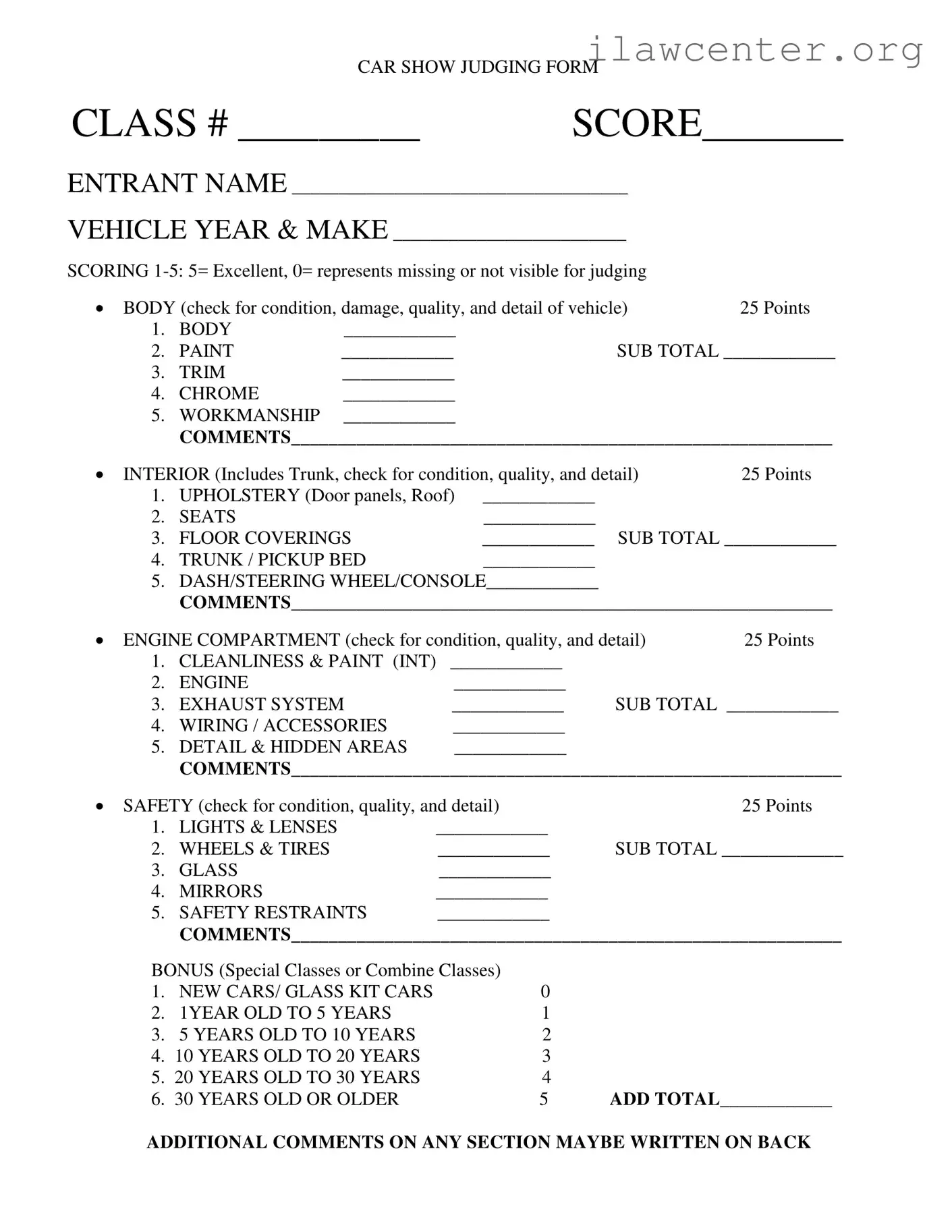
CAR SHOW JUDGING FORM
CLASS # _________ SCORE_______
ENTRANT NAME ____________________________________
VEHICLE YEAR & MAKE _________________________
SCORING 1-5: 5= Excellent, 0= represents missing or not visible for judging
BODY (check for condition, damage, quality, and detail of vehicle) 25 Points
1. BODY ____________
2. PAINT ____________ SUB TOTAL ____________
3. TRIM ____________
4. CHROME ____________
5. WORKMANSHIP ____________
COMMENTS__________________________________________________________
INTERIOR (Includes Trunk, check for condition, quality, and detail) 25 Points
1. UPHOLSTERY (Door panels, Roof) ____________
2. SEATS ____________
3. FLOOR COVERINGS ____________ SUB TOTAL ____________
4. TRUNK / PICKUP BED ____________
5. DASH/STEERING WHEEL/CONSOLE____________
COMMENTS__________________________________________________________
ENGINE COMPARTMENT (check for condition, quality, and detail) 25 Points
1. CLEANLINESS & PAINT (INT) ____________
2. ENGINE ____________
3. EXHAUST SYSTEM ____________ SUB TOTAL ____________
4. WIRING / ACCESSORIES ____________
5. DETAIL & HIDDEN AREAS ____________
COMMENTS___________________________________________________________
SAFETY (check for condition, quality, and detail) 25 Points
1. LIGHTS & LENSES ____________
2. WHEELS & TIRES ____________ SUB TOTAL _____________
3. GLASS ____________
4. MIRRORS ____________
5. SAFETY RESTRAINTS ____________
COMMENTS___________________________________________________________
BONUS (Special Classes or Combine Classes)
1. NEW CARS/ GLASS KIT CARS 0
2. 1YEAR OLD TO 5 YEARS 1
3. 5 YEARS OLD TO 10 YEARS 2
4. 10 YEARS OLD TO 20 YEARS 3
5. 20 YEARS OLD TO 30 YEARS 4
6. 30 YEARS OLD OR OLDER 5 ADD TOTAL____________
ADDITIONAL COMMENTS ON ANY SECTION MAYBE WRITTEN ON BACK

File Properties

Fact Name Description
Class Number The judging form requires a designated class number to categorize the vehicle being judged.
Scoring System Judges score each section on a scale from 0 to 5, with 5 being excellent and 0 indicating something is missing or not visible.
Point Distribution Each major section (Body, Interior, Engine Compartment, Safety) is worth 25 points, allowing for a maximum score of 100.
Bonus Points Additional points can be awarded based on the age of the vehicle, with categories ranging from new cars to those 30 years or older.
Comments Section Judges can provide comments for each section, helping to clarify scores or give feedback on specific areas.
Governing Law State-specific forms may be governed by local vehicle show regulations, which can vary by state.

Instructions on Utilizing Car Show Judging

Completing the Car Show Judging form requires careful attention to detail. Each section of the form evaluates specific aspects of the vehicle, contributing to the overall score. The following steps will guide you through the process of filling out the form accurately.

  1. Write the CLASS # in the designated space.
  2. Enter the SCORE for the vehicle, ranging from 0 to 5.
  3. Fill in the ENTRANT NAME of the vehicle owner.
  4. Specify the VEHICLE YEAR & MAKE.
  5. For the BODY section, assess the following:
    • Rate the BODY condition.
    • Rate the PAINT quality.
    • Rate the TRIM.
    • Rate the CHROME.
    • Rate the WORKMANSHIP.
  6. Calculate the SUB TOTAL for the BODY section and write it down.
  7. Provide COMMENTS regarding the BODY section.
  8. For the INTERIOR section, evaluate the following:
    • Rate the UPHOLSTERY.
    • Rate the SEATS.
    • Rate the FLOOR COVERINGS.
    • Rate the TRUNK / PICKUP BED.
    • Rate the DASH/STEERING WHEEL/CONSOLE.
  9. Calculate the SUB TOTAL for the INTERIOR section and write it down.
  10. Provide COMMENTS regarding the INTERIOR section.
  11. For the ENGINE COMPARTMENT section, assess the following:
    • Rate the CLEANLINESS & PAINT (INT).
    • Rate the ENGINE.
    • Rate the EXHAUST SYSTEM.
    • Rate the WIRING / ACCESSORIES.
    • Rate the DETAIL & HIDDEN AREAS.
  12. Calculate the SUB TOTAL for the ENGINE COMPARTMENT section and write it down.
  13. Provide COMMENTS regarding the ENGINE COMPARTMENT section.
  14. For the SAFETY section, evaluate the following:
    • Rate the LIGHTS & LENSES.
    • Rate the WHEELS & TIRES.
    • Calculate the SUB TOTAL for the SAFETY section and write it down.
    • Rate the GLASS.
    • Rate the MIRRORS.
    • Rate the SAFETY RESTRAINTS.
  15. Provide COMMENTS regarding the SAFETY section.
  16. For the BONUS section, select the appropriate category and assign points:
    • New Cars/Glass Kit Cars: 0 points
    • 1 Year Old to 5 Years: 1 point
    • 5 Years Old to 10 Years: 2 points
    • 10 Years Old to 20 Years: 3 points
    • 20 Years Old to 30 Years: 4 points
    • 30 Years Old or Older: 5 points
  17. Add the total points from all sections and write it down.
  18. Include any ADDITIONAL COMMENTS on the back of the form if necessary.

Important Facts about Car Show Judging

What is the purpose of the Car Show Judging Form?

The Car Show Judging Form is designed to evaluate the overall quality and condition of vehicles entered in the show. It provides a structured way for judges to assess various aspects of each car, including body, interior, engine compartment, and safety features. Each section has specific criteria that help ensure a fair and consistent judging process.

How is the scoring system structured?

The scoring system uses a scale from 0 to 5, where 5 indicates excellent condition and 0 signifies that an element is missing or not visible for judging. Each major category—Body, Interior, Engine Compartment, and Safety—has a maximum score of 25 points, allowing for a total score of up to 100 points, plus any bonus points for special classes.

What categories are included in the judging process?

The judging process includes four main categories: Body, Interior, Engine Compartment, and Safety. Each category is broken down into specific elements that judges will assess. Additionally, there is a bonus section for special or combined classes that can add extra points to the total score.

Can judges provide comments on the judging form?

Yes, judges are encouraged to provide comments in the designated sections of the form. This feedback can offer insights into the strengths and weaknesses of each vehicle. Additionally, judges may write any additional comments on the back of the form for further clarification or detail.

What should be considered when judging the body of a vehicle?

When judging the body, factors such as condition, damage, quality, and detail are critical. Judges should look for signs of rust, dents, or other imperfections. The overall finish and craftsmanship of the bodywork also play a significant role in scoring.

How are bonus points awarded?

Bonus points are awarded based on the age and classification of the vehicle. For example, new cars or glass kit cars receive no bonus points, while cars that are 30 years old or older can earn up to 5 bonus points. This system recognizes the value of vintage and classic vehicles.

What should judges assess in the engine compartment?

Judges should evaluate the cleanliness and paint condition of the engine compartment, as well as the overall condition of the engine, exhaust system, wiring, and any hidden areas. Attention to detail in this section can significantly impact the overall score.

Is there a specific format for filling out the form?

Yes, the form requires judges to fill in specific scores for each category and subcategory, along with comments where applicable. Judges should ensure that all sections are completed accurately to reflect their assessments and provide a comprehensive evaluation of each vehicle.

Common mistakes

When filling out the Car Show Judging form, many entrants make common mistakes that can affect their scores. One frequent error is neglecting to provide complete information in the Entrant Name and Vehicle Year & Make sections. Incomplete or illegible entries can lead to confusion and may result in lower scores. Judges need clear information to accurately assess the vehicle, and missing details can hinder the judging process.

Another mistake involves not accurately reflecting the vehicle's condition in the scoring sections. For instance, when evaluating the Body, Interior, or Engine Compartment, some entrants may score themselves too high or too low. This inconsistency can skew the overall assessment. It is crucial to be honest and objective when assigning scores, as this ensures a fair evaluation based on the vehicle's true condition.

Many entrants also overlook the importance of providing comments in the designated areas. Comments offer judges additional context and insights into the vehicle's features and any unique aspects worth noting. Without these comments, judges may miss important details that could positively influence their scores. Therefore, taking the time to include thoughtful remarks can enhance the judging experience.

Another common error is failing to check for visible damage or missing components. For example, in the Safety section, an entrant might forget to inspect Lights & Lenses or Wheels & Tires thoroughly. Judges will notice these oversights, and they can significantly impact the final score. A comprehensive inspection before submitting the form can help avoid this pitfall.

Some participants mistakenly skip the Bonus section altogether. This section allows for additional points based on the vehicle's age and category. Ignoring this part of the form means missing out on potential points that could elevate the overall score. It is essential to review the bonus criteria and ensure it is filled out accurately to maximize scoring potential.

Lastly, many entrants forget to total their scores accurately. Each section of the form has a subtotal, and these subtotals must be added together to arrive at the final score. Errors in addition can lead to discrepancies that confuse judges and affect the outcome. Double-checking the final score ensures that the judging process runs smoothly and fairly.

Documents used along the form

The Car Show Judging form is a critical document used during automotive events to assess and score vehicles based on various criteria. However, several other forms and documents complement this judging process, enhancing organization and communication among participants, judges, and event organizers. Below is a list of these essential documents.

  • Entrant Registration Form: This document collects vital information from participants, including their name, contact details, vehicle information, and class entries. It ensures that all entrants are officially registered for the event.
  • Judges' Score Sheet: This form allows judges to record their scores for each vehicle in a systematic manner. It typically includes sections for comments and overall impressions, helping to maintain consistency in judging.
  • Event Schedule: This document outlines the timing of the event, including registration, judging, and award presentations. It helps both participants and judges stay informed about the day's activities.
  • Participant Guidelines: This set of instructions provides entrants with essential information about the judging criteria, event rules, and expectations. Clear guidelines help ensure a fair competition.
  • Safety Waiver: Participants may be required to sign this document, acknowledging potential risks associated with the event. It protects organizers from liability while ensuring that entrants are aware of safety protocols.
  • Awards Presentation Form: This form lists the categories and awards to be presented at the end of the event. It helps organizers manage the distribution of trophies and certificates effectively.
  • Feedback Form: After the event, this document allows participants and judges to provide feedback on their experiences. This information can be invaluable for improving future car shows.

Each of these documents plays a vital role in the overall success of a car show, facilitating smooth operations and enhancing the experience for all involved. By utilizing these forms, event organizers can create a structured and enjoyable environment for participants and spectators alike.

Similar forms

  • Event Scoring Sheet: Similar to the Car Show Judging form, an event scoring sheet is used to evaluate participants based on specific criteria. Each section typically includes a scoring range, allowing judges to provide detailed feedback on performance or quality.

  • Competition Evaluation Form: This document assesses competitors in various categories. Like the Car Show Judging form, it features sections for different aspects of performance, with points assigned to each criterion, ensuring a comprehensive evaluation.

  • Performance Review Template: A performance review template evaluates employees or team members. It shares similarities with the judging form in that it includes specific categories for assessment, allowing for detailed comments and scores based on various performance metrics.

  • Quality Control Checklist: This checklist is used in manufacturing or service industries to ensure products or services meet certain standards. It resembles the Car Show Judging form by providing a structured way to assess different components, with points assigned for quality and condition.

Dos and Don'ts

When filling out the Car Show Judging form, attention to detail is crucial. Here are some guidelines to help you complete the form effectively.

  • Do double-check all information for accuracy before submitting.
  • Do use clear and legible handwriting to ensure readability.
  • Do provide detailed comments for each section to support your scores.
  • Do follow the scoring system closely to ensure fair judgment.
  • Don't leave any sections blank; every part is important for evaluation.
  • Don't rush through the form; take your time to assess each vehicle thoroughly.

By adhering to these tips, you can help ensure a smooth judging process. Your careful attention will contribute to the overall success of the car show.

Misconceptions

Misconceptions about the Car Show Judging Form can lead to confusion for both entrants and judges. Here are nine common misconceptions clarified:

  • All categories are equally weighted. Many believe that each section of the judging form holds the same importance. In reality, each category is worth 25 points, but the criteria within each category can differ significantly in impact.
  • Judging is purely subjective. While personal preferences can play a role, judges follow a standardized scoring system. This ensures that evaluations are based on specific criteria rather than personal taste.
  • Comments are optional. Some think that judges can skip comments if they score high. However, detailed feedback is essential for entrants to understand their strengths and areas for improvement.
  • Only the exterior matters. A common belief is that the body and paint are the only factors in scoring. In truth, the interior, engine compartment, and safety features also significantly influence the overall score.
  • Bonus points are automatic. Many entrants assume they will receive bonus points just for participating in special classes. Bonus points are awarded based on specific criteria outlined in the form.
  • Entrants should only focus on high scores. Some participants think that aiming for the highest score in every category is the only goal. However, improvement and learning from feedback are equally important.
  • Judges have unlimited time to evaluate. It’s a misconception that judges can take as long as they want to assess vehicles. Judging is often time-constrained, which means evaluations must be efficient and focused.
  • All judges have the same experience. Not every judge has the same level of expertise or background. Variability in experience can lead to different perspectives on what constitutes excellence in a vehicle.
  • Judging is done in isolation. Some believe judges work alone without any collaboration. In many shows, judges discuss their evaluations to ensure a fair and balanced assessment.

Understanding these misconceptions can enhance the experience for both entrants and judges, leading to a more enjoyable and fair competition.

Key takeaways

When it comes to the Car Show Judging form, understanding its components is essential for effective evaluation. Here are some key takeaways that will help you navigate the form with confidence:

  • Class and Score: Begin by clearly filling in the class number and score at the top of the form. This provides a quick reference for judges and ensures accurate record-keeping.
  • Entrant Information: Include the entrant's name and the vehicle's year and make. This information is crucial for identifying the vehicle being judged.
  • Scoring System: Familiarize yourself with the scoring scale of 1 to 5, where 5 signifies excellence and 0 indicates something is missing or not visible. This scale applies to various categories.
  • Body Evaluation: Assess the body of the vehicle by checking its condition, damage, quality, and detail. This section carries a maximum of 25 points, with specific criteria listed for scoring.
  • Interior Assessment: The interior section also holds a maximum of 25 points. Pay attention to upholstery, seats, floor coverings, trunk or pickup bed, and the dashboard area.
  • Engine Compartment Review: Evaluate the engine compartment for cleanliness, paint condition, and overall detail. This section is equally weighted, with 25 points available.
  • Safety Checks: Safety is paramount. The safety section, which includes lights, lenses, wheels, tires, glass, mirrors, and safety restraints, also totals 25 points.
  • Bonus Points: Be aware of the bonus scoring system for special classes or combined classes. Vehicles are awarded additional points based on their age, ranging from new cars to those 30 years or older.
  • Comments Section: Utilize the comments sections throughout the form to provide specific feedback on each category. Additional comments can be noted on the back of the form if needed.

By keeping these points in mind, judges can ensure a fair and thorough evaluation process, enhancing the overall experience for both entrants and spectators alike.