Carta Poder PDF Template

Carta Poder PDF Template

The Carta Poder is a legal document that grants someone the authority to act on your behalf in various matters, particularly in legal proceedings. This form allows the designated person to represent you, manage your affairs, and make decisions in your absence. If you need to fill out a Carta Poder, click the button below to get started.

Article Guide

The Carta Poder form serves as a crucial legal instrument that empowers an individual to act on behalf of another in various legal matters. This document is often used in situations where the principal cannot be present to handle their affairs, allowing a designated representative to manage legal proceedings, respond to demands, and take necessary actions in their absence. It grants extensive authority, enabling the representative to engage in a wide range of activities, including contesting claims, presenting evidence, and even appealing decisions. The form outlines specific powers, such as the ability to recognize signatures, challenge opposing documents, and appoint witnesses. Furthermore, it allows the representative to execute legal actions like property seizures and the sale of assets. By signing the Carta Poder, the principal entrusts their representative with significant responsibilities, ensuring that their rights and interests are safeguarded in legal contexts. This document is not just a formality; it is a vital tool that can make a difference in the outcome of legal proceedings.

Carta Poder Preview

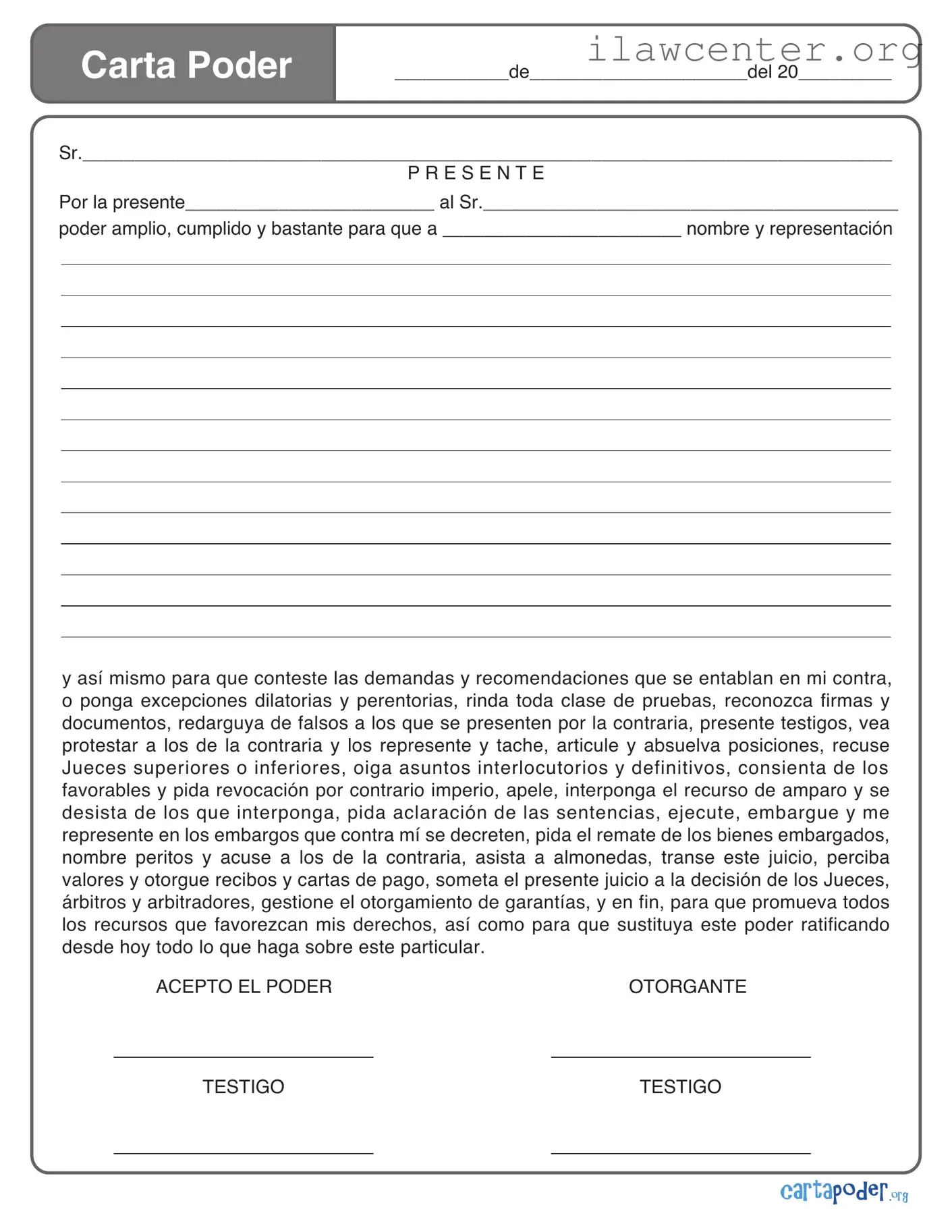
Carta Poder ___________de_____________________del 20_________
Sr.______________________________________________________________________________
P R E S E N T E
Por la presente________________________ al Sr.________________________________________
poder amplio, cumplido y bastante para que a _______________________ nombre y representación
y así mismo para que conteste las demandas y recomendaciones que se entablan en mi contra,
o ponga excepciones dilatorias y perentorias, rinda toda clase de pruebas, reconozca firmas y
documentos, redarguya de falsos a los que se presenten por la contraria, presente testigos, vea
protestar a los de la contraria y los represente y tache, articule y absuelva posiciones, recuse
Jueces superiores o inferiores, oiga asuntos interlocutorios y definitivos, consienta de los
favorables y pida revocación por contrario imperio, apele, interponga el recurso de amparo y se
desista de los que interponga, pida aclaración de las sentencias, ejecute, embargue y me
represente en los embargos que contra mí se decreten, pida el remate de los bienes embargados,
nombre peritos y acuse a los de la contraria, asista a almonedas, transe este juicio, perciba
valores y otorgue recibos y cartas de pago, someta el presente juicio a la decisión de los Jueces,
árbitros y arbitradores, gestione el otorgamiento de garantías, y en fin, para que promueva todos
los recursos que favorezcan mis derechos, así como para que sustituya este poder ratificando
desde hoy todo lo que haga sobre este particular.
ACEPTO EL PODER
TESTIGO TESTIGO
OTORGANTE

File Properties

Fact Name Description
Definition The Carta Poder is a legal document that grants authority to an individual to act on behalf of another person in legal matters.
Usage This form is commonly used in various legal contexts, including representation in court and handling financial transactions.
State-Specific Law In Texas, the Carta Poder is governed by the Texas Civil Practice and Remedies Code, specifically Section 121.002.
Requirements The document must be signed by the person granting the power and may require notarization to be legally binding.

Instructions on Utilizing Carta Poder

Completing the Carta Poder form is an important step in granting someone the authority to act on your behalf in legal matters. This form allows you to specify the powers you wish to delegate to another person. Follow the steps below to ensure that the form is filled out correctly.

  1. Begin by writing the date at the top of the form. Use the format: day/month/year.
  2. In the first blank space, enter your full name. This is the name of the person granting the power.
  3. In the second blank space, write the name of the person you are granting power to. This individual will act on your behalf.
  4. In the next blank, specify the purpose of the power being granted. This could include a general statement or specific actions you want them to take.
  5. Continue filling in the form by listing the specific powers you wish to grant. This may include the ability to respond to legal demands, present evidence, and represent you in court.
  6. At the bottom of the form, sign your name to indicate acceptance of the power. Make sure to include the date next to your signature.
  7. Two witnesses must sign the form as well. Their names should be printed clearly next to their signatures.

After completing the form, ensure that all signatures are legible and that the document is stored safely. You may want to provide a copy to the person you have authorized, as well as keep one for your records.

Important Facts about Carta Poder

What is a Carta Poder form?

The Carta Poder form is a legal document used in various Spanish-speaking countries, granting someone the authority to act on behalf of another person. This form is often utilized in legal matters, allowing the designated individual to represent the grantor in court or other legal proceedings. It outlines the specific powers granted, which can include filing documents, responding to legal actions, and managing financial transactions.

Who can be designated in a Carta Poder?

In a Carta Poder, the person designated to act on behalf of the grantor is typically referred to as the "attorney-in-fact" or representative. This individual can be a family member, friend, or legal professional. It is crucial that the person chosen is trustworthy and capable of handling the responsibilities outlined in the document, as they will have significant authority over the grantor's legal matters.

What powers are granted through a Carta Poder?

The Carta Poder can grant a wide range of powers to the designated representative. These powers may include responding to legal claims, presenting evidence, managing financial transactions, and making decisions related to the grantor's legal rights. The document can be tailored to specify the exact powers being granted, ensuring that the representative acts within the desired scope.

Is a Carta Poder form legally binding?

Yes, a properly executed Carta Poder form is legally binding. For the document to be valid, it typically requires the signatures of both the grantor and the designated representative, along with witnesses. Depending on the jurisdiction, notarization may also be necessary to enhance its legal standing. It is important to follow all legal requirements to ensure the document is enforceable.

Can a Carta Poder be revoked?

Yes, a Carta Poder can be revoked at any time by the grantor, as long as they are of sound mind and able to make decisions. To revoke the power, the grantor should provide written notice to the designated representative and any relevant parties. It is advisable to formally document the revocation to avoid any confusion or disputes regarding the authority of the representative.

Common mistakes

Filling out the Carta Poder form can be straightforward, but many people make mistakes that can lead to complications. One common error is leaving out essential information. The form requires specific details such as names, dates, and locations. Omitting any of these can render the document invalid.

Another frequent mistake is failing to sign the form properly. The signatures of both the grantor and the witnesses are crucial. Without these signatures, the power of attorney cannot be enforced. Double-checking that all required signatures are present can save time and prevent issues later.

Some individuals do not specify the powers being granted clearly. The Carta Poder allows for a wide range of actions, but it is vital to outline exactly what the representative can and cannot do. Vague language can lead to misunderstandings and misuse of the power granted.

People often overlook the importance of including the correct names of the parties involved. The grantor and the representative must be identified accurately. Any misspelling or incorrect name can lead to legal challenges and complications in executing the powers granted.

Another mistake is neglecting to date the document. The date is essential for establishing when the power takes effect. Without a date, it may be unclear if the document is valid, especially if disputes arise later.

Some individuals do not consider the need for witnesses. Depending on state laws, having witnesses may be a requirement for the Carta Poder to be valid. Failing to include witnesses can result in the document being challenged or deemed invalid.

Additionally, individuals may forget to provide clear instructions for revocation. If the grantor wishes to revoke the power at any point, the process should be outlined in the document. This oversight can create confusion and potential legal issues in the future.

People sometimes use outdated forms or templates. Laws and requirements can change, so it is crucial to ensure that the most current version of the Carta Poder is being used. Using an outdated form can lead to compliance issues.

Finally, individuals may not seek legal advice when necessary. While filling out the form may seem simple, consulting with a legal professional can provide clarity and ensure that all aspects are correctly addressed. Taking this step can help avoid costly mistakes down the line.

Documents used along the form

The Carta Poder form is a legal document that grants someone the authority to act on behalf of another person in various matters. In addition to the Carta Poder, several other forms and documents are commonly used in conjunction with it. Understanding these documents can help clarify the powers being granted and ensure that all legal processes are followed correctly.

  • Power of Attorney (POA): This is a broader legal document that allows one person to act on another's behalf in legal and financial matters. Unlike the Carta Poder, which may be limited to specific actions, a POA can be comprehensive and cover a wide range of responsibilities.
  • Affidavit: An affidavit is a written statement confirmed by oath or affirmation, used as evidence in court. It may accompany the Carta Poder to provide additional verification of facts or intentions related to the powers being granted.
  • Notice of Representation: This document informs relevant parties that someone has been authorized to act on behalf of another individual. It is often used in legal proceedings to ensure all parties are aware of the representation.
  • Revocation of Power of Attorney: If the person granting the power wishes to withdraw the authority given, this document formally cancels the previous power granted. It ensures that the individual’s rights are protected and that the representative can no longer act on their behalf.

These documents work together to establish a clear framework for representation and authority. Each serves a specific purpose and can help ensure that the rights and responsibilities of all parties involved are respected and understood.

Similar forms

The Carta Poder form is a legal document that grants authority to another person to act on your behalf. Several other documents serve similar purposes. Here’s a list of seven documents that share similarities with the Carta Poder:

  • Power of Attorney (POA): This document allows someone to make decisions for you, particularly in financial or legal matters. Like the Carta Poder, it can be broad or limited in scope.
  • Durable Power of Attorney: This version remains effective even if you become incapacitated. It offers a similar level of authority as the Carta Poder, ensuring your wishes are followed.
  • Healthcare Proxy: This document designates someone to make medical decisions on your behalf. It parallels the Carta Poder in that it grants authority to act in specific situations.
  • Living Will: A living will outlines your wishes regarding medical treatment. While it doesn’t grant power to another, it complements the healthcare proxy, much like the Carta Poder complements other legal documents.
  • Representation Agreement: This document allows someone to represent you in various matters, similar to the Carta Poder. It can be tailored to specific needs and situations.
  • Financial Power of Attorney: This specifically focuses on financial decisions. It functions like the Carta Poder but is solely dedicated to managing financial affairs.
  • Trust Agreement: A trust can appoint a trustee to manage assets on your behalf. While broader in scope, it serves a similar purpose by allowing someone to act in your best interest.

Each of these documents provides a way to delegate authority, ensuring that your interests are represented even when you cannot act personally.

Dos and Don'ts

When filling out the Carta Poder form, it's essential to approach the process with care. Here’s a list of things you should and shouldn't do to ensure everything is completed correctly.

  • Do read the entire form carefully before starting to fill it out.
  • Do ensure that all names and dates are accurate and clearly written.
  • Do provide complete information about the parties involved.
  • Do sign the document in the designated area once it’s filled out.
  • Do have witnesses sign the form as required.
  • Don't leave any sections blank; fill in all necessary information.
  • Don't use abbreviations or nicknames for names; use full legal names.
  • Don't rush through the process; take your time to avoid mistakes.
  • Don't forget to keep a copy of the completed form for your records.
  • Don't alter the document after it has been signed by the parties involved.

By following these guidelines, you can help ensure that your Carta Poder form is filled out properly and serves its intended purpose. Taking the time to do it right can save you from potential issues down the road.

Misconceptions

Here are eight common misconceptions about the Carta Poder form, along with clarifications for each:

  • It is only used in Mexico. Many believe the Carta Poder is exclusive to Mexico, but it can also be utilized in various Latin American countries and among Spanish-speaking communities in the U.S.
  • It grants unlimited power. Some think that this document gives the representative unrestricted authority. In reality, the powers granted can be specified and limited according to the wishes of the person giving the power.
  • It is only for legal matters. While often associated with legal representation, a Carta Poder can also be used for financial transactions, property management, and other personal matters.
  • It must be notarized to be valid. Although notarization can add an extra layer of legitimacy, many jurisdictions allow for a Carta Poder to be valid without it, provided it meets certain criteria.
  • It is a permanent document. Some people assume that once a Carta Poder is issued, it cannot be revoked. However, the individual who grants the power can revoke it at any time, as long as they are of sound mind.
  • Only lawyers can be appointed. A common belief is that only licensed attorneys can act under a Carta Poder. In fact, anyone can be designated as a representative, as long as they are trustworthy.
  • It is the same as a power of attorney. While a Carta Poder is a type of power of attorney, it is often more informal and may have different legal implications depending on the jurisdiction.
  • It cannot be used for multiple purposes. Many think that a Carta Poder is limited to a single transaction or issue. However, it can encompass a wide range of actions, as specified by the person granting the power.

Key takeaways

When filling out and using the Carta Poder form, consider the following key takeaways:

  • Identify the Parties: Clearly state the names and details of both the person granting the power and the person receiving it.
  • Specify the Date: Include the exact date when the power of attorney is being granted.
  • Define the Scope: Outline the specific powers being granted to the attorney-in-fact. This can include legal representation and the ability to manage various legal matters.
  • Witness Signatures: Ensure that the document is signed by witnesses to validate the power of attorney.
  • Limitations: Be aware of any limitations that may apply to the powers granted. Not all powers may be appropriate for every situation.
  • Revocation: Understand that the Carta Poder can be revoked at any time, as long as the grantor provides proper notice.
  • Legal Compliance: Confirm that the form complies with local laws and regulations to ensure its enforceability.
  • Record Keeping: Keep a copy of the signed Carta Poder for your records, as it may be needed in the future.
  • Consultation: Consider consulting with a legal professional if there are any uncertainties about the powers being granted.