Cash Drawer Count Sheet PDF Template

Cash Drawer Count Sheet PDF Template

The Cash Drawer Count Sheet is a vital tool used by businesses to accurately track the cash in their drawers at the end of each shift. This form helps ensure that the cash on hand matches sales records, preventing discrepancies and potential losses. To maintain financial integrity, consider filling out the form by clicking the button below.

Article Guide

The Cash Drawer Count Sheet form plays a crucial role in maintaining accurate financial records for businesses that handle cash transactions. This form serves as a systematic tool for counting and documenting the cash present in a drawer at the beginning and end of a shift or business day. Typically, it includes sections for recording the date, the name of the employee responsible for the cash drawer, and the total amount of cash counted. Additionally, it provides space for detailing various denominations, such as bills and coins, which ensures clarity and precision in financial reporting. The use of this form not only aids in identifying discrepancies between the cash on hand and sales records but also promotes accountability among employees. By consistently utilizing the Cash Drawer Count Sheet, businesses can enhance their cash management practices, reduce the risk of theft or error, and maintain a transparent financial environment.

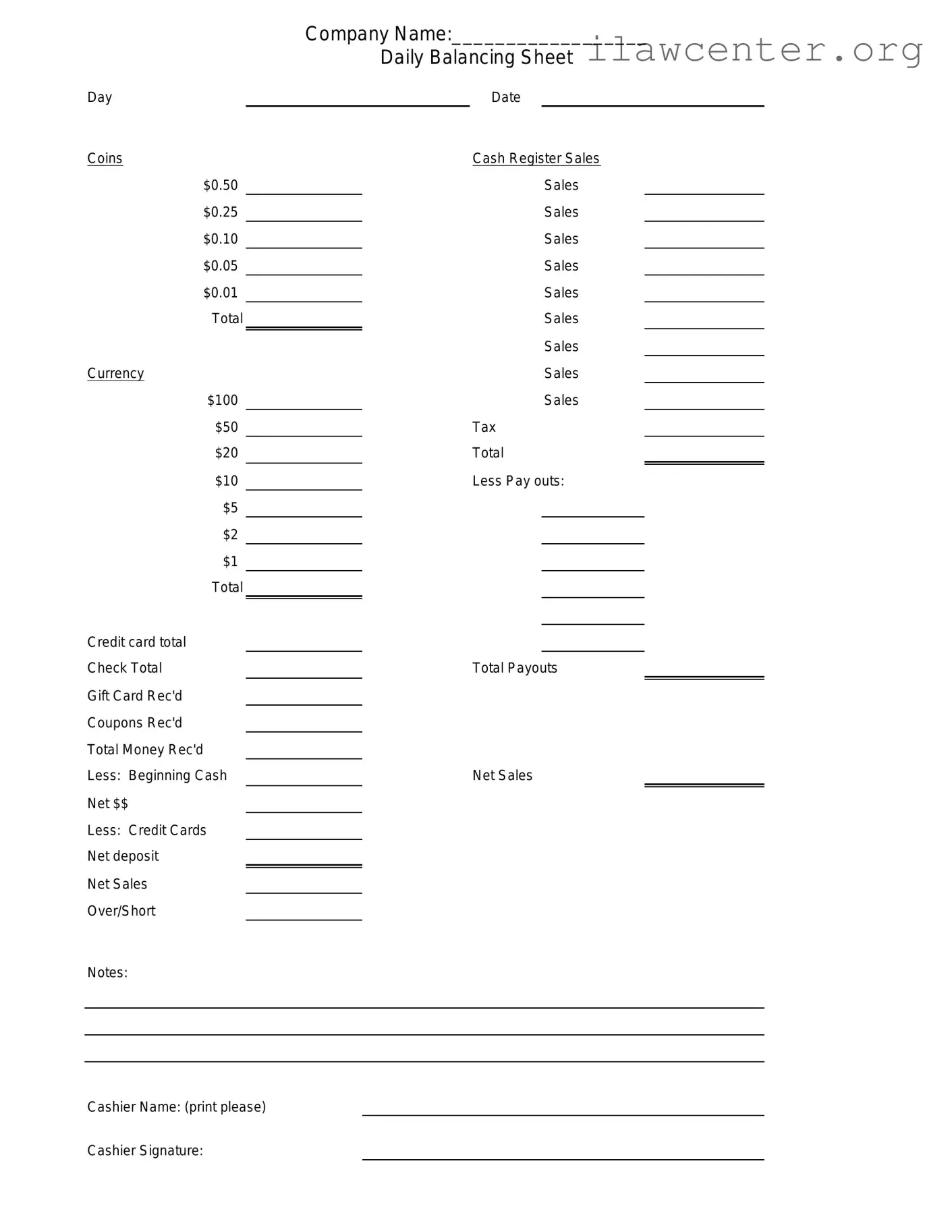
Cash Drawer Count Sheet Preview

Company Name:__________________
Daily Balancing Sheet
Day Date
Coins Cash Register Sales
$0.50 Sales
$0.25 Sales
$0.10 Sales
$0.05 Sales
$0.01 Sales
Total Sales
Sales
Currency Sales
$100 Sales
$50 Tax
$20 Total
$10 Less Pay outs:
$5
$2
$1
Total
Credit card total
Check Total Total Payouts
Gift Card Rec'd
Coupons Rec'd
Total Money Rec'd
Less: Beginning Cash Net Sales
Net $$
Less: Credit Cards
Net deposit
Net Sales
Over/Short
Notes:
Cashier Name: (print please)
Cashier Signature:

File Properties

Fact Name Description
Purpose The Cash Drawer Count Sheet is used to record the cash and other forms of payment in a cash drawer at the end of a shift or business day.
Importance This form helps in ensuring accurate financial reporting and can assist in identifying discrepancies in cash handling.
Components Typically, the form includes sections for listing cash denominations, checks, credit card receipts, and total amounts.
Frequency of Use It is commonly used daily or at the end of each shift, depending on the business’s cash handling policies.
Record Keeping Businesses should retain completed Cash Drawer Count Sheets for auditing purposes and financial records.
Governing Laws In some states, cash handling procedures are regulated by state financial laws and business operation regulations.
Training Employees handling cash should be trained on how to accurately complete the Cash Drawer Count Sheet to minimize errors.
Discrepancy Resolution In cases of discrepancies, the form provides a basis for investigating and resolving cash handling issues.
Digital Alternatives Many businesses now use digital cash management systems that can automate the counting and reporting process.
Compliance Completing the Cash Drawer Count Sheet accurately is essential for compliance with financial regulations and internal policies.

Instructions on Utilizing Cash Drawer Count Sheet

After gathering all necessary cash drawer information, you are ready to fill out the Cash Drawer Count Sheet form. This form will help you accurately record the cash amounts and ensure everything balances correctly.

  1. Begin by entering the date at the top of the form. Use the format MM/DD/YYYY for clarity.
  2. Write down your name or the name of the person responsible for the cash drawer.
  3. In the designated section, list all denominations of cash present in the drawer. This typically includes $1, $5, $10, $20, $50, and $100 bills.
  4. Next to each denomination, write the number of bills counted. Be sure to double-check your counts for accuracy.
  5. Calculate the total amount for each denomination by multiplying the number of bills by the bill value. Write these totals in the appropriate column.
  6. Add all the totals together to find the overall cash total. Write this amount in the designated area for the grand total.
  7. If applicable, note any discrepancies or issues in the comments section. This could include shortages or overages.
  8. Finally, sign and date the form to confirm that the count has been completed and is accurate.

Important Facts about Cash Drawer Count Sheet

What is a Cash Drawer Count Sheet?

A Cash Drawer Count Sheet is a document used by businesses to track the amount of cash in a cash drawer at the end of a shift or business day. It helps ensure accountability and accuracy in cash handling, providing a clear record for reconciliation purposes.

Why is it important to use a Cash Drawer Count Sheet?

Using a Cash Drawer Count Sheet is crucial for maintaining financial integrity. It helps identify discrepancies between the expected cash amount and the actual cash on hand. This practice can prevent theft, errors, and mismanagement of funds, ultimately safeguarding the business's financial health.

How do I fill out a Cash Drawer Count Sheet?

To fill out a Cash Drawer Count Sheet, start by entering the date and the name of the person responsible for the count. Then, list all denominations of cash present in the drawer, including bills and coins. Finally, total the amounts to arrive at the final cash count, ensuring it matches the expected amount.

Who should complete the Cash Drawer Count Sheet?

Typically, the person who is responsible for the cash drawer at the end of their shift should complete the Cash Drawer Count Sheet. This could be a cashier, manager, or any employee tasked with cash handling. It is vital that this person is trustworthy and trained in cash management procedures.

What should I do if there is a discrepancy in the cash count?

If a discrepancy arises, it is important to investigate immediately. Review the transactions that occurred during the shift and check for any errors in counting or recording. If theft is suspected, follow your company's protocol for reporting and handling the situation. Document the findings on the Cash Drawer Count Sheet for future reference.

How often should I use the Cash Drawer Count Sheet?

Ideally, the Cash Drawer Count Sheet should be used at the end of every shift or business day. Regular counts help maintain accurate records and allow for timely detection of any discrepancies. Some businesses may also choose to conduct random counts throughout the day to ensure ongoing accuracy.

Can I use a digital version of the Cash Drawer Count Sheet?

Yes, many businesses now opt for digital versions of the Cash Drawer Count Sheet. Digital tools can streamline the counting process, reduce errors, and allow for easier data storage and retrieval. However, it is essential to ensure that the digital version meets all necessary record-keeping requirements.

What are the benefits of maintaining accurate cash records?

Maintaining accurate cash records provides several benefits. It enhances financial accountability, helps in budgeting and forecasting, and improves overall cash flow management. Furthermore, it can protect against fraud and provide valuable insights into business performance over time.

Is there a specific format for a Cash Drawer Count Sheet?

While there is no universally mandated format, a Cash Drawer Count Sheet should include key elements such as the date, employee name, denominations of cash, total cash count, and space for notes on discrepancies or issues. Businesses may customize the format to suit their specific needs while ensuring all critical information is captured.

How can I ensure compliance with cash handling policies using the Cash Drawer Count Sheet?

To ensure compliance, establish clear cash handling policies and train employees on the importance of accurately completing the Cash Drawer Count Sheet. Regular audits and reviews of cash handling procedures can help reinforce compliance and identify areas for improvement.

Common mistakes

When filling out the Cash Drawer Count Sheet form, individuals often overlook important details, which can lead to inaccuracies. One common mistake is failing to record the starting balance accurately. This initial figure is crucial for tracking cash flow throughout the day. A simple miscalculation can cause discrepancies in the final count.

Another frequent error is neglecting to document all cash transactions. Every sale, return, and cash deposit should be noted. Omitting even one transaction can skew the final totals, leading to confusion and potential financial discrepancies.

Many people also forget to update the form regularly. It's essential to fill out the Cash Drawer Count Sheet throughout the day rather than waiting until the end of the shift. This practice helps maintain an accurate record of cash flow and makes it easier to identify any issues that arise.

In addition, some individuals fail to double-check their math. Simple addition or subtraction errors can occur, especially when working with multiple transactions. Taking a moment to verify calculations can prevent future problems and ensure accuracy.

Using inconsistent terminology is another mistake. For example, referring to cash as "currency" in one section and "cash" in another can create confusion. Consistency in language helps maintain clarity and understanding when reviewing the form.

People may also overlook the importance of signatures. Not signing the Cash Drawer Count Sheet can lead to accountability issues. A signature confirms that the count has been verified and accepted, which is crucial for financial records.

Another mistake is not using the correct date. Filling out the form with the wrong date can cause significant issues during audits or financial reviews. Always ensure the date reflects when the cash drawer was counted.

Some individuals fail to secure the form properly after completion. Leaving it in an unsecured location can lead to tampering or loss. Proper storage helps protect sensitive financial information.

Lastly, not training staff on how to complete the Cash Drawer Count Sheet correctly can lead to ongoing mistakes. Providing clear instructions and regular training ensures that everyone understands the importance of accuracy in financial documentation.

Documents used along the form

The Cash Drawer Count Sheet is an essential tool for tracking cash transactions in a business. However, several other forms and documents complement this sheet to ensure accurate financial management. Below is a list of commonly used documents that work in conjunction with the Cash Drawer Count Sheet.

  • Daily Sales Report: This document summarizes total sales for the day, including cash, credit, and other payment methods. It helps to reconcile cash drawer totals.
  • Cash Deposit Slip: Used when depositing cash into a bank, this slip records the amount being deposited and provides a receipt for the transaction.
  • Transaction Log: A detailed account of all transactions processed during a specific period. This log aids in tracking sales and identifying discrepancies.
  • Refund Request Form: This form documents customer requests for refunds. It includes details about the transaction and the reason for the refund.
  • Expense Report: Employees use this form to report business-related expenses. It helps in managing cash flow and tracking spending.
  • Bank Reconciliation Statement: This document compares cash records with bank statements to ensure accuracy and identify any discrepancies.
  • Cash Handling Policy: A guideline that outlines procedures for handling cash within the business. It helps to maintain security and accountability.
  • End-of-Day Report: A summary of daily operations, including cash counts, sales figures, and any discrepancies noted during the day.
  • Inventory Count Sheet: This form tracks the physical count of inventory items. It is essential for reconciling sales with inventory levels.

Each of these documents plays a crucial role in maintaining financial accuracy and accountability. Together, they help streamline cash management processes and support the overall financial health of the business.

Similar forms

The Cash Drawer Count Sheet form serves as an important tool in financial management, particularly in retail environments. Several other documents share similarities with this form in terms of purpose and functionality. Here are five such documents:

  • Daily Sales Report: This document summarizes the total sales for a specific day. Like the Cash Drawer Count Sheet, it provides a clear overview of cash flow and helps ensure accuracy in financial records.
  • Bank Deposit Slip: Used to record cash and checks being deposited into a bank account, this slip is similar in that it tracks cash movement. Both documents help maintain accountability and transparency in financial transactions.
  • Cash Reconciliation Report: This report compares the cash on hand with sales records. It serves a similar purpose to the Cash Drawer Count Sheet by identifying discrepancies and ensuring that cash balances are accurate.
  • Petty Cash Log: This log tracks small cash transactions made for business expenses. Like the Cash Drawer Count Sheet, it ensures that all cash movements are documented and accounted for.
  • Sales Receipt: This document records individual sales transactions. It is similar to the Cash Drawer Count Sheet in that both serve as proof of cash received and help maintain accurate financial records.

Dos and Don'ts

When filling out the Cash Drawer Count Sheet form, accuracy is essential. Here are five important dos and don'ts to keep in mind:

  • Do double-check your cash totals before submitting the form.
  • Do use clear and legible handwriting to avoid confusion.
  • Do ensure that all sections of the form are completed fully.
  • Don't leave any blank spaces on the form; fill in all required fields.
  • Don't rush through the process; take your time to ensure accuracy.

Misconceptions

The Cash Drawer Count Sheet form is an important tool for businesses that manage cash transactions. However, several misconceptions can lead to confusion about its purpose and use. Here are four common misconceptions:

  • It is only for large businesses. Many believe that only large retailers need a Cash Drawer Count Sheet. In reality, any business that handles cash can benefit from this form, regardless of size. It helps maintain accurate records and ensures accountability.
  • It is only necessary at the end of the day. Some people think the Cash Drawer Count Sheet is only useful for end-of-day cash counts. However, regular use throughout the day can help catch discrepancies early, making it easier to address any issues before they escalate.
  • It is too complicated to use. Many assume that the Cash Drawer Count Sheet is overly complex. In truth, it is designed to be straightforward. With clear sections for recording cash amounts, it can be filled out quickly and efficiently.
  • It is not important for tracking sales. Some might think that the Cash Drawer Count Sheet is unrelated to sales tracking. On the contrary, it provides valuable data that can help analyze sales trends and improve cash management practices.

Understanding these misconceptions can help businesses utilize the Cash Drawer Count Sheet effectively, leading to better financial management and operational efficiency.

Key takeaways

Filling out and utilizing the Cash Drawer Count Sheet form effectively can streamline cash management processes. Here are some key takeaways to consider:

  1. Accuracy is Essential: Always double-check your counts to ensure that the amounts recorded reflect the actual cash present.
  2. Use Clear Labels: Clearly label each section of the form to avoid confusion during the counting process.
  3. Document Every Transaction: Record every cash transaction throughout the day to maintain an accurate cash flow record.
  4. Regular Audits: Conduct regular audits using the Cash Drawer Count Sheet to identify discrepancies early on.
  5. Designate a Responsible Person: Assign a specific individual to manage and oversee the cash drawer counts for accountability.
  6. Include All Cash Types: Ensure the form accounts for all denominations, including coins and bills, for a comprehensive overview.
  7. Utilize for Training: Use the form as a training tool for new employees to familiarize them with cash handling procedures.
  8. Integrate with Software: If possible, integrate the Cash Drawer Count Sheet with your accounting software for seamless record-keeping.
  9. Review Regularly: Regularly review completed sheets to spot trends in cash flow or identify potential issues.
  10. Stay Consistent: Consistently use the same method for filling out the form to maintain uniformity in cash management practices.

By adhering to these principles, individuals and businesses can enhance their cash handling processes, leading to better financial management and reduced errors.