
Certification Of Incapacity PDF Template

Certification Of Incapacity PDF Template

The Certification of Incapacity form is a crucial document that verifies a patient's inability to make informed medical decisions due to their current health condition. This form requires the signatures of attending physicians who have assessed the patient, ensuring that the medical community recognizes the patient's limitations in understanding treatment options. If you need to fill out this important form, please click the button below.

Article Guide

The Certification of Incapacity form is a crucial document used in medical settings to determine a patient's ability to make informed decisions regarding their treatment. This form requires the signatures of two physicians, each of whom must examine the patient and provide their professional assessment of the patient's mental capacity. The first section of the form is completed by the attending physician, who must document their findings regarding the patient's incapacity to understand the nature and consequences of proposed medical treatments. This includes a detailed explanation of the patient's condition and the specific treatments in question. The second physician must also evaluate the patient and provide a similar certification, ensuring that both assessments are made within a two-hour timeframe. The form serves to protect patients who may be unable to communicate their wishes due to medical conditions, thus ensuring that their rights and well-being are prioritized in medical decision-making processes.

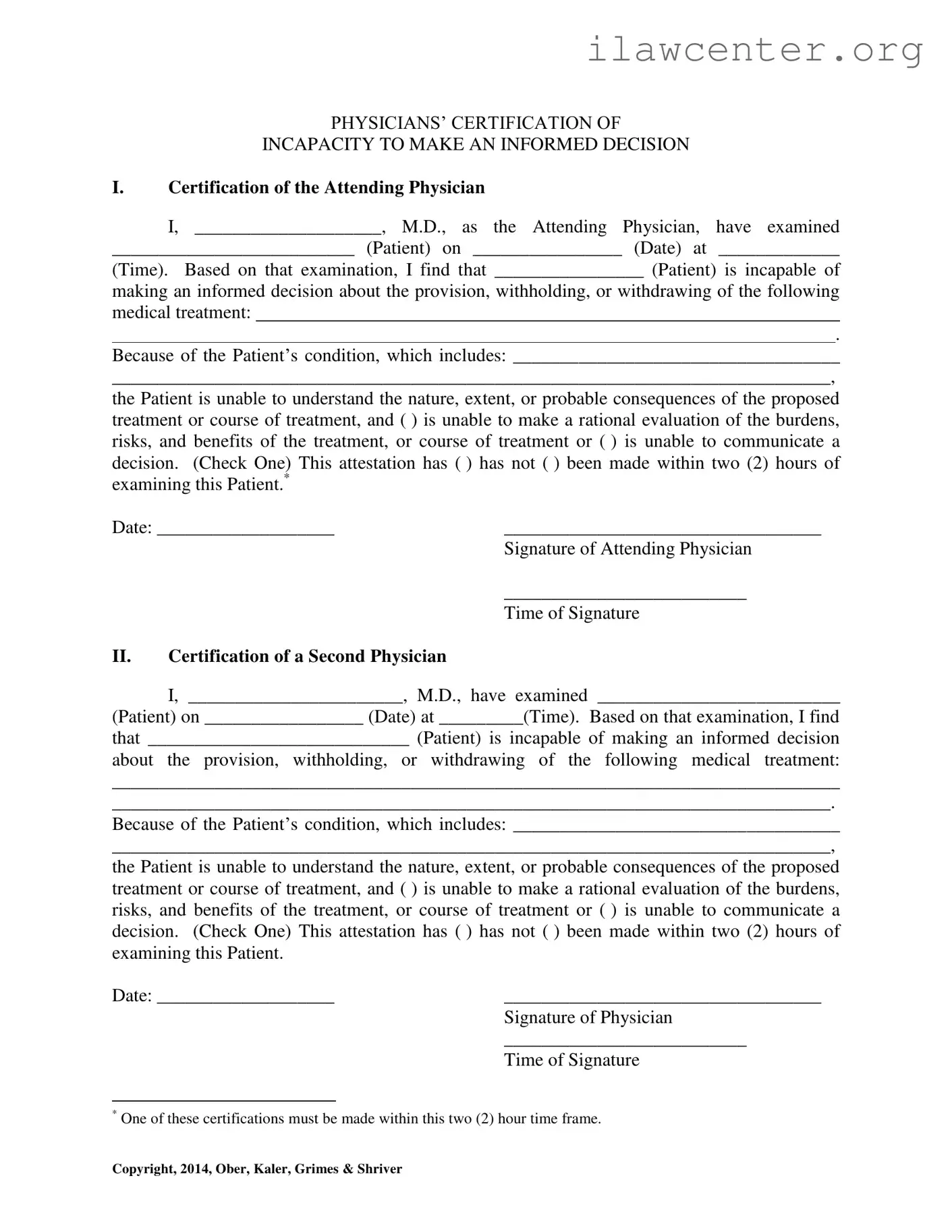
Certification Of Incapacity Preview

Copyright, 2014, Ober, Kaler, Grimes & Shriver
PHYSICIANS’ CERTIFICATION OF
INCAPACITY TO MAKE AN INFORMED DECISION
I. Certification of the Attending Physician
I, ____________________, M.D., as the Attending Physician, have examined
__________________________ (Patient) on ________________ (Date) at _____________
(Time). Based on that examination, I find that ________________ (Patient) is incapable of
making an informed decision about the provision, withholding, or withdrawing of the following
medical treatment:
.
Because of the Patients condition, which includes: ___________________________________
_____________________________________________________________________________,
the Patient is unable to understand the nature, extent, or probable consequences of the proposed
treatment or course of treatment, and ( ) is unable to make a rational evaluation of the burdens,
risks, and benefits of the treatment, or course of treatment or ( ) is unable to communicate a
decision. (Check One) This attestation has ( ) has not ( ) been made within two (2) hours of
examining this Patient.
*
Date: ___________________ __________________________________
Signature of Attending Physician
__________________________
Time of Signature
II. Certification of a Second Physician
I, _______________________, M.D., have examined __________________________
(Patient) on _________________ (Date) at _________(Time). Based on that examination, I find
that ____________________________ (Patient) is incapable of making an informed decision
about the provision, withholding, or withdrawing of the following medical treatment:
______________________________________________________________________________
_____________________________________________________________________________.
Because of the Patients condition, which includes: ___________________________________
_____________________________________________________________________________,
the Patient is unable to understand the nature, extent, or probable consequences of the proposed
treatment or course of treatment, and ( ) is unable to make a rational evaluation of the burdens,
risks, and benefits of the treatment, or course of treatment or ( ) is unable to communicate a
decision. (Check One) This attestation has ( ) has not ( ) been made within two (2) hours of
examining this Patient.
Date: ___________________ __________________________________
Signature of Physician
__________________________
Time of Signature
*
One of these certifications must be made within this two (2) hour time frame.
File Properties

Fact Name Details
Purpose The Certification of Incapacity form is used to determine if a patient can make informed medical decisions.
Physician Requirement The form requires certification from at least two physicians to confirm the patient's incapacity.
Time Frame One of the physician certifications must be completed within two hours of examining the patient.
Patient's Condition Physicians must detail the patient's condition that affects their ability to understand treatment options.
Informed Decision Criteria The form assesses if the patient can evaluate risks, benefits, and communicate decisions.
Legal Framework State-specific laws govern the use of the Certification of Incapacity form, such as the Uniform Health-Care Decisions Act.
Signature Requirement Both physicians must sign the form, indicating their examination and conclusions regarding the patient.
Confidentiality The information contained in the form is confidential and should be handled according to HIPAA regulations.

Instructions on Utilizing Certification Of Incapacity

Completing the Certification of Incapacity form is an important step in documenting a patient's ability to make informed medical decisions. Follow these steps carefully to ensure all necessary information is accurately provided.

  1. Begin with the section titled "Certification of the Attending Physician." Fill in your name as the attending physician.
  2. Enter the patient's name in the designated space.
  3. Provide the date of the examination.
  4. Indicate the time of the examination.
  5. Clearly state the medical treatment that the patient is incapable of making an informed decision about.
  6. Detail the patient's condition that leads to their incapacity.
  7. Check one of the boxes to indicate whether the patient is unable to make a rational evaluation of treatment options or unable to communicate a decision.
  8. Mark whether the attestation was made within two hours of examining the patient.
  9. Sign and date the form, including the time of your signature.

Next, move on to the "Certification of a Second Physician" section. Repeat the same steps as above, ensuring that the second physician's details are correctly filled in.

Important Facts about Certification Of Incapacity

What is the purpose of the Certification of Incapacity form?

The Certification of Incapacity form is used to document that a patient is unable to make informed medical decisions due to their medical condition. It serves as an official record from physicians stating that the patient cannot understand the nature, risks, or benefits of proposed treatments.

Who can complete the Certification of Incapacity form?

Only licensed physicians can complete this form. It requires the signatures of both the attending physician and a second physician who has also examined the patient. This ensures that the assessment of incapacity is thorough and unbiased.

What information is required on the form?

The form requires details such as the patient's name, the date and time of the examination, and a description of the patient's condition. Physicians must also indicate whether the patient can make rational evaluations or communicate decisions regarding their treatment.

What does it mean if a patient is unable to make a rational evaluation?

If a patient is unable to make a rational evaluation, it means they cannot weigh the benefits, risks, and burdens of a proposed treatment. This incapacity may stem from cognitive impairments, mental health issues, or severe medical conditions affecting their judgment.

Is there a time frame for completing the certifications?

Yes, one of the certifications must be completed within two hours of the physician's examination of the patient. This time constraint ensures that the assessment reflects the patient's current state accurately.

What happens if the patient recovers capacity?

If a patient regains the ability to make informed decisions, they can communicate their preferences regarding treatment. Physicians should document this change in capacity and respect the patient's wishes moving forward.

Can family members influence the decision-making process?

Family members may provide input about the patient's wishes and values, but the final decision about incapacity rests with the physicians. Their assessments are based on medical evaluations rather than family opinions.

What if the patient disagrees with the assessment?

If a patient disagrees with the assessment of incapacity, they have the right to seek a second opinion from another physician. This can help ensure that the evaluation is accurate and fair.

Is the Certification of Incapacity form legally binding?

Yes, the Certification of Incapacity form is a legal document. It can be used in medical and legal contexts to guide decisions about a patient's care when they are unable to make those decisions themselves.

Common mistakes

Filling out the Certification of Incapacity form is a critical task that requires careful attention to detail. One common mistake people make is leaving the patient’s name blank. This essential information is necessary to identify the individual for whom the certification is being completed. Without it, the document lacks validity and could lead to confusion.

Another frequent error is not providing the date and time of the examination. These details are vital as they establish the context of the certification. Omitting them can result in questions about the timing of the physician's assessment, which may affect the legal standing of the document.

People often forget to check one of the boxes regarding the patient's ability to make decisions. This section is crucial, as it clarifies whether the patient is unable to evaluate their treatment options or communicate a decision. Failing to check a box leaves the certification open to interpretation and may undermine its purpose.

Additionally, some individuals do not include a clear description of the medical treatment in question. This lack of specificity can create ambiguity about what decisions the patient cannot make. A detailed explanation helps ensure that everyone involved understands the medical context and implications.

Another mistake involves not providing a thorough description of the patient’s condition. This section should explain why the patient is deemed incapable of making informed decisions. Insufficient information can lead to misunderstandings and may complicate the patient's care.

People sometimes neglect to have the second physician's certification completed within the required two-hour timeframe. This requirement is in place to ensure that the assessments are timely and relevant. Missing this deadline can invalidate the certification and create legal complications.

It is also common for individuals to overlook the signature of the attending physician. Without a signature, the document lacks authenticity and cannot be considered valid. Always double-check that all required signatures are present before submission.

Finally, some individuals fail to keep a copy of the completed form. Retaining a copy is essential for record-keeping and can provide clarity in future medical decisions. Not having a copy can lead to confusion or disputes later on.

By being aware of these common mistakes, individuals can ensure that the Certification of Incapacity form is completed accurately and effectively. Taking the time to review each section carefully can prevent complications and ensure that the patient's needs are met appropriately.

Documents used along the form

The Certification of Incapacity form is often accompanied by several other important documents that help clarify the medical and legal status of a patient. Each of these forms serves a specific purpose in ensuring that the patient's rights and health care preferences are respected. Below is a list of related forms and documents commonly used alongside the Certification of Incapacity.

  • Durable Power of Attorney for Health Care: This document allows a person to designate someone else to make health care decisions on their behalf if they become unable to do so. It ensures that the appointed individual can act according to the patient's wishes.
  • Living Will: A living will outlines a person's preferences regarding medical treatment in situations where they are unable to communicate their wishes. It provides guidance to health care providers and loved ones about the patient's desires concerning end-of-life care.
  • Do Not Resuscitate (DNR) Order: A DNR order specifies that a patient does not wish to receive cardiopulmonary resuscitation (CPR) in the event of cardiac or respiratory arrest. This document must be signed by a physician to be valid.
  • Advance Directive: An advance directive is a broader term that encompasses both living wills and durable powers of attorney for health care. It provides instructions about medical care preferences and appoints a decision-maker.
  • Patient Advocate Designation: This form allows an individual to appoint a patient advocate who can make health care decisions on their behalf. It is particularly useful when a patient is incapacitated.
  • Medical History Form: This document provides a comprehensive overview of a patient's medical background, including past treatments, surgeries, and medications. It helps health care providers make informed decisions about care.
  • Health Care Proxy: Similar to a durable power of attorney, a health care proxy allows a person to appoint someone to make medical decisions for them if they are unable to do so. It is often used in conjunction with other advance directives.
  • Patient Consent Form: This form is used to obtain a patient's consent for specific medical treatments or procedures. It ensures that the patient understands what they are agreeing to and the associated risks.

Each of these documents plays a critical role in the health care decision-making process, especially for individuals who may not be able to advocate for themselves. Understanding their functions can help families and caregivers navigate complex medical situations more effectively.

Similar forms

The Certification of Incapacity form is essential for determining a patient's ability to make informed medical decisions. Several other documents serve similar purposes in healthcare and legal contexts. Here are ten documents that share similarities with the Certification of Incapacity form:

  • Advance Directive: This document outlines a person's preferences for medical treatment in case they become unable to communicate their wishes. Like the Certification of Incapacity, it emphasizes patient autonomy and informed decision-making.
  • Durable Power of Attorney for Healthcare: This legal document designates an individual to make healthcare decisions on behalf of another person. It parallels the Certification of Incapacity by ensuring that someone can act when the patient cannot.
  • Living Will: Similar to an Advance Directive, a Living Will specifies what types of medical treatment a person wishes or does not wish to receive if incapacitated. Both documents focus on patient preferences in critical situations.
  • Medical Power of Attorney: This grants authority to a designated person to make healthcare decisions for someone else, akin to the Certification of Incapacity, which confirms a patient's inability to make decisions.
  • Patient Self-Determination Act Documentation: This act requires healthcare providers to inform patients of their rights regarding decision-making. It aligns with the Certification of Incapacity in promoting informed patient choices.
  • Psychiatric Evaluation Report: This document assesses a patient's mental state and decision-making capacity, similar to the Certification of Incapacity, which evaluates a patient's ability to understand treatment options.
  • Competency Evaluation: Conducted by a qualified professional, this evaluation determines a person's ability to make decisions. It shares the goal of the Certification of Incapacity in assessing decision-making capabilities.
  • Informed Consent Form: This form ensures that patients understand the risks and benefits of a treatment before agreeing to it. Like the Certification of Incapacity, it emphasizes the importance of informed decision-making.
  • Healthcare Proxy Form: This document allows a person to appoint someone to make healthcare decisions on their behalf. It is similar to the Certification of Incapacity in that it addresses situations where the patient cannot make decisions.
  • Emergency Medical Services (EMS) Do Not Resuscitate (DNR) Order: This order indicates a patient's wishes regarding resuscitation efforts in emergencies. It complements the Certification of Incapacity by ensuring that patient preferences are honored when they cannot communicate.

Dos and Don'ts

Filling out the Certification of Incapacity form can be a crucial task, and it’s important to approach it with care. Here’s a list of what you should and shouldn’t do while completing this form:

  • Do ensure accuracy. Double-check all patient information and details of the examination.
  • Do use clear language. Avoid medical jargon that might confuse the reader.
  • Do check the time frame. Make sure the certification is completed within the required two-hour window after the examination.
  • Do communicate effectively. Make sure to explain the patient’s condition and the reasons for their incapacity clearly.
  • Do sign and date appropriately. Ensure your signature is legible and the date is filled in correctly.
  • Don't rush the process. Take your time to fill out the form thoroughly and thoughtfully.
  • Don't leave sections blank. Every part of the form should be completed to avoid confusion later.
  • Don't use abbreviations. Write everything out to ensure clarity and avoid misinterpretation.
  • Don't forget to check the boxes. Make sure to indicate the patient's ability to make decisions by checking the appropriate options.
  • Don't overlook the second physician's certification. Remember that this may be necessary for validation.

By following these guidelines, you can help ensure that the Certification of Incapacity form is filled out correctly and effectively, supporting the best interests of the patient.

Misconceptions

Understanding the Certification of Incapacity form is essential for both healthcare providers and patients. However, several misconceptions can lead to confusion. Here’s a list of common misunderstandings:

  • It only requires one physician's certification. In fact, two physicians must certify the patient's incapacity. This ensures a thorough evaluation of the patient's condition.
  • The form is only for end-of-life decisions. This is not true. The form can be used for any medical treatment decisions where a patient may be unable to make informed choices.
  • Patients cannot regain decision-making capacity. Many patients can recover their ability to make informed decisions. The form is a temporary measure, not a permanent status.
  • Any physician can fill out the form. Only attending physicians who have examined the patient can complete this certification. Their direct involvement is crucial.
  • The certification must be completed immediately. While the form must be completed within two hours of examination, it does not need to be filled out instantly. Physicians have a brief window to ensure accuracy.
  • Once certified, the patient cannot participate in their care. Patients may still be involved in their care decisions as much as possible, even if they are currently incapacitated.
  • The form is legally binding without further review. The certification serves as a guideline for medical decisions but does not override legal requirements or patient rights.

Being informed about these misconceptions can help ensure that the Certification of Incapacity form is used correctly and effectively, promoting better patient care.

Key takeaways

Filling out the Certification of Incapacity form is an important task that requires attention to detail. Here are some key takeaways to keep in mind:

  • Understand the Purpose: This form certifies that a patient is unable to make informed medical decisions.
  • Two Physicians Required: Both an attending physician and a second physician must complete the form.
  • Examination Details: Each physician must provide the date and time of their examination of the patient.
  • Patient's Condition: Clearly describe the patient's condition that leads to their incapacity.
  • Decision-Making Ability: Indicate whether the patient can evaluate treatment options or communicate a decision.
  • Time Frame: One of the certifications must be completed within two hours of the examination.
  • Signature Required: Both physicians must sign and date the form to validate it.
  • Keep Copies: Always keep copies of the completed form for medical records and future reference.

By following these guidelines, you can ensure that the Certification of Incapacity form is filled out correctly and serves its intended purpose.