Fillable Character Letter for Court Document

Fillable Character Letter for Court Document

The Character Letter for Court form is a document that provides a personal account of an individual's character, often written by friends, family, or colleagues. This letter can significantly influence court decisions by offering insights into the person's behavior and reputation. If you need to fill out this form, click the button below to get started.

Article Guide

When facing legal proceedings, the support of friends, family, or colleagues can be invaluable. A Character Letter for Court serves as a powerful tool in this context, providing insight into an individual's character and personal history. This letter typically includes details about the writer's relationship with the person in question, highlighting positive traits and contributions to the community. It may also address specific incidents or experiences that showcase the individual’s integrity and responsibility. The tone of the letter should be respectful and sincere, aiming to present a well-rounded view of the person’s character. Such letters can be instrumental in influencing a judge's perspective during sentencing or custody hearings, as they offer a glimpse into the individual’s life beyond the charges they face. When crafted thoughtfully, a Character Letter can make a significant difference in the outcome of a case.

Character Letter for Court Preview

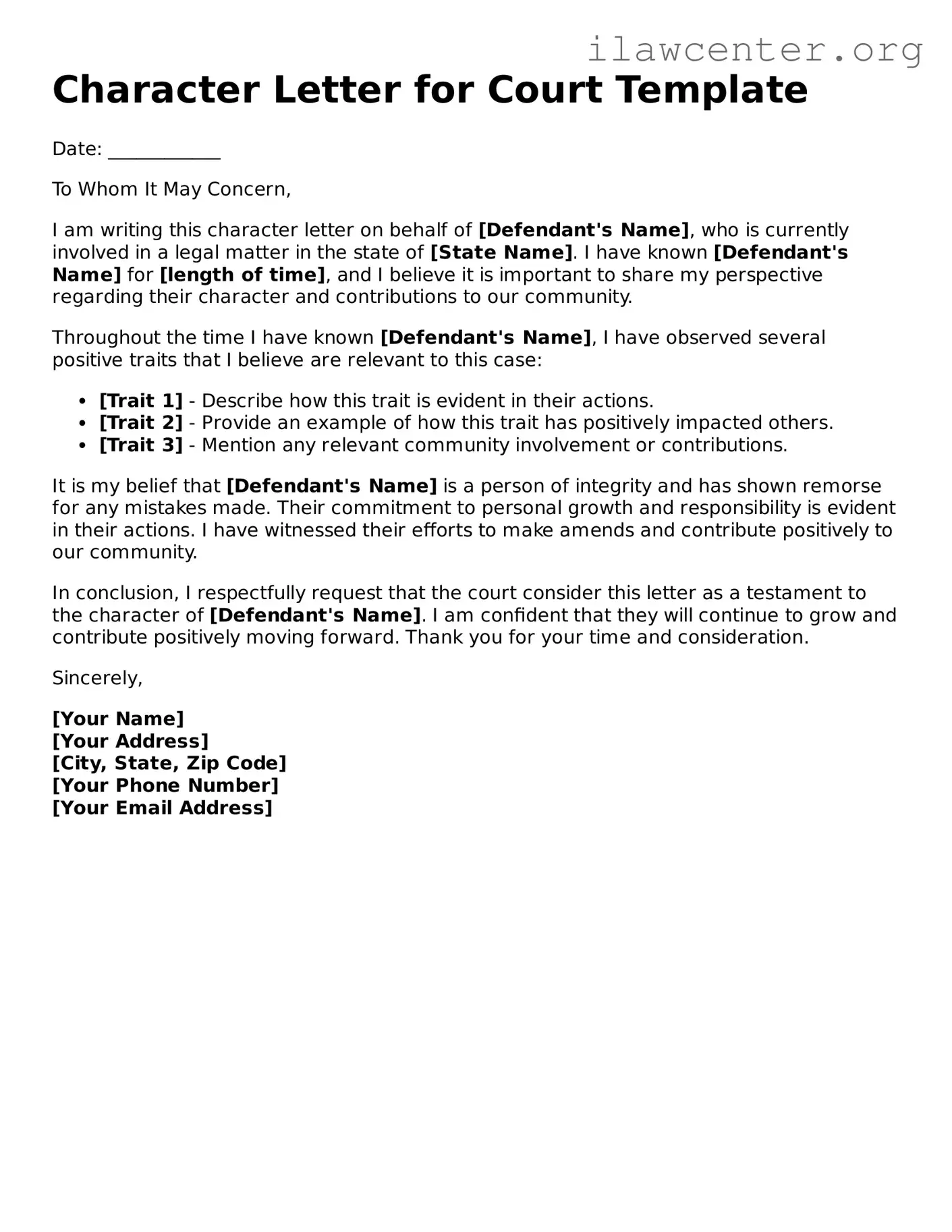
Character Letter for Court Template

Date: ____________

To Whom It May Concern,

I am writing this character letter on behalf of [Defendant's Name], who is currently involved in a legal matter in the state of [State Name]. I have known [Defendant's Name] for [length of time], and I believe it is important to share my perspective regarding their character and contributions to our community.

Throughout the time I have known [Defendant's Name], I have observed several positive traits that I believe are relevant to this case:

  • [Trait 1] - Describe how this trait is evident in their actions.
  • [Trait 2] - Provide an example of how this trait has positively impacted others.
  • [Trait 3] - Mention any relevant community involvement or contributions.

It is my belief that [Defendant's Name] is a person of integrity and has shown remorse for any mistakes made. Their commitment to personal growth and responsibility is evident in their actions. I have witnessed their efforts to make amends and contribute positively to our community.

In conclusion, I respectfully request that the court consider this letter as a testament to the character of [Defendant's Name]. I am confident that they will continue to grow and contribute positively moving forward. Thank you for your time and consideration.

Sincerely,

[Your Name]
[Your Address]
[City, State, Zip Code]
[Your Phone Number]
[Your Email Address]

PDF Form Characteristics

Fact Name Details
Purpose A Character Letter for Court is intended to provide the judge with insight into a person's character and reputation, often during sentencing or custody hearings.
Format The letter should be written in a formal style, typically typed and signed, and should include the writer's contact information and relationship to the individual.
Length While there is no strict length requirement, a one-page letter is generally sufficient to convey the necessary information without overwhelming the reader.
Content It should include specific examples of the individual's positive traits, behaviors, and contributions to the community, rather than vague statements.
State-Specific Forms Some states may have specific guidelines or forms for character letters; it is essential to check local court rules.
Governing Law In many jurisdictions, the use of character letters is governed by local court rules, which may vary by state.
Submission Character letters can often be submitted directly to the court or provided to the individual's attorney for inclusion in court documents.
Confidentiality Writers should be aware that character letters may become part of the public record, and sensitive information should be handled accordingly.

Instructions on Utilizing Character Letter for Court

Filling out the Character Letter for Court form is an important step in supporting someone during their court proceedings. This letter serves as a personal testament to the individual’s character and can provide valuable insight to the court. Follow these steps to ensure that you complete the form accurately and effectively.

  1. Begin by gathering your thoughts about the person you are writing the letter for. Consider their positive traits and any specific examples that illustrate their character.
  2. At the top of the form, write your name, address, and contact information. This information helps the court identify you as the author of the letter.
  3. Next, include the date on which you are writing the letter. This provides a timeline for the court.
  4. Address the letter to the appropriate court or judge. Use a formal greeting, such as "Dear Honorable Judge [Last Name]."
  5. In the first paragraph, introduce yourself and explain your relationship to the individual. Mention how long you have known them and in what capacity.
  6. In the following paragraphs, provide specific examples of the individual’s character. Focus on their positive traits, such as honesty, kindness, and reliability. Personal anecdotes can make your letter more impactful.
  7. Wrap up the letter by reiterating your support for the individual. You might express your belief in their potential for positive change or highlight their contributions to the community.
  8. End with a formal closing, such as "Sincerely," followed by your signature and printed name.
  9. Review the letter for clarity and correctness. Ensure that it is free of spelling and grammatical errors.
  10. Finally, make a copy of the completed letter for your records before submitting it to the court.

Important Facts about Character Letter for Court

What is a Character Letter for Court?

A Character Letter for Court is a written statement that provides insight into a person's character. It is often used in legal proceedings to support an individual's case. The letter typically highlights positive traits, behaviors, and contributions of the person in question, helping the court understand their character beyond the legal issues at hand.

Who can write a Character Letter for Court?

Anyone who knows the individual well can write a Character Letter for Court. This includes friends, family members, colleagues, teachers, or community leaders. The writer should be someone who can provide a genuine perspective on the person's character and experiences. Their relationship to the individual should be clearly stated in the letter.

What should be included in a Character Letter for Court?

A Character Letter should include the writer's contact information, a brief introduction of themselves, and a clear statement of their relationship to the individual. It should detail specific examples of the person's positive traits and contributions. The letter should also express the writer's belief in the individual's character and potential for rehabilitation, if applicable.

How long should a Character Letter for Court be?

Typically, a Character Letter for Court should be one page long. This length allows the writer to provide enough detail while remaining concise. It's important to get to the point quickly and focus on the most relevant information that supports the individual's character.

Can a Character Letter for Court be handwritten?

Yes, a Character Letter can be handwritten. However, it is generally recommended to type the letter for clarity and professionalism. If handwriting is chosen, it should be neat and legible. Regardless of the format, the content should remain sincere and authentic.

How should a Character Letter for Court be submitted?

The submission process for a Character Letter varies depending on the court's requirements. It may be submitted directly to the court, included with other documents, or presented during a hearing. Always check with the court or legal representative for specific instructions on how to submit the letter properly.

Common mistakes

Filling out a Character Letter for Court form can be a crucial step in legal proceedings, yet many people make common mistakes that can undermine their efforts. One frequent error is failing to address the letter to the correct recipient. It is essential to ensure that the letter is directed to the appropriate judge or court. If the letter is misdirected, it may not reach the intended audience, rendering it ineffective.

Another common mistake is neglecting to include specific examples of the individual’s character. Generic statements about a person's character may not have the desired impact. Instead, including anecdotes or specific instances that illustrate the person’s qualities can make the letter more persuasive and relatable.

People often forget to maintain a respectful tone throughout the letter. While it is important to convey support for the individual, the letter should not come across as overly emotional or biased. A balanced tone helps to present the writer as credible and serious about their statements.

Additionally, some individuals overlook the importance of proofreading. Spelling and grammatical errors can detract from the letter's professionalism. A well-written letter reflects the seriousness of the situation and shows respect for the court’s time and process.

Another mistake is failing to sign the letter or include contact information. A signature adds authenticity and allows the court to reach out for any clarifications if needed. Without this information, the letter may be dismissed as untrustworthy.

Sometimes, writers make the mistake of being too vague about their relationship with the individual in question. Clearly stating how they know the person and the length of their relationship provides context and credibility to the letter. This information helps the court understand the perspective from which the writer is speaking.

Lastly, some people submit the letter without considering the overall length. A character letter should be concise yet comprehensive. Striking a balance between being thorough and being brief is key. Lengthy letters can lose the reader's attention, while overly short letters may not provide enough information.

Documents used along the form

When preparing for court, it's essential to have various documents that support your case. The Character Letter for Court is just one of many forms that can help present a comprehensive view of the situation. Here are some other documents that are often used in conjunction with the Character Letter:

  • Affidavit of Support: This document provides a sworn statement from a witness who can attest to the character and credibility of the individual involved in the case.
  • Personal Statement: A written account from the defendant or involved party that outlines their perspective on the situation and any relevant background information.
  • Letters of Recommendation: These letters come from friends, family, or colleagues who can speak positively about the individual’s character and contributions to the community.
  • Criminal Record Check: A document that shows any prior convictions or legal issues, which can be important for the court to consider in context.
  • Psychological Evaluation: This report provides insights from a mental health professional regarding the individual's mental state, which may be relevant to the case.
  • Evidence of Rehabilitation: Documents that demonstrate efforts made by the individual to improve themselves, such as certificates from programs, letters from counselors, or proof of community service.

Gathering these documents can create a stronger case and present a well-rounded view of the individual’s character. Each piece of information adds context and may influence the court's decision positively.

Similar forms

  • Affidavit of Support: This document serves as a written statement made under oath, often used to demonstrate a person's commitment to support another individual, similar to how a character letter expresses support for someone in court.
  • Personal Reference Letter: A personal reference letter provides insight into an individual's character and behavior. Like a character letter, it is intended to influence a decision by offering a personal perspective on the individual.
  • Recommendation Letter: This type of letter highlights a person's qualifications and character traits. Both recommendation letters and character letters aim to advocate for the individual, presenting their positive attributes to decision-makers.
  • Victim Impact Statement: This document allows victims to express how a crime has affected their lives. While it focuses on the victim's perspective, both it and a character letter aim to provide context and influence the court's understanding of a situation.

Dos and Don'ts

When preparing to fill out a Character Letter for Court, it is essential to understand the best practices to ensure your letter is effective and appropriate. Below is a list of things you should and shouldn't do during this process.

  • Do provide specific examples of the person's character and behavior.
  • Do keep the tone respectful and professional throughout the letter.
  • Do address the letter to the appropriate judge or court.
  • Do include your contact information for follow-up if necessary.
  • Do proofread the letter for grammar and spelling errors before submission.
  • Don't use overly emotional language that may detract from your message.
  • Don't include irrelevant personal opinions or anecdotes.
  • Don't exaggerate the person's qualities or downplay any issues.
  • Don't forget to sign the letter before submitting it to the court.

Following these guidelines can help ensure that your Character Letter for Court is taken seriously and serves its intended purpose effectively.

Misconceptions

When dealing with the Character Letter for Court form, several misconceptions can lead to confusion. Here are four common misunderstandings:

  • Misconception 1: The letter is only for criminal cases.
  • This is not true. A Character Letter can be beneficial in various types of cases, including family court and civil disputes. It helps provide insight into a person's character regardless of the legal context.

  • Misconception 2: Anyone can write a Character Letter.
  • While technically anyone can write one, it is most effective when authored by someone who knows the individual well, such as a friend, family member, or colleague. Their relationship lends credibility to the letter.

  • Misconception 3: The letter must be lengthy to be effective.
  • Length does not equate to impact. A concise, well-written letter that clearly conveys the writer's perspective can be more powerful than a long, rambling one. Focus on quality over quantity.

  • Misconception 4: The letter guarantees a favorable outcome.
  • While a Character Letter can influence a judge's perception, it does not guarantee a specific outcome. It is one piece of a larger puzzle in legal proceedings.

Key takeaways

Filling out and using the Character Letter for Court form can significantly impact a case. Here are some key takeaways to keep in mind:

  • Understand the Purpose: The letter serves to provide the court with insights into the character and behavior of the individual involved in the case.
  • Be Honest and Sincere: Authenticity is crucial. The letter should reflect genuine thoughts and feelings about the person.
  • Keep it Relevant: Focus on specific traits or incidents that highlight the individual's character in relation to the case.
  • Maintain a Professional Tone: While personal, the letter should still be respectful and formal, avoiding overly casual language.
  • Include Personal Experiences: Sharing personal anecdotes can strengthen the letter and provide context to the individual's character.
  • Follow Court Guidelines: Ensure the letter adheres to any specific requirements set by the court regarding format and content.

These takeaways can help in crafting a letter that effectively communicates the character of the individual to the court.