Fillable Character Reference Letter for Child Custody Document

Fillable Character Reference Letter for Child Custody Document

The Character Reference Letter for Child Custody form serves as a valuable tool in family court proceedings, providing insight into a parent's character and suitability for custody. This letter can help demonstrate the positive attributes of a parent, as seen by friends, family, or colleagues. To assist in your custody case, consider filling out the form by clicking the button below.

Article Guide

When navigating the complexities of child custody arrangements, a Character Reference Letter can play a crucial role in the court's decision-making process. This letter serves as a testament to a parent’s character, providing insights into their parenting abilities, stability, and overall suitability for custody. It is typically written by someone who knows the parent well, such as a family member, friend, or colleague, and highlights positive traits and behaviors that demonstrate the parent’s commitment to their child’s well-being. The letter should be sincere and detailed, offering specific examples of the parent’s interactions with their child and their ability to provide a nurturing environment. In addition, it may address the parent’s lifestyle, community involvement, and support systems, all of which can influence the court's perception of their fitness as a custodial parent. Ultimately, a well-crafted Character Reference Letter can significantly impact the outcome of custody proceedings, making it an essential component of the legal process.

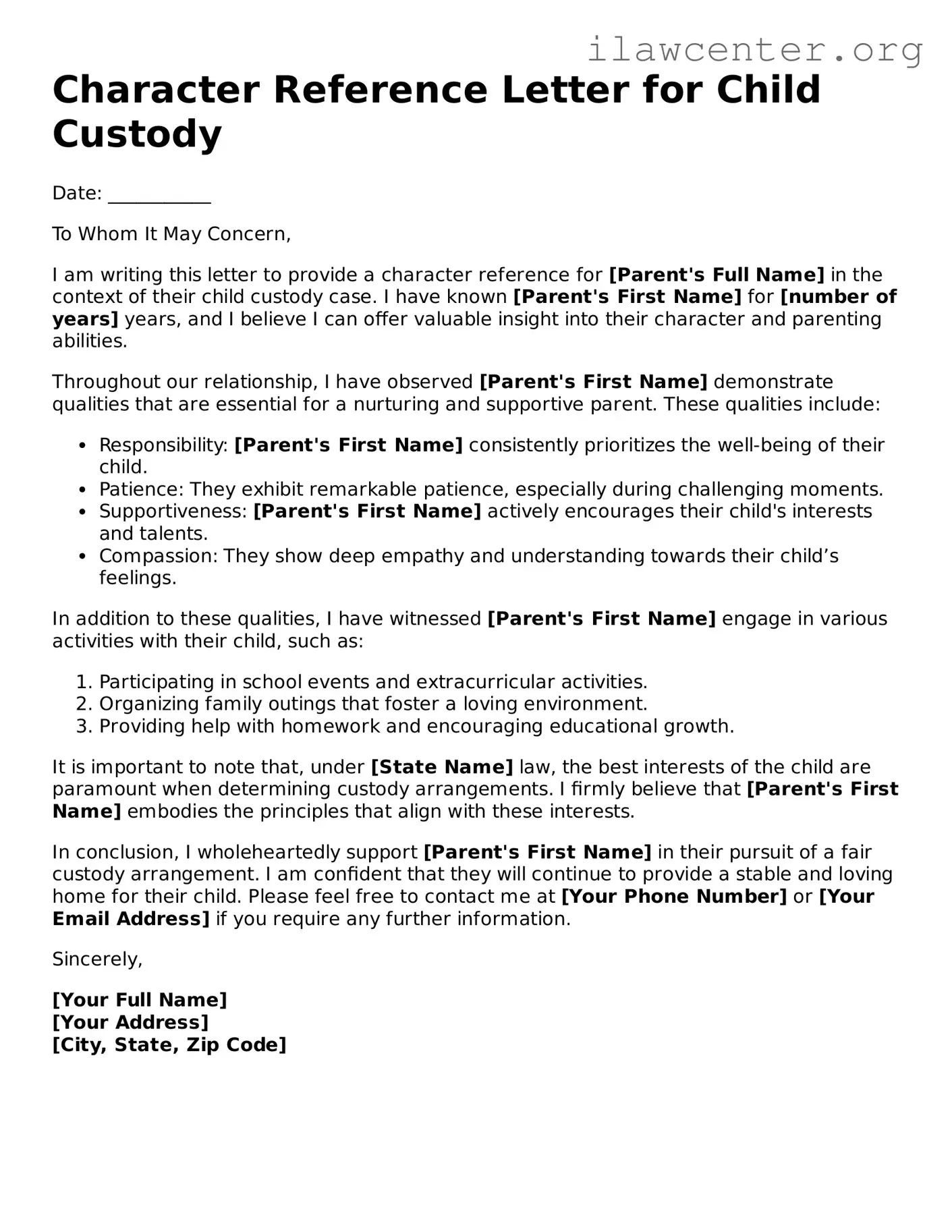
Character Reference Letter for Child Custody Preview

Character Reference Letter for Child Custody

Date: ___________

To Whom It May Concern,

I am writing this letter to provide a character reference for [Parent's Full Name] in the context of their child custody case. I have known [Parent's First Name] for [number of years] years, and I believe I can offer valuable insight into their character and parenting abilities.

Throughout our relationship, I have observed [Parent's First Name] demonstrate qualities that are essential for a nurturing and supportive parent. These qualities include:

  • Responsibility: [Parent's First Name] consistently prioritizes the well-being of their child.
  • Patience: They exhibit remarkable patience, especially during challenging moments.
  • Supportiveness: [Parent's First Name] actively encourages their child's interests and talents.
  • Compassion: They show deep empathy and understanding towards their child’s feelings.

In addition to these qualities, I have witnessed [Parent's First Name] engage in various activities with their child, such as:

  1. Participating in school events and extracurricular activities.
  2. Organizing family outings that foster a loving environment.
  3. Providing help with homework and encouraging educational growth.

It is important to note that, under [State Name] law, the best interests of the child are paramount when determining custody arrangements. I firmly believe that [Parent's First Name] embodies the principles that align with these interests.

In conclusion, I wholeheartedly support [Parent's First Name] in their pursuit of a fair custody arrangement. I am confident that they will continue to provide a stable and loving home for their child. Please feel free to contact me at [Your Phone Number] or [Your Email Address] if you require any further information.

Sincerely,

[Your Full Name]
[Your Address]
[City, State, Zip Code]

PDF Form Characteristics

Fact Name Description
Purpose A character reference letter for child custody serves to provide insight into a parent's character, parenting abilities, and overall suitability for custody.
Format The letter should be formatted formally, including the writer's contact information, date, and a clear salutation.
Content It should include specific examples of the parent’s positive traits, parenting skills, and the relationship with the child.
Length Typically, the letter should be one to two pages long, providing enough detail without being overly lengthy.
State-Specific Requirements Some states may have specific requirements for character reference letters, so it’s important to check local guidelines.
Governing Laws In California, for example, family law governs custody matters, including character references (California Family Code Section 3011).
Submission The letter should be submitted to the court as part of the custody case documentation, often included in a larger package of evidence.

Instructions on Utilizing Character Reference Letter for Child Custody

Filling out a Character Reference Letter for Child Custody form requires careful attention to detail. This letter serves as a way to provide insight into the character and suitability of a parent or guardian involved in custody proceedings. Follow these steps to complete the form accurately.

  1. Begin by entering the date at the top of the letter.
  2. Include your full name, address, and contact information. This information should be placed at the top of the letter, below the date.
  3. Address the letter to the appropriate party, which may include the court or the specific individual overseeing the custody case.
  4. Start with a formal greeting, such as "Dear [Name or Title]."
  5. In the opening paragraph, introduce yourself and explain your relationship to the parent or guardian. Be specific about how long you have known them and in what capacity.
  6. In the body of the letter, provide specific examples of the parent’s character, parenting skills, and any relevant experiences that demonstrate their suitability for custody.
  7. Conclude the letter with a summary of your support for the parent or guardian. Reiterate your belief in their ability to provide a loving and stable environment.
  8. Sign the letter at the bottom, including your printed name beneath your signature.

After completing the form, review it for clarity and accuracy. Ensure that all information is correct and that the letter reflects your genuine perspective. Once satisfied, it can be submitted as part of the custody proceedings.

Important Facts about Character Reference Letter for Child Custody

What is a Character Reference Letter for Child Custody?

A Character Reference Letter for Child Custody is a document that provides insight into a parent’s character, parenting abilities, and overall suitability for custody. It is typically written by someone who knows the parent well, such as a family member, friend, teacher, or community leader. This letter can help the court understand the parent’s strengths and their relationship with the child.

Who should write the Character Reference Letter?

The letter should be written by individuals who have a strong understanding of the parent’s character and parenting style. Ideal writers include family members, close friends, teachers, or coaches who can provide specific examples of the parent’s positive attributes and interactions with the child. It is crucial that the writer is credible and can speak to the parent’s abilities in a meaningful way.

What should be included in the letter?

The letter should begin with the writer’s relationship to the parent and how long they have known each other. It should include specific examples of the parent’s involvement in the child’s life, highlighting their strengths and positive parenting practices. Additionally, the letter should express the writer's belief in the parent’s ability to provide a stable and nurturing environment for the child.

How long should the Character Reference Letter be?

A Character Reference Letter for Child Custody should typically be one to two pages long. This length allows the writer to provide enough detail without overwhelming the reader. Clarity and conciseness are key; the letter should be easy to read and to the point while still conveying essential information.

Is there a specific format to follow?

While there is no strict format, the letter should be typed and professionally presented. It should include the writer’s name, address, and contact information at the top, followed by the date. The salutation should be formal, such as "To Whom It May Concern." The body of the letter should be clear and organized, concluding with the writer’s signature and printed name.

Can the letter be submitted to the court directly?

Yes, the Character Reference Letter can be submitted to the court as part of the custody case documentation. However, it is advisable to check with legal counsel regarding the specific requirements for submission. In some cases, the letter may need to be presented during a court hearing, where the writer could also be asked to testify about its contents.

Common mistakes

When filling out a Character Reference Letter for Child Custody, many individuals inadvertently make mistakes that can affect the outcome of the custody arrangement. One common error is failing to include specific examples of the child's character and behavior. Instead of vague statements, concrete instances provide a clearer picture of the child's personality and needs.

Another frequent mistake is using overly emotional language. While it's important to convey genuine feelings, excessive sentiment can come across as biased or insincere. Keeping the tone professional and balanced helps maintain credibility.

People often neglect to mention their relationship with the child. A reference letter should clarify how long and in what capacity the writer knows the child. This context establishes the writer's authority to speak on the child's behalf.

Additionally, many forget to proofread their letter. Spelling and grammatical errors can undermine the letter's professionalism. A polished document reflects attention to detail and seriousness about the child's welfare.

Some individuals mistakenly focus solely on the custodial parent. While it's important to highlight their strengths, neglecting to mention the child's needs and how both parents can meet them can weaken the letter's impact.

Another pitfall is failing to address any potential concerns. If there are issues that may affect the child's well-being, acknowledging them and discussing how they can be managed shows a thoughtful approach to custody considerations.

People may also overlook the importance of being concise. A lengthy letter can lose the reader's attention. Sticking to key points ensures that the most important information stands out.

Finally, not following the specific guidelines provided by the court can lead to complications. Each court may have different requirements for character reference letters. Adhering to these guidelines is crucial for ensuring the letter is accepted and considered.

Documents used along the form

When navigating the complexities of child custody cases, several documents complement the Character Reference Letter for Child Custody. Each of these forms serves a specific purpose and can provide valuable insights into the child's well-being and the suitability of the custodial arrangement.

  • Affidavit of Support: This document is a sworn statement that outlines the affiant's relationship to the child and their willingness to support the custodial parent. It can help establish a network of support for the child.
  • Parenting Plan: A detailed plan that outlines how parents will share responsibilities for their child. It includes schedules, decision-making processes, and other important arrangements, demonstrating the parents' commitment to cooperative co-parenting.
  • Child Custody Evaluation Report: Conducted by a mental health professional, this report assesses the family dynamics and the child's needs. It provides an objective analysis that can significantly influence custody decisions.
  • Financial Disclosure Statement: This document outlines the financial situation of both parents. It is crucial for determining child support obligations and ensuring that the child's needs are met.
  • School Records: Documents from the child's school, such as report cards and attendance records, can provide insight into the child's academic performance and social interactions, which are relevant to custody considerations.

Understanding these additional documents can enhance the effectiveness of the Character Reference Letter for Child Custody. Together, they create a comprehensive picture of the child's environment and the parents' commitment to their well-being.

Similar forms

  • Personal Reference Letter: This document serves a similar purpose by providing insight into a person’s character. It often highlights personal experiences and qualities that make the individual suitable for certain responsibilities, much like how a character reference letter does in custody cases.
  • Employment Reference Letter: Employers often write these letters to vouch for an employee's character and work ethic. Just as a character reference letter can demonstrate a parent’s suitability, an employment reference can showcase reliability and responsibility in a professional setting.
  • Academic Reference Letter: Teachers or professors commonly write these letters for students applying to colleges or scholarships. They provide a perspective on the student’s character, work ethic, and potential, similar to how a character reference letter addresses a parent's qualities in custody matters.
  • Community Service Reference Letter: This type of letter highlights an individual's contributions to the community. It can reflect a person's commitment to helping others, paralleling how a character reference letter illustrates a parent's dedication to their child's well-being.
  • Character Witness Statement: Often used in legal settings, this document provides a firsthand account of a person's character. Like a character reference letter for custody, it aims to influence a decision by portraying the individual in a positive light.

Dos and Don'ts

When filling out a Character Reference Letter for Child Custody, there are several important considerations to keep in mind. Below are five things you should do and five things you shouldn't do.

Things You Should Do:

  • Provide specific examples of your relationship with the child.
  • Highlight the positive traits of the parent seeking custody.
  • Be honest and straightforward in your assessment.
  • Keep the tone respectful and supportive.
  • Sign the letter and include your contact information for follow-up.

Things You Shouldn't Do:

  • Include irrelevant personal information about yourself.
  • Make negative comments about the other parent.
  • Use overly emotional language that may seem biased.
  • Forget to proofread for errors and clarity.
  • Submit the letter without ensuring it meets the required format.

Misconceptions

When it comes to child custody cases, a character reference letter can play a significant role. However, several misconceptions surround this important document. Here are six common misunderstandings:

  • Only close relatives can write a character reference letter. Many people believe that only family members can provide a character reference. In reality, anyone who knows the parent well—friends, teachers, or colleagues—can write a helpful letter.
  • The letter must be lengthy to be effective. Some think that a longer letter carries more weight. However, a concise and focused letter that highlights key qualities and experiences can be just as powerful.
  • Character reference letters are not considered by the court. Many assume that these letters hold no value in court. In fact, judges often take them into account when making custody decisions, as they provide insight into the parent’s character.
  • Character reference letters should only focus on positive traits. While it’s important to highlight strengths, it’s also valuable to mention how the parent has overcome challenges. This shows resilience and growth.
  • Any format will do for a character reference letter. Some people think that there are no specific requirements. However, a well-structured letter that includes a clear introduction, body, and conclusion is more effective.
  • Character reference letters are only necessary for contested custody cases. Many believe these letters are only needed when custody is disputed. In truth, they can be beneficial in any custody situation, even when parents are amicable.

Understanding these misconceptions can help ensure that character reference letters are used effectively in child custody matters.

Key takeaways

When filling out the Character Reference Letter for Child Custody form, consider the following key takeaways:

  • Ensure the letter is written by someone who knows the child well and can speak to the parent’s character.
  • Provide specific examples of the parent’s positive qualities and their relationship with the child.
  • Keep the tone respectful and objective, avoiding any emotional language or personal opinions.
  • Include contact information for the reference, as the court may want to reach out for further discussion.