Fillable Character Reference Letter for Immigration Document

Fillable Character Reference Letter for Immigration Document

The Character Reference Letter for Immigration is a crucial document that helps individuals demonstrate their good moral character during the immigration process. This letter, often written by friends, family, or colleagues, provides insight into the applicant's character and community contributions. Ready to support someone’s journey? Fill out the form by clicking the button below.

Article Guide

When navigating the complex landscape of immigration, every detail matters, and a Character Reference Letter can play a crucial role in the process. This letter serves as a testament to an individual’s character and contributions to their community, often influencing the outcome of immigration applications. Typically, it is written by someone who knows the applicant well—be it a friend, employer, or community leader—who can provide insights into the individual’s moral standing and positive traits. The letter should highlight the applicant’s strengths, such as their integrity, work ethic, and commitment to society. It is essential to include specific examples that illustrate these qualities, as personal anecdotes can make a compelling case. Moreover, the letter must be formatted appropriately, containing the writer's contact information and a clear statement of their relationship with the applicant. By crafting a thoughtful and sincere Character Reference Letter, the writer not only supports the applicant’s case but also reinforces the values of trust and community that immigration processes aim to uphold.

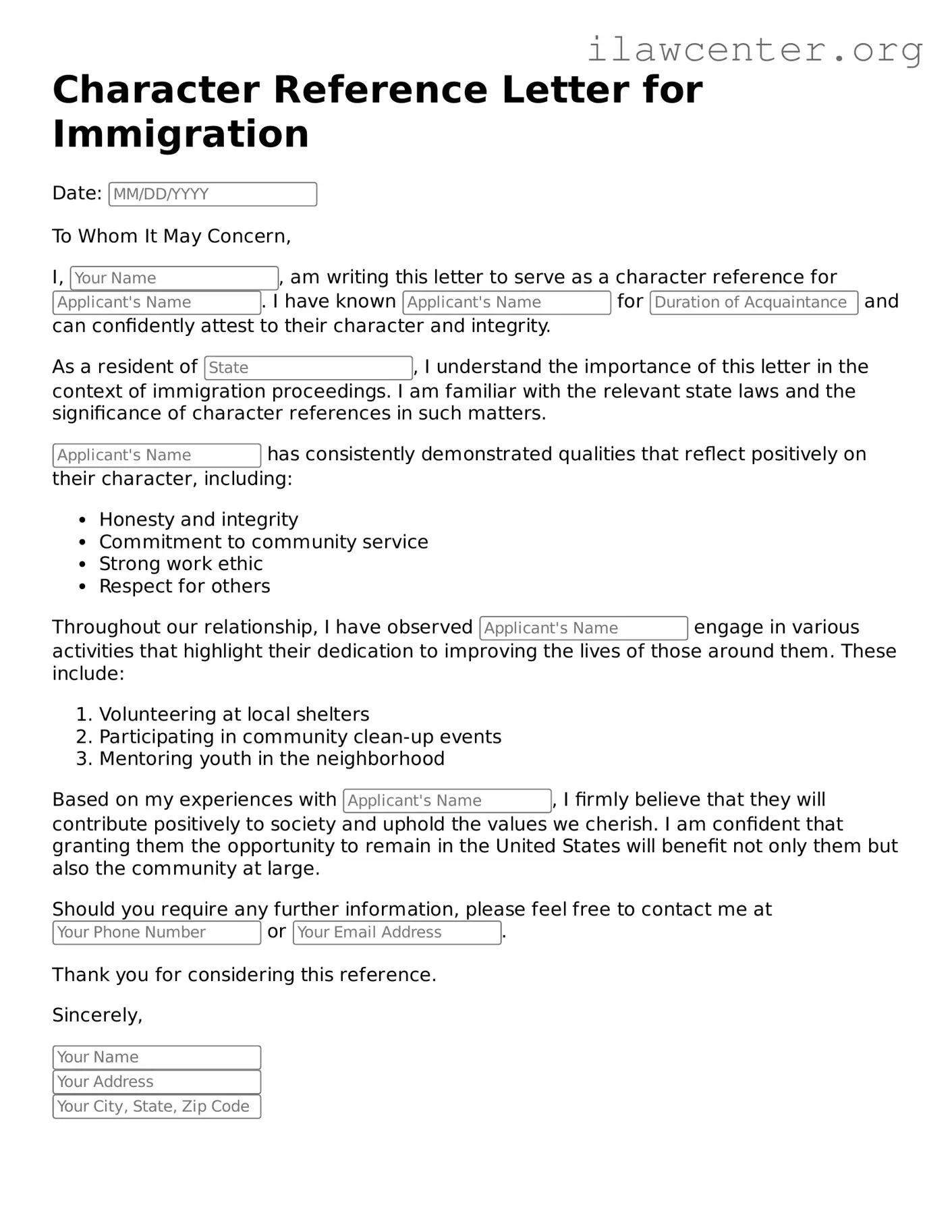
Character Reference Letter for Immigration Preview

Character Reference Letter for Immigration

Date:

To Whom It May Concern,

I, , am writing this letter to serve as a character reference for . I have known for and can confidently attest to their character and integrity.

As a resident of , I understand the importance of this letter in the context of immigration proceedings. I am familiar with the relevant state laws and the significance of character references in such matters.

has consistently demonstrated qualities that reflect positively on their character, including:

  • Honesty and integrity
  • Commitment to community service
  • Strong work ethic
  • Respect for others

Throughout our relationship, I have observed engage in various activities that highlight their dedication to improving the lives of those around them. These include:

  1. Volunteering at local shelters
  2. Participating in community clean-up events
  3. Mentoring youth in the neighborhood

Based on my experiences with , I firmly believe that they will contribute positively to society and uphold the values we cherish. I am confident that granting them the opportunity to remain in the United States will benefit not only them but also the community at large.

Should you require any further information, please feel free to contact me at or .

Thank you for considering this reference.

Sincerely,


PDF Form Characteristics

Fact Name Description
Purpose A character reference letter supports an immigration application by providing personal insights into the applicant's character and community ties.
Format The letter should be typed, formatted professionally, and include the writer's contact information, date, and a formal greeting.
Content It should detail the writer's relationship with the applicant, specific examples of good character, and any contributions to the community.
Length A well-crafted letter typically ranges from one to two pages, providing enough detail without being overly lengthy.
Signatures The letter must be signed by the writer, which adds authenticity and personal touch to the reference.
State-Specific Forms Some states may have specific requirements for character reference letters, so it’s important to check local immigration guidelines.
Governing Laws Federal immigration laws govern the overall process, but state laws may influence the content or format of the letter.

Instructions on Utilizing Character Reference Letter for Immigration

Filling out the Character Reference Letter for Immigration form is an important step in supporting someone's immigration case. This letter will help convey personal insights about the individual and their character. Follow these steps to complete the form accurately.

  1. Begin by writing your full name at the top of the letter.
  2. Include your address, phone number, and email address below your name.
  3. State the date when you are writing the letter.
  4. Address the letter to the appropriate immigration office or official, using "To Whom It May Concern" if you are unsure.
  5. Introduce yourself and explain your relationship with the person in question. Be clear about how long you have known them.
  6. Share specific examples of the person's character traits. Highlight their positive qualities and contributions to the community.
  7. Discuss any relevant experiences you have had with the individual that demonstrate their good character.
  8. Conclude with a strong statement of support for the individual’s immigration case.
  9. Sign the letter at the bottom and print your name below your signature.

After completing the letter, review it for clarity and accuracy. Make sure to keep a copy for your records before submitting it as part of the immigration application process.

Important Facts about Character Reference Letter for Immigration

What is a Character Reference Letter for Immigration?

A Character Reference Letter for Immigration is a document that provides a personal account of an individual's character and behavior. This letter is often submitted as part of an immigration application or petition. It serves to support the applicant’s case by highlighting their positive traits, contributions to the community, and overall moral character. The letter is typically written by someone who knows the applicant well, such as a friend, employer, or community leader.

Who should write the Character Reference Letter?

The letter should be written by someone who has a close relationship with the applicant and can provide specific examples of their character. Ideal writers include employers, teachers, mentors, or long-time friends. It is important that the writer is credible and can speak to the applicant's positive attributes and contributions. The letter should reflect the writer's genuine opinion and be written in a respectful tone.

What should be included in the Character Reference Letter?

The letter should include the writer's name, address, and contact information, along with a brief introduction of their relationship with the applicant. Specific examples of the applicant's good character, such as their work ethic, community involvement, and personal integrity, should be highlighted. It is also beneficial to mention any relevant experiences that demonstrate the applicant's positive impact on others. Finally, the writer should conclude with a strong endorsement of the applicant's character.

How long should the Character Reference Letter be?

The ideal length for a Character Reference Letter is typically one to two pages. It should be concise yet detailed enough to convey the writer's perspective on the applicant's character. Clarity and relevance are key; unnecessary information can detract from the letter's effectiveness. Keeping the letter focused will ensure that the most important points are communicated effectively.

Is there a specific format for the Character Reference Letter?

While there is no strict format, the letter should be professionally structured. It should begin with the date, followed by the writer's contact information, and then the recipient's information, if known. A formal greeting should precede the body of the letter. The content should be organized logically, with clear paragraphs. Finally, the letter should end with a courteous closing and the writer's signature. Using a standard font and maintaining a professional tone throughout is advisable.

Common mistakes

Filling out a Character Reference Letter for Immigration can be a daunting task. Many individuals make mistakes that can hinder the process. One common error is failing to provide specific examples of the individual's character. General statements such as "he is a good person" do not carry much weight. Instead, it is more effective to share specific instances that illustrate the person's qualities.

Another frequent mistake is not including relevant personal information about the person being referenced. Details such as their relationship to the writer, how long they have known each other, and in what capacity can help establish credibility. Without this context, the letter may lack the necessary depth.

Some writers overlook the importance of a clear and concise structure. A well-organized letter helps the reader follow the writer's thoughts easily. It is beneficial to begin with an introduction, followed by the body that includes specific examples, and conclude with a strong closing statement. Failing to adhere to this structure can make the letter less effective.

Additionally, using overly complex language or legal jargon can confuse the reader. The goal is to communicate clearly and effectively. Simple, straightforward language often resonates more with immigration officials. Clarity should always take precedence over complexity.

Another mistake involves neglecting to proofread the letter. Spelling and grammatical errors can detract from the letter's professionalism. A well-written letter reflects the seriousness of the situation and the respect the writer has for the process.

Some individuals also forget to mention the positive contributions the person has made to the community. Highlighting involvement in local organizations or volunteer work can strengthen the case for immigration. This aspect shows that the individual is not only a good person but also a valuable member of society.

Lastly, it is important to remember that the letter should be signed and dated. An unsigned letter may be viewed as incomplete or less credible. Including a signature adds a personal touch and affirms the authenticity of the statement.

Documents used along the form

When applying for immigration, a Character Reference Letter can be a vital part of your application. However, it is often accompanied by other important documents that help to strengthen your case. Below is a list of forms and documents commonly used alongside the Character Reference Letter.

  • Personal Statement: This document provides a detailed account of your background, experiences, and reasons for seeking immigration. It allows you to express your personal story and motivations.
  • Proof of Relationship: This may include marriage certificates, birth certificates, or other documents that establish your relationship with family members or sponsors in the U.S.
  • Employment Verification Letter: A letter from your employer confirming your job title, salary, and employment status can demonstrate your financial stability and ties to the community.
  • Criminal Background Check: This document shows that you have no criminal history, which is crucial for your immigration application. It may include police clearance certificates or court records.
  • Financial Support Affidavit: If someone is sponsoring your immigration, this affidavit outlines their commitment to support you financially. It assures immigration authorities that you will not become a public charge.
  • Identity Documents: These include passports, national ID cards, or other forms of identification that verify your identity and nationality.

Gathering these documents can enhance your application and provide a clearer picture of your situation. Each piece contributes to a stronger case for your immigration request, so it’s important to prepare them carefully.

Similar forms

  • Affidavit of Support: This document demonstrates a sponsor's financial capability to support an immigrant. Similar to a character reference letter, it provides personal insights into the relationship between the sponsor and the immigrant, establishing credibility and trustworthiness.

  • Personal Statement: A personal statement offers an individual's account of their life experiences and aspirations. Like a character reference letter, it serves to provide context about the individual, highlighting their character and intentions in the immigration process.

  • Employment Verification Letter: This letter confirms an individual's employment status and role. It parallels the character reference letter by affirming the individual's contributions to the community and showcasing their reliability and work ethic.

  • Recommendation Letter: Often used in academic or professional settings, a recommendation letter endorses an individual's qualifications. Similar to a character reference letter, it emphasizes the individual's strengths and character traits, supporting their case for immigration.

  • Community Support Letter: This document reflects the support of community members for an individual's immigration application. Like a character reference letter, it illustrates the positive impact the individual has made within the community, reinforcing their character and integration potential.

Dos and Don'ts

When filling out a Character Reference Letter for Immigration, it's essential to present your information clearly and accurately. Here are some important dos and don'ts to keep in mind:

  • Do be honest and sincere in your statements. Authenticity is crucial.
  • Do include specific examples of the person's character and contributions to the community.
  • Do use a respectful tone and proper formatting. A well-structured letter reflects professionalism.
  • Do provide your contact information for any follow-up questions.
  • Don't exaggerate or make false claims about the person's character.
  • Don't include irrelevant personal information or opinions that do not pertain to the person's character.

By following these guidelines, you can help ensure that your letter serves its purpose effectively.

Misconceptions

When it comes to immigration processes, a Character Reference Letter can play a crucial role. However, several misconceptions surround this important document. Understanding these misconceptions can help individuals navigate the immigration system more effectively.

  • Misconception 1: A Character Reference Letter is not necessary.
  • Many believe that this letter is optional. In reality, it can significantly strengthen an immigration application by providing personal insights into the applicant’s character.

  • Misconception 2: Anyone can write a Character Reference Letter.
  • While friends and family can write these letters, it’s more effective when they come from someone with credibility, such as an employer or community leader.

  • Misconception 3: The letter must be lengthy to be effective.
  • Some think that longer letters carry more weight. In truth, a concise, well-written letter that gets to the point can be just as impactful.

  • Misconception 4: The letter should only focus on positive traits.
  • While highlighting positive qualities is essential, acknowledging challenges and how the applicant has overcome them can provide a more balanced view.

  • Misconception 5: The letter must be notarized.
  • Many assume that notarization is required. However, it is typically not necessary, though it can add an extra layer of authenticity.

  • Misconception 6: There’s a specific format that must be followed.
  • While there are general guidelines, there is no strict format. Each letter should reflect the writer's voice and relationship with the applicant.

  • Misconception 7: Submitting multiple letters is redundant.
  • Some think that one letter is enough. In reality, multiple letters from different perspectives can provide a well-rounded view of the applicant’s character.

By addressing these misconceptions, individuals can better prepare their Character Reference Letters and enhance their immigration applications.

Key takeaways

When filling out and using the Character Reference Letter for Immigration form, consider the following key takeaways:

  • Personal Connection: The letter should come from someone who knows the individual well. This adds credibility and personal insight.
  • Clear Purpose: Clearly state the purpose of the letter at the beginning. This helps the reader understand its significance in the immigration process.
  • Specific Examples: Include specific examples of the individual's character and contributions. This strengthens the letter's impact.
  • Professional Tone: Maintain a professional tone throughout the letter. This reflects seriousness and respect for the immigration process.
  • Contact Information: Provide complete contact information for the writer. This allows immigration officials to verify the letter if needed.
  • Signature: The letter should be signed by the writer. A handwritten signature adds authenticity.
  • Review and Edit: Before submission, review the letter for clarity and correctness. Errors can detract from the message.