Fillable Child Photo Release Document

Fillable Child Photo Release Document

A Child Photo Release form is a legal document that allows parents or guardians to grant permission for their child's photograph to be used for specific purposes, such as marketing or promotional materials. This form ensures that the rights of both the child and the parent are protected while allowing organizations to utilize images responsibly. To safeguard your child's image, consider filling out the form by clicking the button below.

Article Guide

In today's digital age, capturing and sharing photographs has become an integral part of our lives, especially when it comes to children. Whether it's for school events, sports activities, or family gatherings, the images we take often hold significant emotional value. However, with this convenience comes the responsibility of ensuring that the rights and privacy of children are respected. This is where the Child Photo Release form plays a crucial role. This form serves as a legal document that grants permission for the use of a child's photograph in various contexts, such as marketing materials, websites, or social media. It outlines important aspects, including the scope of usage, the duration of the consent, and the rights of the parents or guardians. By clearly defining these elements, the form not only protects the interests of the child but also provides peace of mind for parents, knowing that they have control over how their child's image is used. Understanding the nuances of this form is essential for anyone involved in activities that may involve photographing children, ensuring that all parties are on the same page regarding consent and usage rights.

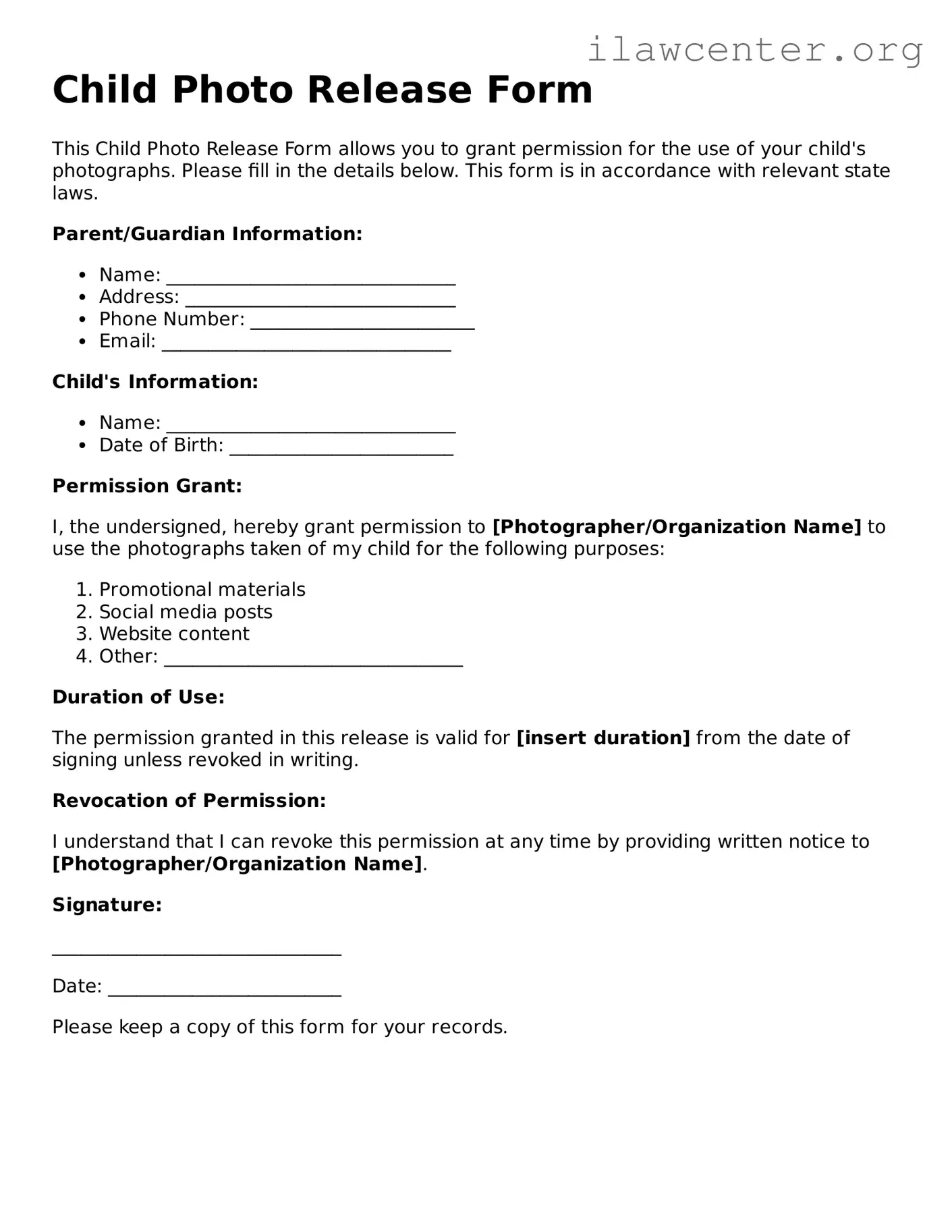
Child Photo Release Preview

Child Photo Release Form

This Child Photo Release Form allows you to grant permission for the use of your child's photographs. Please fill in the details below. This form is in accordance with relevant state laws.

Parent/Guardian Information:

  • Name: _______________________________
  • Address: _____________________________
  • Phone Number: ________________________
  • Email: _______________________________

Child's Information:

  • Name: _______________________________
  • Date of Birth: ________________________

Permission Grant:

I, the undersigned, hereby grant permission to [Photographer/Organization Name] to use the photographs taken of my child for the following purposes:

  1. Promotional materials
  2. Social media posts
  3. Website content
  4. Other: ________________________________

Duration of Use:

The permission granted in this release is valid for [insert duration] from the date of signing unless revoked in writing.

Revocation of Permission:

I understand that I can revoke this permission at any time by providing written notice to [Photographer/Organization Name].

Signature:

_______________________________

Date: _________________________

Please keep a copy of this form for your records.

PDF Form Characteristics

Fact Name Description
Purpose A Child Photo Release form allows parents or guardians to grant permission for the use of their child's photographs.
Consent Requirement Consent must be obtained from a parent or legal guardian before using a child's image for commercial or promotional purposes.
Scope of Use The form specifies how and where the child's image may be used, including print, online, or other media.
Duration Permissions can be granted for a specific time period or indefinitely, depending on the agreement.
State-Specific Laws Some states have specific laws governing the use of children's images, such as California Civil Code § 3344.
Revocation Parents or guardians may have the right to revoke consent at any time, depending on state laws and the terms of the form.
Compensation The form may outline whether the child or guardian will receive compensation for the use of the child's image.
Legal Protection A properly executed release form protects the photographer and the entity using the images from potential legal disputes.

Instructions on Utilizing Child Photo Release

Filling out a Child Photo Release form is straightforward. This document allows you to grant permission for the use of your child's photographs in various media. After completing the form, you'll be able to submit it to the relevant party, ensuring that everyone is on the same page regarding the use of your child's images.

  1. Begin by entering the name of your child in the designated space.
  2. Provide your full name as the parent or guardian.
  3. Fill in your contact information, including your phone number and email address.
  4. Specify the date when you are completing the form.
  5. Read through the terms outlined in the form carefully.
  6. Indicate your consent by signing your name in the appropriate section.
  7. Print your name below your signature to clarify who has signed the document.
  8. Finally, add the date next to your signature to confirm when you granted permission.

Important Facts about Child Photo Release

What is a Child Photo Release form?

A Child Photo Release form is a legal document that allows parents or guardians to grant permission for the use of their child's photographs. This form is often used by photographers, schools, and organizations to ensure that they have the right to publish or distribute images of children in various media, such as websites, brochures, or social media.

Why is a Child Photo Release form important?

This form is important because it protects the rights of both the child and the parent or guardian. It ensures that the child's image is used in a manner that the parent or guardian approves of, and it provides legal protection for the entity using the images. Without this consent, the use of a child's photo could lead to legal issues.

Who needs to sign the Child Photo Release form?

The form must be signed by the child's parent or legal guardian. This ensures that the individual who has the legal authority over the child is the one granting permission for the use of the child's likeness.

What types of uses are covered by the Child Photo Release form?

The form typically covers a variety of uses, including but not limited to promotional materials, social media posts, websites, and other marketing materials. It can also cover educational uses, such as school newsletters or yearbooks. Specific uses should be clearly outlined in the form to avoid any confusion.

Can a Child Photo Release form be revoked?

Is there a specific format for a Child Photo Release form?

Do I need a Child Photo Release form for every photo taken?

Common mistakes

Filling out a Child Photo Release form can seem straightforward, but many people make common mistakes that can lead to complications. One frequent error is failing to provide complete information. Each section of the form should be filled out accurately. Omitting details like the child's full name or the date can cause delays in processing.

Another mistake is not obtaining proper consent from all guardians. If both parents or legal guardians are involved, their signatures are typically required. Ignoring this step can render the release invalid and create legal issues down the line.

Some individuals overlook the importance of specifying the purpose of the photo release. The form should clearly outline how the images will be used. Without this clarity, misunderstandings may arise, leading to disputes over usage rights.

Additionally, people often forget to check the expiration date of the release. A photo release should have a defined time frame for which it is valid. Without this, the rights may remain ambiguous, complicating future use of the photos.

Another common error is failing to read the entire form before signing. Many individuals rush through the process and miss critical information or clauses. This oversight can lead to unintended consequences, especially if the terms are not fully understood.

Some may also neglect to keep a copy of the signed form. It is essential to retain documentation for personal records. Without a copy, proving consent or understanding the terms can become challenging.

In some cases, people do not consider the implications of sharing the release with third parties. If the form allows for broader use of the images, those involved should be aware of how their child’s likeness may be used by others.

Finally, individuals sometimes fail to update the form if circumstances change. For instance, if a guardian's contact information or relationship status changes, it’s crucial to revise the form accordingly. Keeping the information current protects everyone involved.
Documents used along the form

When engaging in activities that involve the use of a child's image, several forms and documents often accompany the Child Photo Release form. Each of these documents serves a specific purpose and helps protect the rights and interests of all parties involved. Below is a list of commonly used documents.

  • Parental Consent Form: This document secures permission from a parent or guardian for their child to participate in activities, ensuring that they are informed about the nature of the event.
  • Medical Release Form: This form allows parents to authorize medical treatment for their child in case of an emergency, ensuring that care can be provided without delay.
  • Liability Waiver: A liability waiver protects organizations from legal claims related to injuries or accidents that may occur during an event, safeguarding both the organization and the participants.
  • Event Registration Form: This form collects essential information about participants, such as contact details and emergency contacts, facilitating smooth communication and organization during events.
  • Code of Conduct Agreement: This document outlines expected behavior and responsibilities for participants, helping to create a safe and respectful environment.
  • Photo/Video Consent Form: Similar to the Child Photo Release form, this document specifically addresses consent for the use of video footage, ensuring clarity about how recordings will be used.
  • Release of Information Form: This form allows for the sharing of specific information about the child, which may be necessary for coordination with schools, medical professionals, or other organizations.
  • Emergency Contact Form: This document provides vital information regarding whom to contact in case of an emergency, ensuring that immediate assistance can be reached if needed.

These documents work together to create a comprehensive framework for managing the participation of children in various activities. Each form plays a vital role in ensuring the safety, rights, and well-being of the child while also protecting the interests of organizations and individuals involved.

Similar forms

The Child Photo Release form is an important document that grants permission for the use of a child's image in various contexts. Similar documents serve comparable purposes, often focusing on consent and the use of personal information or images. Here are ten documents that share similarities with the Child Photo Release form:

  • Adult Photo Release Form: This document is used to obtain consent from an adult for the use of their image in promotional materials, videos, or other media. Like the Child Photo Release, it ensures that the individual understands how their image will be used.
  • Video Release Form: This form allows individuals to grant permission for their likeness to be captured in video recordings. It is similar to the Child Photo Release in that it focuses on visual representation and consent.
  • Testimonial Release Form: When a person provides a testimonial, this form is used to obtain permission to publish their words and likeness. It parallels the Child Photo Release by emphasizing consent for public use.
  • Social Media Release Form: This document is designed for individuals to consent to the sharing of their images or videos on social media platforms. It shares the same goal of ensuring informed consent as the Child Photo Release.
  • Event Waiver and Release: Often used at events, this form protects organizers by obtaining consent from participants to use their images. It is akin to the Child Photo Release in its focus on protecting the rights of the organizer while respecting individual consent.
  • Model Release Form: This document is specifically for models to grant permission for photographers to use their images for commercial purposes. It serves a similar function to the Child Photo Release by outlining the terms of use for the likeness.
  • Audio Release Form: This form allows individuals to consent to the use of their voice in recordings or broadcasts. It shares the same principle of consent as the Child Photo Release, focusing on audio representation.
  • Parental Consent Form: Often used in educational settings, this form allows parents to give permission for their child’s participation in activities, including media recording. It is similar in that it requires parental approval for the use of a child's image.
  • Publicity Release Form: This document grants permission for the use of an individual’s image or name for promotional purposes. Like the Child Photo Release, it emphasizes the importance of consent in public representation.
  • Consent for Medical Photography: In healthcare settings, this form is used to obtain consent for taking and using photographs for medical purposes. It parallels the Child Photo Release by ensuring that consent is obtained before capturing and using images.

Dos and Don'ts

When filling out a Child Photo Release form, it is important to follow certain guidelines to ensure clarity and compliance. Here are six things you should and shouldn't do:

  • Do read the entire form carefully before signing.
  • Do provide accurate information about the child and the parent or guardian.
  • Do specify the purpose for which the photos may be used.
  • Do keep a copy of the signed form for your records.
  • Don't leave any required fields blank.
  • Don't sign the form if you do not agree with the terms outlined.

Misconceptions

Understanding the Child Photo Release form is crucial for parents and guardians. However, several misconceptions often arise regarding its purpose and implications. Here are five common misconceptions:

  • It gives away all rights to the child's image. Many believe that signing a release form means they lose all control over their child's photos. In reality, the form typically grants permission for specific uses, and parents can specify how and where the images may be used.
  • It's only necessary for professional photographers. Some think that only professional photographers require a release form. However, any individual or organization planning to use a child's image for promotional or public purposes should obtain a release to protect both the child and themselves.
  • Once signed, it cannot be revoked. A common belief is that a signed release is permanent and cannot be changed. In fact, parents may have the ability to revoke permission in certain circumstances, depending on the terms outlined in the form.
  • It is not legally binding. Some assume that a Child Photo Release form is merely a formality and lacks legal weight. On the contrary, when properly executed, it can serve as a legally binding document that protects the rights of both the child and the photographer or organization.
  • It only applies to photos taken in public. Many people think a release is unnecessary for photos taken in public spaces. However, even images captured in public settings can require a release if they are used commercially or in a way that identifies the child.

Clarifying these misconceptions can help ensure that parents make informed decisions about their child's image and privacy.

Key takeaways

Filling out and using a Child Photo Release form is an important step for anyone working with children in various contexts, such as schools, camps, or community organizations. Here are key takeaways to consider:

  1. Obtain Consent: Always secure permission from a parent or guardian before taking or using a child's photo.
  2. Understand the Purpose: Clarify why the photos are being taken and how they will be used, whether for promotional materials, websites, or social media.
  3. Be Specific: Clearly outline the scope of the release. Specify the types of media in which the photos may appear.
  4. Include Contact Information: Ensure that the form collects contact details for the parent or guardian for any follow-up questions.
  5. Consider Age Appropriateness: Tailor the language of the form to be understandable for the age group involved.
  6. Keep Records: Maintain a copy of the signed release form for your records, as it serves as proof of consent.
  7. Allow for Withdrawal: Make it clear that parents or guardians can revoke consent at any time and outline the process for doing so.
  8. Review Local Laws: Be aware of any state or local regulations regarding the use of children's images.
  9. Communicate Clearly: Provide clear instructions on how to fill out the form and what to do with it once completed.

By following these guidelines, individuals and organizations can respect the rights of children and their families while effectively using photographs for various purposes.