Fillable Child Travel Consent Form Document

Fillable Child Travel Consent Form Document

A Child Travel Consent Form is a legal document that grants permission for a minor to travel with someone other than their parents or legal guardians. This form is essential for ensuring that all parties involved are aware of the travel arrangements and have consented to them. If you need to prepare this document, click the button below to fill out the form.

Article Guide

Traveling with children can be an exciting adventure, but it also comes with important responsibilities. One crucial aspect of ensuring a smooth journey is the Child Travel Consent Form. This document serves as a formal agreement from a parent or legal guardian, granting permission for a child to travel with someone else, whether it's a family member, friend, or even a group. The form typically includes essential details such as the child’s name, the names of the accompanying adult(s), and the destination of travel. It may also outline the duration of the trip and any specific activities planned. Having this consent form can help prevent misunderstandings and potential legal issues at borders or during travel, providing peace of mind for both the child and the adult responsible for their care. Understanding the significance of this document is vital for anyone planning to travel with minors, ensuring that all necessary precautions are taken for a safe and enjoyable experience.

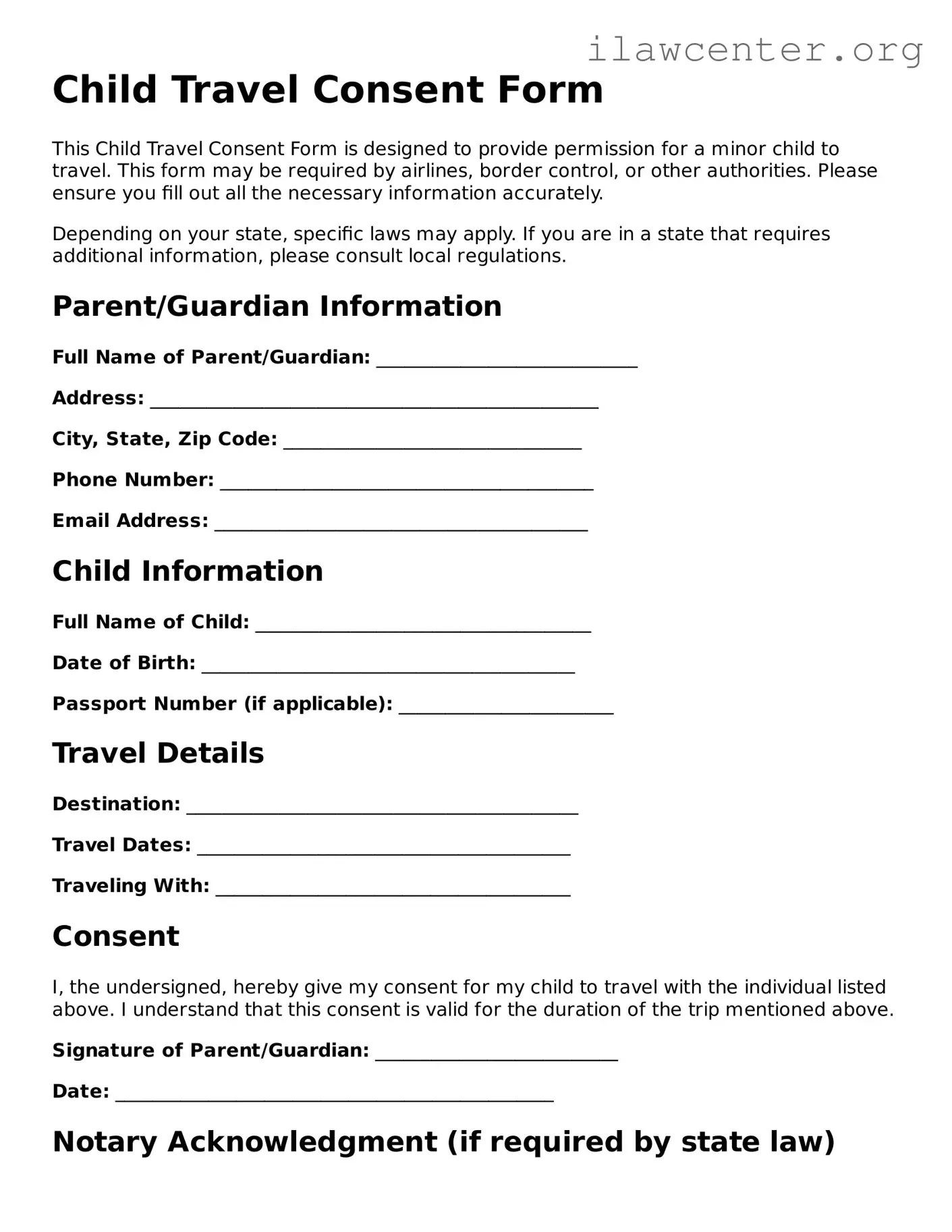
Child Travel Consent Form

This Child Travel Consent Form is designed to provide permission for a minor child to travel. This form may be required by airlines, border control, or other authorities. Please ensure you fill out all the necessary information accurately.

Depending on your state, specific laws may apply. If you are in a state that requires additional information, please consult local regulations.

Parent/Guardian Information

Full Name of Parent/Guardian: ____________________________

Address: ________________________________________________

City, State, Zip Code: ________________________________

Phone Number: ________________________________________

Email Address: ________________________________________

Child Information

Full Name of Child: ____________________________________

Date of Birth: ________________________________________

Passport Number (if applicable): _______________________

Travel Details

Destination: __________________________________________

Travel Dates: ________________________________________

Traveling With: ______________________________________

Consent

I, the undersigned, hereby give my consent for my child to travel with the individual listed above. I understand that this consent is valid for the duration of the trip mentioned above.

Signature of Parent/Guardian: __________________________

Date: _______________________________________________

Notary Acknowledgment (if required by state law)

State of _______________

County of _______________

Subscribed and sworn to before me this _____ day of __________, 20__.

Notary Public Signature: _____________________________

My Commission Expires: _____________________________

Thank you for ensuring the safety and legality of your child's travel plans. Always keep a copy of this form for your records.

PDF Form Characteristics

Fact Name Details
Purpose A Child Travel Consent Form allows a minor to travel with someone who is not their parent or legal guardian, ensuring that the adult has permission to take the child on a trip.
Requirements Typically, the form must be signed by both parents or legal guardians. It may need to be notarized, depending on state laws.
State-Specific Forms Many states have their own versions of the form. For example, California requires compliance with Family Code Section 6940.
Use Cases This form is often used for international travel, but it can also be beneficial for domestic trips, especially when crossing state lines.

Filling out the Child Travel Consent Form is an important step when planning to travel with a child. This form provides the necessary permissions and information to ensure a smooth travel experience. Follow the steps below to complete the form accurately.

  1. Begin by entering the full name of the child as it appears on their identification.
  2. Provide the child’s date of birth in the specified format.
  3. List the names of the parents or legal guardians. Include both first and last names.
  4. Fill in the contact information for the parents or guardians, including phone numbers and email addresses.
  5. Specify the travel destination, including the country and any specific locations.
  6. Indicate the dates of travel, including the departure and return dates.
  7. Include the name of the adult traveling with the child, if applicable.
  8. Provide any additional details or special instructions that may be relevant to the travel.
  9. Sign and date the form at the bottom. Make sure the signature is that of a parent or legal guardian.

Once you have completed the form, review it for accuracy. Ensure all necessary signatures are in place. Keep a copy for your records before submitting it as required for your travel plans.

What is a Child Travel Consent Form?

A Child Travel Consent Form is a legal document that grants permission for a child to travel with someone other than their parent or legal guardian. This form is particularly important when a child is traveling domestically or internationally, as it helps prevent potential issues related to custody disputes or parental abduction. By providing this consent, parents or guardians can ensure that the child can travel safely and legally with another adult, such as a relative, family friend, or travel group leader.

Who needs to sign the Child Travel Consent Form?

The form typically requires the signatures of both parents or legal guardians. If one parent has sole custody, that individual may only need to sign the document. In cases where one parent is unavailable, such as in instances of separation or divorce, it may be necessary to provide additional documentation, such as a custody agreement or court order, to clarify the situation. It is essential to ensure that all necessary parties are involved in the consent process to avoid any complications during travel.

What information is included in the form?

The Child Travel Consent Form generally includes several key pieces of information. First, it will identify the child, including their full name, date of birth, and any relevant identification numbers. Next, the form will specify the name of the adult accompanying the child, along with their contact information. Additionally, the document may outline the travel itinerary, including dates, destinations, and modes of transportation. Lastly, it often includes a statement of consent from the parents or guardians, affirming their approval for the child to travel with the designated adult.

Is a Child Travel Consent Form required for all travel?

While a Child Travel Consent Form is not legally required for every travel situation, it is highly recommended, especially for international trips. Many airlines, border control agencies, and customs officials may ask for this documentation to ensure the child's safety and verify that they have permission to travel. For domestic travel, requirements can vary by airline and destination, so it is wise to check with the relevant authorities or travel providers beforehand. Having the form can help prevent delays or complications during the journey.

How can I obtain a Child Travel Consent Form?

Obtaining a Child Travel Consent Form is relatively straightforward. Many legal websites provide templates that can be downloaded and customized. Additionally, some travel agencies and family law offices may offer the form as part of their services. It is important to ensure that the form complies with the laws of the state or country where you reside, as requirements may vary. When filling out the form, accuracy is crucial, so double-check all information before signing and notarizing the document if necessary.

Common mistakes

Filling out the Child Travel Consent Form can be straightforward, but many people make common mistakes that can lead to delays or complications. One frequent error is incomplete information. Parents or guardians often forget to fill in all required fields, such as the child's full name, date of birth, or travel dates. Leaving any section blank can raise questions and delay the approval process.

Another common mistake is not providing proper identification. The form typically requires a copy of the child's passport or other identification. Failing to include this documentation can result in the form being rejected or not processed in a timely manner.

Some individuals overlook the importance of notarization. Many jurisdictions require the consent form to be notarized to ensure its authenticity. Skipping this step can lead to issues when the child attempts to travel, as authorities may not accept an unnotarized form.

Additionally, people often forget to check the validity of signatures. Both parents or legal guardians usually need to sign the form. If one signature is missing or not properly executed, it can render the form invalid. It is essential to ensure that all required signatures are present before submitting the form.

Another mistake involves using outdated forms. Regulations and requirements can change, and using an old version of the Child Travel Consent Form may lead to complications. Always check for the most recent version to ensure compliance with current laws.

In some cases, individuals fail to provide travel details. The form should include specific information about the trip, such as destinations, travel dates, and the name of the adult accompanying the child. Omitting these details can lead to confusion or rejection of the form.

Moreover, people sometimes neglect to review the form for errors before submission. Simple mistakes like typos or incorrect dates can cause significant issues. Taking the time to double-check the form can help avoid unnecessary problems.

Finally, many individuals do not keep copies of the completed form. It is crucial to retain a copy for personal records and for any future travel needs. Without a copy, it may be challenging to address any issues that arise during the travel process.

Documents used along the form

When planning to travel with a child, it is important to have the appropriate documentation in order to ensure a smooth journey. Along with the Child Travel Consent Form, several other forms and documents may be necessary to facilitate travel. Below are five commonly used documents that can help in this process.

  • Passport: A passport is an official government document that certifies a person's identity and nationality. For international travel, each child must have their own passport.
  • Birth Certificate: A birth certificate serves as proof of a child's age and identity. It may be required to verify the relationship between the adult and the child during travel.
  • Travel Insurance Policy: This document provides coverage for unexpected events such as medical emergencies, trip cancellations, or lost luggage. It is advisable to have insurance to protect against potential risks while traveling.
  • Medical Consent Form: This form grants permission for medical treatment in case of an emergency. It is crucial to have this document in case the child requires medical attention while away from home.
  • Itinerary: An itinerary outlines the travel plans, including flight details, accommodation information, and planned activities. Having a clear itinerary can help in case of emergencies or unexpected changes during travel.

Having these documents prepared and organized can help ensure that traveling with a child is a positive experience. Each document plays a vital role in safeguarding the child's welfare and ensuring compliance with legal requirements during travel.

Similar forms

  • Parental Consent Form: This document grants permission for a child to engage in specific activities, such as medical treatment or participation in events. Like the Child Travel Consent Form, it requires signatures from guardians and outlines the scope of consent.
  • Medical Consent Form: When a child requires medical treatment, this form allows parents or guardians to authorize healthcare providers to proceed with necessary procedures. It shares the same purpose of ensuring that a child's welfare is prioritized during absence or emergencies.
  • Travel Insurance Waiver: This document is often used to acknowledge that a guardian understands the risks associated with travel and agrees to waive certain liabilities. Similar to the Child Travel Consent Form, it involves parental acknowledgment and consent regarding a child's safety while traveling.
  • School Field Trip Permission Slip: Schools often require this form to obtain consent from parents for their children to participate in off-campus activities. It serves a similar function by ensuring that parents are informed and approve of their child's participation.
  • Emergency Contact Form: This document provides essential information about whom to contact in case of an emergency involving a child. It parallels the Child Travel Consent Form by ensuring that guardians are informed and can be reached if issues arise during travel.
  • Child Care Authorization Form: Parents use this form to designate someone else to care for their child temporarily. It is akin to the Child Travel Consent Form, as both documents require clear consent from guardians regarding the care and supervision of a child.
  • Visitation Agreement: In cases of custody arrangements, this agreement outlines the terms for a child’s visitation with a non-custodial parent. It shares similarities with the Child Travel Consent Form in that it establishes consent and guidelines for the child’s whereabouts.
  • Adoption Consent Form: This legal document is used when a parent consents to the adoption of their child. Both this form and the Child Travel Consent Form involve parental consent and detail the rights and responsibilities of the parties involved.
  • Power of Attorney for Minor Child: This document allows a designated adult to make decisions on behalf of a child. It is similar to the Child Travel Consent Form as it requires parental consent and outlines the authority granted to another individual.
  • Child Medical History Form: This form collects information about a child's medical background, which is essential for caregivers. Like the Child Travel Consent Form, it ensures that anyone responsible for the child is aware of their health needs and any pertinent information.

Dos and Don'ts

When filling out the Child Travel Consent Form, it's important to ensure that all information is accurate and complete. Here are some key points to consider:

  • Do provide all required information, including the child's full name and travel details.
  • Do ensure that both parents or legal guardians sign the form if applicable.
  • Do double-check for any spelling errors or incorrect information.
  • Do include contact information for the adult traveling with the child.
  • Don't leave any fields blank unless specified; incomplete forms may be rejected.
  • Don't use outdated versions of the form; always download the latest version.
  • Don't forget to keep a copy of the signed form for your records.

Following these guidelines will help ensure a smooth travel experience for you and your child. Act promptly to avoid any last-minute issues.

Misconceptions

When it comes to traveling with children, understanding the Child Travel Consent Form is essential. However, several misconceptions often arise. Here are ten common misunderstandings about this form:

  1. It is only needed for international travel.

    Many believe that the consent form is necessary only for trips outside the United States. In reality, it can also be beneficial for domestic travel, especially when a child is traveling with one parent or a guardian.

  2. Only parents can provide consent.

    While parents typically complete the form, legal guardians or other authorized adults can also provide consent. It is important that the person completing the form has the legal authority to do so.

  3. The form is not legally binding.

    Some people think that the consent form holds no legal weight. However, it can serve as a useful document to demonstrate consent, especially in situations where proof may be required.

  4. It is not necessary if both parents are traveling.

    Even if both parents are traveling together, having a consent form can help clarify any potential misunderstandings or disputes that may arise during the trip.

  5. All airlines require the same form.

    Different airlines may have varying requirements regarding the consent form. It is important to check with the specific airline to ensure compliance with their policies.

  6. The form must be notarized.

    While notarization can add an extra layer of credibility, it is not always a requirement. Many situations allow for a simple signed form without a notary.

  7. It can be filled out last minute.

    Some travelers think they can complete the form just before departure. However, it is best to prepare the form well in advance to avoid any last-minute issues.

  8. Only one form is needed for multiple children.

    Travelers often assume that one form can cover multiple children. In fact, each child should have their own individual consent form to ensure clarity and compliance.

  9. It is only necessary for vacations.

    Some people believe the form is only needed for leisure travel. However, it can also be important for other situations, such as school trips or visits to family members.

  10. The form is the same in every state.

    While the general purpose of the form is consistent, specific requirements may vary by state. It is advisable to check local laws to ensure the form meets all necessary regulations.

Understanding these misconceptions can help ensure a smoother travel experience for both children and their guardians.

Key takeaways

Filling out and using the Child Travel Consent Form is an important step for parents and guardians when traveling with minors. Here are key takeaways to keep in mind:

  • Purpose of the Form: The Child Travel Consent Form grants permission for a child to travel with someone other than their parent or legal guardian.
  • Required Information: The form typically requires details such as the child's name, date of birth, and the names of the accompanying adult(s).
  • Notarization: While notarization is not always required, having the form notarized can add an extra layer of legitimacy and may be requested by authorities.
  • Travel Destination: Clearly state the destination and duration of travel to avoid any confusion or issues at checkpoints.
  • Emergency Contact: Include an emergency contact number for the parent or guardian in case any issues arise during travel.
  • Multiple Copies: It is advisable to carry multiple copies of the completed form. Keep one with the child and provide another to the accompanying adult.
  • Check Requirements: Different countries and airlines may have specific requirements regarding child travel consent, so it’s important to check these before traveling.