Clinical Social Experience Verification PDF Template

Clinical Social Experience Verification PDF Template

The Clinical Social Experience Verification form is a crucial document required for individuals seeking licensure as clinical social workers in California. This form must be completed by a supervisor who has overseen the applicant's clinical experience, ensuring that all necessary information is accurately provided. To initiate the process of verification, please fill out the form by clicking the button below.

Article Guide

The Clinical Social Experience Verification form is a crucial document for aspiring clinical social workers in California, serving as a key component of the licensure application process. This form requires detailed information about both the applicant and their supervisor, ensuring that the applicant has received appropriate training and supervision in a legitimate clinical setting. Each applicant must submit a separate form for each supervisor and employer, highlighting the importance of accurate and thorough documentation. Supervisors are responsible for verifying that the applicant's work aligns with the state's experience and supervision requirements, as well as confirming that the setting provided lawful clinical social work or mental health counseling. Key sections of the form include the applicant's employer information, supervisor details, and a comprehensive breakdown of the applicant's supervised experience, including total hours worked, types of supervision received, and specific clinical activities performed. Additionally, the form emphasizes the necessity of an original or electronic signature from the supervisor, underscoring the importance of authenticity and accountability in the application process. By ensuring that all these aspects are meticulously addressed, applicants can move forward confidently in their pursuit of licensure.

Clinical Social Experience Verification Preview

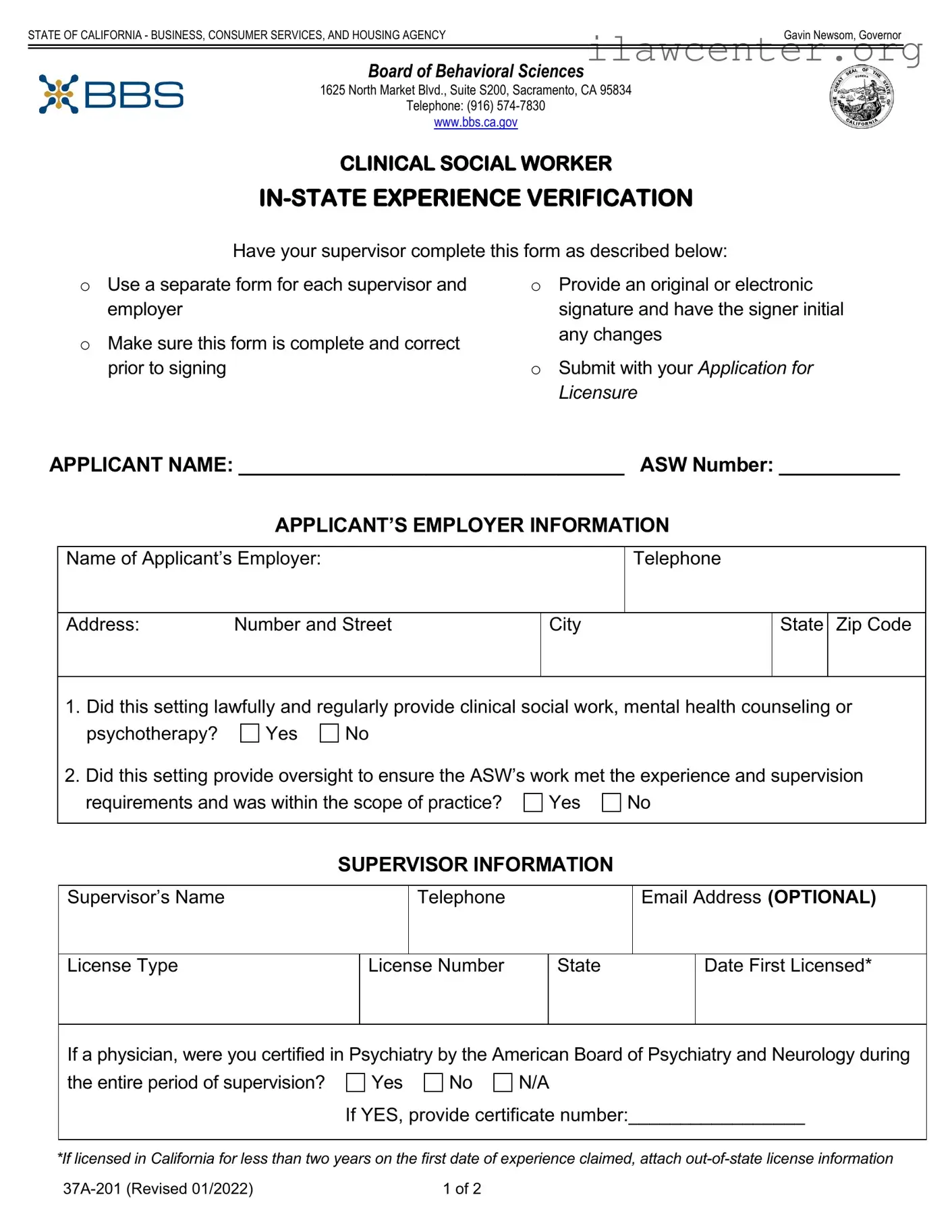
37A-201 (Revised 01/2022) 1 of 2
STATE OF CALIFORNIA - BUSINESS, CONSUMER SERVICES, AND HOUSING AGENCY Gavin Newsom, Governor
Board of Behavioral Sciences
1625 North Market Blvd., Suite S200, Sacramento, CA 95834
Telephone: (916) 574-7830
www.bbs.ca.gov
CLINICAL SOCIAL WORKER
IN-STATE EXPERIENCE VERIFICATION
Have your supervisor complete this form as described below:
o Use a separate form for each supervisor and
employer
o Make sure this form is complete and correct
prior to signing
o Provide an original or electronic
signature and have the signer initial
any changes
o Submit with your Application for
Licensure
APPLICANT NAME: ___________________________________ ASW Number: ___________
APPLICANT’S EMPLOYER INFORMATION
Name of Applicant’s Employer:
Telephone
Address: Number and Street
City
State
1. Did this setting lawfully and regularly provide clinical social work, mental health counseling or
psychotherapy? Yes No
2. Did this setting provide oversight to ensure the ASW’s work met the experience and supervision
requirements and was within the scope of practice? Yes No
SUPERVISOR INFORMATION
Supervisor’s Name
Telephone
Email Address (OPTIONAL)
License Type
License Number
State
Date First Licensed*
If a physician, were you certified in Psychiatry by the American Board of Psychiatry and Neurology during
the entire period of supervision? Yes No N/A
If YES, provide certificate number:_________________
*If licensed in California for less than two years on the first date of experience claimed, attach out-of-state license information
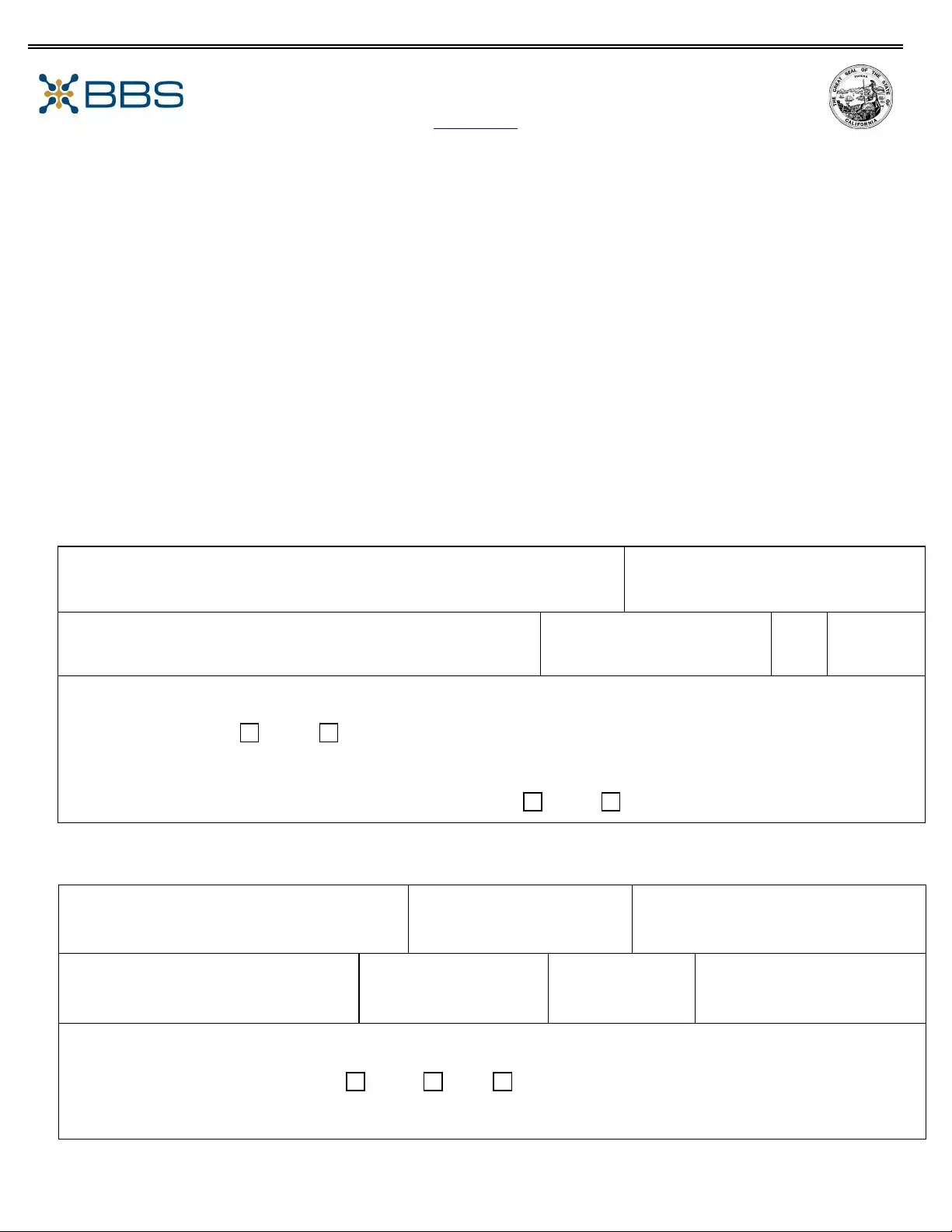
37A-201 (Revised 01/2022) 2 of 2
APPLICANT NAME: __________________________________________ ASW#: _______________
SUPERVISOR INFORMATION (continued)
Were you (the supervisor) employed by the supervisee’s employer? Yes No
If NO, did you and the supervisee’s employer sign a written agreement pertaining to oversight of
the supervisee? Yes No
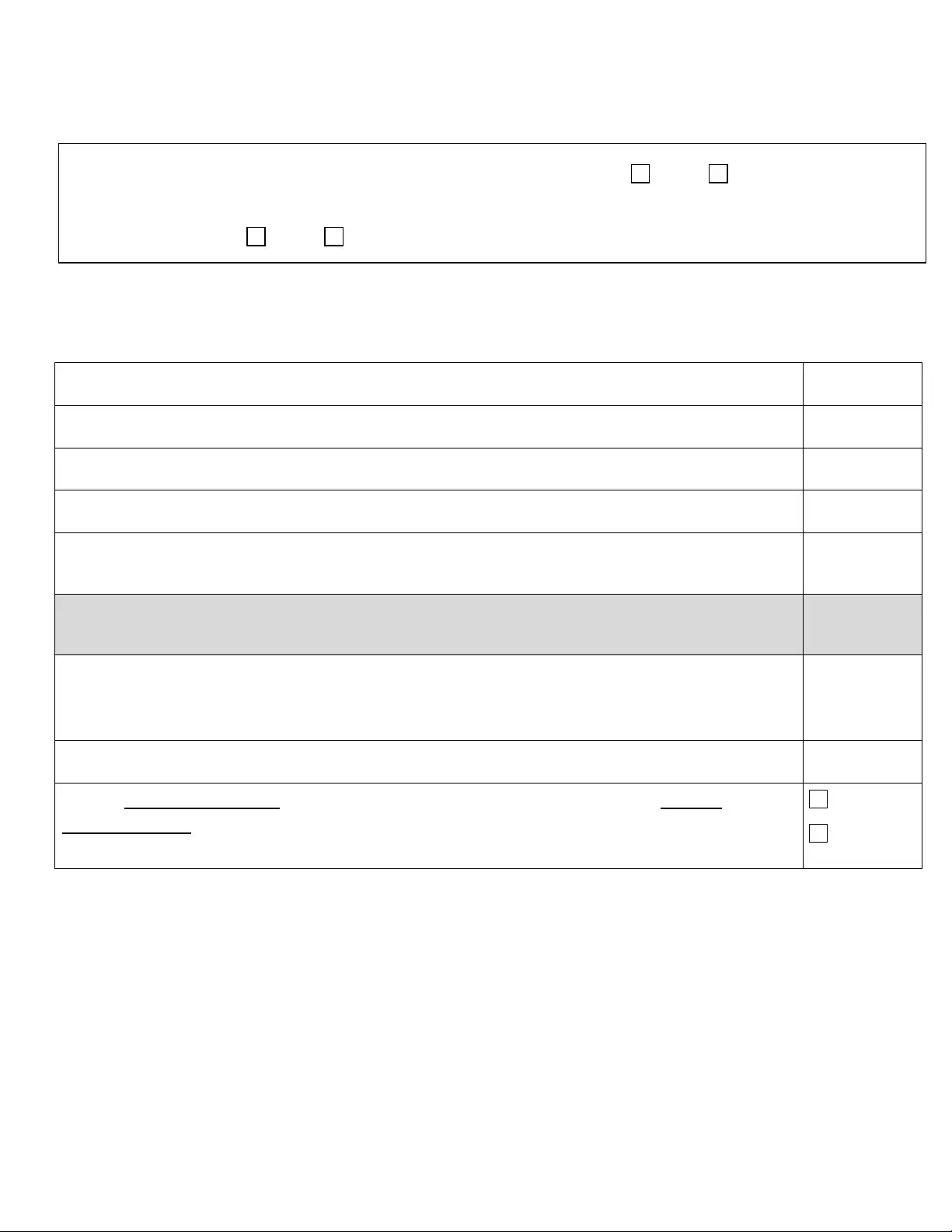
EXPERIENCE INFORMATION: Dates of experience: From ____________ to ____________
(mm/dd/yyyy) (mm/dd/yyyy)
1. Total supervised weeks (Minimum 104 overall):
2. Total hours in individual or triadic supervision (Minimum 52 overall):
3. Total hours in group supervision:
4. Average hours worked per week (Maximum 40):
5. Total hours of clinical psychosocial diagnosis, assessment, and treatment, including
individual or group psychotherapy / counseling (Minimum 2,000 overall):
A.
6. Of the above hours, how many were gained performing face-to-face individual or
group psychotherapy/counseling (Minimum 750 overall):
7. Total hours of client-centered advocacy, consultation, evaluation, research,
workshops, seminars, training sessions or conferences and direct supervisor contact*
(Maximum 1,000 overall):
B.
8. Total hours of experience (Minimum 3,000 overall): (A + B = C) C.
9. Was one additional hour of face-to-face individual or triadic supervision OR two
additional hours of face-to-face group supervision provided for every week in which more
than 10 hours of direct clinical counseling was performed?
Yes
No
*A maximum of six (6) hours of direct supervisor contact per week may be counted toward
the 1,000 hours.
NOTE: Knowingly providing false information or omitting pertinent information may be
grounds for denial of the application. The Board may take disciplinary action on a licensee
who helps an applicant obtain a license by fraud, deceit or misrepresentation. All information
on this form is subject to verification.
Signature of Supervisor: _____________________________________ Date: ______________
ORIGINAL OR ELECTRONIC SIGNATURE REQUIRED

File Properties

Fact Name Details
Governing Body The Clinical Social Experience Verification form is governed by the Board of Behavioral Sciences in California.
Purpose This form verifies the clinical social work experience of an Associate Social Worker (ASW) under supervision.
Completion Requirement Each supervisor must complete a separate form for each ASW they supervise.
Signature Requirement The supervisor must provide an original or electronic signature, and initial any changes made to the form.
Experience Verification The form ensures that the ASW's work meets the required experience and supervision standards.
Minimum Supervision Hours A minimum of 104 weeks of supervised experience is required to qualify.
Clinical Hours ASWs must complete at least 3,000 hours of total experience, including 2,000 hours of clinical work.
Face-to-Face Requirements At least 750 hours of the clinical experience must involve face-to-face individual or group therapy.
Supervisor's Qualifications The supervisor must hold a valid license in their field and provide verification of their qualifications.
False Information Consequences Providing false information on this form may result in application denial or disciplinary action against the licensee.

Instructions on Utilizing Clinical Social Experience Verification

After completing the Clinical Social Experience Verification form, you will need to submit it along with your application for licensure. Make sure all information is accurate and that your supervisor has signed the form. Follow the steps below to fill it out correctly.

  1. Write your name and ASW number at the top of the form.
  2. Provide your employer's information, including the name, telephone number, and address.
  3. Answer the first two questions regarding the setting's compliance and oversight. Mark "Yes" or "No" for each question.
  4. Fill in your supervisor's details, including their name, telephone number, email address (optional), license type, license number, and state.
  5. Indicate the date your supervisor was first licensed.
  6. If your supervisor is a physician, answer whether they were certified in Psychiatry during the entire supervision period. If "Yes," include the certificate number.
  7. State whether your supervisor was employed by your employer. Answer "Yes" or "No."
  8. If "No," confirm if there was a written agreement between your supervisor and your employer regarding oversight.
  9. Fill out the experience information section with the dates of your experience, total supervised weeks, and hours for supervision and clinical work.
  10. Ensure the total hours for clinical psychosocial diagnosis, assessment, and treatment meet the minimum requirements.
  11. Answer the question about additional supervision hours based on your direct clinical counseling.
  12. Have your supervisor sign and date the form, ensuring that their signature is original or electronic.

Important Facts about Clinical Social Experience Verification

What is the purpose of the Clinical Social Experience Verification form?

The Clinical Social Experience Verification form is designed to confirm that an Associate Social Worker (ASW) has completed the necessary clinical social work experience under the supervision of a qualified professional. This verification is essential for the licensure process in California, ensuring that applicants meet the required standards before becoming licensed clinical social workers.

Who needs to complete this form?

This form must be completed by the ASW's supervisor. Each supervisor must fill out a separate form for every employer the ASW has worked for. It's crucial that the supervisor provides accurate information regarding the ASW's clinical experience and supervision.

What information is required from the supervisor?

The supervisor must provide their name, contact information, license type, license number, and the date they were first licensed. If applicable, they must also indicate whether they were certified in Psychiatry by the American Board of Psychiatry and Neurology during the supervision period. Additionally, the supervisor must confirm the nature of the clinical setting and the oversight provided to the ASW.

What should I do if my supervisor is not employed by my employer?

If the supervisor is not employed by the ASW's employer, a written agreement must be signed by both the supervisor and the employer. This agreement should outline the terms of oversight for the ASW's work. It's important to ensure that all documentation is complete and accurate to avoid delays in the licensure process.

What are the minimum requirements for supervised experience?

The form outlines several minimum requirements, including a total of at least 3,000 hours of experience, with a minimum of 2,000 hours dedicated to clinical psychosocial diagnosis, assessment, and treatment. Additionally, there must be at least 750 hours of face-to-face individual or group psychotherapy. Supervision hours also have specific minimums that must be met.

What happens if I provide false information on this form?

Providing false information or omitting important details can lead to serious consequences, including the denial of your application for licensure. The Board of Behavioral Sciences may also take disciplinary action against any licensee who assists an applicant in obtaining a license through fraudulent means. It is imperative to ensure that all information provided is truthful and complete.

How should I submit the completed form?

The completed Clinical Social Experience Verification form should be submitted along with your Application for Licensure. Ensure that the form is signed by the supervisor, either with an original or electronic signature, and that any changes are initialed by the signer. Submitting accurate and complete documentation is essential for a smooth licensure process.

Where can I find more information about the licensure process?

For more information regarding the licensure process, including the Clinical Social Experience Verification form, you can visit the Board of Behavioral Sciences website at www.bbs.ca.gov. Additionally, you can contact the Board directly at (916) 574-7830 for any specific questions or concerns you may have.

Common mistakes

Completing the Clinical Social Experience Verification form is a crucial step in the licensure process for social workers. However, many applicants make mistakes that can delay their application or even lead to denial. Understanding these common errors can help ensure a smoother experience.

One frequent mistake is failing to use a separate form for each supervisor and employer. Each supervisor must complete their own verification form, regardless of how many supervisors an applicant has had. This requirement is in place to ensure that each supervisor's input is accurately represented. By not adhering to this guideline, applicants risk submitting an incomplete application, which can lead to unnecessary complications.

Another common error involves the accuracy of the information provided. It is essential to ensure that all details are complete and correct prior to signing the form. Inaccurate or incomplete information can raise red flags during the review process. For instance, if the total hours of clinical experience are miscalculated or if the supervisor's license information is incorrect, it may result in delays or a request for additional documentation.

Additionally, applicants sometimes overlook the importance of signatures. It is critical that the form includes an original or electronic signature from the supervisor. Any changes made to the form should be initialed by the supervisor as well. Neglecting to follow these signature protocols can lead to the form being considered invalid, further complicating the licensure process.

Finally, applicants may forget to provide the necessary documentation when required. For example, if a supervisor has been licensed for less than two years, the applicant must attach out-of-state license information. Failing to include such supporting documents can hinder the progress of the application. Being thorough and attentive to all requirements can greatly enhance the likelihood of a successful application.

Documents used along the form

When applying for licensure as a clinical social worker in California, several forms and documents may be needed alongside the Clinical Social Experience Verification form. Each document plays a crucial role in ensuring that the application process is smooth and complete. Here’s a brief overview of some of these important documents.

  • Application for Licensure: This is the primary form that you submit to apply for your clinical social work license. It gathers essential personal information, educational background, and work experience details.
  • Transcripts: Official transcripts from your educational institution are required. They verify that you have completed the necessary coursework and degree requirements for licensure.
  • Supervisor Agreement: This document outlines the terms of supervision between you and your supervisor. It ensures that both parties understand their responsibilities during the supervision period.
  • Background Check Authorization: A background check is typically required as part of the licensing process. This form allows the licensing board to conduct a thorough review of your criminal history and professional conduct.
  • Continuing Education Certificates: If applicable, you may need to provide proof of completed continuing education courses. This demonstrates your commitment to staying current in the field of social work.
  • Proof of Clinical Experience: Additional documentation that details your clinical hours and types of services provided may be required. This helps validate the information submitted in your Clinical Social Experience Verification form.

Gathering these documents can feel overwhelming, but each one is essential for a successful application. Ensuring that everything is accurate and complete will help you move forward in your journey to becoming a licensed clinical social worker.

Similar forms

  • Experience Verification Form: Similar to the Clinical Social Experience Verification form, this document is used to confirm an individual’s professional experience in a specific field. It typically requires details about the applicant's work history and supervisor information.
  • Supervisor Evaluation Form: This form allows supervisors to assess the performance of their supervisees. Like the Clinical Social Experience Verification form, it requires input from both the supervisor and the applicant regarding their professional relationship and experiences.
  • Internship Verification Form: This document verifies the completion of an internship. It shares similarities in requiring details about the intern's work, supervision, and the nature of the internship experience.
  • Professional Reference Form: This form collects references from professionals who can speak to an applicant's qualifications. It often includes sections for the referee to describe their relationship with the applicant, similar to the supervisory relationship outlined in the Clinical Social Experience Verification form.
  • Licensure Application Form: This document is part of the process for obtaining a professional license. It usually requires verification of experience and education, akin to the requirements found in the Clinical Social Experience Verification form.
  • Continuing Education Verification Form: This form is used to confirm the completion of required continuing education credits. It often includes similar verification elements, such as dates and types of training completed.
  • Employment Verification Form: This document verifies an individual's employment history. It requires similar information about the employer and the nature of the work performed, paralleling the details in the Clinical Social Experience Verification form.
  • Clinical Hours Log: This log tracks the hours spent in clinical practice. It serves a similar purpose of documenting experience, much like the Clinical Social Experience Verification form does for social workers.
  • Fieldwork Evaluation Form: This document is used to evaluate a student's performance during fieldwork placements. It shares the focus on supervision and experience verification found in the Clinical Social Experience Verification form.
  • Competency Assessment Form: This form assesses an individual's competencies in their field. It often requires detailed descriptions of experience and supervision, similar to the Clinical Social Experience Verification form.

Dos and Don'ts

Things to Do:

  • Use a separate form for each supervisor and employer.
  • Ensure the form is complete and correct before signing.
  • Provide an original or electronic signature.
  • Have the signer initial any changes made to the form.
  • Submit the form with your Application for Licensure.
  • Verify that the setting lawfully provided clinical social work or mental health counseling.
  • Confirm that supervision met the experience requirements.
  • Clearly state the total hours and weeks of supervised experience.

Things Not to Do:

  • Do not use the same form for multiple supervisors or employers.
  • Do not submit an incomplete or incorrect form.
  • Do not forget to sign the form.
  • Do not leave any required fields blank.
  • Do not provide false information or omit pertinent details.
  • Do not assume that verbal agreements are sufficient; written agreements are necessary.
  • Do not exceed the maximum hours allowed for direct supervisor contact.
  • Do not neglect to check the requirements for face-to-face supervision hours.

Misconceptions

  • Misconception 1: The Clinical Social Experience Verification form is optional.
  • Many believe that submitting this form is not necessary for licensure. In reality, it is a crucial part of the application process. Without it, your application may be incomplete, leading to delays or denial.

  • Misconception 2: Any supervisor can complete the form.
  • Not just anyone can sign off on this form. The supervisor must meet specific qualifications, including being licensed in a relevant field. This ensures that the experience being verified is legitimate and adheres to professional standards.

  • Misconception 3: The hours reported on the form can be estimated.
  • Some individuals think they can simply guess their hours of experience. However, accuracy is vital. The form requires precise reporting of hours worked, as discrepancies may lead to complications in the licensure process.

  • Misconception 4: The form does not need to be signed by the supervisor.
  • It is a common misunderstanding that a signature is not necessary. In fact, an original or electronic signature is required, along with initials for any changes. This helps verify the authenticity of the information provided.

Key takeaways

Filling out the Clinical Social Experience Verification form is a crucial step in the licensing process for clinical social workers in California. Here are key takeaways to ensure successful completion and submission:

  • Use Separate Forms: Each supervisor and employer requires a distinct form. This ensures clarity and accuracy in reporting your experience.
  • Check for Completeness: Before signing, confirm that all sections of the form are filled out correctly. Incomplete forms can delay your application.
  • Signatures Matter: Obtain an original or electronic signature from your supervisor. Any changes made should be initialed by the signer.
  • Submit with Your Application: Include this form with your Application for Licensure to avoid processing delays.
  • Verify Employment Details: Ensure that the employer’s name, address, and contact information are accurate. This information is essential for verification.
  • Document Supervisor’s Credentials: Provide complete information about your supervisor, including their license type and number. This establishes their qualifications.
  • Accurate Experience Dates: Clearly indicate the dates of your supervised experience. This helps in validating the duration of your training.
  • Track Supervision Hours: Record the total hours of supervision accurately. A minimum of 104 weeks and 52 hours of individual or triadic supervision is required.
  • Detail Clinical Hours: Document all clinical hours meticulously. You must meet the minimum requirements for individual or group psychotherapy.
  • Understand Oversight Requirements: Confirm whether the supervisor was employed by your employer and if a written agreement exists if they were not. This is crucial for compliance.

By following these guidelines, applicants can navigate the verification process more effectively, ensuring that their form is completed accurately and submitted on time.