Fillable Codicil to Will Document

Fillable Codicil to Will Document

A Codicil to Will form is a legal document used to make changes or additions to an existing will without having to rewrite the entire document. This form allows individuals to update their wishes regarding the distribution of their estate, ensuring that their intentions are clear and legally recognized. For those looking to modify their will, filling out the Codicil to Will form is a crucial step—click the button below to get started.

Article Guide

A Codicil to Will form serves as an important legal tool for individuals who wish to make amendments to their existing wills without the need to create an entirely new document. This form allows for modifications, such as adding or removing beneficiaries, changing the distribution of assets, or updating the executor's information. It is essential for ensuring that a person’s final wishes are accurately reflected, especially as circumstances change over time. The process of creating a codicil is typically straightforward; however, it requires careful attention to detail to ensure that the amendments are legally binding. Signatures and witnesses may be necessary, depending on state laws, to validate the changes made. Understanding the purpose and proper use of a Codicil to Will form is crucial for anyone looking to maintain control over their estate planning and ensure that their intentions are honored after their passing.

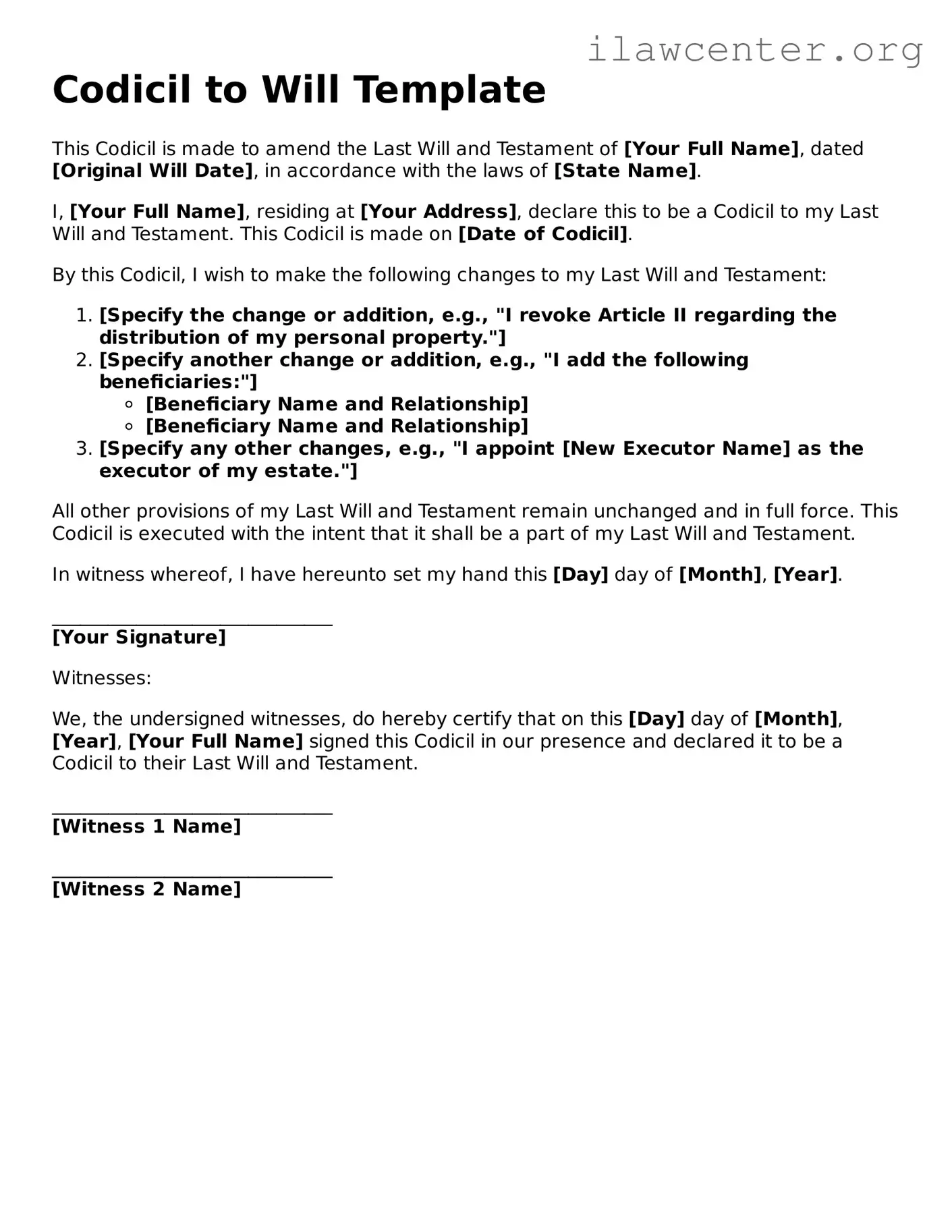
Codicil to Will Preview

Codicil to Will Template

This Codicil is made to amend the Last Will and Testament of [Your Full Name], dated [Original Will Date], in accordance with the laws of [State Name].

I, [Your Full Name], residing at [Your Address], declare this to be a Codicil to my Last Will and Testament. This Codicil is made on [Date of Codicil].

By this Codicil, I wish to make the following changes to my Last Will and Testament:

  1. [Specify the change or addition, e.g., "I revoke Article II regarding the distribution of my personal property."]
  2. [Specify another change or addition, e.g., "I add the following beneficiaries:"]
    • [Beneficiary Name and Relationship]
    • [Beneficiary Name and Relationship]
  3. [Specify any other changes, e.g., "I appoint [New Executor Name] as the executor of my estate."]

All other provisions of my Last Will and Testament remain unchanged and in full force. This Codicil is executed with the intent that it shall be a part of my Last Will and Testament.

In witness whereof, I have hereunto set my hand this [Day] day of [Month], [Year].

______________________________
[Your Signature]

Witnesses:

We, the undersigned witnesses, do hereby certify that on this [Day] day of [Month], [Year], [Your Full Name] signed this Codicil in our presence and declared it to be a Codicil to their Last Will and Testament.

______________________________
[Witness 1 Name]

______________________________
[Witness 2 Name]

PDF Form Characteristics

Fact Name Description
Definition A codicil is a legal document that modifies, adds to, or revokes provisions in an existing will.
State-Specific Forms Each state has its own requirements for a codicil. It's important to use the correct form based on your state.
Governing Laws The laws governing codicils vary by state. For example, in California, the Probate Code outlines the requirements.
Execution Requirements Generally, a codicil must be signed and witnessed, similar to the original will, to be legally valid.

Instructions on Utilizing Codicil to Will

After obtaining the Codicil to Will form, the next steps involve carefully filling it out to ensure your wishes are clearly stated. It is essential to follow the instructions closely to avoid any potential confusion or issues in the future.

  1. Begin by entering your full name at the top of the form.
  2. Provide your address, including city, state, and zip code.
  3. Clearly state the date on which you are completing the codicil.
  4. Reference the original will by including the date it was executed.
  5. Specify the changes you wish to make to your original will. Be precise and clear about what you want to add, remove, or modify.
  6. Sign the form at the designated area. Ensure your signature matches the one on your original will.
  7. Have the codicil witnessed by at least two individuals who are not beneficiaries of the will. They should sign and date the form in the appropriate sections.
  8. Make copies of the completed codicil for your records and for any relevant parties.

Important Facts about Codicil to Will

What is a Codicil to a Will?

A codicil is a legal document that allows you to make changes to your existing will without having to rewrite the entire document. It can be used to add new provisions, modify existing ones, or revoke certain parts of the will. This flexibility can be particularly useful for individuals who want to update their wishes due to changes in circumstances, such as marriage, divorce, or the birth of a child.

How do I create a Codicil to my Will?

Creating a codicil typically involves drafting the document to clearly outline the changes you wish to make. It should reference your original will and specify which parts are being altered. After drafting, it is essential to sign the codicil in accordance with state laws, which often require witnesses. This ensures that the codicil is legally binding and recognized alongside your original will.

Do I need a lawyer to create a Codicil?

While it is not strictly necessary to hire a lawyer to create a codicil, consulting one can be beneficial. A legal professional can help ensure that your codicil is properly drafted and complies with state laws. This can prevent potential disputes or confusion among your heirs in the future. If your changes are straightforward and you feel confident, you may choose to create one on your own.

Can I revoke my original Will with a Codicil?

A codicil can revoke specific parts of your original will, but it does not automatically revoke the entire document. If you wish to revoke your entire will, you should do so explicitly in the codicil or create a new will altogether. It’s important to clearly state your intentions to avoid any ambiguity that could lead to disputes among your beneficiaries.

Is a Codicil to a Will valid in all states?

Generally, codicils are valid across the United States, but specific requirements may vary by state. Each state has its own laws regarding the execution and witnessing of codicils. It’s essential to familiarize yourself with the regulations in your state to ensure that your codicil is legally enforceable. Checking with a local attorney can provide clarity on any state-specific requirements.
Common mistakes

Filling out a Codicil to Will form can be a straightforward process, but many individuals make common mistakes that can lead to complications in the future. One frequent error is failing to properly identify the original will. It is essential to reference the original document clearly, including its date and any relevant details. Without this information, the codicil may not be recognized as a valid amendment.

Another mistake is neglecting to include specific language that indicates the intention to amend the will. A codicil should explicitly state that it is meant to modify or revoke certain provisions of the original will. If this language is absent, the codicil may not fulfill its intended purpose, leading to confusion or disputes among heirs.

Many people also overlook the importance of signatures. A codicil must be signed by the testator, the person making the will, and in some states, it may require witnesses. Failing to include the necessary signatures can render the codicil invalid. Always check local laws to ensure compliance with signature requirements.

In addition, individuals sometimes forget to date the codicil. A date is crucial because it establishes the timeline of the testator's wishes. Without a date, it may be difficult to determine whether the codicil was created before or after the original will, which can lead to legal challenges.

Another common error involves not providing clear instructions regarding the changes being made. Vague language can create ambiguity, making it hard to understand the testator's intentions. Clear and precise language is vital to ensure that the changes are understood and executed correctly.

Lastly, individuals may fail to keep the codicil in a safe and accessible location. After completing the codicil, it is important to store it alongside the original will or inform trusted individuals about its whereabouts. If the codicil is lost or not easily found, the changes may not be honored, and the original will may prevail.

Documents used along the form

A Codicil to a Will is an important document that allows individuals to make changes to their existing wills without having to create a new one. When updating a will, several other forms and documents may be used to ensure that all legal aspects are properly addressed. Here’s a list of some common documents that often accompany a Codicil to Will:

  • Last Will and Testament: This is the primary document that outlines how a person's assets will be distributed upon their death. It serves as the foundation for any codicils or amendments.
  • Power of Attorney: This document grants someone the authority to make decisions on behalf of another person, particularly in financial or legal matters, in case they become incapacitated.
  • Healthcare Proxy: A healthcare proxy allows an individual to designate someone to make medical decisions on their behalf if they are unable to do so themselves.
  • Living Will: This document outlines a person's wishes regarding medical treatment and end-of-life care, providing guidance to healthcare providers and family members.
  • Revocation of Will: If someone decides to cancel their existing will, this document formally revokes it, ensuring there is no confusion about which will is valid.
  • Trust Documents: These documents establish a trust, which can hold assets for beneficiaries. They may work alongside a will to manage how assets are distributed.
  • Beneficiary Designations: Certain assets, like life insurance policies and retirement accounts, require specific beneficiary designations. These should be updated alongside any changes to a will or codicil.
  • Affidavit of Witness: This document may be used to confirm that the codicil was executed properly, especially if there are any disputes about its validity.

Understanding these documents can help ensure that your estate planning is comprehensive and clear. Each plays a vital role in making sure your wishes are honored and that your loved ones are taken care of according to your preferences.

Similar forms

The Codicil to Will form serves as an important document for making amendments to an existing will. Several other legal documents share similarities with a codicil in terms of purpose and function. Here are six documents that are similar to a codicil:

  • Last Will and Testament: This is the primary document that outlines how a person's assets will be distributed after their death. A codicil modifies the provisions of this document without the need to create a new will.
  • Living Will: While a living will addresses medical decisions, it can also be amended. Similar to a codicil, changes can be made to reflect a person's current wishes regarding healthcare.
  • Power of Attorney: This document grants someone the authority to make decisions on behalf of another person. Just as a codicil updates a will, a power of attorney can be amended to change the designated agent or the scope of authority.
  • Trust Amendment: A trust amendment alters the terms of an existing trust. Like a codicil, it allows for changes without the need to create an entirely new trust document.
  • Revocable Living Trust: This document allows a person to retain control over their assets during their lifetime while specifying how they will be distributed after death. Amendments can be made, similar to a codicil, to adjust beneficiaries or terms.
  • Health Care Proxy: This document designates someone to make healthcare decisions on behalf of another. Changes can be made to reflect a person's current preferences, similar to how a codicil updates a will.

Dos and Don'ts

When filling out the Codicil to Will form, it’s important to follow certain guidelines to ensure that your intentions are clear and legally valid. Here are some key dos and don’ts:

  • Do clearly identify the original will by including the date it was signed.
  • Do specify the changes you wish to make in clear, concise language.
  • Do sign and date the codicil in the presence of witnesses, if required by your state’s laws.
  • Do keep the codicil with your original will in a safe place.
  • Don't make changes to the original will itself; use the codicil for any amendments.
  • Don't forget to inform your executor or family members about the existence of the codicil.
  • Don't use vague language that could lead to confusion regarding your intentions.
  • Don't assume that a verbal agreement or understanding will suffice; written documentation is essential.

Misconceptions

Understanding the Codicil to Will form can be challenging, especially with the various misconceptions surrounding it. Here are eight common misunderstandings that people often have:

  1. A codicil is a new will.

    This is not true. A codicil is an amendment to an existing will, not a complete replacement. It allows you to make specific changes without drafting an entirely new document.

  2. You don't need witnesses for a codicil.

    Many believe that a codicil can be signed without witnesses. However, in most states, witnesses are required to validate the changes made in the codicil, just like a will.

  3. A codicil can only change one thing.

    While a codicil can certainly address a single issue, it can also make multiple changes at once. You have the flexibility to update several aspects of your will in one codicil.

  4. You can write a codicil on any piece of paper.

    Although it might seem convenient, a codicil should be written in a formal manner and follow the legal requirements of your state. This ensures it is valid and enforceable.

  5. A codicil must be notarized.

    This is a common misconception. While notarization can add an extra layer of validation, it is not always necessary. The requirements vary by state, so it’s essential to check local laws.

  6. You can use a codicil to change beneficiaries after your death.

    This is impossible. A codicil must be executed while you are alive. Changes to beneficiaries made after your death will not be recognized.

  7. A codicil is a permanent solution.

    A codicil can be revoked or replaced at any time, just like a will. If circumstances change, you can always create a new codicil or draft a new will altogether.

  8. Once a codicil is created, it cannot be changed.

    This is false. Codicils can be modified or revoked, allowing you to keep your estate plan up to date with your current wishes.

Being informed about these misconceptions can help you navigate the process of updating your will more effectively. Always consult with a legal professional to ensure that your estate planning documents meet your needs and comply with state laws.

Key takeaways

When it comes to updating your will, a codicil can be a useful tool. Here are some key takeaways to consider when filling out and using a Codicil to Will form:

  • Understand the Purpose: A codicil allows you to make changes to your existing will without having to create an entirely new document.
  • Follow Legal Requirements: Ensure that your codicil meets the same legal standards as your original will, including being signed and witnessed properly.
  • Be Clear and Specific: Clearly state the changes you wish to make. Ambiguity can lead to confusion and potential disputes.
  • Reference the Original Will: Include information about the original will, such as the date it was executed, to avoid any misunderstandings.
  • Keep It Simple: If the changes are minor, a codicil is appropriate. For major changes, consider drafting a new will.
  • Store Together: Keep your codicil with your original will in a safe place to ensure they are both accessible when needed.
  • Inform Relevant Parties: Let your executor and family members know about the codicil and where it can be found.
  • Review Periodically: Regularly review your will and any codicils to ensure they reflect your current wishes and circumstances.