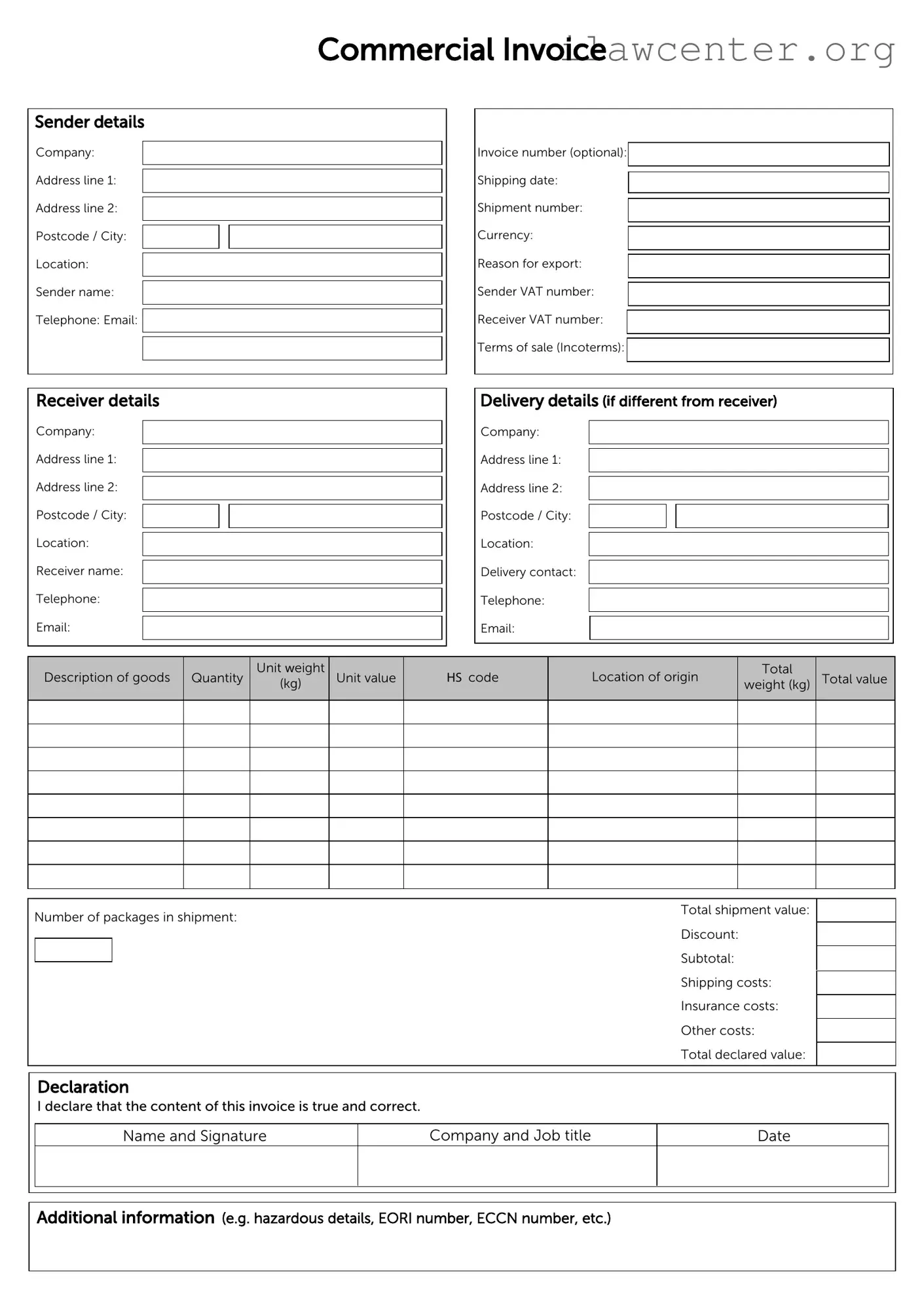
Commercial Invoice PDF Template

Commercial Invoice PDF Template

A Commercial Invoice is a crucial document used in international trade. It serves as a bill for the goods sold and provides essential details about the transaction, including the buyer, seller, and item descriptions. Understanding how to fill out this form accurately is vital for smooth shipping and customs clearance. Click the button below to start filling out the Commercial Invoice form.

Article Guide

The Commercial Invoice form plays a crucial role in international trade, serving as a key document that facilitates the movement of goods across borders. This form contains essential information about the transaction, including details of the buyer and seller, a description of the goods, their value, and the terms of sale. It acts as a receipt for the buyer and a record for the seller, ensuring transparency in the transaction. Additionally, the Commercial Invoice is vital for customs clearance, as it provides customs authorities with the necessary information to assess duties and taxes. Each section of the form is designed to capture specific details, such as the quantity and type of goods, shipping information, and payment terms, which collectively help in streamlining the import and export process. Understanding the nuances of this form is essential for businesses engaged in international commerce, as it not only aids in compliance with legal requirements but also helps in maintaining good relationships with trading partners.

Commercial Invoice Preview







Location 








Location






























Location








Location

 


File Properties

Fact Name Detail
Definition A Commercial Invoice is a document used in international trade that outlines the sale transaction between a buyer and a seller.
Purpose This form serves as a bill for the goods sold, providing essential details for customs clearance and taxation.
Contents The invoice typically includes the seller's and buyer's information, a description of the goods, quantities, and prices.
Governing Law In the United States, the Uniform Commercial Code (UCC) governs the sale of goods, which may apply to Commercial Invoices.
Currency Transactions are usually listed in the currency agreed upon by both parties, often US dollars for domestic sales.
Signatures While not always required, signatures from both parties can enhance the invoice's validity and enforceability.
Compliance Compliance with local and international regulations is crucial, as inaccuracies can lead to delays or fines during customs processing.

Instructions on Utilizing Commercial Invoice

Filling out a Commercial Invoice form is a critical step in the shipping process. This document provides essential information about the goods being shipped, ensuring compliance with customs regulations. Follow these steps carefully to complete the form accurately.

  1. Header Information: Start by entering your company’s name, address, and contact information at the top of the form.
  2. Invoice Number: Assign a unique invoice number for reference and record-keeping.
  3. Invoice Date: Fill in the date when the invoice is issued.
  4. Consignee Information: Provide the recipient's name, address, and contact details.
  5. Shipping Information: Indicate the shipping method and service level (e.g., express, standard).
  6. Item Description: List each item being shipped, including quantity, unit price, and total value.
  7. Country of Origin: Specify the country where each item was manufactured or produced.
  8. Currency: Indicate the currency used for the transaction (e.g., USD).
  9. Terms of Sale: State the terms of sale, such as FOB (Free on Board) or CIF (Cost, Insurance, and Freight).
  10. Signature: Sign and date the invoice to validate it.

Once you have completed the form, ensure that all information is accurate and legible. This will facilitate a smooth shipping process and help avoid potential delays with customs clearance.

Important Facts about Commercial Invoice

What is a Commercial Invoice?

A Commercial Invoice is a document used in international trade. It provides details about the goods being sold, including descriptions, quantities, and prices. This document serves as a bill for the buyer and is crucial for customs clearance. It helps customs officials determine duties and taxes. Having a clear and accurate Commercial Invoice can prevent delays in shipping and ensure smooth transactions.

What information do I need to include on a Commercial Invoice?

Your Commercial Invoice should include several key pieces of information. Start with the seller's and buyer's contact details, including names, addresses, and phone numbers. Next, list the items being sold, including their descriptions, quantities, and unit prices. Don’t forget to include the total value of the invoice. Additionally, you should mention the payment terms and any shipping information. The more detailed and accurate your invoice, the better it will serve its purpose.

How do I use a Commercial Invoice for shipping?

What happens if I don’t use a Commercial Invoice?

Failing to use a Commercial Invoice can lead to several issues. Your shipment may be delayed at customs, or it could be returned to you. Without this document, customs officials cannot determine the value of the goods, which means they can't assess the correct duties and taxes. This can result in fines or additional fees. To avoid complications, always ensure you have a properly completed Commercial Invoice for your shipments.

Common mistakes

Filling out a Commercial Invoice form is a critical step for businesses involved in international trade. However, mistakes can lead to delays, additional costs, or even penalties. Here are five common errors that individuals often make when completing this important document.

One frequent mistake is inaccurate descriptions of goods. It is essential to provide clear and precise details about the items being shipped. Vague descriptions can cause confusion with customs officials and may lead to delays in processing. Always ensure that the description matches the actual product, including its intended use, to avoid complications.

Another common error is incorrect pricing information. The invoice must reflect the correct value of the goods being shipped. If the value is understated, it may result in customs penalties or additional duties. Conversely, overstating the value can lead to unnecessary taxes and fees. It is crucial to verify that all pricing aligns with the purchase agreements and market values.

People also often forget to include complete contact information. Both the sender and recipient's details should be fully provided. This includes names, addresses, phone numbers, and email addresses. Incomplete information can hinder communication and may result in the shipment being returned or delayed.

Another mistake is failing to declare the correct country of origin. This information is vital for customs purposes. Misrepresenting the origin can lead to severe penalties and affect the ability to import or export goods in the future. Always check the rules regarding country of origin to ensure compliance.

Finally, individuals sometimes overlook the need for appropriate signatures. The Commercial Invoice must be signed by an authorized person. An unsigned invoice can be deemed invalid, causing further delays in processing. Ensure that all required signatures are obtained before submitting the document to avoid unnecessary complications.

Documents used along the form

When engaging in international trade, a Commercial Invoice is a crucial document that outlines the transaction details between a buyer and a seller. However, several other forms and documents may accompany the Commercial Invoice to facilitate the shipping process and ensure compliance with regulations. Below is a list of commonly used documents in conjunction with the Commercial Invoice.

  • Bill of Lading: This document serves as a contract between the shipper and the carrier. It details the type, quantity, and destination of the goods being transported. The Bill of Lading also acts as a receipt for the cargo once it has been shipped.
  • Packing List: This document provides a detailed breakdown of the contents of each package being shipped. It includes information such as item descriptions, quantities, and weights, helping customs officials and the receiving party verify the shipment.
  • Certificate of Origin: This certificate verifies the country in which the goods were manufactured or produced. It may be required by customs authorities to determine the appropriate duties and tariffs applicable to the shipment.
  • Export License: Depending on the nature of the goods being exported, an export license may be necessary. This document grants permission from the government to export specific items and ensures compliance with export regulations.
  • Import License: Similar to the export license, an import license may be required by the importing country. It allows the recipient to legally receive the goods and may be contingent upon meeting specific regulatory standards.
  • Insurance Certificate: This document provides proof of insurance coverage for the shipment. It protects against potential loss or damage during transit, giving both the buyer and seller peace of mind.
  • Proforma Invoice: This preliminary invoice is issued before the actual sale takes place. It outlines the expected costs and terms of the transaction, allowing the buyer to understand the financial commitment before proceeding.
  • Customs Declaration: This document is submitted to customs authorities when goods are imported or exported. It contains information about the shipment, including its value, description, and intended use, ensuring compliance with local laws.
  • Health and Safety Certificates: For certain products, especially food and pharmaceuticals, health and safety certificates may be required. These documents confirm that the goods meet specific health standards and regulations.

Each of these documents plays a vital role in the international shipping process. They not only facilitate the smooth transit of goods but also help ensure compliance with legal and regulatory requirements. Proper preparation and understanding of these forms can significantly enhance the efficiency of your shipping operations.

Similar forms

The Commercial Invoice is an essential document in international trade, serving as a record of the sale between a buyer and a seller. Several other documents share similarities with the Commercial Invoice, each serving unique purposes but often containing overlapping information. Here’s a list of nine documents that are similar to the Commercial Invoice:

  • Proforma Invoice: This document is issued before a sale takes place. Like the Commercial Invoice, it outlines the terms of sale, including product details, pricing, and payment terms, but it is not a demand for payment.
  • Bill of Lading: This document serves as a receipt for goods shipped and provides details about the shipment. It contains information about the consignee and the seller, similar to the Commercial Invoice.
  • Packing List: This document details the contents of a shipment. It complements the Commercial Invoice by providing specific information about how items are packed, including weights and dimensions.
  • Certificate of Origin: This document certifies the country of origin of the goods. While it does not contain pricing information, it is often submitted alongside the Commercial Invoice for customs purposes.
  • Export License: Required for certain goods, this document authorizes the export of specific items. It may accompany the Commercial Invoice to demonstrate compliance with export regulations.
  • Customs Declaration: This document is submitted to customs authorities and includes details about the shipment. It often references the Commercial Invoice to verify the value and nature of the goods being imported or exported.
  • Insurance Certificate: This document provides proof of insurance for the goods being shipped. It is important for risk management and may reference the Commercial Invoice to indicate the value of the insured goods.
  • Sales Contract: This is a legal agreement between buyer and seller detailing the terms of the sale. It shares many elements with the Commercial Invoice, such as pricing and product descriptions.
  • Letter of Credit: This financial document guarantees that a seller will receive payment from the buyer's bank. It is often linked to the Commercial Invoice as part of the payment process in international transactions.

Understanding these documents and their similarities to the Commercial Invoice can help streamline the process of international trade, ensuring compliance and clarity in transactions.

Dos and Don'ts

When filling out the Commercial Invoice form, attention to detail is crucial. Here are six important dos and don'ts to keep in mind:

  • Do ensure all fields are completed accurately.
  • Do include a detailed description of the goods being shipped.
  • Do specify the correct value of the items.
  • Do provide the correct shipping and billing addresses.
  • Don't use vague terms or abbreviations that may confuse customs officials.
  • Don't forget to sign and date the invoice before submission.

Completing the Commercial Invoice accurately can significantly impact the smooth processing of shipments. Each detail matters, and errors can lead to delays or additional costs. Be diligent and thorough in your approach.

Misconceptions

Here are six common misconceptions about the Commercial Invoice form:

  • It is only required for international shipments. Many believe that a Commercial Invoice is necessary only for goods shipped overseas. In reality, it can also be required for domestic shipments, especially for customs purposes.
  • All invoices are the same. Some think that any invoice can serve as a Commercial Invoice. However, a Commercial Invoice has specific details that must be included, such as the description of goods, value, and terms of sale.
  • It is not important for customs clearance. There is a misconception that the Commercial Invoice does not impact customs clearance. In fact, it plays a crucial role in determining duties and taxes owed on imported goods.
  • Only the seller needs to fill it out. Some assume that only the seller is responsible for completing the Commercial Invoice. The buyer may also need to provide information, especially if they are handling the customs process.
  • It can be submitted at any time. Many believe that the Commercial Invoice can be submitted whenever it is convenient. However, it must be submitted at the time of shipment or as required by the customs authority.
  • It is only for high-value shipments. There is a notion that a Commercial Invoice is only necessary for shipments of high value. In truth, it is required for all commercial shipments, regardless of value.

Key takeaways

When filling out and using the Commercial Invoice form, there are several important points to keep in mind. Here are six key takeaways that can help ensure a smooth process:

  • Accurate Information: Always provide precise details about the items being shipped. This includes descriptions, quantities, and values. Inaccuracies can lead to delays or additional fees.
  • Consistent Formatting: Use clear and consistent formatting throughout the invoice. This helps customs officials easily read and process the document.
  • Include Sender and Recipient Details: Clearly list both the sender's and recipient's names and addresses. This information is crucial for the delivery of goods.
  • Declare the Purpose: Specify the purpose of the shipment, whether it’s for sale, a gift, or a sample. This helps customs classify the shipment correctly.
  • Attach Additional Documents: If necessary, include any additional documents that may support the shipment, such as purchase orders or contracts. These can clarify the transaction.
  • Review Before Submission: Always double-check the completed invoice for any errors or omissions. A thorough review can prevent complications later on.

By following these guidelines, you can facilitate a more efficient shipping process and minimize potential issues with customs.