Fillable Conditional Contractor’s Lien Release Document

Fillable Conditional Contractor’s Lien Release Document

The Conditional Contractor’s Lien Release form is a legal document that allows contractors to waive their right to file a lien against a property, provided they receive payment for their work. This form protects property owners while ensuring contractors are compensated for their services. To learn more about how to fill out this form, click the button below.

Article Guide

The Conditional Contractor’s Lien Release form is a crucial document in the construction industry, designed to protect the rights of contractors, subcontractors, and property owners alike. This form serves as a formal acknowledgment that a contractor has received payment for work completed, allowing them to waive their right to file a lien against the property for that specific payment. It is conditional because it typically stipulates that the release is valid only upon the actual receipt of funds. By utilizing this form, parties can ensure clarity in their financial transactions and prevent disputes related to payment. The document outlines essential details such as the amount paid, the scope of work performed, and the relevant property information, making it a vital tool in managing construction projects. Understanding the implications of signing this form is essential for all parties involved, as it can significantly impact their legal rights and obligations regarding payment and property claims.

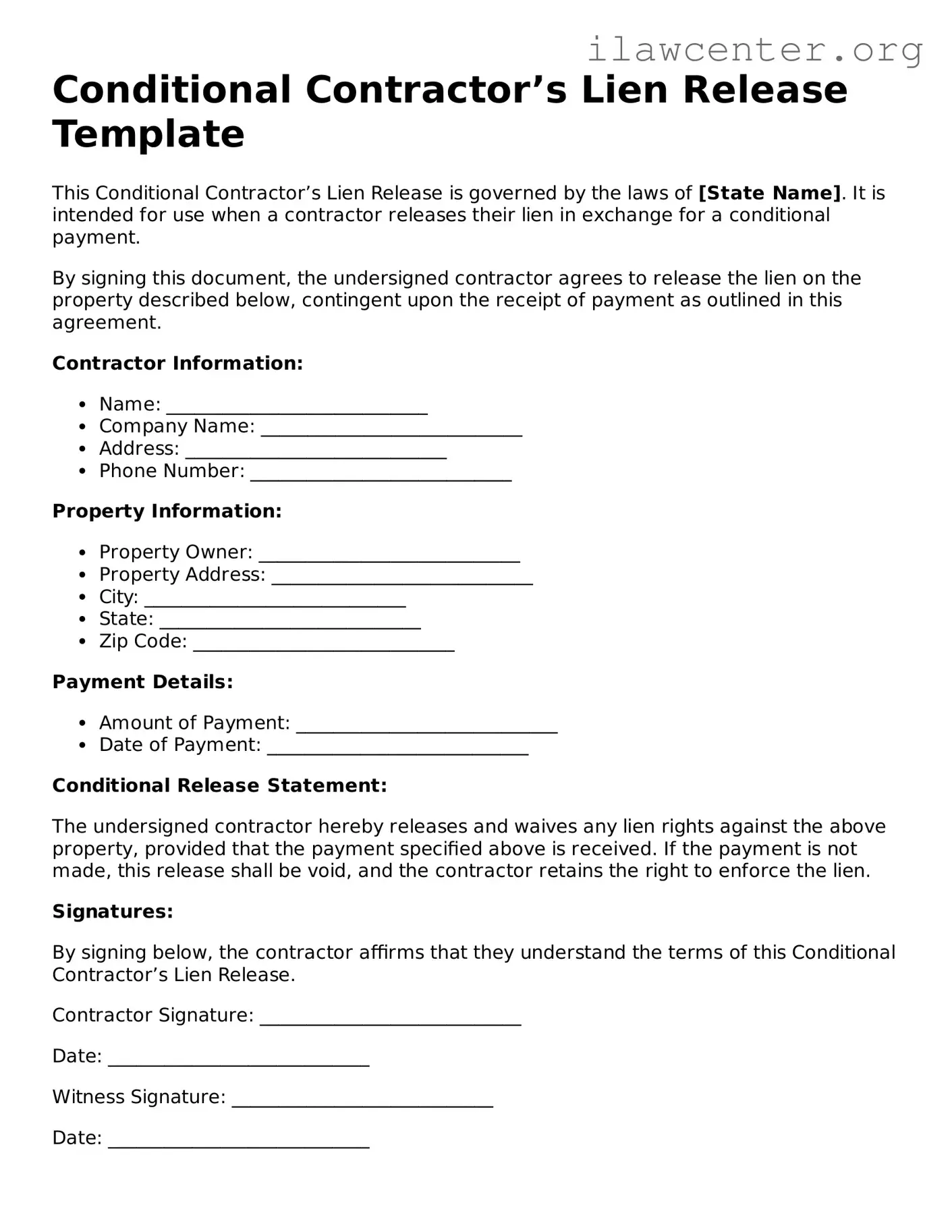
Conditional Contractor’s Lien Release Preview

Conditional Contractor’s Lien Release Template

This Conditional Contractor’s Lien Release is governed by the laws of [State Name]. It is intended for use when a contractor releases their lien in exchange for a conditional payment.

By signing this document, the undersigned contractor agrees to release the lien on the property described below, contingent upon the receipt of payment as outlined in this agreement.

Contractor Information:

  • Name: ____________________________
  • Company Name: ____________________________
  • Address: ____________________________
  • Phone Number: ____________________________

Property Information:

  • Property Owner: ____________________________
  • Property Address: ____________________________
  • City: ____________________________
  • State: ____________________________
  • Zip Code: ____________________________

Payment Details:

  • Amount of Payment: ____________________________
  • Date of Payment: ____________________________

Conditional Release Statement:

The undersigned contractor hereby releases and waives any lien rights against the above property, provided that the payment specified above is received. If the payment is not made, this release shall be void, and the contractor retains the right to enforce the lien.

Signatures:

By signing below, the contractor affirms that they understand the terms of this Conditional Contractor’s Lien Release.

Contractor Signature: ____________________________

Date: ____________________________

Witness Signature: ____________________________

Date: ____________________________

PDF Form Characteristics

Fact Name Description
Purpose The Conditional Contractor’s Lien Release form is used to release a lien on property conditionally, often upon receipt of payment.
State Variations Different states may have specific versions of the form, reflecting their unique laws and requirements.
Governing Laws In states like California, the governing law for lien releases can be found in the California Civil Code, specifically sections 8132-8134.
Conditional Nature This form is conditional, meaning that the release is effective only when certain conditions are met, such as payment being received.
Importance for Contractors Using this form helps contractors ensure that they do not lose their lien rights until payment is secured.
Potential Risks Filing a Conditional Contractor’s Lien Release without proper understanding may lead to unintended loss of lien rights if conditions are not fulfilled.

Instructions on Utilizing Conditional Contractor’s Lien Release

After obtaining the Conditional Contractor’s Lien Release form, it’s important to fill it out accurately to ensure that all parties involved are protected. The next steps involve providing clear and precise information, which will help avoid any potential misunderstandings later on.

  1. Begin by entering the date at the top of the form. This date should reflect when you are completing the release.
  2. Next, write the name of the property owner. Ensure that you spell their name correctly to avoid any issues.
  3. Fill in the address of the property where the work was performed. Include the street address, city, state, and zip code.
  4. Identify the contractor’s name. This should be the individual or company that performed the work on the property.
  5. Provide the contractor’s address, including the street address, city, state, and zip code.
  6. In the next section, specify the type of work that was completed. Be as detailed as possible to clarify what services were provided.
  7. Indicate the amount that has been paid for the work completed. This should reflect the total payment received up to this point.
  8. Sign and date the form at the bottom. Ensure that your signature matches the name provided earlier in the document.
  9. Finally, provide any additional information required, such as contact details, if necessary.

Important Facts about Conditional Contractor’s Lien Release

What is a Conditional Contractor’s Lien Release form?

A Conditional Contractor’s Lien Release form is a legal document used in construction projects. It allows a contractor or subcontractor to release their claim against a property for unpaid work, contingent upon receiving payment. This means that if the payment is not made, the contractor retains their right to file a lien against the property. This form helps protect the contractor's interests while ensuring that the property owner is aware of any outstanding payments.

When should I use a Conditional Contractor’s Lien Release form?

This form should be used when a contractor or subcontractor is about to receive a payment for their services but wants to provide assurance to the property owner that they will not file a lien, as long as the payment is made. It is typically used in conjunction with progress payments or final payments on a construction project. Using this form can help facilitate smoother transactions and maintain good relationships between contractors and property owners.

What information is required to complete the form?

To complete the Conditional Contractor’s Lien Release form, you will need to provide specific information, including the names of the parties involved (contractor and property owner), the property address, a description of the work performed, and the amount of payment being made. Additionally, it is important to include the date of the release and any relevant contract details to ensure clarity and legal validity.

Is the Conditional Contractor’s Lien Release form legally binding?

Yes, once properly completed and signed, the Conditional Contractor’s Lien Release form is legally binding. It serves as a formal acknowledgment that the contractor releases their lien rights, contingent on the payment being received. Both parties should keep a copy of the signed form for their records. It is advisable to consult with a legal professional if there are any concerns about the implications of the release.

What happens if the payment is not made after the release?

If the payment is not made after the Conditional Contractor’s Lien Release form has been signed, the contractor retains the right to file a lien against the property. The release is conditional, meaning it only takes effect if payment is received. If the payment fails to materialize, the contractor can take further legal action to secure the owed amount, including filing a lien to protect their interests in the property.

Common mistakes

Filling out the Conditional Contractor’s Lien Release form can be a straightforward process, but several common mistakes can lead to complications. One frequent error is failing to include all necessary information. Each section of the form must be completed accurately. Missing details, such as the project address or the names of the parties involved, can render the form invalid. Always double-check that every required field is filled out.

Another mistake often made is not using the correct version of the form. Forms can change over time, and using an outdated version can cause issues. It is essential to ensure you have the most current version of the Conditional Contractor’s Lien Release form before filling it out. This helps to avoid any legal complications that may arise from using obsolete documentation.

People sometimes overlook the importance of signatures. A common error is having the form signed by someone who is not authorized. Only individuals with the proper authority should sign the document. This means that if you are a contractor, you should ensure that the person signing on behalf of your company has the right to do so. Without the correct signatures, the release may be considered invalid.

Additionally, many individuals forget to provide a clear description of the work performed. The form should specify the nature of the work and the amount paid. Vague descriptions can lead to misunderstandings or disputes later on. Being specific not only clarifies the agreement but also protects the interests of all parties involved.

Another common mistake is neglecting to keep copies of the completed form. After submitting the Conditional Contractor’s Lien Release, it is wise to retain a copy for your records. This can be invaluable if questions arise in the future regarding the release. Having documentation on hand can provide peace of mind and serve as a reference point.

Finally, many people do not understand the implications of the Conditional Contractor’s Lien Release. It’s crucial to recognize that signing this form means you are relinquishing your right to file a lien against the property for the work completed. Ensure that you fully understand the consequences before proceeding. Consulting with a legal professional can provide clarity and help you make informed decisions.

Documents used along the form

The Conditional Contractor’s Lien Release form is an important document in construction and contracting. It helps ensure that payments are made and that contractors and subcontractors are protected from potential lien claims. Several other forms and documents are often used in conjunction with this release to maintain clarity and legal compliance throughout the project. Below is a list of these commonly used documents.

  • Unconditional Lien Release: This document confirms that a contractor or subcontractor has been paid in full for their work. It releases any claim of lien on the property, providing peace of mind to the property owner.
  • Notice of Intent to Lien: This notice informs the property owner that a contractor intends to file a lien if payment is not received. It serves as a warning and encourages timely payment.
  • Contractor Agreement: This is a formal agreement between the property owner and the contractor outlining the scope of work, payment terms, and other essential details of the project.
  • Change Order: A change order documents any modifications to the original contract. It outlines changes in scope, cost, or schedule and must be agreed upon by both parties.
  • Payment Application: This form is used by contractors to request payment for work completed. It details the work performed and the amount due, ensuring transparency in billing.
  • Subcontractor Agreement: This agreement outlines the terms between a contractor and a subcontractor. It details the work to be performed, payment schedules, and responsibilities.
  • Final Waiver of Lien: This document is provided upon final payment. It confirms that the contractor waives any future lien rights on the property, ensuring the owner is free from further claims.
  • Project Completion Certificate: This certificate verifies that the project has been completed according to the agreed terms. It can be important for final payments and lien releases.

These documents collectively help protect the rights of all parties involved in a construction project. Proper use of each form ensures clarity, reduces disputes, and facilitates smooth transactions between contractors, subcontractors, and property owners.

Similar forms

The Conditional Contractor’s Lien Release form is an important document in construction and contracting. It serves to release a lien on a property under certain conditions. There are several other documents that share similarities with this form. Here are ten of them:

  • Unconditional Lien Release: This document also releases a lien but does so without any conditions attached. Once signed, it confirms that the contractor has received payment and relinquishes all claims to the property.
  • Partial Lien Release: Similar to the Conditional Lien Release, this document allows a contractor to release a portion of their lien. It indicates that a specific amount has been paid, while still retaining the right to claim for any unpaid balance.
  • Notice of Intent to Lien: This document serves as a warning to property owners that a contractor may file a lien if payment is not received. It establishes the contractor's intent and is often a precursor to filing a lien.
  • Mechanic’s Lien: This is the actual claim filed against a property when payment is not made. While the Conditional Lien Release aims to remove a lien, the Mechanic’s Lien is what initiates the claim for unpaid work.
  • Waiver of Lien Rights: This document is signed by a contractor to waive their right to file a lien. It is often used in conjunction with payment to ensure that the contractor cannot later claim a lien for the work completed.
  • Release of Claim: This document releases a party from any further claims related to a specific project or payment. It is similar in purpose to the Conditional Lien Release, as both serve to confirm that obligations have been met.
  • Payment Application: This document outlines the amounts due for work completed. It is related to the Conditional Lien Release in that it often accompanies a request for payment, leading to the release of the lien once payment is made.
  • Final Lien Release: This document is used at the end of a project to confirm that all payments have been made, and all liens have been released. It serves a similar purpose to the Conditional Lien Release but is used when all work is completed.
  • Construction Contract: This agreement outlines the terms of the work to be performed. While it does not directly release a lien, it establishes the obligations that may lead to the need for a Conditional Lien Release if payments are not made.
  • Subcontractor Lien Release: Similar to the Conditional Lien Release, this document is used by subcontractors to release their lien rights against a property once they receive payment from the general contractor.

Dos and Don'ts

When filling out the Conditional Contractor’s Lien Release form, it is essential to follow certain guidelines to ensure accuracy and compliance. Below is a list of things to do and avoid:

  • Do read the entire form carefully before starting.
  • Do provide accurate information about the project and parties involved.
  • Do sign and date the form in the appropriate sections.
  • Do keep a copy of the completed form for your records.
  • Do verify that all required attachments are included.
  • Don't leave any sections blank unless instructed to do so.
  • Don't use incorrect or outdated information.
  • Don't forget to check for spelling errors or typos.
  • Don't submit the form without confirming that all parties have agreed to the release.

Misconceptions

Understanding the Conditional Contractor’s Lien Release form is crucial for those involved in construction projects. However, several misconceptions often lead to confusion. Below are five common misunderstandings about this important document:

  1. The form guarantees payment.

    Many believe that signing a Conditional Contractor’s Lien Release guarantees they will receive payment. In reality, this form is conditional and only releases the lien based on the expectation that payment will be made. If payment is not received, the contractor may still have the right to pursue a lien.

  2. It can be used at any time.

    Some individuals think they can use the Conditional Contractor’s Lien Release form at any point in the project. However, it is meant to be used specifically when a contractor is providing a release based on a promise of payment, typically at a designated milestone or completion stage.

  3. All parties must sign the release.

    There is a misconception that all parties involved in the contract must sign the release for it to be valid. In fact, only the party providing the lien release needs to sign it, as they are the ones relinquishing their right to the lien based on the terms outlined.

  4. It is the same as an unconditional release.

    Many confuse the Conditional Contractor’s Lien Release with an unconditional release. The conditional version is tied to the receipt of payment, while the unconditional release removes the lien regardless of whether payment has been made.

  5. It eliminates all future claims.

    Some believe that signing a Conditional Contractor’s Lien Release form eliminates any possibility of future claims. However, this form only pertains to the specific lien being released and does not prevent the contractor from pursuing other claims related to the project.

By clarifying these misconceptions, individuals can better navigate the complexities of construction contracts and ensure that their rights and responsibilities are understood.

Key takeaways

When filling out and using the Conditional Contractor’s Lien Release form, consider the following key takeaways:

  1. Understand the purpose: This form is used to release a lien conditionally, typically upon receipt of payment.
  2. Complete all required fields: Ensure that all necessary information is filled out accurately, including names, addresses, and project details.
  3. Verify payment conditions: Clearly state the conditions under which the lien will be released, such as the receipt of full payment.
  4. Sign and date the form: The form must be signed and dated by the appropriate parties to be valid.
  5. Provide copies: Distribute copies of the signed form to all relevant parties, including the property owner and any contractors involved.
  6. Retain a copy for records: Keep a copy of the signed release for your records in case of future disputes.