Fillable Credit Check Authorization Document

Fillable Credit Check Authorization Document

The Credit Check Authorization form is a document that allows a lender or service provider to access your credit report. This form is often required when applying for loans, rental agreements, or other financial services. If you need to complete a credit check, consider filling out the form by clicking the button below.

Article Guide

The Credit Check Authorization form plays a crucial role in various financial transactions, particularly when applying for loans, credit cards, or rental agreements. This form serves as a written agreement that allows lenders or landlords to access an individual's credit history. It typically requires personal information such as the applicant's name, address, Social Security number, and date of birth. By signing the form, individuals grant permission for a credit check to be conducted, which helps the lender assess the applicant's creditworthiness. Understanding the implications of this authorization is essential, as it can impact one's ability to secure financing or housing. Additionally, the form often includes information about how long the authorization remains valid and what the applicant can expect in terms of privacy and data protection. Overall, the Credit Check Authorization form is a vital document that facilitates informed financial decisions while safeguarding the rights of all parties involved.

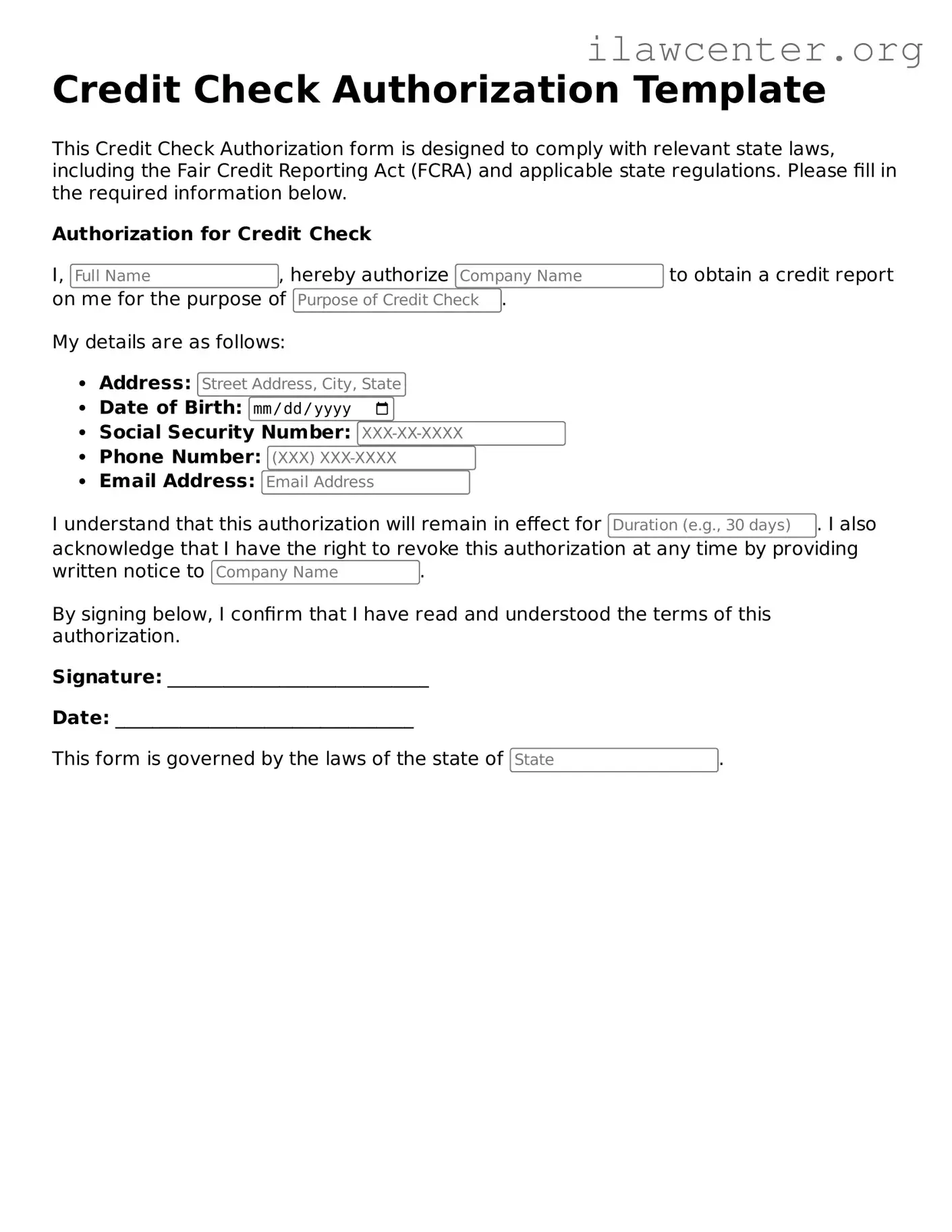
Credit Check Authorization Preview

Credit Check Authorization Template

This Credit Check Authorization form is designed to comply with relevant state laws, including the Fair Credit Reporting Act (FCRA) and applicable state regulations. Please fill in the required information below.

Authorization for Credit Check

I, , hereby authorize to obtain a credit report on me for the purpose of .

My details are as follows:

  • Address:
  • Date of Birth:
  • Social Security Number:
  • Phone Number:
  • Email Address:

I understand that this authorization will remain in effect for . I also acknowledge that I have the right to revoke this authorization at any time by providing written notice to .

By signing below, I confirm that I have read and understood the terms of this authorization.

Signature: ____________________________

Date: ________________________________

This form is governed by the laws of the state of .

PDF Form Characteristics

Fact Name Description
Purpose The Credit Check Authorization form allows businesses to obtain permission from individuals to perform a credit check.
Required Information Individuals must provide personal information, such as name, address, Social Security number, and date of birth.
State-Specific Forms Some states require specific versions of the form to comply with local laws.
Governing Laws In California, the Fair Credit Reporting Act governs the use of credit checks. In New York, similar regulations apply under state law.
Revocation of Consent Individuals have the right to revoke their authorization at any time, which must be acknowledged by the requesting party.

Instructions on Utilizing Credit Check Authorization

Once you have the Credit Check Authorization form in front of you, it’s time to fill it out carefully. Completing this form accurately is essential for the next steps in your application process. Follow these steps to ensure all necessary information is provided correctly.

  1. Begin by entering your full name in the designated field at the top of the form.
  2. Provide your current address, including street, city, state, and zip code.
  3. Fill in your date of birth. Make sure to use the correct format specified on the form.
  4. Enter your Social Security number. Double-check for accuracy to avoid any delays.
  5. Indicate your phone number, ensuring it is a number where you can be easily reached.
  6. Provide your email address. This will be used for communication regarding your application.
  7. Read the authorization statement carefully. Ensure you understand what you are agreeing to.
  8. Sign and date the form at the bottom. Your signature confirms your consent for the credit check.

After completing the form, review all entries to ensure everything is accurate. Once you are satisfied, submit the form as instructed, and await further communication regarding your application status.

Important Facts about Credit Check Authorization

What is a Credit Check Authorization form?

The Credit Check Authorization form is a document that allows a lender or landlord to obtain a credit report on an individual. This report provides insights into the individual's credit history, including payment history, outstanding debts, and credit scores. The form ensures that the individual gives their consent for this information to be accessed.

Why do I need to fill out a Credit Check Authorization form?

Filling out the form is necessary for various reasons. Lenders often require it to assess your creditworthiness before approving loans or credit cards. Landlords may use it to determine if you are a reliable tenant. By completing the form, you are allowing these entities to evaluate your financial history responsibly.

What information do I need to provide on the form?

You will typically need to provide personal information such as your full name, Social Security number, date of birth, and current address. This information helps the lender or landlord accurately identify your credit history. Be sure to double-check for accuracy to avoid any delays in processing.

Is my personal information safe when I submit the form?

Yes, reputable lenders and landlords take your privacy seriously. They implement security measures to protect your personal information. Always ensure you are dealing with a trustworthy organization before submitting your form. If you have concerns, ask about their data protection policies.

How long does it take to get the results of a credit check?

The time it takes to receive the results can vary. Generally, you may receive feedback within a few minutes to a few days. Factors such as the credit bureau used and the volume of requests they are handling can affect the timing. If you have not heard back within a reasonable timeframe, consider following up with the entity that requested the check.

What happens if my credit check reveals negative information?

If negative information appears on your credit report, it may impact your ability to secure loans or rentals. However, you have the right to dispute inaccuracies. You can also take steps to improve your credit score over time by paying bills on time and reducing debt. Understanding your credit report is the first step toward addressing any issues.

Can I refuse to authorize a credit check?

You can refuse to authorize a credit check, but this may affect your chances of getting approved for a loan or rental agreement. Lenders and landlords often rely on credit checks to make informed decisions. If you have concerns about your credit history, discuss them openly with the lender or landlord.

Do I need to sign the form every time a credit check is requested?

Yes, you typically need to sign a new Credit Check Authorization form for each request. This ensures that you are aware of and agree to each specific inquiry. Some lenders may have a blanket authorization for multiple checks, but it’s important to clarify this with them.

What should I do if I find errors on my credit report after the check?

If you discover errors, contact the credit bureau that provided the report immediately. You can dispute inaccuracies by providing documentation that supports your claim. The bureau is required to investigate and respond to your dispute, usually within 30 days.

Can I request a copy of my credit report?

Yes, you are entitled to request a copy of your credit report. Under federal law, you can obtain one free report per year from each of the major credit bureaus. Regularly checking your report can help you stay informed about your credit status and spot any potential issues early.
Common mistakes

Filling out a Credit Check Authorization form can seem straightforward, but many people make common mistakes that can lead to delays or complications. Understanding these pitfalls can help ensure a smoother process. Here are ten mistakes often encountered.

One frequent error is not providing complete personal information. This includes missing details such as your full name, address, or Social Security number. Each piece of information is crucial for the credit check to be performed accurately. Without complete data, the request may be rejected.

Another mistake is failing to sign the form. A signature is often required to authorize the credit check. Omitting your signature can cause the entire application to be invalid. Always double-check that you have signed where indicated.

Some individuals overlook the date on the form. Failing to include the date can lead to confusion about when the authorization was granted. It’s important to ensure that this detail is not missed, as it can affect the validity of the authorization.

Inaccurate information can also be a significant issue. Providing incorrect personal details, such as a misspelled name or wrong Social Security number, can result in delays. Credit reporting agencies rely on precise information to pull your credit report, so accuracy is key.

Additionally, people often forget to read the fine print. Understanding the terms and conditions associated with the credit check is essential. Not being aware of what you are consenting to can lead to unexpected consequences later on.

Another common mistake is not specifying the purpose of the credit check. Some forms may require you to indicate why the check is being requested. Omitting this information can lead to confusion and may delay the process.

Sometimes, individuals fail to provide contact information for follow-up. Including a phone number or email address can help expedite the process if there are questions or issues with your application. Without this information, communication may be hindered.

Another oversight is not keeping a copy of the completed form. Retaining a copy for your records can be helpful if any issues arise later. It’s always wise to have documentation of what you submitted.

Some people may also ignore submission deadlines. Be aware of any time limits associated with the authorization. Submitting the form late can impact your application or the credit check process.

Finally, a lack of clarity in your handwriting can lead to misunderstandings. If the form is handwritten, ensure that your writing is legible. Illegible handwriting can result in errors and delays in processing your request.

By being mindful of these common mistakes, you can enhance the accuracy and efficiency of your Credit Check Authorization form submission. Taking the time to carefully review your information can save you from potential setbacks.

Documents used along the form

The Credit Check Authorization form is an essential document used in various financial transactions, particularly in rental agreements and loan applications. However, it often accompanies several other forms and documents that help streamline the process and ensure all parties have the necessary information. Below are some commonly used documents that may be required alongside the Credit Check Authorization form.

  • Rental Application: This form collects personal information from potential tenants, including employment history, income, and references. It helps landlords assess the suitability of applicants.
  • Income Verification Form: This document is used to confirm an applicant's income through pay stubs, tax returns, or bank statements. It provides assurance that the applicant can meet financial obligations.
  • Lease Agreement: A legally binding contract between the landlord and tenant that outlines the terms of the rental arrangement, including rent amount, duration, and responsibilities of both parties.
  • Background Check Consent Form: This form allows landlords or lenders to conduct a background check on the applicant. It typically covers criminal history and previous rental behavior.
  • Personal Reference Form: This document gathers contact information for individuals who can vouch for the applicant's character and reliability, providing additional context for the decision-making process.
  • Guarantor Agreement: If an applicant does not meet certain financial criteria, a guarantor agreement may be required. This document outlines the responsibilities of a guarantor, who agrees to cover the lease or loan if the primary applicant defaults.

Each of these documents plays a crucial role in the evaluation process, helping to create a comprehensive profile of the applicant. Together, they ensure that landlords and lenders make informed decisions while protecting their interests and those of the applicants.

Similar forms

The Credit Check Authorization form serves a specific purpose in the context of financial transactions and lending. Several other documents share similarities in terms of their function and the information they collect. Below are four documents that are comparable to the Credit Check Authorization form:

  • Loan Application Form: Like the Credit Check Authorization form, the Loan Application Form collects personal and financial information from the applicant. Both documents require the applicant's consent for the lender to verify their financial history.
  • Background Check Authorization Form: This document, similar to the Credit Check Authorization form, allows an employer or organization to conduct a background check on an individual. It also requires the individual's consent and includes personal information necessary for the verification process.
  • Employment Application Form: The Employment Application Form gathers information about a candidate's qualifications and work history. It often includes a section where the applicant consents to a credit check, making it similar to the Credit Check Authorization form in terms of consent and purpose.
  • Rental Application Form: This form is used by landlords to assess potential tenants. It typically includes a request for a credit check and personal information, paralleling the Credit Check Authorization form in its function of evaluating financial reliability.

Dos and Don'ts

When filling out the Credit Check Authorization form, it's important to follow certain guidelines to ensure the process goes smoothly. Here are some helpful tips on what to do and what to avoid.

  • Do: Read the entire form carefully before starting.
  • Do: Provide accurate personal information, including your full name and address.
  • Do: Double-check your Social Security number for accuracy.
  • Do: Sign and date the form where indicated.
  • Don't: Leave any required fields blank.
  • Don't: Use nicknames or abbreviations for your name.
  • Don't: Forget to review the terms and conditions associated with the credit check.

By following these guidelines, you can help ensure that your Credit Check Authorization form is filled out correctly, making the process easier for everyone involved.

Misconceptions

Understanding the Credit Check Authorization form is crucial for anyone applying for credit. However, several misconceptions can lead to confusion. Here are ten common misconceptions about this form:

  1. It guarantees loan approval. Many believe that signing the Credit Check Authorization form ensures they will be approved for a loan. In reality, it only permits the lender to check your credit history.
  2. Only bad credit affects approval. Some assume that only poor credit scores will lead to denial. Lenders also consider other factors, such as income and debt-to-income ratio.
  3. It is only required for large loans. People often think this form is only necessary for significant loans like mortgages. In fact, many lenders require it for smaller loans and credit applications as well.
  4. Signing it gives lenders unlimited access to my credit report. This is a misconception. The authorization is typically limited to a specific time frame and purpose.
  5. It can be revoked at any time. While you can withdraw consent, doing so after a lender has already accessed your credit may not change their decision-making process.
  6. It affects my credit score. Signing the form itself does not impact your credit score. However, a hard inquiry resulting from the credit check may have a temporary effect.
  7. All lenders use the same criteria. Different lenders have varying criteria for credit checks. What one lender considers acceptable may not be the same for another.
  8. Only individuals with poor credit need to worry. Even those with good credit should understand the implications of the Credit Check Authorization form, as it can still affect their financial future.
  9. It is a standard form and does not require careful reading. Each Credit Check Authorization form may have specific terms. It is essential to read and understand the details before signing.
  10. Once signed, I cannot negotiate terms. Signing the form does not lock you into a deal. You still have the right to negotiate terms with the lender.

Being informed about these misconceptions can help you navigate the credit application process with confidence. Take the time to understand what you are signing and the implications it may have on your financial situation.

Key takeaways

When filling out and using the Credit Check Authorization form, there are several important points to keep in mind. Below are key takeaways to ensure a smooth process.

  • Provide Accurate Information: Ensure all personal details, such as your name, address, and Social Security number, are correct. Mistakes can delay the process.
  • Understand the Purpose: This form allows a lender or landlord to check your credit history. Be aware of how this information will be used.
  • Review the Terms: Read any terms or conditions associated with the credit check. Knowing what you are agreeing to is essential.
  • Sign and Date: Your signature is required to authorize the credit check. Don’t forget to include the date.
  • Keep a Copy: After submitting the form, keep a copy for your records. This will help you track your authorization.
  • Know Your Rights: Familiarize yourself with your rights regarding credit checks. You have the right to dispute any inaccuracies in your report.
  • Follow Up: If you do not hear back after a reasonable time, follow up with the lender or landlord to check the status of your application.

By keeping these points in mind, you can navigate the credit check process with greater confidence.