Credit Report Dispute PDF Template

Credit Report Dispute PDF Template

The Credit Report Dispute form is a tool that allows individuals to challenge inaccuracies or errors found in their credit reports. By submitting this form, consumers can initiate a review process to ensure their credit information is accurate and up-to-date. If you believe there are mistakes on your credit report, consider filling out the form by clicking the button below.

Article Guide

When reviewing your credit report, you may come across inaccuracies that could impact your financial health. The Credit Report Dispute form serves as a crucial tool for addressing these discrepancies. This form allows consumers to formally contest errors found in their credit reports, such as incorrect account details, outdated information, or fraudulent entries. By submitting this form, individuals initiate a process that prompts credit reporting agencies to investigate the claims and rectify any inaccuracies. It’s essential to provide clear and concise information when filling out the form, including specific details about the disputed items and any supporting documentation. Understanding the structure and requirements of the Credit Report Dispute form can empower you to take control of your credit history, ensuring that it accurately reflects your financial behavior and status.

Credit Report Dispute Preview

_________________________________________________________________________________________________________________
_________________________________________________________________________________________________________________
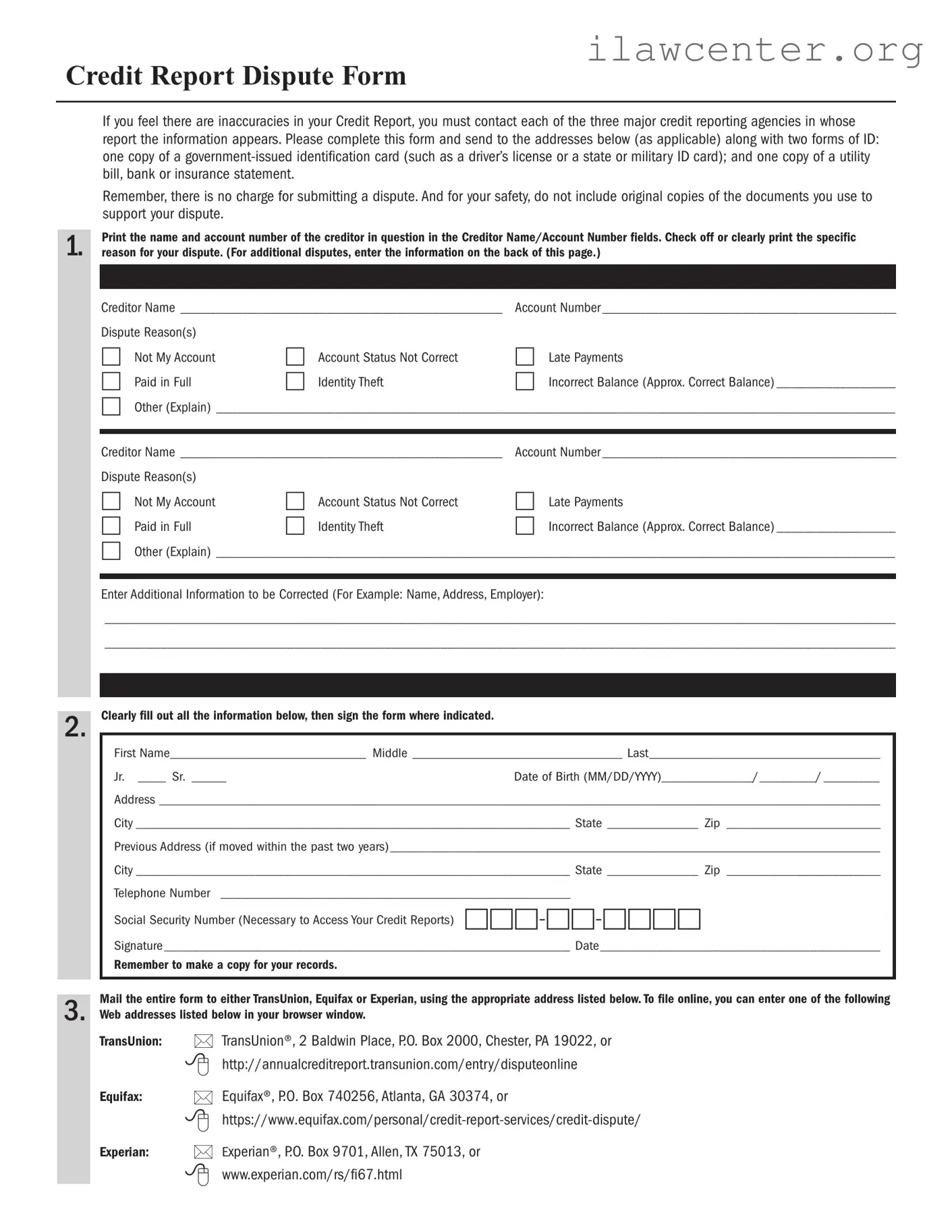
Credit Report Dispute Form
If you feel there are inaccuracies in your Credit Report, you must contact each of the three major credit reporting agencies in whose
report the information appears. Please complete this form and send to the addresses below (as applicable) along with two forms of ID:
one copy of a government-issued identification card (such as a driver’s license or a state or military ID card); and one copy of a utility
bill, bank or insurance statement.
Remember, there is no charge for submitting a dispute. And for your safety, do not include original copies of the documents you use to
support your dispute.
1.
Print the name and account number of the creditor in question in the Creditor Name/Account Number fields. Check off or clearly print the specific
reason for your dispute. (For additional disputes, enter the information on the back of this page.)
Creditor Name ______________________________________________ Account Number __________________________________________
Dispute Reason(s)
Not My Account Account Status Not Correct Late Payments
Paid in Full Identity Theft Incorrect Balance (Approx. Correct Balance) _________________
Other (Explain) _________________________________________________________________________________________________
Creditor Name ______________________________________________ Account Number __________________________________________
Dispute Reason(s)
Not My Account Account Status Not Correct Late Payments
Paid in Full Identity Theft Incorrect Balance (Approx. Correct Balance) _________________
Other (Explain) _________________________________________________________________________________________________
Enter Additional Information to be Corrected (For Example: Name, Address, Employer):
Clearly fill out all the information below, then sign the form where indicated.
2.
First Name____________________________ Middle ______________________________ Last_________________________________
Jr. ____ Sr. _____ Date of Birth (MM/DD/YYYY)_____________/________/ ________
Address _______________________________________________________________________________________________________
City ______________________________________________________________ State _____________ Zip ______________________
Previous Address (if moved within the past two years)______________________________________________________________________
City ______________________________________________________________ State _____________ Zip ______________________
Telephone Number __________________________________________________
Social Security Number (Necessary to Access Your Credit Reports)
□□□-□□-□□□□
Signature__________________________________________________________ Date________________________________________
Remember to make a copy for your records.
Mail the entire form to either TransUnion, Equifax or Experian, using the appropriate address listed below. To file online, you can enter one of the following
3.
Web addresses listed below in your browser window.
TransUnion:
TransUnion®, 2 Baldwin Place, P.O. Box 2000, Chester, PA 19022, or
http://annualcreditreport.transunion.com/entry/disputeonline
Equifax:
Equifax®, P.O. Box 740256, Atlanta, GA 30374, or
https://www.equifax.com/personal/credit-report-services/credit-dispute/
Experian:
Experian®, P.O. Box 9701, Allen, TX 75013, or
www.experian.com/rs/fi67.html
Creditor Name ________________________________________________ Account Number_______________________________________________
Dispute Reason(s)
Not My Account Account Status Not Correct Late Payments
Paid in Full Identity Theft Incorrect Balance (Approx. Correct Balance) ______________________
Other (Explain)________________________________________________________________________________________________________
Creditor Name ________________________________________________ Account Number_______________________________________________
Dispute Reason(s)
Not My Account Account Status Not Correct Late Payments
Paid in Full Identity Theft Incorrect Balance (Approx. Correct Balance) ______________________
Other (Explain)________________________________________________________________________________________________________
Creditor Name ________________________________________________ Account Number_______________________________________________
Dispute Reason(s)
Not My Account Account Status Not Correct Late Payments
Paid in Full Identity Theft Incorrect Balance (Approx. Correct Balance) ______________________
Other (Explain)________________________________________________________________________________________________________
Creditor Name ________________________________________________ Account Number_______________________________________________
Dispute Reason(s)
Not My Account Account Status Not Correct Late Payments
Paid in Full Identity Theft Incorrect Balance (Approx. Correct Balance) ______________________
Other (Explain)________________________________________________________________________________________________________
Creditor Name ________________________________________________ Account Number_______________________________________________
Dispute Reason(s)
Not My Account Account Status Not Correct Late Payments
Paid in Full Identity Theft Incorrect Balance (Approx. Correct Balance) ______________________
Other (Explain)________________________________________________________________________________________________________
Creditor Name ________________________________________________ Account Number_______________________________________________
Dispute Reason(s)
Not My Account Account Status Not Correct Late Payments
Paid in Full Identity Theft Incorrect Balance (Approx. Correct Balance) ______________________
Other (Explain)________________________________________________________________________________________________________
Creditor Name ________________________________________________ Account Number_______________________________________________
Dispute Reason(s)
Not My Account Account Status Not Correct Late Payments
Paid in Full Identity Theft Incorrect Balance (Approx. Correct Balance) ______________________
Other (Explain)________________________________________________________________________________________________________

File Properties

Fact Name Description
Purpose The Credit Report Dispute form is used by consumers to challenge inaccuracies in their credit reports.
Submission Process Consumers can submit the form to credit reporting agencies, which are required to investigate disputes within 30 days.
State-Specific Forms Some states have their own versions of the dispute form, governed by state laws like the California Consumer Credit Reporting Agencies Act.
Consumer Rights Under the Fair Credit Reporting Act, consumers have the right to dispute inaccurate information and receive a response from the reporting agency.

Instructions on Utilizing Credit Report Dispute

After obtaining your credit report and identifying any inaccuracies, you will need to fill out the Credit Report Dispute form. This form allows you to formally challenge any errors you believe are present in your report. Once completed, you can submit it to the appropriate credit reporting agency to initiate the dispute process.

  1. Begin by carefully reading the instructions provided with the form.
  2. Enter your personal information, including your full name, address, and contact details.
  3. Provide your Social Security number. Ensure that this information is accurate to avoid delays.
  4. List the specific items on your credit report that you believe are incorrect. Be clear and concise.
  5. For each disputed item, explain why you believe it is inaccurate. Include any supporting documentation if available.
  6. Sign and date the form at the designated area to confirm that the information provided is true to the best of your knowledge.
  7. Make a copy of the completed form for your records before submitting it.
  8. Send the form to the appropriate credit reporting agency, ensuring you use the correct address provided in the instructions.

Important Facts about Credit Report Dispute

What is a Credit Report Dispute form?

A Credit Report Dispute form is a document that allows individuals to formally challenge inaccuracies or errors in their credit reports. These inaccuracies can include incorrect account information, wrong balances, or accounts that do not belong to the individual. By submitting this form, consumers can initiate a review process to correct these discrepancies.

Who can file a Credit Report Dispute?

Any individual who has a credit report can file a dispute. This includes consumers who believe there is incorrect information on their credit report, as well as those who have been victims of identity theft or fraud. It is important for individuals to regularly review their credit reports to ensure accuracy.

How do I obtain a Credit Report Dispute form?

You can obtain a Credit Report Dispute form directly from the credit reporting agency that generated your report. Most agencies offer the form on their websites, and you can download it for convenience. Additionally, you may contact the agency’s customer service for assistance in obtaining the form.

What information do I need to provide on the form?

The form typically requires personal information, such as your name, address, and Social Security number. You will also need to specify the items you are disputing and provide a brief explanation of why you believe the information is incorrect. Supporting documentation can strengthen your case, so include any relevant papers if possible.

How long does it take to resolve a dispute?

The Fair Credit Reporting Act mandates that credit reporting agencies investigate disputes within 30 days of receiving the request. After the investigation, the agency must inform you of the results. If the dispute is resolved in your favor, the agency will update your credit report accordingly.

What happens if my dispute is not resolved in my favor?

If the credit reporting agency concludes that the information is accurate, you will receive a notice explaining their findings. You have the right to add a statement of dispute to your credit report, which will provide context to potential lenders reviewing your credit history. This statement can help explain your perspective on the disputed item.

Can I dispute information on my credit report more than once?

Yes, you can dispute information multiple times if you believe it is still inaccurate after the initial investigation. However, it is advisable to provide new evidence or additional context with each subsequent dispute to strengthen your case.

Is there a fee to file a Credit Report Dispute?

No, filing a Credit Report Dispute is free of charge. The credit reporting agencies are required by law to allow consumers to dispute inaccuracies without imposing fees. It is an important consumer protection measure to ensure that individuals can maintain accurate credit histories.

What should I do if I find multiple errors on my credit report?

If you discover multiple errors, you can address them in a single dispute or submit separate disputes for each error. It may be more effective to submit individual disputes, especially if the errors are unrelated. Ensure that each dispute is clearly documented and supported by evidence.

How can I track the status of my dispute?

You can track the status of your dispute by contacting the credit reporting agency directly. Most agencies provide a way to check the status online or through customer service. Keeping records of your communications and any reference numbers provided can help facilitate this process.

Common mistakes

Filing a Credit Report Dispute can be a crucial step in correcting inaccuracies on your credit report. However, many individuals make mistakes that can hinder their chances of success. One common error is failing to provide sufficient details about the disputed item. When filling out the form, it’s essential to clearly identify the specific information you believe is incorrect. Vague descriptions can lead to confusion and may result in your dispute being dismissed.

Another frequent mistake is neglecting to include supporting documentation. If you have evidence that backs up your claim, such as payment records or correspondence with creditors, be sure to attach these documents. Without them, the credit bureau may not have enough information to investigate your dispute thoroughly. Incomplete submissions can delay the process or lead to an unfavorable outcome.

People often overlook the importance of checking their personal information for accuracy before submitting the form. Typos in your name, address, or Social Security number can create additional complications. Such errors can make it challenging for the credit bureau to locate your account and address your dispute. Always double-check your information to ensure it matches what is on your credit report.

Timing can also play a significant role in the dispute process. Some individuals submit disputes without considering the time limits set by credit reporting agencies. Each agency has its own timeline for handling disputes, and waiting too long to file can affect your ability to correct errors. Being aware of these deadlines is crucial for a successful dispute.

Finally, a common misstep is failing to follow up on the dispute after submission. Many people submit their forms and then forget about them. It’s important to keep track of the status of your dispute and respond promptly if the credit bureau requests additional information. Regular follow-ups can ensure that your dispute is being taken seriously and is progressing toward resolution.

Documents used along the form

When disputing information on your credit report, several forms and documents may be helpful in supporting your case. These documents can provide additional context or evidence to strengthen your dispute. Here is a list of common forms and documents used alongside the Credit Report Dispute form:

  • Credit Report: This is the primary document that shows your credit history. It includes details about your credit accounts, payment history, and any negative information.
  • Proof of Identity: Documents such as a driver's license or passport may be required to verify your identity when filing a dispute.
  • Supporting Documentation: This can include bank statements, payment receipts, or any other documents that support your claim about the disputed information.
  • Dispute Letter: A letter outlining your dispute can be helpful. It should clearly state what you are disputing and why.
  • Correspondence Records: Keep copies of any previous communication with creditors or credit reporting agencies related to the dispute.
  • Identity Theft Report: If you suspect identity theft, this report from the Federal Trade Commission can help support your dispute.
  • Affidavit of Fraud: This sworn statement can be used if you believe fraudulent information is affecting your credit report.
  • Credit Monitoring Reports: These reports can provide ongoing updates about your credit status and any changes that occur after your dispute.
  • Verification of Debt: A request for the creditor to provide evidence that you owe the disputed debt can be useful in your dispute process.

Gathering these documents can help clarify your situation and provide the necessary evidence to support your credit report dispute. Being organized and thorough will improve your chances of resolving the issue effectively.

Similar forms

The Credit Report Dispute form shares similarities with several other documents used in financial and legal contexts. Below is a list of these documents and their similarities:

  • Consumer Complaint Form: Like the Credit Report Dispute form, this document allows individuals to formally express concerns regarding inaccuracies or issues related to financial products or services.
  • Identity Theft Report: Both documents serve to address discrepancies in personal information, with the Identity Theft Report focusing specifically on fraudulent activities affecting a person's credit history.
  • Loan Modification Request: This form requests changes to loan terms, similar to how the Credit Report Dispute form seeks corrections to credit reports, both aiming to improve financial situations.
  • Bankruptcy Petition: While more comprehensive, a bankruptcy petition and the Credit Report Dispute form both involve the disclosure of financial difficulties and aim to rectify a person's financial standing.
  • Debt Validation Letter: This letter requests proof of a debt, akin to how the Credit Report Dispute form seeks validation of information on a credit report.
  • Credit Freeze Request: Both documents are tools for consumers to protect their credit. A Credit Freeze Request prevents unauthorized access, while the Dispute form seeks to correct inaccuracies.
  • Financial Hardship Letter: This letter explains a person's inability to meet financial obligations, similar to how the Credit Report Dispute form addresses inaccuracies that may contribute to financial distress.

Dos and Don'ts

When it comes to filling out a Credit Report Dispute form, being careful and thorough is key. Here are some important dos and don'ts to keep in mind:

  • Do gather all relevant documents before you start. This includes your credit report, any supporting evidence, and personal identification.
  • Do be clear and concise in your explanation of the dispute. State the issue directly and provide specific details.
  • Do check for errors in your personal information. Ensure that your name, address, and Social Security number are accurate.
  • Do keep copies of everything you send. This will help you track your dispute and provide evidence if needed.
  • Don't use vague language. Avoid phrases like "I think" or "maybe." Be assertive in your claims.
  • Don't submit the form without reviewing it. Double-check for any typos or missing information.
  • Don't ignore deadlines. Make sure you send your dispute within the time frame required by the credit reporting agency.
  • Don't include unnecessary personal information. Stick to what's relevant to the dispute to protect your privacy.

By following these guidelines, you can help ensure your dispute is handled efficiently and effectively. Remember, clarity and accuracy are your best friends in this process!

Misconceptions

Understanding the Credit Report Dispute form is crucial for anyone looking to correct errors on their credit report. However, several misconceptions can lead to confusion. Here are nine common misunderstandings:

  1. Disputes can only be filed by the person whose credit report it is.

    While it's true that individuals can dispute their own reports, authorized representatives can also file disputes on behalf of someone else with proper documentation.

  2. You can only dispute negative information.

    Disputes can be filed for any incorrect information, whether it is positive or negative. If an account is inaccurately reported, it should be disputed.

  3. Filing a dispute guarantees removal of the negative item.

    Filing a dispute does not automatically mean the negative information will be removed. The credit bureau will investigate and determine if the information is accurate.

  4. Disputes must be filed in writing only.

    While written disputes are common, many credit bureaus also allow disputes to be filed online or over the phone.

  5. Once a dispute is filed, it will be resolved quickly.

    Dispute resolutions can take time. The credit bureaus typically have 30 days to investigate and respond to your dispute.

  6. You can only dispute information on your credit report once.

    If new information comes to light or if the dispute is not resolved satisfactorily, you can file additional disputes.

  7. All credit bureaus must respond to a dispute in the same way.

    Each credit bureau operates independently and may have different procedures and timelines for handling disputes.

  8. You do not need to provide evidence when disputing an item.

    While you can file a dispute without evidence, providing supporting documentation can strengthen your case and help expedite the process.

  9. Disputing an item will hurt your credit score.

    Filing a dispute itself does not affect your credit score. However, if the disputed information is verified as accurate, it may impact your score.

Clearing up these misconceptions can help you navigate the dispute process more effectively. Make sure to gather all necessary information and follow the appropriate steps to ensure your dispute is handled properly.

Key takeaways

Filling out and using the Credit Report Dispute form is a crucial step in managing your credit. Here are ten key takeaways to keep in mind:

  1. Gather all relevant information before starting the form. This includes your personal details and the specific items you wish to dispute.
  2. Clearly identify the errors on your credit report. Be specific about what is incorrect and why.
  3. Use the correct form provided by the credit reporting agency. Each agency may have a slightly different process.
  4. Include supporting documentation. Attach copies of any documents that back up your claim.
  5. Keep a copy of your dispute form and all attachments for your records. This will be important for follow-up.
  6. Submit your dispute through the recommended channels. Many agencies allow online submissions, which can speed up the process.
  7. Be aware of the timeframes. Credit reporting agencies typically have 30 days to investigate your dispute.
  8. Follow up if you do not receive a response. Contact the agency to check on the status of your dispute.
  9. Review the results of the investigation carefully. Ensure that any corrections are made to your credit report.
  10. If your dispute is denied, you have the right to add a statement to your credit report explaining your position.

Taking these steps can help ensure that your credit report accurately reflects your financial history. Don't delay in addressing any discrepancies you find.