Ct Resale Certificate PDF Template

Ct Resale Certificate PDF Template

The Connecticut Resale Certificate is a form used by buyers to certify that they are purchasing goods for resale, rather than for personal use. This certificate allows registered wholesalers, retailers, manufacturers, and lessors to make tax-exempt purchases within the state. To ensure compliance, it is important to fill out the form accurately and completely.

To get started, please fill out the form by clicking the button below.

Article Guide

The Connecticut Resale Certificate form plays a crucial role in the sales process for businesses engaged in wholesale, retail, manufacturing, and leasing. This document allows registered buyers to purchase goods without paying sales tax, as long as those goods are intended for resale or as components of a new product. To utilize the form, a buyer must provide their business name, address, and registration details, including relevant state and city identifiers. Additionally, the form requires a general description of the products to be purchased, ensuring clarity in the transaction. Buyers must also certify that they will pay any applicable sales or use tax if the purchased items are used in a manner that makes them taxable. This certificate remains valid for future orders unless the buyer cancels it in writing or it is revoked by the state or city. The authorized signature, along with the date and title of the signer, confirms the accuracy of the information provided, underscoring the importance of honesty in the certification process. Understanding the nuances of this form can help businesses navigate their tax responsibilities effectively.

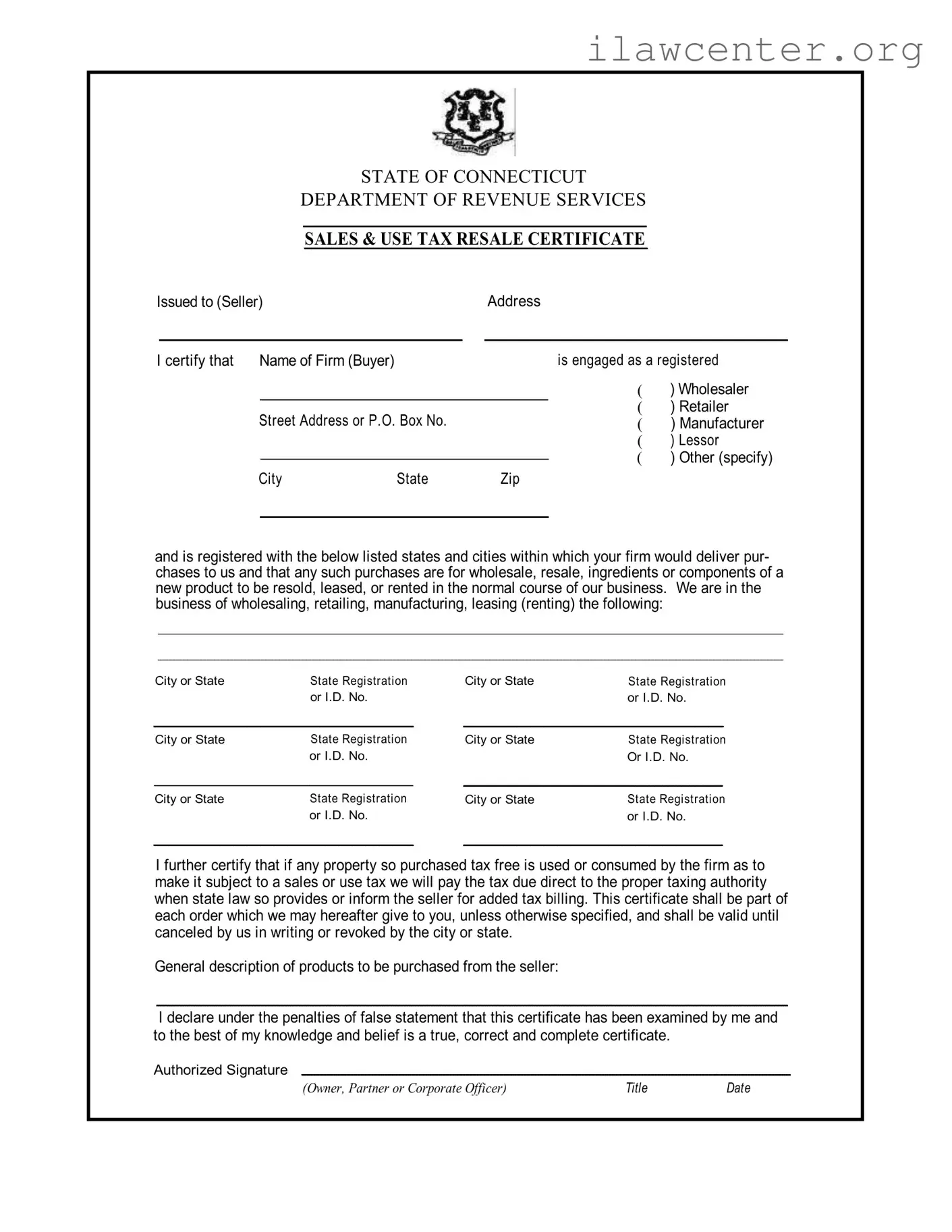
Ct Resale Certificate Preview

STATE OF CONNECTICUT
DEPARTMENT OF REVENUE SERVICES
SALES & USE TAX RESALE CERTIFICATE
Address
Issued to (Seller)
is engaged as a registered
Name of Firm (Buyer)I certify that
) Wholesaler
(
(
(
(
(
) Retailer
Street Address or P.O. Box No.
) Manufacturer
) Lessor
) Other (specify)
State
City Zip
and is registered with the below listed states and cities within which your firm would deliver pur-
chases to us and that any such purchases are for wholesale, resale, ingredients or components of a
new product to be resold, leased, or rented in the normal course of our business. We are in the
business of wholesaling, retailing, manufacturing, leasing (renting) the following:
State Registration
City or State
City or State
State Registration
or I.D. No.
or I.D. No.
State Registration
City or State
City or State
State Registration
or I.D. No.
Or I.D. No.
State Registration
City or State
State Registration
or I.D. No.
or I.D. No.
I further certify that if any property so purchased tax free is used or consumed by the firm as to
make it subject to a sales or use tax we will pay the tax due direct to the proper taxing authority
when state law so provides or inform the seller for added tax billing. This certificate shall be part of
each order which we may hereafter give to you, unless otherwise specified, and shall be valid until
canceled by us in writing or revoked by the city or state.
General description of products to be purchased from the seller:
I declare under the penalties of false statement that this certificate has been examined by me and
to the best of my knowledge and belief is a true, correct and complete certificate.
Authorized Signature
Date
Title
(Owner, Partner or Corporate Officer)
City or State

File Properties

Fact Name Details
Purpose The Connecticut Resale Certificate allows buyers to purchase goods tax-free for resale purposes.
Applicable Law Governing law is found in the Connecticut General Statutes, specifically under Chapter 219 (Sales and Use Taxes).
Eligible Buyers Buyers must be registered as wholesalers, retailers, manufacturers, lessors, or other specified entities.
Registration Requirement Buyers must provide their state registration or identification number on the form.
Usage of Goods Goods purchased with this certificate must be intended for resale, leasing, or as components of a new product.
Tax Responsibility If goods are used for personal consumption, the buyer must pay the applicable sales or use tax.
Validity The certificate remains valid until it is canceled in writing by the buyer or revoked by the state.
Signature Requirement An authorized signature from an owner, partner, or corporate officer is required for the certificate to be valid.

Instructions on Utilizing Ct Resale Certificate

Completing the Connecticut Resale Certificate form involves providing specific information about the buyer and the nature of their business. After filling out the form, it should be presented to the seller to confirm that the purchases made will be for resale purposes. Ensure all required fields are accurately filled to avoid any issues.

  1. Begin by entering the name of the seller in the space provided for "Issued to (Seller)".
  2. Provide the seller's address, including street address, city, and zip code.
  3. In the section labeled "Name of Firm (Buyer)", write the name of the buyer's firm.
  4. Indicate the type of business by checking the appropriate box: Wholesaler, Retailer, Manufacturer, Lessor, or Other (specify).
  5. Fill in the buyer's street address or P.O. Box number.
  6. Complete the city, state, and zip code fields for the buyer's address.
  7. List the cities or states where the buyer is registered, along with their respective state registration or I.D. numbers. Repeat this step for each registration, using additional lines as necessary.
  8. Provide a general description of the products that will be purchased from the seller.
  9. Sign the form in the "Authorized Signature" section. This should be done by an owner, partner, or corporate officer of the buyer's firm.
  10. Indicate the title of the person signing the form.
  11. Finally, date the form to confirm when it was completed.

Important Facts about Ct Resale Certificate

What is the purpose of the Connecticut Resale Certificate?

The Connecticut Resale Certificate allows businesses to purchase goods without paying sales tax. This certificate is used when the items bought are intended for resale, leasing, or rental. It helps streamline the purchasing process for wholesalers, retailers, manufacturers, and others who need to acquire products for business purposes.

Who can use the Connecticut Resale Certificate?

Any registered business in Connecticut can use this certificate. This includes wholesalers, retailers, manufacturers, lessors, and other businesses that plan to resell or lease the items they purchase. It is essential that the buyer is properly registered with the state and provides accurate information on the certificate.

How do I fill out the Connecticut Resale Certificate?

To complete the certificate, provide your business name, address, and registration details. Indicate the nature of your business, such as wholesaler or retailer. You will also need to describe the products you intend to purchase. Make sure to sign and date the certificate to validate it.

Is there a specific format for the Connecticut Resale Certificate?

Yes, the certificate follows a specific format as outlined by the Connecticut Department of Revenue Services. It includes sections for the seller's and buyer's information, business type, and product descriptions. Using the official form ensures compliance with state regulations.

How long is the Connecticut Resale Certificate valid?

The certificate remains valid until it is canceled in writing by the buyer or revoked by the state. It is important for businesses to keep their records updated and to notify sellers if there are any changes to their status or registration.

What happens if I use the certificate incorrectly?

If a business uses the resale certificate incorrectly, it may face penalties. If items purchased tax-free are later used or consumed, the business must pay the sales tax directly to the appropriate authority. Misuse can lead to audits and fines, so it is crucial to use the certificate properly.

Can I use the Connecticut Resale Certificate for purchases made out of state?

The Connecticut Resale Certificate is primarily for use within Connecticut. However, some out-of-state sellers may accept it if they are familiar with Connecticut's tax laws. Always check with the seller before making a purchase to ensure they accept the certificate.

How do I obtain a Connecticut Resale Certificate?

To obtain a Connecticut Resale Certificate, you do not need to apply for a separate document. Instead, you can fill out the certificate form as needed for each transaction. Ensure you have your business registration number and any other required information ready to complete the form accurately.

Common mistakes

Filling out the Connecticut Resale Certificate form requires attention to detail. One common mistake is failing to provide complete information about the buyer. The form asks for the name of the firm, address, and the type of business. Omitting any of these details can lead to confusion and potential tax issues.

Another frequent error is neglecting to check the appropriate box for the type of business. The options include wholesaler, retailer, manufacturer, and lessor, among others. Choosing the wrong category can result in complications during audits or disputes with the seller.

People often overlook the requirement to list the state registration or ID numbers. This information is crucial for verifying that the buyer is indeed registered to make tax-exempt purchases. Failing to include this data can invalidate the resale certificate and lead to unexpected tax liabilities.

Additionally, many individuals forget to describe the products being purchased. The form includes a section for a general description of these products. Without this information, sellers may not understand the intended use of the items, which can raise red flags for tax authorities.

Lastly, not having the correct authorized signature can invalidate the certificate. It must be signed by an owner, partner, or corporate officer. Ensure that the title and date are also included. Missing this step can lead to complications in the resale process, leaving the buyer liable for sales tax.

Documents used along the form

The Connecticut Resale Certificate form is an essential document for businesses involved in the sale of goods. However, it is often used in conjunction with other forms and documents that facilitate the sales process and ensure compliance with tax regulations. Below is a list of related documents that may be necessary.

  • Sales Tax Permit: This document allows a business to collect sales tax from customers. It is issued by the state and is required for any business selling taxable goods or services.
  • Purchase Order: A purchase order is a formal request issued by a buyer to a seller, indicating the type and quantity of goods or services required. It serves as a contract between both parties.
  • Invoice: An invoice is a detailed bill sent by the seller to the buyer. It outlines the products sold, their prices, and the total amount due, including any applicable taxes.
  • Certificate of Exemption: This certificate allows a buyer to purchase goods without paying sales tax. It is typically used by non-profit organizations or government entities that are exempt from sales tax.
  • W-9 Form: This form is used to request the Taxpayer Identification Number (TIN) of a vendor. It is essential for tax reporting purposes, especially for independent contractors and freelancers.
  • Resale Certificate from Other States: If a business operates in multiple states, it may need resale certificates from those states to ensure tax compliance when purchasing goods for resale.
  • Sales Tax Return: This document is filed periodically with the state to report sales and calculate the amount of sales tax owed. It ensures that businesses comply with state tax laws.

Understanding these forms and documents can help streamline the sales process and maintain compliance with tax regulations. Always ensure that your business has the necessary paperwork in order to avoid any potential issues down the line.

Similar forms

The Connecticut Resale Certificate form serves a specific purpose in the realm of sales and use tax. However, it shares similarities with several other important documents. Here are four such documents, along with a brief explanation of how they relate to the resale certificate:

  • Sales Tax Exemption Certificate: This document allows a buyer to purchase goods without paying sales tax. Like the resale certificate, it certifies that the buyer is exempt from tax due to their specific business activities, ensuring that tax is not applied at the point of sale.
  • Wholesale License: A wholesale license permits a business to purchase goods at wholesale prices without paying sales tax. This document is similar to the resale certificate in that it confirms the buyer's status as a wholesaler, allowing them to buy products intended for resale.
  • Manufacturer's Exemption Certificate: This certificate is used by manufacturers to purchase materials tax-free that will be incorporated into a final product. It parallels the resale certificate by affirming that the purchased items are for use in a business that will ultimately resell the finished goods.
  • Direct Pay Permit: A direct pay permit allows a buyer to pay sales tax directly to the state instead of to the seller. This document is akin to the resale certificate as it also verifies the buyer's tax status and their intention to use the purchased items in a manner that qualifies for tax exemption.

Dos and Don'ts

When filling out the Connecticut Resale Certificate form, there are important dos and don'ts to keep in mind. Here’s a straightforward list to help guide you.

  • Do provide accurate information about your business.
  • Do specify the type of business you operate (wholesaler, retailer, etc.).
  • Do list all relevant state registrations or ID numbers.
  • Do include a clear description of the products you intend to purchase.
  • Do sign and date the certificate to validate it.
  • Don't leave any fields blank unless they are not applicable.
  • Don't use outdated information from previous certificates.
  • Don't forget to inform the seller of any changes to your business status.
  • Don't misuse the certificate for personal purchases.
  • Don't submit the form without reviewing it for accuracy.

Misconceptions

Understanding the Connecticut Resale Certificate can be crucial for businesses engaged in buying and selling goods. However, several misconceptions can lead to confusion. Below are ten common misunderstandings about the form, along with clarifications.

  1. It is only for retailers.

    Many believe that the resale certificate is exclusively for retailers. In reality, it is also applicable to wholesalers, manufacturers, and lessors who purchase items for resale or incorporation into products.

  2. It exempts all purchases from sales tax.

    The certificate allows tax-free purchases only for items intended for resale. If the items are used or consumed, the tax must be paid directly to the taxing authority.

  3. It can be used indefinitely without renewal.

    While the certificate remains valid until canceled or revoked, businesses should regularly review and update their information to ensure compliance with state regulations.

  4. It requires no specific documentation.

    In order to use the resale certificate, businesses must be registered with the appropriate state and provide valid identification numbers. Documentation is essential for legitimacy.

  5. Only one certificate is needed for multiple purchases.

    Each transaction may require a new certificate unless otherwise specified. It is advisable to include the certificate with each order to avoid complications.

  6. It is the seller's responsibility to verify the certificate.

    While sellers should be cautious, it is ultimately the buyer's responsibility to ensure they are using the certificate correctly and in accordance with state laws.

  7. It can be used in any state.

    The Connecticut Resale Certificate is only valid within Connecticut. Businesses operating in multiple states must comply with each state's regulations and may need different forms.

  8. It can be filled out by anyone in the business.

    The certificate must be signed by an authorized individual, such as an owner, partner, or corporate officer, to ensure accountability and authenticity.

  9. It is not necessary for online purchases.

    Online transactions also require the use of a resale certificate if the items are intended for resale. The same tax regulations apply regardless of the sales channel.

  10. It guarantees tax-free status forever.

    While the certificate allows for tax-free purchases, if the buyer uses the items in a way that subjects them to tax, they must pay the applicable sales tax. The tax exemption is conditional.

By dispelling these misconceptions, businesses can better navigate the requirements surrounding the Connecticut Resale Certificate and ensure compliance with tax regulations.

Key takeaways

When filling out and using the Connecticut Resale Certificate form, there are several important points to keep in mind. Here are key takeaways to ensure proper use:

  • Identify the Buyer and Seller: Clearly fill in the names and addresses of both the buyer and the seller. This establishes the parties involved in the transaction.
  • Specify the Business Type: Indicate the type of business the buyer operates, such as wholesaler, retailer, manufacturer, or lessor. This classification is crucial for tax purposes.
  • List Registration Information: Provide the state registration or identification numbers for each location where the buyer operates. This verifies that the buyer is registered to make tax-exempt purchases.
  • Understand Tax Responsibilities: The buyer must acknowledge that if any purchased items are used in a way that triggers tax obligations, they are responsible for paying the appropriate taxes to the taxing authority.
  • Keep the Certificate Updated: The resale certificate remains valid until it is canceled in writing by the buyer or revoked by the state. Ensure that any changes in business operations or status are reflected promptly.

By adhering to these guidelines, both buyers and sellers can navigate the resale process more effectively and remain compliant with state tax regulations.