Da 4986 PDF Template

Da 4986 PDF Template

The DA 4986 form is a personal property record used primarily by military personnel to document their high-value items. This form plays a crucial role in identifying and recovering lost or stolen property, as well as in filing claims against the government for any loss or damage. To ensure your valuable items are protected, consider filling out the form by clicking the button below.

Article Guide

The DA 4986 form, known as the Personal Property Record, serves a crucial role in the management and protection of personal property for military personnel. This form is designed to record identifying data about high-value items, ensuring that individuals can easily track their possessions. It is essential for anyone in the military to understand the importance of accurately documenting their property. The information collected on this form is not only used for personal inventory but also plays a significant role in the recovery of lost or stolen items. In the event of a loss, the details recorded can assist in filing claims against the government or private insurance, facilitating a smoother recovery process. While providing information on the DA 4986 is voluntary, individuals are encouraged to complete it to avoid complications in the event of property loss. The form includes spaces for the owner's name, social security number, item descriptions, and other critical details. Additionally, it advises users on how to mark their property for identification and emphasizes the importance of keeping the record in a safe place. Overall, the DA 4986 form is an invaluable tool for service members to safeguard their personal belongings and navigate the complexities of property management.

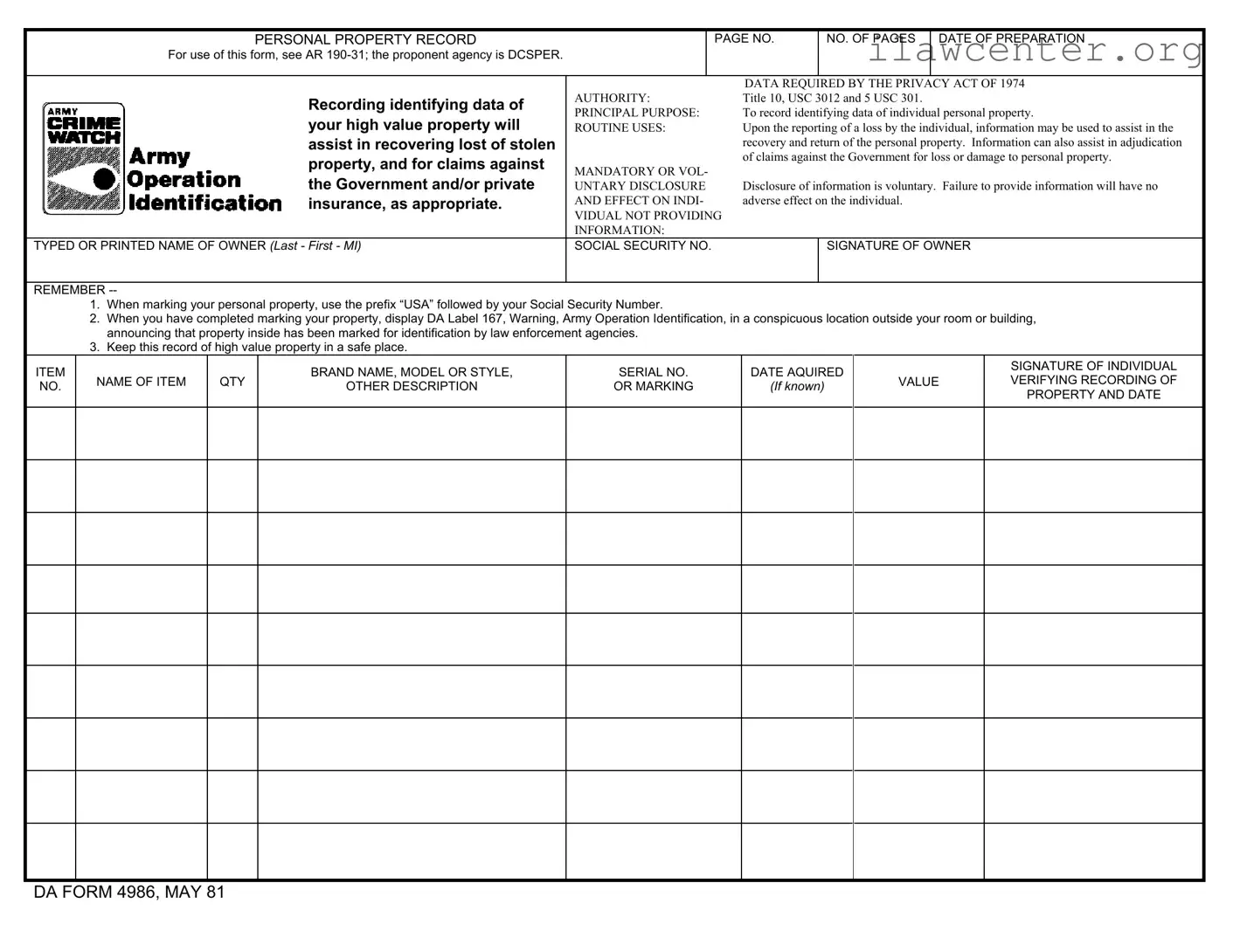
Da 4986 Preview

PERSONAL PROPERTY RECORD
For use of this form, see AR 190-31; the proponent agency is DCSPER.
PAGE NO.
NO. OF PAGES
DATE OF PREPARATION
DATA REQUIRED BY THE PRIVACY ACT OF 1974
Recording identifying data of
your high value property will
assist in recovering lost of stolen
property, and for claims against
the Government and/or private
insurance, as appropriate.
AUTHORITY:
PRINCIPAL PURPOSE:
ROUTINE USES:
MANDATORY OR VOL-
UNTARY DISCLOSURE
AND EFFECT ON INDI-
VIDUAL NOT PROVIDING
INFORMATION:
Title 10, USC 3012 and 5 USC 301.
To record identifying data of individual personal property.
Upon the reporting of a loss by the individual, information may be used to assist in the
recovery and return of the personal property. Information can also assist in adjudication
of claims against the Government for loss or damage to personal property.
Disclosure of information is voluntary. Failure to provide information will have no
adverse effect on the individual.
TYPED OR PRINTED NAME OF OWNER (Last - First - MI)
SOCIAL SECURITY NO.
SIGNATURE OF OWNER
REMEMBER --
1. When marking your personal property, use the prefix “USA” followed by your Social Security Number.
2. When you have completed marking your property, display DA Label 167, Warning, Army Operation Identification, in a conspicuous location outside your room or building,
announcing that property inside has been marked for identification by law enforcement agencies.
3. Keep this record of high value property in a safe place.
ITEM
NO.
NAME OF ITEM QTY
BRAND NAME, MODEL OR STYLE,
OTHER DESCRIPTION
SERIAL NO.
OR MARKING
DATE AQUIRED
(If known)
VALUE
SIGNATURE OF INDIVIDUAL
VERIFYING RECORDING OF
PROPERTY AND DATE
DA FORM 4986, MAY 81
ITEM
NO.
NAME OF ITEM QTY
BRAND NAME, MODEL OR STYLE,
OTHER DESCRIPTION
SERIAL NO.
OR MARKING
DATE AQUIRED
(If known)
VALUE
SIGNATURE OF INDIVIDUAL
VERIFYING RECORDING OF
PROPERTY AND DATE
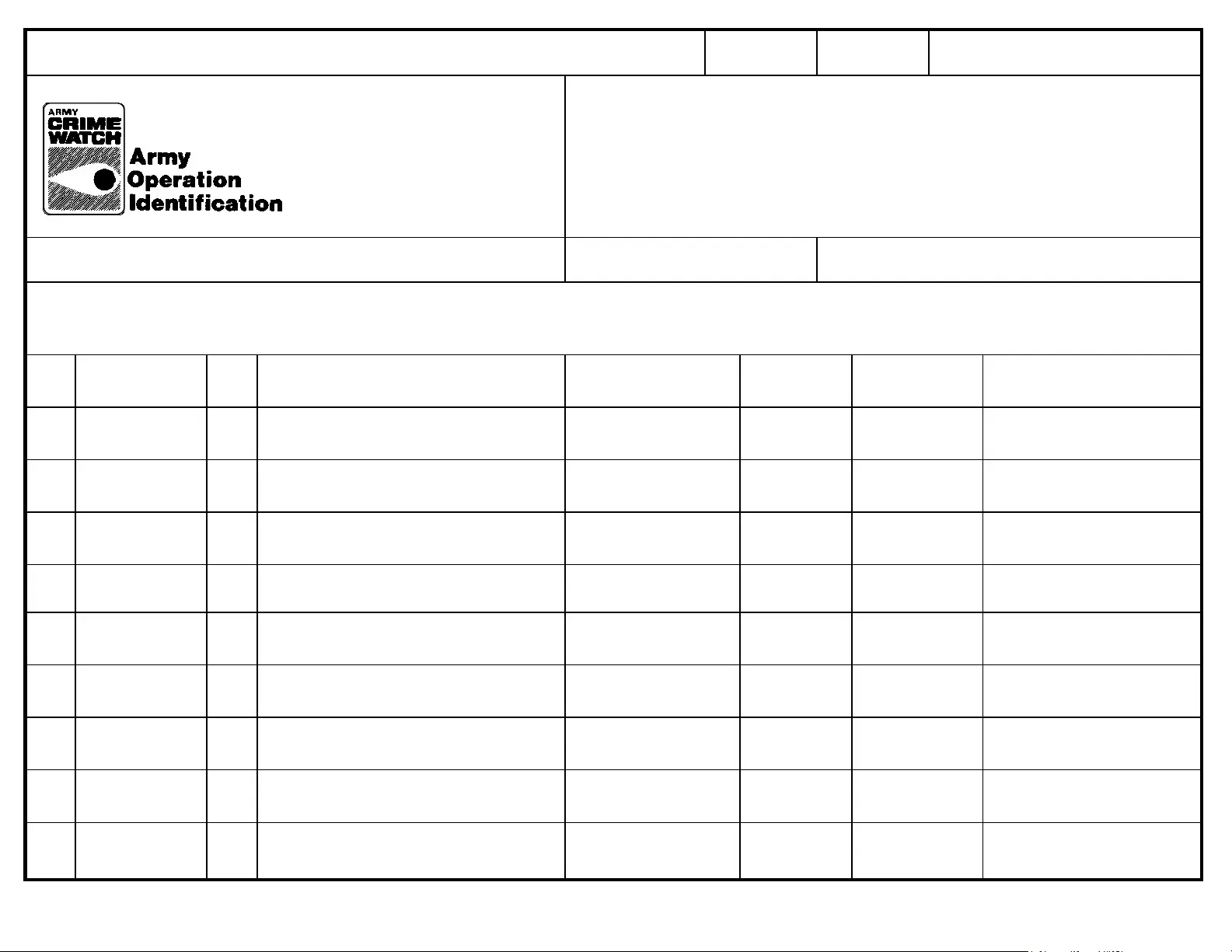
Reverse of DA Form 4986

File Properties

Fact Name Details
Purpose The DA Form 4986 is used to record identifying data of personal property owned by individuals.
Governing Law This form is governed by Title 10, USC 3012 and 5 USC 301.
Privacy Act Compliance The form adheres to the Privacy Act of 1974, ensuring personal information is protected.
Voluntary Disclosure Providing information on the form is voluntary; however, not providing it will not adversely affect the individual.
High Value Property Individuals are encouraged to mark high-value items with the prefix “USA” followed by their Social Security Number.
Loss Reporting Information recorded can assist in recovering lost or stolen property when reported by the individual.
Claims Assistance The data may also aid in adjudicating claims against the Government for loss or damage to personal property.
Record Keeping It is advisable to keep the record of high-value property in a safe place for future reference.
DA Label 167 After marking property, individuals should display DA Label 167 to inform law enforcement of the identification markings.
Signature Requirement A signature is required from the individual verifying the recording of property and the date of the record.

Instructions on Utilizing Da 4986

Filling out the DA 4986 form is an essential step in documenting personal property, especially for high-value items. After completing this form, it is crucial to keep it in a secure location and display the appropriate identification labels to deter theft and assist in recovery if necessary.

  1. Obtain a copy of the DA 4986 form.
  2. In the top section, enter the date of preparation.
  3. Fill in the typed or printed name of the owner, including last name, first name, and middle initial.
  4. Provide the Social Security number of the owner.
  5. Sign the form in the signature of owner section.
  6. Begin listing your personal property. For each item, complete the following:
    • ITEM NO. - Assign a number to each item for reference.
    • NAME OF ITEM - Write the name of the item.
    • QTY - Indicate the quantity of the item.
    • BRAND NAME, MODEL OR STYLE, OTHER DESCRIPTION - Provide detailed descriptions.
    • SERIAL NO. OR MARKING - Enter the serial number or any identifying marks.
    • DATE ACQUIRED (IF KNOWN) - Specify when you acquired the item.
    • VALUE - Estimate the item's value.
  7. After completing the list, have an individual verify the recording of property and sign in the signature of individual verifying recording of property and date section.
  8. Store the completed form in a safe place for future reference.

Important Facts about Da 4986

What is the DA 4986 form used for?

The DA 4986 form is a Personal Property Record. It is primarily used to record identifying data of an individual's personal property, especially high-value items. This record helps in the recovery of lost or stolen property and assists in claims against the government for loss or damage.

Who needs to fill out the DA 4986 form?

Any individual who owns personal property, particularly high-value items, should fill out the DA 4986 form. This includes military personnel and their families. Keeping a detailed record of your property can be beneficial in case of theft or loss.

What information is required on the DA 4986 form?

The form requires various details, including the owner's name, Social Security number, item description, quantity, brand name, model or style, serial number, date acquired, and the item's value. This information is crucial for identifying and recovering property.

Is it mandatory to provide information on the DA 4986 form?

Providing information on the DA 4986 form is voluntary. However, failing to provide this information may hinder your ability to recover lost property or file claims against the government for any loss or damage.

How should I mark my personal property?

When marking your personal property, use the prefix "USA" followed by your Social Security number. This unique identifier helps law enforcement agencies recognize your property as yours, enhancing the chances of recovery if lost or stolen.

What should I do after marking my property?

After marking your property, display the DA Label 167, which indicates that the property has been marked for identification. Place this label in a visible location outside your room or building to alert others, including law enforcement, about the marked items inside.

Where should I keep the DA 4986 form?

It is essential to keep your completed DA 4986 form in a safe place. This record serves as an important document that can aid in the recovery of your personal property if it is lost or stolen.

What happens if I lose my DA 4986 form?

If you lose your DA 4986 form, it is advisable to recreate the record as soon as possible. Gather all necessary details about your personal property again and fill out a new form to ensure you have an up-to-date record for future reference.

Can I use the DA 4986 form for items that are not high-value?

While the DA 4986 form is designed for high-value property, you can use it for any personal items you wish to keep a record of. Having a comprehensive inventory can still be beneficial for personal organization and insurance purposes.

Common mistakes

Filling out the DA 4986 form can be straightforward, but many people make common mistakes that can lead to complications later. One frequent error is not providing a complete typed or printed name. It’s essential to include your last name, first name, and middle initial. Omitting any part can cause confusion and hinder the identification of your property.

Another common mistake is failing to include the Social Security Number. This number is crucial for tracking your personal property. Leaving it blank can delay processing and recovery efforts if your items are lost or stolen.

Many individuals also overlook the importance of marking their property correctly. When marking your items, you should start with the prefix “USA” followed by your Social Security Number. Skipping this step can lead to difficulties in identifying your property as yours.

People often forget to display the DA Label 167 after marking their property. This label acts as a warning that your items are marked for identification. Not displaying it can result in your property not being recognized as marked, which could complicate recovery efforts.

Another mistake is not keeping the record of high-value property in a safe place. This record is vital for tracking your items. If it gets lost or damaged, you may struggle to prove ownership or value.

Some individuals fail to provide complete details about their items. When listing an item, ensure that you include the brand name, model or style, and serial number. Incomplete information can lead to issues during claims processing.

Additionally, many people do not verify the recording of their property. It’s important to have someone else sign as a witness to the recording. This step adds an extra layer of verification and can be helpful if disputes arise.

Another common oversight is neglecting to include the date acquired for each item. This information can be crucial for insurance claims or when proving ownership, so it should not be overlooked.

Some individuals may also forget to update their records if they acquire new items or dispose of old ones. Keeping your property record current is essential for accurate tracking and recovery.

Lastly, people sometimes misinterpret the voluntary nature of the disclosure. While providing information is voluntary, not filling out the form completely can lead to complications later on. It’s always best to provide as much information as possible to avoid issues down the line.

Documents used along the form

The DA Form 4986 is a crucial document for recording personal property, particularly for military personnel. It assists in identifying high-value items and provides a basis for recovery in case of loss or theft. Alongside this form, several other documents may be required to ensure comprehensive management of personal property. Below is a list of these forms and documents.

  • DA Form 167: This form serves as a warning label, indicating that property has been marked for identification. It is essential for alerting law enforcement and others that the items are recorded and can be traced back to the owner.
  • DA Form 2404: This is the Equipment Inspection and Maintenance Worksheet. It documents the condition and maintenance history of military equipment, ensuring accountability and proper upkeep.
  • DA Form 3151: This form is used for transferring property between individuals or units. It helps maintain accurate records of ownership and location of personal property within the military.
  • DA Form 7000: This form is a request for a Personal Property Inventory. It is used to initiate an inventory of personal belongings, particularly during moves or deployments.
  • DD Form 250: Known as the Material Inspection and Receiving Report, this form documents the receipt of property and materials. It is vital for ensuring that all items received are accounted for and in good condition.
  • DD Form 1610: This is a Request and Authorization for Temporary Duty (TDY) Travel of DOD Personnel. It may be necessary when military personnel need to travel with their personal property for official duties.
  • DA Form 2028: This form is used for recommending changes to publications or forms. It can be relevant when updates or corrections are needed for property management processes.
  • SF 95: This is a Claim for Damage, Injury, or Death form. It is used to file claims against the government for loss or damage to personal property, ensuring that individuals can seek compensation if necessary.

Understanding these documents and their purposes can help individuals effectively manage their personal property within the military context. Proper documentation not only aids in the recovery of lost items but also ensures accountability and compliance with regulations.

Similar forms

The DA 4986 form is a personal property record used primarily by military personnel. Several other documents serve similar purposes in recording, managing, and tracking personal property. Here’s a list of eight documents that are comparable to the DA 4986 form:

  • DA Form 2404: This form is used for recording maintenance and inspection of equipment. Like the DA 4986, it helps track the condition and details of property.
  • DA Form 3161: This document is utilized for the temporary transfer of property. It shares the purpose of documenting property details and ownership.
  • DA Form 3749: This form is used for the hand receipt of property. It is similar in that it records the transfer and accountability of personal property.
  • DA Form 2062: This is a hand receipt for property that helps maintain accountability. It parallels the DA 4986 in ensuring that property is tracked and recorded.
  • DA Form 7000: This document serves as a personal property inventory. Like the DA 4986, it lists items and their details for record-keeping purposes.
  • DA Form 7281: This form is used for recording lost or stolen property. It assists in tracking and recovering items, similar to the DA 4986.
  • DA Form 2063: This is a document for the accountability of property in the Army. It is akin to the DA 4986 in its role of maintaining detailed records.
  • DA Form 3151: This form is used for the transfer of property between units. It shares the function of documenting ownership and details of personal property.

Dos and Don'ts

When filling out the DA 4986 form, it's important to pay attention to detail to ensure your personal property is accurately recorded. Here are some helpful tips on what to do and what to avoid:

  • Do: Clearly print or type your name, Social Security Number, and other required information to avoid any confusion.
  • Do: Use the prefix “USA” followed by your Social Security Number when marking your personal property.
  • Do: Keep a copy of the completed form in a safe place for your records.
  • Do: Display DA Label 167 in a visible location to inform others that your property is marked for identification.
  • Don't: Skip any fields on the form. Incomplete forms can lead to issues with property recovery.
  • Don't: Use abbreviations or unclear descriptions when listing your property. Be as specific as possible.
  • Don't: Forget to sign the form. An unsigned form may not be considered valid.
  • Don't: Share your Social Security Number or personal information without ensuring the recipient's legitimacy.

By following these guidelines, you can help ensure that your personal property is properly recorded and protected.

Misconceptions

There are several misconceptions about the DA 4986 form that can lead to confusion. Here are seven common misunderstandings:

  • The DA 4986 form is mandatory for all military personnel. Many believe that every service member must fill out this form. In reality, it is only required for those who wish to record their personal property for identification and recovery purposes.
  • Filling out the form guarantees recovery of lost property. Some individuals think that submitting the DA 4986 ensures that lost or stolen items will be recovered. While the form assists in identifying property, recovery is not guaranteed.
  • Only high-value items need to be recorded. A common misconception is that only expensive items should be documented. In fact, any personal property can be recorded, regardless of its value, to aid in identification.
  • Information on the form is shared widely. Many people worry that their personal information will be disclosed to unauthorized parties. However, the data collected is protected under the Privacy Act of 1974 and is used solely for specific purposes related to property recovery.
  • There are penalties for not completing the form. Some individuals fear that failing to fill out the DA 4986 will lead to disciplinary actions. In truth, disclosure of information is voluntary, and not completing the form does not have adverse effects.
  • Marking property is only for those in combat zones. It is a misconception that marking personal property is only necessary for service members deployed in combat. All personnel, regardless of location, can benefit from marking their items for identification.
  • The DA 4986 form is outdated and no longer relevant. Some believe that the DA 4986 is an obsolete form. However, it remains a useful tool for service members to keep track of their personal property and protect their assets.

Key takeaways

When filling out and using the DA 4986 form, it is essential to keep several key points in mind. This form serves as a personal property record, and understanding its requirements can facilitate the proper documentation of your belongings.

  • Personal Identification: Clearly print your name, Social Security number, and signature on the form. This information is crucial for identification purposes.
  • Property Marking: When marking your personal property, use the prefix “USA” followed by your Social Security number. This helps in identifying your items.
  • Display Warning: After marking your property, place DA Label 167 in a visible area. This label alerts others that the property is marked for identification.
  • Secure Record Keeping: Store the completed form in a safe location. Keeping this record helps in recovering lost or stolen items.
  • Property Details: Provide comprehensive details about each item. Include the name, quantity, brand, model, serial number, and estimated value.
  • Verification: Have an individual verify the recording of your property by signing the form. This adds an additional layer of credibility.
  • Privacy Act Compliance: Be aware that the information you provide is protected under the Privacy Act of 1974. Disclosure is voluntary.
  • Loss Reporting: In the event of a loss, the information recorded can assist in the recovery process and claims against the government or private insurance.
  • Mandatory Information: While the disclosure of information is voluntary, it is advisable to provide as much detail as possible to avoid complications later.
  • Regular Updates: Regularly update your DA 4986 form as you acquire new items or if any details change regarding your existing property.

By following these guidelines, you can ensure that your personal property is documented accurately and efficiently, providing peace of mind in the event of loss or damage.