

Dar Genealogy Worksheet PDF Template

Dar Genealogy Worksheet PDF Template

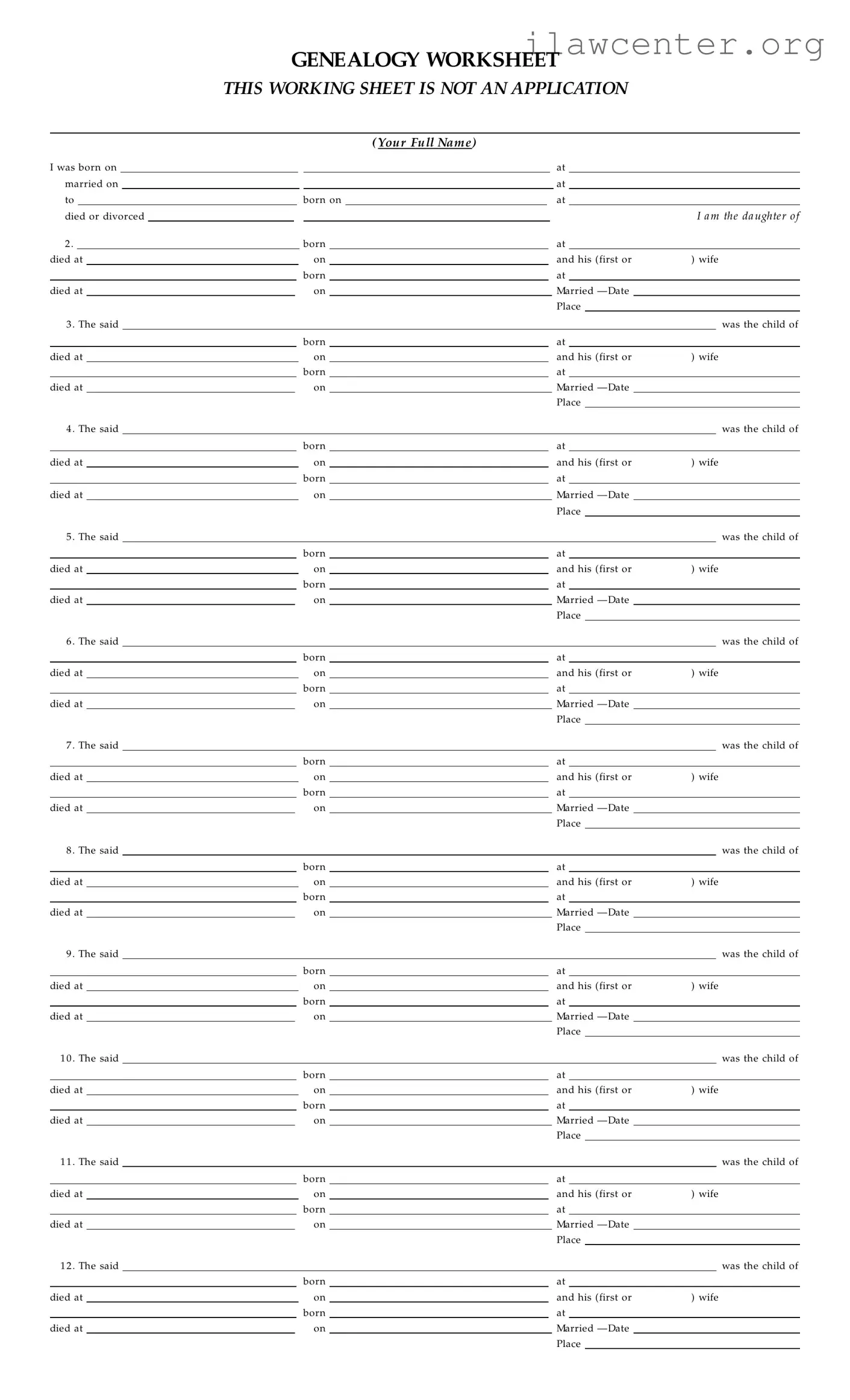
The DAR Genealogy Worksheet is a valuable tool for individuals seeking to trace their lineage, particularly for those interested in proving descent from a Revolutionary War ancestor. This form helps organize vital information about family members, including birth, marriage, and death details, while also documenting the services of ancestors during the American Revolution. To begin your genealogical journey, fill out the form by clicking the button below.

Article Guide

The DAR Genealogy Worksheet is a crucial tool for individuals seeking to trace their lineage back to ancestors who served during the American Revolution. This form is designed to organize vital information about family connections, including birth, marriage, and death dates, as well as places associated with these events. The worksheet allows users to detail their direct lineage, starting from themselves and moving backward through multiple generations. Each section prompts the user to provide the names of ancestors, their life events, and their spouses, ensuring that all relevant details are captured systematically. Additionally, the form requires documentation of the ancestor's military service during the Revolutionary War, along with citations for the sources of this information. Users must also provide evidence for each generational connection, such as wills, census records, and other official documents, as mere tradition is not considered valid proof. This structured approach not only aids in the application process for membership in the Daughters of the American Revolution but also serves as a valuable resource for genealogical research.

Dar Genealogy Worksheet Preview

I was born on
married on
to
died or divorced
born on
at
at
at
I a m the da ughter of
GENEALOGY WORKSHEET
THIS WORKING SHEET IS NOT AN APPLICATION
( You r Fu ll Name)
died at
died at
born
on
born
on
at
and his (first or ) wife
at
Married Date
Place
3. The said was the child of
died at
died at
born
on
born
on
at
and his (first or ) wife
at
Married Date
Place
4. The said was the child of
died at
died at
born
on
born
on
at
and his (first or ) wife
at
Married Date
Place
5. The said was the child of
died at
died at
born
on
born
on
at
and his (first or ) wife
at
Married Date
Place
6. The said was the child of
died at
died at
born
on
born
on
at
and his (first or ) wife
at
Married Date
Place
7. The said was the child of
died at
died at
born
on
born
on
at
and his (first or ) wife
at
Married Date
Place
8. The said was the child of
died at
died at
born
on
born
on
at
and his (first or ) wife
at
Married Date
Place
9. The said was the child of
died at
died at
born
on
born
on
at
and his (first or ) wife
at
Married Date
Place
10 . The said was the child of
died at
died at
born
on
born
on
at
and his (first or ) wife
at
Married Date
Place
11 . The said was the child of
2.
died at
died at
born
on
born
on
at
and his (first or ) wife
at
Married Date
Place
died at
died at
born
on
born
on
at
and his (first or ) wife
at
Married Date
Place
12 . The said was the child of
ANCESTOR’S SERVICES
The said
who resided during the American
Revolution at
assisted in establishing
American Independence, while acting in the capacity of
My Ancestor’s services during the Revolutionary War were as follows:
Give source for ancestor’s service above. For published records give author, title, volume and page: applicant shall file a photocopy of
official unpublished record.
REFERENCES FOR LINEAGE
Give below proof for EACH statement of Birth, marriage, death dates and places and connections between generations from the applicant through the generation of the
Revolutionary ancestor. Published authorities should be cited by title, author, date of publication, volume and page. Send one certified, attested copy or photocopy of each
unpublished data. Proofs of line of descent comprise wills, administrations, deeds, church, town and court records, Bible, census and pension records, tombstone inscriptions,
genealogies and such other records. TRADITION is not acceptable. Give National Numbers and relationships of any close relatives credited with this ancestor.
1st. Gen.
2nd Gen.
3rd Gen.
4th Gen.
5th Gen.
6th Gen.
7th Gen.
8th Gen.
9th Gen.
10th Gen.
11th Gen.
CHILDREN OF REVOLUTIONARY ANCESTOR
(By ea ch ma rriage, if married more than once .)
NAMES
TO WHOM MARRIED, NOTING IF
MARRIED MORE THAN ONCE
DATES OF BIRTH
Do cum e nt No. RGG-1001 ( Revised February 1999) (0101MS3000PS)

File Properties

Fact Name Fact Description
Form Purpose The Dar Genealogy Worksheet is a tool for documenting ancestry and lineage.
Not an Application This worksheet is explicitly stated as not being an application for membership.
Information Required It requires personal details such as full name, birth date, marriage date, and spouse information.
Generational Tracking The form allows for tracking lineage up to twelve generations.
Revolutionary Ancestor Applicants must provide details about their ancestor's role during the American Revolution.
Proof of Lineage Proof of birth, marriage, and death dates is required for each generation.
Acceptable Records Records such as wills, census data, and tombstone inscriptions are acceptable as proof.
References Required Applicants must cite published authorities for each statement of lineage.
Document Submission One certified copy or photocopy of unpublished data must be submitted.
State-Specific Laws Governing laws may vary by state, and applicants should refer to local regulations for genealogy documentation.

Instructions on Utilizing Dar Genealogy Worksheet

Once you have the DAR Genealogy Worksheet form in front of you, it’s time to fill it out carefully. Gather your family information, including dates and places of birth, marriage, and death. Ensure that all details are accurate, as this will help in establishing your lineage. Follow the steps below to complete the form effectively.

  1. Start with your full name at the top of the form. Include your birth date and place.
  2. Fill in your marriage details, including the date and place, along with your spouse's full name.
  3. For each ancestor, fill in their full name, birth date, and place. Include their death date or divorce status.
  4. Continue listing ancestors, filling out their spouse's information as required. Repeat this for each generation, up to 12 ancestors.
  5. For each ancestor, note their service during the American Revolution, if applicable. Include the capacity in which they served.
  6. Provide sources for each ancestor's service. If using published records, include the author, title, volume, and page number.
  7. List proof for each statement regarding birth, marriage, and death dates. Include connections between generations.
  8. Gather and attach certified copies or photocopies of any necessary documents that support your claims.
  9. For close relatives connected to your ancestor, provide their National Numbers and relationships.
  10. Finally, document any children of your Revolutionary ancestor, noting marriages and additional details as required.

Important Facts about Dar Genealogy Worksheet

What is the purpose of the DAR Genealogy Worksheet?

The DAR Genealogy Worksheet is designed to help individuals document their family history in a structured format. It serves as a working sheet, allowing users to gather and organize information about their ancestors, including names, dates of birth, marriage, and death. This worksheet is essential for those seeking membership in the Daughters of the American Revolution (DAR), as it provides a clear lineage that connects the applicant to a Revolutionary War ancestor.

How should I fill out the DAR Genealogy Worksheet?

When filling out the worksheet, start with your full name, including your birth date and any relevant marriage information. Proceed to list your parents, grandparents, and further generations, ensuring to include their names, birth dates, marriage dates, and death dates. It is crucial to provide accurate information, as this will form the basis of your lineage proof. Each ancestor should be documented in a separate section, and you must indicate the relationship to the Revolutionary ancestor clearly.

What types of documentation are required to support my lineage?

Can I use the DAR Genealogy Worksheet for purposes other than DAR membership?

Common mistakes

Filling out the DAR Genealogy Worksheet form can be a straightforward process, but several common mistakes can lead to complications. One frequent error is not providing complete names. It is essential to include full names, including middle names or initials, to ensure clarity in the lineage.

Another mistake involves incorrect dates. People often enter birth, marriage, or death dates that are inaccurate or incomplete. Double-checking these dates can prevent confusion and delays in processing the application.

Many individuals overlook the importance of documenting places. Providing the city, county, and state for each event helps establish a clear connection to the ancestor's history. Missing this information can lead to questions about the validity of the claims.

Some applicants forget to include their relationship to the Revolutionary ancestor. Clearly stating this relationship is crucial for establishing the lineage and ensuring the application meets the necessary criteria.

Inadequate sourcing of information is another common issue. Applicants often fail to provide proper citations for the proof of birth, marriage, and death. Each statement should be backed by credible sources, and it is vital to include the author, title, and page numbers when applicable.

Not distinguishing between direct ancestors and collateral relatives can create confusion. It is important to clearly identify which individuals are direct ancestors and which are not, as this affects the lineage being traced.

Some individuals neglect to sign and date the form. This step is often seen as minor, but it is essential for validating the submission. An unsigned form may be returned for correction.

Using outdated or incorrect forms can also lead to issues. Always ensure that the latest version of the DAR Genealogy Worksheet is being used to avoid any complications during the submission process.

Another mistake is failing to provide documentation for services rendered during the American Revolution. Applicants should clearly outline their ancestor's contributions and include any relevant records to support these claims.

Lastly, many applicants do not take the time to review their completed forms. A thorough review can help catch errors or omissions before submission, making the process smoother and more efficient.

Documents used along the form

The DAR Genealogy Worksheet is an essential tool for documenting lineage and proving descent from a Revolutionary War ancestor. However, several other forms and documents are often used in conjunction with this worksheet to provide comprehensive proof of ancestry. Below is a list of these additional documents, each serving a specific purpose in the genealogical process.

  • Birth Certificate: This official document verifies the birth details of an individual, including date, place, and parentage. It serves as a primary source for establishing lineage.
  • Marriage Certificate: This document provides proof of a marriage between two individuals. It includes names, dates, and locations, which are crucial for connecting generations.
  • Death Certificate: This record confirms the death of an individual and includes pertinent information such as date, place, and cause of death. It helps establish the timeline of family history.
  • Will: A legal document that outlines the distribution of an individual's estate after death. Wills often contain names of heirs and can establish family relationships.
  • Census Records: These records provide demographic information about families at specific points in time. They can show relationships between individuals and track changes over the years.
  • Pension Records: These documents offer insights into the service of Revolutionary War veterans. They may include personal details and can help verify an ancestor's military service.
  • Church Records: These records often include baptisms, marriages, and burials. They can provide vital information about family events and connections within the community.
  • Family Bible Records: Many families keep a Bible that contains handwritten records of births, marriages, and deaths. These records can serve as valuable primary sources for genealogical research.

Collectively, these documents support the claims made on the DAR Genealogy Worksheet and provide a clearer picture of an individual's ancestry. Gathering these records can be a meticulous process, but they are invaluable for establishing a verified lineage.

Similar forms

The DAR Genealogy Worksheet form is a valuable tool for documenting family history and lineage. It shares similarities with several other documents commonly used in genealogy research. Below are four documents that are comparable to the DAR Genealogy Worksheet, along with their specific similarities:

  • Family Group Sheet: Like the DAR Worksheet, a Family Group Sheet organizes information about a family unit, including parents, children, and marriage details. Both documents emphasize relationships and require similar data points, such as birth and marriage dates.
  • Pedigree Chart: This chart provides a visual representation of an individual's ancestry. It parallels the DAR Worksheet by outlining direct lineage and connections across generations, helping to trace descent from a common ancestor.
  • Genealogical Research Log: A research log tracks sources and findings during genealogy research. Similar to the DAR Worksheet, it documents proof of lineage and requires citation of sources, ensuring accuracy in family history claims.
  • Vital Records Form: This form collects essential information about births, marriages, and deaths. Both the DAR Worksheet and vital records forms aim to establish familial connections and require precise details to substantiate claims of lineage.

Dos and Don'ts

When filling out the DAR Genealogy Worksheet form, it is important to approach the task with care and attention to detail. Here are some guidelines to help you navigate the process effectively.

  • Do provide your full name and accurate birth date at the top of the worksheet.
  • Do list your parents and their details clearly, including their birth and death dates.
  • Do use consistent formatting for dates, such as month, day, and year.
  • Do include all relevant marriages and note if any ancestor was married more than once.
  • Do provide documentation for each claim, including copies of birth, marriage, and death certificates.
  • Don't rely on oral tradition; only use documented evidence for your claims.
  • Don't leave any sections blank; if information is unavailable, note that clearly.
  • Don't forget to cite your sources for any published records used in your application.
  • Don't confuse generations; ensure each ancestor is correctly placed in the lineage.
  • Don't hesitate to seek assistance if you are unsure about any part of the form.

By following these guidelines, you will create a thorough and accurate record of your genealogy, which is essential for your application. Take your time and double-check your entries for clarity and correctness.

Misconceptions

Misconceptions about the DAR Genealogy Worksheet can lead to confusion for individuals seeking to document their lineage. Below are seven common misconceptions clarified for better understanding.

  • It is an application form. Many believe the DAR Genealogy Worksheet is an official application for membership. In reality, it serves as a working document to organize genealogical information before submitting a formal application.
  • Only direct descendants can use it. Some think only direct descendants of Revolutionary War ancestors can utilize the worksheet. However, anyone interested in tracing their lineage or gathering family history can benefit from it.
  • All information must be verified before use. A common misconception is that all entries must be fully verified prior to filling out the worksheet. While accuracy is important, the worksheet is primarily a tool for collecting information that can be verified later.
  • It requires extensive documentation from the start. Many assume that extensive documentation is necessary to begin using the worksheet. In truth, the form is designed to help users compile information gradually, allowing for the addition of sources over time.
  • Only published records are acceptable. Some believe that only published records can be used as proof for lineage claims. However, the worksheet accepts a variety of documentation, including unpublished records, as long as they are properly cited.
  • Tradition is sufficient for proof. There is a misconception that oral tradition or family stories are adequate for proving lineage. The worksheet explicitly states that tradition is not acceptable; documented proof is required.
  • It is only for those with extensive genealogical knowledge. Many think the worksheet is only suitable for experienced genealogists. In fact, it is designed to be user-friendly, making it accessible for individuals at any level of expertise.

Key takeaways

When filling out and using the DAR Genealogy Worksheet form, keep these key takeaways in mind:

  • Accuracy is crucial. Ensure all names, dates, and places are correct to avoid complications later.
  • Follow the format. Stick to the structure provided in the worksheet for consistency and clarity.
  • Document your sources. For each ancestor, provide the necessary proof of birth, marriage, and death dates.
  • Use certified copies. When submitting documents, send certified or attested copies of any unpublished records.
  • Provide detailed lineage. Clearly outline the connections between generations, showing how you descend from the Revolutionary ancestor.
  • Include all relevant marriages. If an ancestor married multiple times, list each spouse and their details.
  • Be thorough with references. Cite published authorities accurately, including titles, authors, and publication details.

By keeping these points in mind, you can effectively complete the DAR Genealogy Worksheet and ensure your application process goes smoothly.