
Dd 2977 PDF Template

Dd 2977 PDF Template

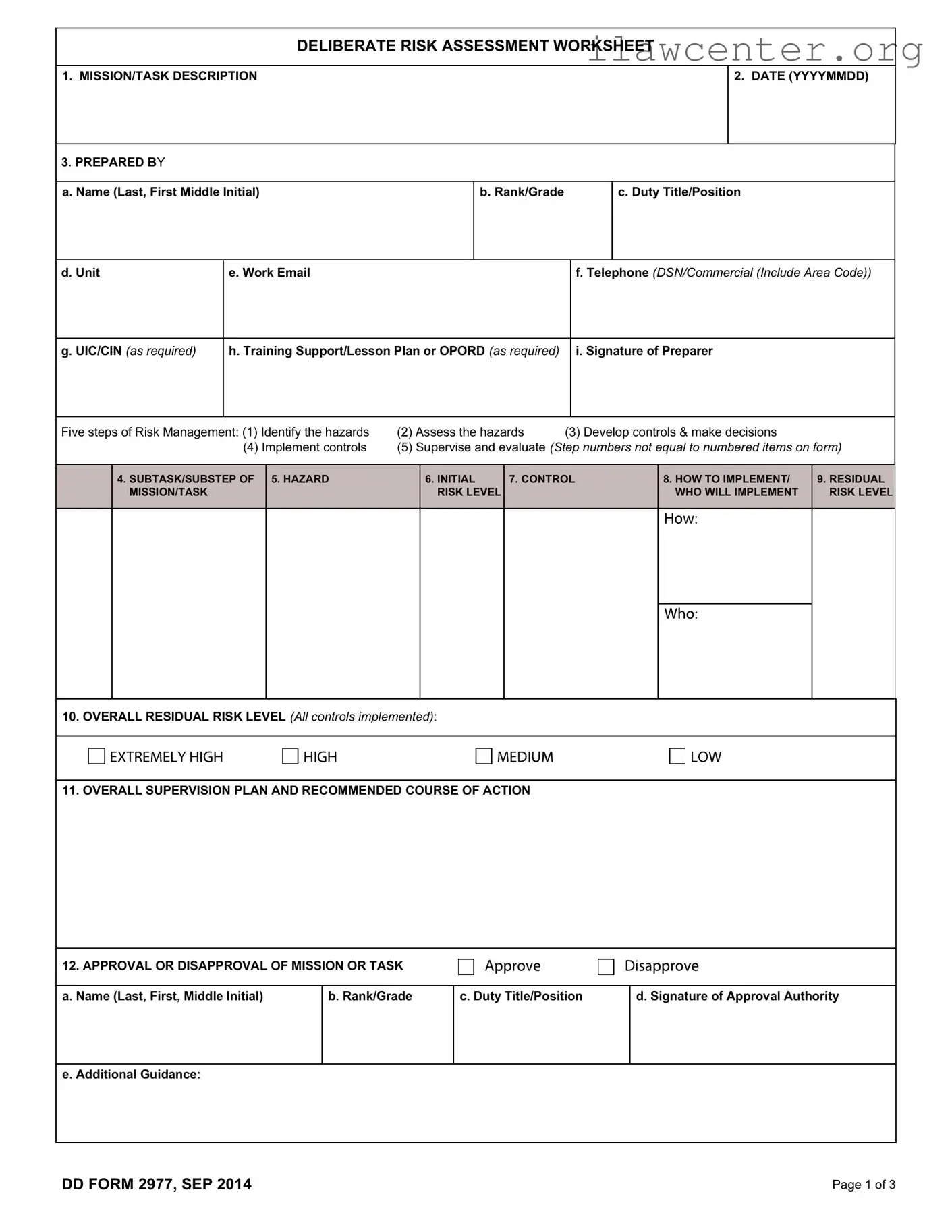
The DD Form 2977, known as the Deliberate Risk Assessment Worksheet, is a tool used by military personnel to evaluate and manage risks associated with specific missions or tasks. This form facilitates a structured approach to identifying hazards, assessing their potential impact, and implementing controls to mitigate risks. Understanding how to properly fill out this form is essential for ensuring safety and mission success.

To begin the process of filling out the DD Form 2977, click the button below.

Article Guide

The DD 2977 form, officially known as the Deliberate Risk Assessment Worksheet, serves as a crucial tool in managing risks associated with military missions and tasks. This form is designed to help personnel systematically identify, assess, and mitigate potential hazards that may arise during operations. It begins with a clear mission or task description, followed by essential details such as the date, preparer's information, and specifics about the unit involved. The form emphasizes a structured approach to risk management, broken down into five key steps: identifying hazards, assessing them, developing and implementing controls, and finally supervising and evaluating the entire process. Each section of the form captures vital information, including initial and residual risk levels, control measures, and the overall supervision plan. Additionally, it provides a framework for approval or disapproval of missions based on the assessed risks, ensuring that all operations are conducted safely and effectively. By documenting feedback and lessons learned, the DD 2977 not only aids in immediate risk management but also contributes to continuous improvement in future operations.

Dd 2977 Preview

DD FORM 2977, SEP 2014
Page 1 of 3
DELIBERATE RISK ASSESSMENT WORKSHEET
1. MISSION/TASK DESCRIPTION 2. DATE (YYYYMMDD)
3. PREPARED BY
a. Name (Last, First Middle Initial) b. Rank/Grade c. Duty Title/Position
d. Unit e. Work Email f. Telephone (DSN/Commercial (Include Area Code))
g. UIC/CIN (as required) h. Training Support/Lesson Plan or OPORD (as required) i. Signature of Preparer
Five steps of Risk Management: (1) Identify the hazards (2) Assess the hazards (3) Develop controls & make decisions
(4) Implement controls (5) Supervise and evaluate (Step numbers not equal to numbered items on form)
4. SUBTASK/SUBSTEP OF
MISSION/TASK
5. HAZARD 6. INITIAL
RISK LEVEL
7. CONTROL 8. HOW TO IMPLEMENT/
WHO WILL IMPLEMENT
9. RESIDUAL
RISK LEVEL
10. OVERALL RESIDUAL RISK LEVEL (All controls implemented):
11. OVERALL SUPERVISION PLAN AND RECOMMENDED COURSE OF ACTION
12. APPROVAL OR DISAPPROVAL OF MISSION OR TASK
a. Name (Last, First, Middle Initial) b. Rank/Grade c. Duty Title/Position d. Signature of Approval Authority
e. Additional Guidance:
DD FORM 2977, SEP 2014
Page 2 of 3
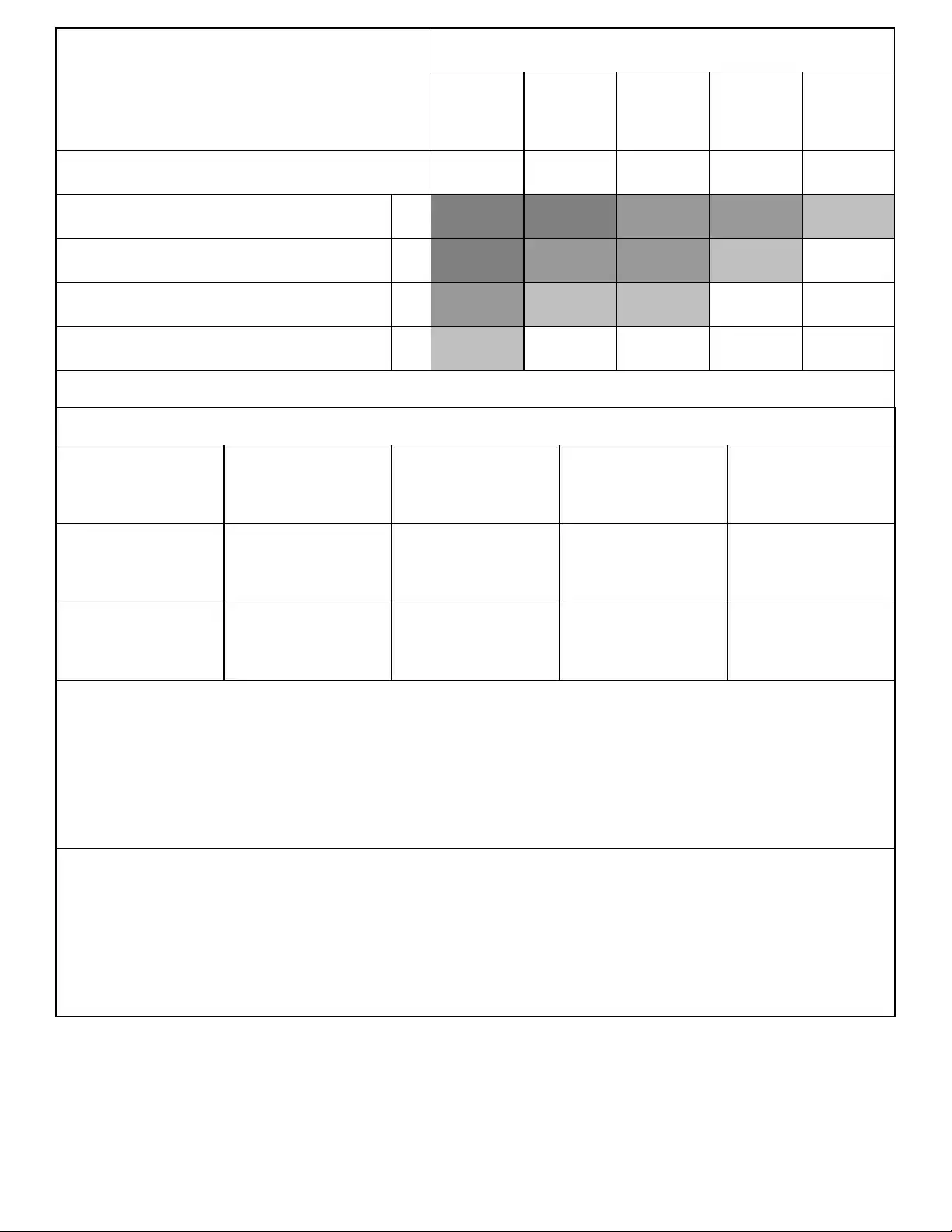
Probability (expected frequency)
Risk Assessment Matrix
Frequent:
Continuous,
regular, or
inevitable
occurrences
Likely:
Several or
numerous
occurrences
Occasional:
Sporadic or
intermittent
occurrences
Seldom:
Infrequent
occurrences
Unlikely:
Possible
occurrences
but improbable
Severity (expected consequence) A B C D E
Catastrophic: Mission failure, unit readiness eliminated;
death, unacceptable loss or damage
I EH EH H H M
Critical: Significantly degraded unit readiness or mission
capability; severe injury, illness, loss or damage
II EH H H M L
Moderate: Somewhat degraded unit readiness or mission
capability; minor injury, illness, loss, or damage
III H M M L L
Negligible: Little or no impact to unit readiness or mission
capability; minimal injury, loss, or damage
IV M L L L L
Legend: EH - Extremely High Risk H - High Risk M - Medium Risk L - Low Risk
13. RISK ASSESSMENT REVIEW (Required when assessment applies to ongoing operations or activities)
a. Date b. Last Name c. Rank/Grade d. Duty Title/Position e. Signature of Reviewer
14. FEEDBACK AND LESSONS LEARNED
15. ADDITIONAL COMMENTS OR REMARKS
DD FORM 2977, SEP 2014
Page 3 of 3
Instructions for Completing DD Form 2977, "Deliberate Risk Assessment Worksheet"
1. Mission/Task Description: Briefly describe
the overall Mission or Task for which the
deliberate risk assessment is being conducted.
2. Date (DD/MM/YYY): Self Explanatory.
3. Prepared By: Information provided by the
individual conducting the deliberate risk
assessment for the operation or training.
Legend: UIC = Unit Identification Code; CIN =
Course ID Number; OPORD = operation order;
DSN = defense switched network; COMM =
commercial
4. Sub-task/Sub-Step of Mission/Task: Briefly
describe all subtasks or substeps that warrant
risk management.
5. Hazard: Specify hazards related to the
subtask in block 4.
6. Initial Risk Level: Determine probability and
severity. Using the risk assessment matrix (page
3), determine level of risk for each hazard
specified. probability, severity and associated
Risk Level; enter level into column.
7. Control: Enter risk mitigation resources/
controls identified to abate or reduce risk relevant
to the hazard identified in block 5.
8. How to Implement / Who Will Implement:
Briefly describe the means of employment for
each control (i.e., OPORD, briefing, rehearsal)
and the name of the individual unit or office that
has primary responsibility for control
implementation.
9. Residual Risk Level: After controls are
implemented, determine resulting probability,
severity, and residual risk level.
10. Overall Risk After Controls are
Implemented: Assign an overall residual risk
level. This is equal to or greater than the highest
residual risk level (from block 9).
11. Supervision Plan and Recommended
Course of Action: Completed by preparer.
Identify specific tasks and levels of responsibility
for supervisory personnel and provide the
decision authority with a recommend course of
action for approval or disapproval based upon
the overall risk assessment.
12. Approval/Disapproval of Mission/Task:
Risk approval authority approves or disapproves
the mission or task based on the overall risk
assessment, including controls, residual risk
level, and supervision plan.
13. Risk Assessment Review: Should be
conducted on a regular basis. Reviewers should
have sufficient oversight of the mission or activity
and controls to provide valid input on changes or
adjustments needed. If the residual risk rises
above the level already approved, operations
should cease until the appropriate approval
authority is contacted and approves continued
operations.
14. Feedback and Lessons Learned: Provide
specific input on the effectiveness of risk controls
and their contribution to mission success or
failure. Include recommendations for new or
revised controls, practicable solutions, or
alternate actions. Submit and brief valid lessons
learned as necessary to persons affected.
15. Additional Comments or Remarks:
Preparer or approval authority provides any
additional comments, remarks, or information to
support the integration of risk management.
Additional Guidance: Blocks 4-9 may be
reproduced as necessary for processing of all
subtasks/ substeps of the mission/task. The
addition and subtraction buttons are designed to
enable users to accomplish this task.

File Properties

Fact Name Details
Form Purpose The DD Form 2977 is used to conduct a deliberate risk assessment for military missions and tasks.
Preparation Requirements The form must be prepared by an individual with relevant knowledge of the mission, including their name, rank, and contact information.
Risk Management Steps Five steps of risk management are outlined: identifying hazards, assessing hazards, developing controls, implementing controls, and supervising/evaluating.
Initial Risk Level The initial risk level is determined based on the probability and severity of identified hazards.
Residual Risk Level After implementing controls, the residual risk level must be assessed to ensure it is acceptable for mission continuation.
Approval Process The mission or task requires approval or disapproval from an authority, who must sign the form and provide additional guidance if necessary.
Feedback Mechanism Section 14 allows for feedback and lessons learned to improve future risk assessments and mission planning.
Governing Law This form is governed by Department of Defense directives and regulations related to risk management and operational safety.

Instructions on Utilizing Dd 2977

Completing the DD Form 2977 involves several steps to ensure that all necessary information is accurately captured. This form is essential for conducting a deliberate risk assessment for missions or tasks. Follow the steps outlined below to fill out the form correctly.

  1. Mission/Task Description: Provide a brief overview of the mission or task for which the risk assessment is being conducted.
  2. Date: Enter the date in the format YYYYMMDD.
  3. Prepared By: Fill in the details of the individual conducting the assessment, including:
    • Name (Last, First Middle Initial)
    • Rank/Grade
    • Duty Title/Position
    • Unit
    • Work Email
    • Telephone (DSN/Commercial with Area Code)
    • UIC/CIN (if required)
    • Training Support/Lesson Plan or OPORD (if required)
    • Signature of Preparer
  4. Subtask/Substep of Mission/Task: Describe any subtasks or substeps that require risk management.
  5. Hazard: Identify hazards associated with the subtasks listed in the previous step.
  6. Initial Risk Level: Assess the probability and severity of each hazard using the risk assessment matrix, and document the risk level.
  7. Control: List the risk mitigation strategies or controls that will help reduce the identified risks.
  8. How to Implement / Who Will Implement: Describe how each control will be implemented and identify the responsible person or unit.
  9. Residual Risk Level: After implementing controls, reassess the probability and severity to determine the new residual risk level.
  10. Overall Residual Risk Level: Assign a final overall risk level based on the highest residual risk from the previous step.
  11. Supervision Plan and Recommended Course of Action: Outline the supervisory tasks and provide a recommended course of action for approval.
  12. Approval or Disapproval of Mission or Task: The approval authority will review and sign off on the mission or task, indicating approval or disapproval.
  13. Risk Assessment Review: Regularly review the assessment, including the date, reviewer’s name, rank/grade, duty title, and signature.
  14. Feedback and Lessons Learned: Document insights regarding the effectiveness of risk controls and any recommendations for future assessments.
  15. Additional Comments or Remarks: Provide any further information that supports the risk management process.

Important Facts about Dd 2977

What is the purpose of the DD Form 2977?

The DD Form 2977, also known as the Deliberate Risk Assessment Worksheet, is used to identify, assess, and manage risks associated with military missions or tasks. It helps ensure that potential hazards are recognized and controlled before operations begin. The form provides a structured way to document the assessment process, which is essential for maintaining safety and mission effectiveness.

Who is responsible for completing the DD Form 2977?

The individual conducting the risk assessment, often referred to as the preparer, is responsible for completing the DD Form 2977. This person must provide their name, rank, duty title, unit, and contact information. It is crucial that the preparer has a clear understanding of the mission or task being assessed, as well as the associated hazards.

What steps are involved in the risk management process outlined in the DD Form 2977?

The risk management process consists of five key steps: (1) Identify the hazards, (2) Assess the hazards, (3) Develop controls and make decisions, (4) Implement controls, and (5) Supervise and evaluate. Each step is designed to systematically address risks, ensuring that all potential issues are considered and managed appropriately.

How is the initial and residual risk level determined on the form?

The initial risk level is determined by evaluating the probability and severity of each identified hazard using the risk assessment matrix provided in the form. After implementing the identified controls, the residual risk level is assessed again to determine the new probability and severity of the remaining risks. This helps in understanding the effectiveness of the controls put in place.

What happens if the residual risk level exceeds the approved level?

If the residual risk level rises above the previously approved level, operations should cease immediately. The appropriate approval authority must be contacted to reassess the situation and provide new authorization before operations can continue. This ensures that safety remains a priority throughout the mission or task.

Common mistakes

Filling out the DD Form 2977 can be a complex process, and mistakes are common. One frequent error is failing to provide a clear mission/task description. This section should succinctly summarize the operation, but many individuals write vague descriptions that lack essential details. A precise description helps everyone understand the context and the associated risks.

Another common mistake is incorrectly entering the date. The format is specific: YYYYMMDD. Some people mistakenly use DD/MM/YYYY or other variations, which can lead to confusion regarding the timeline of the assessment.

People often overlook the prepared by section, particularly the requirement to include the full name, rank, and contact information. Omitting this information can delay the approval process or create accountability issues later on.

In the hazard section, individuals sometimes fail to specify all relevant hazards. This oversight can lead to an incomplete risk assessment. Each hazard must be clearly identified to ensure that appropriate controls are developed.

Many users also struggle with the initial risk level. They may not fully understand how to use the risk assessment matrix, leading to inaccurate assessments of probability and severity. This mistake can undermine the entire risk management process.

When detailing controls, some individuals provide vague descriptions or fail to identify specific resources. Clear and actionable controls are essential for effective risk mitigation. Without this clarity, the implementation may falter.

Another mistake occurs in the how to implement/who will implement section. People often neglect to assign specific responsibilities, which can lead to confusion about who is accountable for executing the controls. Clear delegation is vital for successful implementation.

After controls are implemented, the residual risk level must be accurately assessed. Some individuals forget to update this section, which can lead to an inflated perception of safety. It’s crucial to reflect the true level of risk after controls are in place.

In the overall supervision plan, mistakes often arise from a lack of detail. This section should outline specific supervisory tasks and levels of responsibility. Vague plans can lead to ineffective oversight and potential failures in risk management.

Finally, the feedback and lessons learned section is frequently underutilized. Many individuals do not take the time to reflect on what worked and what didn’t. This feedback is essential for continuous improvement and can significantly enhance future assessments.

Documents used along the form

The DD Form 2977 is an essential document for conducting risk assessments in military operations. However, it is often accompanied by other important forms and documents that help ensure a comprehensive evaluation of risks. Below is a list of these related forms and documents, each serving a specific purpose in the risk management process.

  • DD Form 1391: This form is used to request military construction projects. It provides a detailed justification for the project, including cost estimates and the anticipated benefits, which aids in understanding the risks associated with the construction.
  • OPORD (Operation Order): This document outlines a military operation's objectives, tasks, and the command structure. It provides context for the risk assessment by detailing the mission's scope and objectives.
  • DA Form 7566: Known as the Risk Management Worksheet, this form helps identify and assess hazards associated with specific tasks. It complements the DD Form 2977 by providing a more granular look at potential risks.
  • DA Form 2028: This form is used for submitting recommendations for changes or improvements to Army publications. It can include feedback on risk management practices, ensuring continuous improvement in safety protocols.
  • DA Form 4856: The Developmental Counseling Form is utilized to document counseling sessions. It can be important for addressing individual soldier performance and behaviors that may impact mission risks.
  • AF Form 102: This form is used for documenting safety mishaps and near misses in the Air Force. It helps capture lessons learned and contributes to the overall risk management process by identifying trends and areas for improvement.
  • Safety Assessment Report: This report evaluates the safety measures in place for a specific operation or task. It provides a detailed analysis of potential hazards and recommendations for mitigating risks.

Utilizing these forms and documents alongside the DD Form 2977 enhances the effectiveness of risk management efforts. Each document plays a crucial role in identifying, assessing, and mitigating risks, ultimately contributing to the success and safety of military operations.

Similar forms

The DD Form 2977, or Deliberate Risk Assessment Worksheet, shares similarities with several other documents used for risk management and operational planning. Here are nine documents that are comparable:

  • DD Form 1391 - This form is used for military construction projects. Like the DD Form 2977, it assesses risks associated with construction activities, ensuring safety and compliance with regulations.
  • Risk Management Plan - This document outlines the processes for identifying, assessing, and mitigating risks in projects. Similar to the DD Form 2977, it focuses on proactive risk management to enhance project success.
  • Operational Risk Management (ORM) Worksheet - This worksheet is utilized to evaluate risks in operational settings. It mirrors the DD Form 2977 by emphasizing hazard identification and control measures.
  • Safety Assessment Worksheet - This worksheet assesses safety risks in various activities. It parallels the DD Form 2977 in its structured approach to identifying hazards and implementing safety controls.
  • Project Risk Assessment Form - Used in project management, this form identifies potential risks that could impact project timelines or outcomes. It aligns with the DD Form 2977's goal of minimizing risks to ensure mission success.
  • Environmental Risk Assessment - This assessment evaluates environmental hazards related to projects. Like the DD Form 2977, it requires thorough analysis and documentation to address risks effectively.
  • Incident Report Form - This form documents incidents and near misses. It is similar to the DD Form 2977 in that it helps organizations learn from past experiences to prevent future risks.
  • Training Risk Assessment - This document evaluates risks associated with training activities. It shares the same purpose as the DD Form 2977 in ensuring that training is conducted safely and effectively.
  • Mission Planning Worksheet - Used for planning military missions, this worksheet assesses potential risks involved. It parallels the DD Form 2977 by focusing on thorough preparation and risk mitigation strategies.

Dos and Don'ts

When filling out the DD 2977 form, it is important to follow certain guidelines to ensure clarity and accuracy. Below is a list of things you should and shouldn't do.

  • Do provide a clear mission or task description in the designated section.
  • Do use the correct date format (YYYYMMDD) for the date.
  • Do include your full name, rank, and contact information in the "Prepared By" section.
  • Do accurately identify all hazards related to the mission or task.
  • Do determine the initial risk level based on the risk assessment matrix.
  • Don't leave any sections blank; complete all required fields.
  • Don't underestimate risks; evaluate hazards thoroughly.
  • Don't skip the implementation plan; specify how and who will implement controls.
  • Don't forget to review and update the risk assessment as necessary.

By following these guidelines, you can help ensure that the DD 2977 form is completed correctly and effectively. This is vital for the safety and success of the mission.

Misconceptions

Here are six common misconceptions about the DD Form 2977, also known as the Deliberate Risk Assessment Worksheet, along with clarifications for each:

  • It's only for military use. Many believe this form is exclusive to military personnel. However, it can also be beneficial for civilian organizations engaged in risk management.
  • Completing the form is optional. Some think that filling out the DD Form 2977 is not mandatory. In reality, it is often required for specific missions or training exercises to ensure safety and accountability.
  • Only one person needs to fill it out. There is a misconception that only the preparer is responsible for the form. In fact, multiple individuals may need to contribute, especially for larger tasks or missions.
  • It only assesses physical hazards. Many assume the form focuses solely on physical dangers. In truth, it also considers operational, environmental, and even psychological risks.
  • Once completed, the form is set in stone. Some believe that the risk assessment is final after submission. However, it should be regularly reviewed and updated as conditions change.
  • The risk levels are subjective. There is a notion that the risk levels assigned are arbitrary. In reality, they are based on a structured matrix that evaluates both probability and severity systematically.

Key takeaways

Here are key takeaways for filling out and using the DD 2977 form, also known as the Deliberate Risk Assessment Worksheet:

  • Mission/Task Description: Clearly describe the mission or task for which the risk assessment is being conducted.
  • Date: Enter the date in the format YYYYMMDD.
  • Prepared By: Include detailed information about the individual conducting the assessment, such as name, rank, duty title, unit, email, and phone number.
  • Hazard Identification: Specify all hazards related to the subtasks or substeps of the mission.
  • Initial Risk Level: Assess the probability and severity of each hazard using the risk assessment matrix to determine the initial risk level.
  • Control Measures: List the risk mitigation resources or controls that will reduce the identified risks.
  • Implementation Plan: Describe how and by whom the controls will be implemented, including necessary methods such as OPORDs or briefings.
  • Residual Risk Level: After implementing controls, reassess the risks to determine the residual risk level.
  • Approval Process: The risk approval authority must review and either approve or disapprove the mission based on the overall risk assessment.

Completing the DD 2977 form accurately is crucial for effective risk management. Regular reviews of the risk assessment should occur to ensure ongoing operations remain safe and compliant with established guidelines.