Fillable Deed of Trust Document

Fillable Deed of Trust Document

A Deed of Trust is a legal document that secures a loan by transferring the title of a property to a trustee until the loan is paid off. This form is commonly used in real estate transactions to protect the interests of lenders while allowing borrowers to access funds. To get started with your own Deed of Trust, click the button below.

Article Guide

The Deed of Trust form plays a crucial role in real estate transactions, serving as a binding agreement between borrowers and lenders. This document outlines the terms of a loan secured by real property, ensuring that the lender has a legal claim to the property should the borrower default on their obligations. Typically, the form includes essential details such as the names of the parties involved, a description of the property, the loan amount, and the repayment terms. Additionally, it establishes the responsibilities of the borrower and the lender, including the rights of the lender to foreclose in the event of non-payment. Understanding the Deed of Trust is vital for anyone involved in real estate financing, as it provides clarity on the obligations and protections afforded to both parties. By outlining the process for managing the loan and the property, this form not only facilitates smooth transactions but also helps mitigate potential disputes, making it an indispensable tool in the realm of property financing.

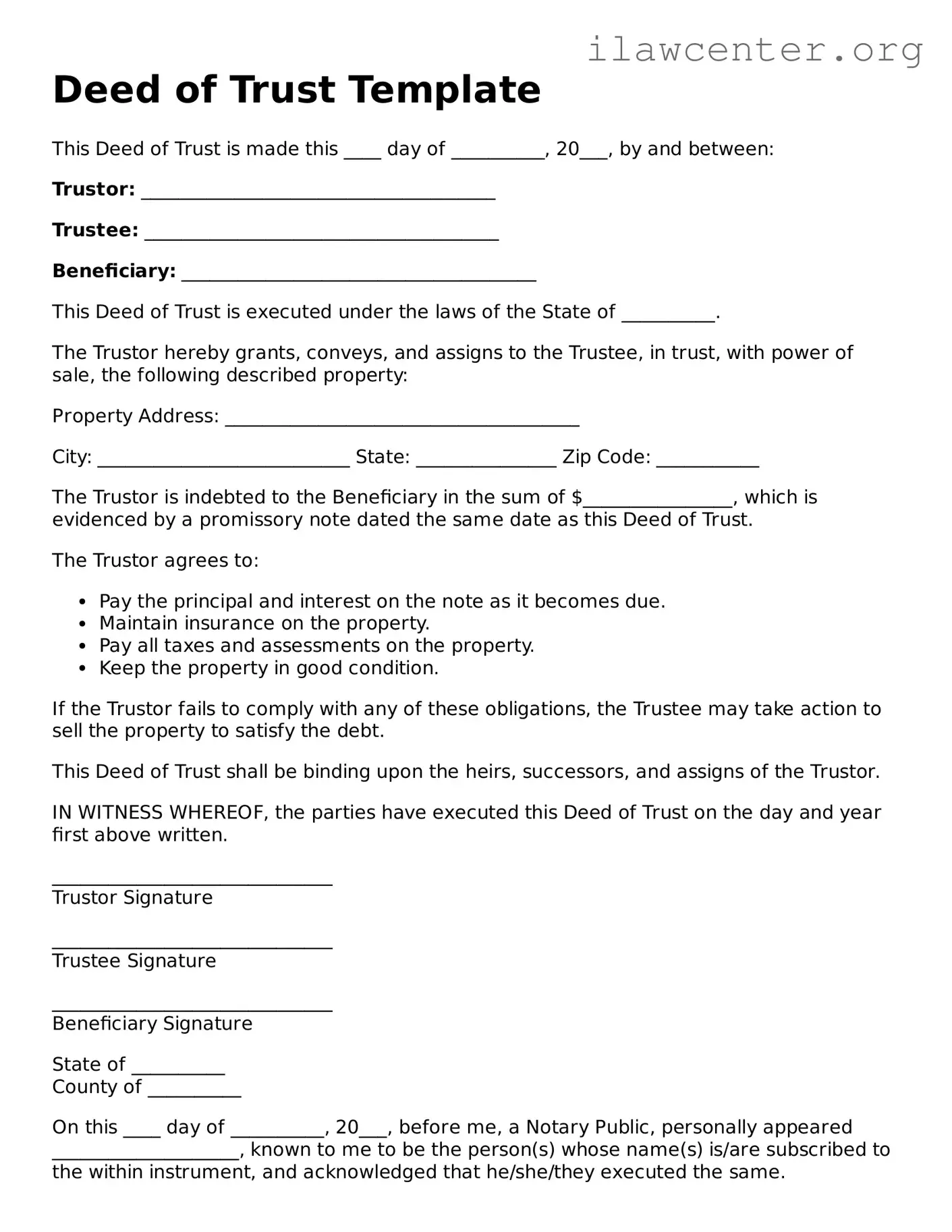
Deed of Trust Preview

Deed of Trust Template

This Deed of Trust is made this ____ day of __________, 20___, by and between:

Trustor: ______________________________________

Trustee: ______________________________________

Beneficiary: ______________________________________

This Deed of Trust is executed under the laws of the State of __________.

The Trustor hereby grants, conveys, and assigns to the Trustee, in trust, with power of sale, the following described property:

Property Address: ______________________________________

City: ___________________________ State: _______________ Zip Code: ___________

The Trustor is indebted to the Beneficiary in the sum of $________________, which is evidenced by a promissory note dated the same date as this Deed of Trust.

The Trustor agrees to:

  • Pay the principal and interest on the note as it becomes due.
  • Maintain insurance on the property.
  • Pay all taxes and assessments on the property.
  • Keep the property in good condition.

If the Trustor fails to comply with any of these obligations, the Trustee may take action to sell the property to satisfy the debt.

This Deed of Trust shall be binding upon the heirs, successors, and assigns of the Trustor.

IN WITNESS WHEREOF, the parties have executed this Deed of Trust on the day and year first above written.

______________________________
Trustor Signature

______________________________
Trustee Signature

______________________________
Beneficiary Signature

State of __________
County of __________

On this ____ day of __________, 20___, before me, a Notary Public, personally appeared ____________________, known to me to be the person(s) whose name(s) is/are subscribed to the within instrument, and acknowledged that he/she/they executed the same.

Witness my hand and official seal.

______________________________
Notary Public

My commission expires: ________________

PDF Form Characteristics

Fact Name Description
Definition A Deed of Trust is a legal document that secures a loan by transferring the title of the property to a trustee until the borrower repays the loan.
Parties Involved The Deed of Trust involves three parties: the borrower (trustor), the lender (beneficiary), and the trustee.
Governing Law The laws governing Deeds of Trust vary by state. For example, California and Texas have specific statutes that outline their use.
Foreclosure Process In most states, a Deed of Trust allows for a non-judicial foreclosure process, which can be quicker than judicial foreclosure.
Recording Requirement A Deed of Trust must be recorded with the county recorder’s office to provide public notice of the lender’s interest in the property.
Difference from Mortgage Unlike a mortgage, a Deed of Trust involves a third party (the trustee) who holds the title until the loan is paid off.

Instructions on Utilizing Deed of Trust

Once you have your Deed of Trust form ready, it’s time to fill it out accurately. Make sure you have all necessary information on hand, including details about the borrower, lender, and property. Follow these steps to complete the form correctly.

  1. Begin by entering the date at the top of the form.
  2. Fill in the names and addresses of the borrower(s). Ensure all names are spelled correctly.
  3. Provide the lender’s name and address in the designated section.
  4. Describe the property being secured by the Deed of Trust. Include the full address and any legal descriptions if required.
  5. Specify the loan amount. This is the total amount borrowed by the borrower.
  6. List any additional terms or conditions that apply to the loan, if applicable.
  7. Include the interest rate, if there is one, and indicate whether it is fixed or variable.
  8. Sign and date the form where indicated. Ensure all borrowers sign as required.
  9. Have the form notarized. This step is crucial for the validity of the document.
  10. Make copies of the completed form for your records and for the lender.

Important Facts about Deed of Trust

What is a Deed of Trust?

A Deed of Trust is a legal document used in real estate transactions. It secures a loan by transferring the title of the property to a third party, known as a trustee, until the borrower repays the loan. This arrangement protects the lender's interest in the property while allowing the borrower to maintain possession and use of it.

Who are the parties involved in a Deed of Trust?

There are typically three parties involved: the borrower (also known as the trustor), the lender (beneficiary), and the trustee. The borrower receives the loan, the lender provides the funds, and the trustee holds the title to the property until the loan is fully paid off.

How does a Deed of Trust differ from a mortgage?

While both a Deed of Trust and a mortgage serve the same purpose of securing a loan, they differ in structure. A mortgage involves two parties—the borrower and the lender. In contrast, a Deed of Trust involves three parties and places the title with a trustee, which can simplify the foreclosure process if the borrower defaults.

What happens if the borrower defaults on the loan?

If the borrower fails to make payments, the lender can initiate foreclosure proceedings. In a Deed of Trust, the trustee can sell the property without going through the court system, making the process generally faster than with a mortgage. The proceeds from the sale go to pay off the loan balance.

Is a Deed of Trust recorded?

Yes, a Deed of Trust is typically recorded in the county where the property is located. Recording the document provides public notice of the lender's interest in the property and helps establish the priority of claims against the property in case of default.

Can a Deed of Trust be modified?

Yes, a Deed of Trust can be modified, but both the lender and borrower must agree to the changes. This might involve altering the loan terms, such as the interest rate or payment schedule. A written amendment should be executed to document any modifications.

What are the benefits of using a Deed of Trust?

A Deed of Trust offers several benefits. It can streamline the foreclosure process, providing quicker resolution for lenders. For borrowers, it can allow for more flexible terms. Additionally, it can provide a clear legal framework for both parties, reducing potential disputes.

Do I need a lawyer to create a Deed of Trust?

While it is not strictly necessary to have a lawyer draft a Deed of Trust, it is highly recommended. Legal professionals can ensure that the document complies with state laws and accurately reflects the intentions of both parties, reducing the risk of future complications.
Common mistakes

Filling out a Deed of Trust form is a critical step in securing a loan for real estate. However, many individuals make common mistakes that can lead to complications down the line. One frequent error is failing to accurately identify the parties involved. This includes not just the borrower and lender, but also the trustee. Each party must be clearly named, as any ambiguity can lead to disputes or delays in the enforcement of the deed.

Another common mistake is neglecting to provide a precise legal description of the property. A vague or incorrect description can create significant issues, particularly if the property is ever sold or transferred. It is essential to include the full address and any relevant parcel numbers. Without this information, the Deed of Trust may not be enforceable, and the lender's security interest in the property could be jeopardized.

Moreover, many people overlook the importance of signatures. All parties involved must sign the document, and their signatures must be notarized. Failing to do so can render the deed invalid. It's also important to ensure that the signatories have the authority to bind the parties they represent. This is particularly crucial in the case of corporate entities or trusts, where specific individuals must be authorized to act on behalf of the organization.

Lastly, individuals often forget to review the terms outlined in the Deed of Trust. This document typically contains provisions regarding the repayment of the loan, default conditions, and the rights of the parties involved. Not understanding these terms can lead to misunderstandings later on. It is advisable to read the document carefully and, if necessary, seek legal advice before signing. Taking these steps can help avoid costly mistakes and ensure that the Deed of Trust serves its intended purpose.

Documents used along the form

A Deed of Trust is a key document in real estate transactions, particularly when securing a loan. However, several other forms and documents are commonly used alongside it to ensure a smooth process. Below is a list of these important documents.

  • Promissory Note: This document outlines the borrower's promise to repay the loan. It includes details such as the loan amount, interest rate, and repayment schedule.
  • Loan Application: This form collects essential information from the borrower, including financial details and employment history, to assess their eligibility for a loan.
  • Title Insurance Policy: This insurance protects the lender and borrower from potential defects in the title of the property, ensuring clear ownership.
  • Closing Disclosure: Provided to the borrower before closing, this document details all costs associated with the loan and the transaction, promoting transparency.
  • Property Appraisal: An assessment of the property's value, this document helps lenders determine how much they are willing to lend based on the property's worth.
  • Homeowners Insurance Policy: This insurance protects the property against damages and is often required by lenders as a condition of the loan.
  • Escrow Agreement: This document outlines the terms of the escrow arrangement, detailing how funds and documents will be managed during the transaction process.
  • Loan Estimate: This form provides a summary of the loan terms and estimated costs, allowing borrowers to compare different loan offers easily.

Understanding these documents is crucial for anyone involved in a real estate transaction. Each plays a specific role in protecting the interests of all parties and ensuring that the process runs efficiently.

Similar forms

  • Mortgage: Like a Deed of Trust, a mortgage secures a loan with real property. Both documents create a lien on the property, ensuring that the lender can recover the loan amount if the borrower defaults.
  • Promissory Note: This document outlines the borrower's promise to repay the loan. While the Deed of Trust secures the loan, the promissory note details the terms, including interest rates and payment schedules.
  • Security Agreement: Similar to a Deed of Trust, a security agreement grants a lender a security interest in specific property. This document is often used in personal property transactions rather than real estate.
  • Quitclaim Deed: A quitclaim deed transfers interest in property without warranties. While it does not secure a loan, it can be used in conjunction with a Deed of Trust to clarify ownership interests.
  • Loan Agreement: This document outlines the terms and conditions of the loan. It may include details about the Deed of Trust, ensuring both parties understand their rights and obligations.
  • Title Insurance Policy: While not a trust document, title insurance protects against defects in title. It often accompanies a Deed of Trust to assure the lender that the property is free of claims that could affect their security interest.

Dos and Don'ts

When filling out the Deed of Trust form, it is important to follow certain guidelines to ensure accuracy and compliance. Below is a list of things you should and shouldn't do:

  • Do read the instructions carefully before starting.
  • Do provide accurate information about the property and the parties involved.
  • Do sign the form in front of a notary public.
  • Do keep a copy of the completed form for your records.
  • Do double-check for any errors or missing information before submission.
  • Don't use abbreviations or shorthand when filling out the form.
  • Don't leave any sections blank; fill in all required fields.
  • Don't rush through the process; take your time to ensure accuracy.
  • Don't forget to include the correct legal description of the property.

Misconceptions

Understanding the Deed of Trust form is crucial for anyone involved in real estate transactions. However, several misconceptions can lead to confusion. Here are five common misunderstandings:

  • A Deed of Trust is the same as a mortgage. Many people think these terms are interchangeable. While both serve to secure a loan, a Deed of Trust involves three parties: the borrower, the lender, and a trustee. A mortgage, on the other hand, typically involves just two parties: the borrower and the lender.
  • A Deed of Trust guarantees ownership of the property. This is not accurate. The Deed of Trust secures the loan, but it does not convey ownership. The borrower retains ownership rights until they default on the loan.
  • You can’t sell the property if there’s a Deed of Trust. This is a misconception. You can sell the property, but the loan must be settled. This often means paying off the Deed of Trust during the sale process.
  • The trustee has full control over the property. This is misleading. The trustee holds the title as a security measure but acts on behalf of the lender. Their role is limited to handling the property in case of default.
  • A Deed of Trust is only used for residential properties. This is false. Deeds of Trust can be utilized for both residential and commercial properties, making them versatile in real estate financing.

Clearing up these misconceptions can help you navigate real estate transactions more effectively. Always seek professional advice if you have questions about specific situations.

Key takeaways

Filling out and using a Deed of Trust form can seem daunting, but understanding its key components can simplify the process. Here are some important takeaways to keep in mind:

  • Understand the Purpose: A Deed of Trust serves as a security agreement between a borrower and a lender, allowing the lender to hold a claim on the property until the loan is repaid.
  • Identify the Parties: Clearly list all parties involved, including the borrower, lender, and trustee. This ensures that everyone understands their role in the agreement.
  • Property Description: Provide a detailed description of the property being secured. This includes the address and any legal descriptions necessary for clarity.
  • Loan Amount: Specify the total amount of the loan. This figure is crucial as it determines the financial obligation of the borrower.
  • Interest Rate: Include the interest rate agreed upon for the loan. This information is essential for calculating future payments.
  • Default Terms: Outline what constitutes a default. Knowing the consequences of default helps all parties understand their responsibilities.
  • Signatures Required: Ensure all parties sign the document. Without signatures, the Deed of Trust is not legally binding.
  • Record the Deed: After signing, it’s important to record the Deed of Trust with the appropriate local government office. This protects the lender’s interest in the property.

By keeping these key points in mind, you can navigate the process of completing a Deed of Trust with greater confidence and clarity.