Fillable Dental Records Release Document

Fillable Dental Records Release Document

The Dental Records Release form is a document that allows patients to authorize the sharing of their dental records with another party, such as a new dentist or insurance provider. This form ensures that individuals maintain control over their personal health information while facilitating seamless transitions in dental care. To begin the process, please fill out the form by clicking the button below.

Article Guide

The Dental Records Release form is an essential document that facilitates the transfer of a patient’s dental information from one provider to another. This form ensures that patients maintain control over their personal health information while enabling seamless communication between dental professionals. Key components of the form typically include the patient’s name, contact information, and a detailed description of the records being requested. Additionally, it often requires the patient’s signature to authorize the release, confirming their consent. The form may also specify the purpose of the request, whether for ongoing treatment, insurance claims, or personal records. Understanding the importance of this document can help patients navigate their dental care more effectively, ensuring that they receive the best possible treatment based on complete and accurate information.

Dental Records Release Preview

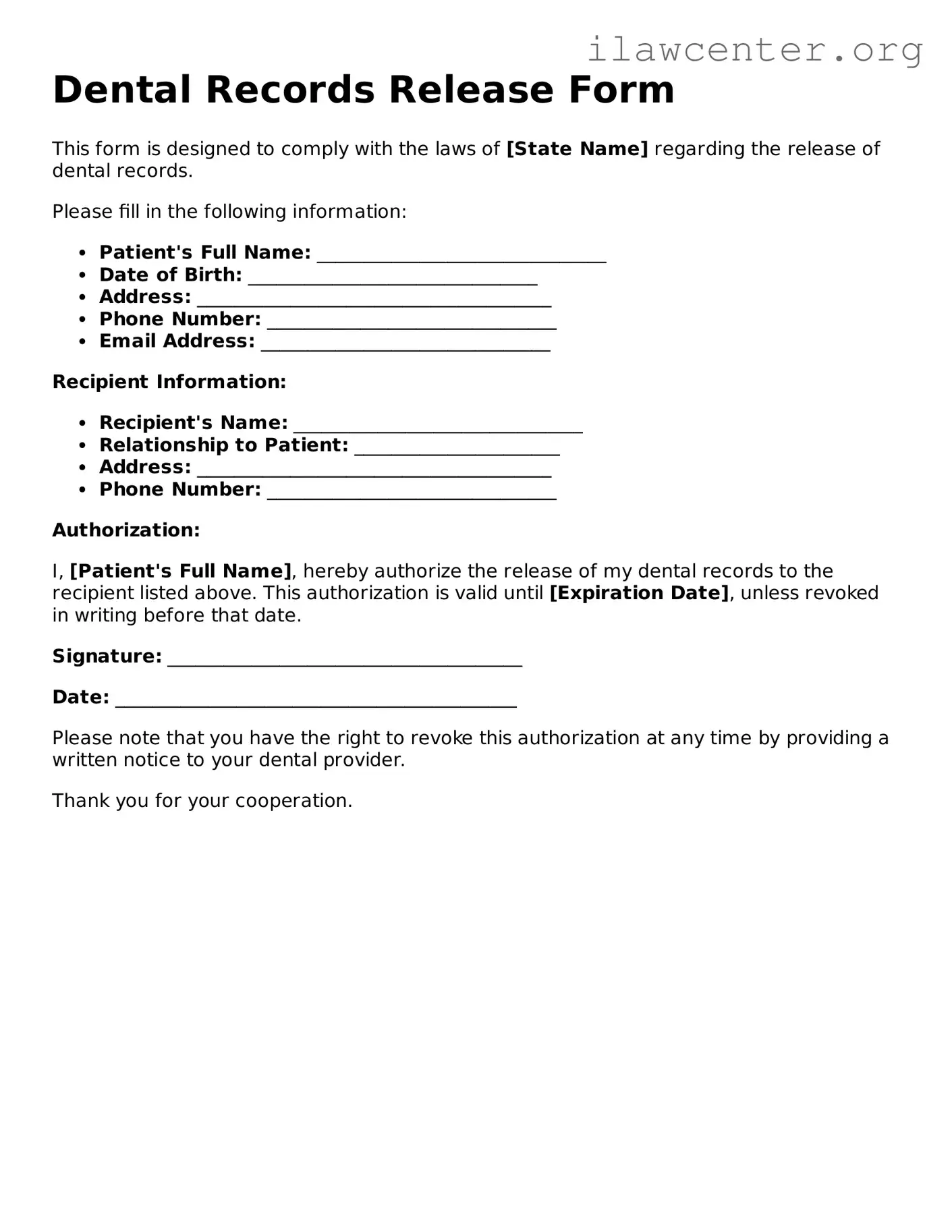
Dental Records Release Form

This form is designed to comply with the laws of [State Name] regarding the release of dental records.

Please fill in the following information:

  • Patient's Full Name: _______________________________
  • Date of Birth: _______________________________
  • Address: ______________________________________
  • Phone Number: _______________________________
  • Email Address: _______________________________

Recipient Information:

  • Recipient's Name: _______________________________
  • Relationship to Patient: ______________________
  • Address: ______________________________________
  • Phone Number: _______________________________

Authorization:

I, [Patient's Full Name], hereby authorize the release of my dental records to the recipient listed above. This authorization is valid until [Expiration Date], unless revoked in writing before that date.

Signature: ______________________________________

Date: ___________________________________________

Please note that you have the right to revoke this authorization at any time by providing a written notice to your dental provider.

Thank you for your cooperation.

PDF Form Characteristics

Fact Name Description
Purpose The Dental Records Release form allows patients to authorize the sharing of their dental records with other healthcare providers or entities.
Patient Consent Patients must provide informed consent before their dental records can be released, ensuring they understand what information is being shared.
State-Specific Forms Each state may have its own version of the Dental Records Release form, reflecting local laws and regulations regarding patient privacy.
Governing Laws In many states, the release of dental records is governed by state-specific health information privacy laws, as well as the federal Health Insurance Portability and Accountability Act (HIPAA).
Expiration Date Most forms include an expiration date, after which the authorization to release records is no longer valid, protecting patient privacy.
Revocation Patients have the right to revoke their consent at any time, which must be done in writing to ensure that no further records are released.
Record Retention Dental practices are typically required to retain patient records for a specified period, even after a release has been authorized.

Instructions on Utilizing Dental Records Release

Completing the Dental Records Release form is an important step in accessing your dental history. Once you have filled it out, you can submit it to your dental office or the relevant authority to obtain the records you need.

  1. Begin by writing your full name at the top of the form.
  2. Provide your date of birth in the specified format.
  3. Enter your current address, including street, city, state, and zip code.
  4. Fill in your phone number and email address for contact purposes.
  5. Identify the dental office or provider from whom you are requesting records.
  6. Include the address of the dental office or provider.
  7. Specify the dates of service for which you are requesting records.
  8. Sign and date the form to authorize the release of your dental records.

After completing these steps, review the form for accuracy. Ensure all required fields are filled out clearly. Once you are satisfied, you can submit the form as instructed.

Important Facts about Dental Records Release

What is a Dental Records Release form?

A Dental Records Release form is a document that allows patients to authorize their dental care providers to share their dental records with another individual or organization. This could include another dental office, a specialist, or an insurance company. The form ensures that patient privacy is respected while enabling the transfer of important health information.

Why would I need to fill out a Dental Records Release form?

Filling out this form is often necessary when you want to transfer your dental records to a new dentist or when a specialist requires your dental history for treatment. It can also be used for insurance purposes, where your dental records may be needed to process claims or verify coverage.

Who can request my dental records?

Typically, you or your legal representative can request your dental records. In some cases, a family member may also request records if they have your consent. However, dental practices may have their own policies regarding who can request records, so it’s always best to check with your provider.

How do I fill out the Dental Records Release form?

The form usually requires basic information, such as your name, date of birth, and contact information. You will also need to specify the recipient of the records and the purpose of the request. Ensure that you sign and date the form to validate it. If you have any questions, your dental office can assist you with the process.

Is there a fee for obtaining my dental records?

Some dental offices may charge a fee for copying and transferring records, while others may provide this service at no cost. It's important to inquire about any potential fees when you request your records. This can help you avoid any surprises during the process.

How long does it take to receive my dental records?

The time it takes to receive your dental records can vary. Many dental offices aim to process requests within a few days, but it can take longer depending on the office’s policies and the complexity of the request. If you need your records urgently, be sure to communicate this when you submit your request.

Can I revoke my consent after signing the Dental Records Release form?

Yes, you can revoke your consent at any time. To do this, you would need to submit a written request to your dental provider, specifying that you wish to withdraw your authorization. However, keep in mind that any actions taken before the revocation may still be valid.

What happens if I don’t fill out the Dental Records Release form?

If you choose not to fill out the form, your dental records will remain confidential and cannot be shared with anyone else without your explicit consent. This means that if you need to see a new dentist or a specialist, they may not have access to your previous dental history, which could affect your treatment.

Are there any limitations on what can be shared in my dental records?

Yes, there are limitations. Dental records generally include information about your treatment history, diagnoses, and any other relevant health information. However, certain sensitive information may be protected under privacy laws, and dental offices must comply with regulations when sharing this data.

What should I do if my dental records are incorrect or incomplete?

If you find that your dental records are incorrect or incomplete, you should contact your dental office immediately. They are obligated to correct any inaccuracies and provide you with updated records. It’s important to ensure that your dental history is accurate for your ongoing care.
Common mistakes

When individuals fill out a Dental Records Release form, several common mistakes can hinder the process of obtaining important dental information. One frequent error is the failure to provide complete and accurate personal information. This includes not only the name and contact details of the patient but also the correct information for the dental office releasing the records. Incomplete information can lead to delays, as the dental office may need to reach out for clarification, thereby prolonging the retrieval of records.

Another common mistake involves not specifying the exact records needed. Patients often request a general release of all records without detailing which specific documents they require. This lack of clarity can result in receiving unnecessary information or, conversely, missing critical records. It is essential to clearly outline the specific dates of service or types of records needed, such as x-rays or treatment summaries, to ensure a smooth process.

Additionally, individuals sometimes overlook the importance of signing and dating the form. A signature is a vital part of the release process, as it confirms that the patient authorizes the release of their dental records. Without a signature, the request may be considered invalid. Similarly, failing to date the form can create confusion regarding the timing of the request, which may affect how the records are processed.

Lastly, some patients neglect to understand the implications of the release. They may not realize that by signing the form, they are granting permission for their dental information to be shared with another party. This can lead to concerns about privacy and confidentiality. It is crucial for individuals to read the form carefully and understand who will have access to their information and how it will be used. Taking the time to address these common mistakes can significantly streamline the process of obtaining dental records.

Documents used along the form

The Dental Records Release form is a vital document that allows patients to authorize the transfer of their dental records to another party. This form is often accompanied by other important documents that facilitate the management of dental care and patient information. Below are some commonly used forms that you might encounter alongside the Dental Records Release form.

  • Patient Information Form: This form collects essential details about the patient, including contact information, medical history, and insurance details. It ensures that the dental practice has accurate and up-to-date information for effective treatment.
  • Consent to Treat Form: Before any dental procedures can begin, patients must sign this form. It confirms that they understand the treatments being proposed and agree to undergo them, protecting both the patient and the provider legally.
  • Financial Agreement Form: This document outlines the payment terms and conditions for dental services. Patients review and sign it to acknowledge their financial responsibilities, including co-pays, deductibles, and payment plans.
  • Medical History Form: Patients complete this form to provide their dental team with important health information. It includes past illnesses, allergies, medications, and any previous dental work, which can impact current treatment plans.
  • Insurance Claim Form: This form is used to submit claims to insurance companies for reimbursement. It includes details about the services provided and the costs incurred, helping patients receive the benefits they are entitled to.
  • HIPAA Privacy Notice: This document informs patients about their rights regarding their health information under the Health Insurance Portability and Accountability Act. It explains how their data will be used and protected by the dental practice.

Each of these forms plays a crucial role in the dental care process, ensuring that both patients and providers are on the same page regarding treatment, financial obligations, and privacy. Understanding these documents can help streamline your experience and enhance communication with your dental care team.

Similar forms

  • Medical Records Release Form: Similar to the Dental Records Release form, this document allows patients to authorize the sharing of their medical history and treatment records with other healthcare providers. Both forms prioritize patient confidentiality and require explicit consent.
  • Psychological Records Release Form: This form enables the release of psychological or mental health records. Like the Dental Records Release form, it ensures that sensitive information is shared only with the patient’s consent, protecting their privacy.
  • Immunization Records Release Form: This document permits the sharing of a patient's immunization history. It shares similarities with the Dental Records Release form in that it requires patient approval for the release of health-related information.
  • Substance Abuse Treatment Records Release Form: This form is used to authorize the release of treatment records related to substance abuse. Both forms emphasize the importance of consent and confidentiality regarding sensitive health information.
  • Educational Records Release Form: Used primarily in school settings, this document allows parents or guardians to authorize the sharing of a student’s educational records. It shares the same principle of consent as the Dental Records Release form.
  • Insurance Records Release Form: This form allows the release of records necessary for insurance claims. Both forms require explicit patient consent to share personal health information, ensuring that privacy is maintained.
  • Release of Information for Research: This document allows researchers to access a patient’s health records for study purposes. Similar to the Dental Records Release form, it requires informed consent to ensure that individuals are aware of how their information will be used.

Dos and Don'ts

When filling out a Dental Records Release form, it is important to follow certain guidelines to ensure that the process goes smoothly. Below are some key do's and don'ts to keep in mind.

  • Do provide accurate personal information.
  • Do sign and date the form where required.
  • Don't forget to specify the purpose of the records request.
  • Don't leave any sections blank unless instructed to do so.

Misconceptions

  • Misconception 1: Dental records can be released without patient consent.

    This is not true. Dental records are considered confidential. A signed release form from the patient is necessary for any disclosure.

  • Misconception 2: Only dentists can request dental records.

    While dentists can request records for treatment purposes, other authorized individuals, such as insurance companies or legal representatives, can also request them with proper consent.

  • Misconception 3: A dental records release form is only needed once.

    This is incorrect. Each time records are requested for a new purpose or to a different party, a new release form must be completed.

  • Misconception 4: Patients cannot see their own dental records.

    Patients have the right to access their dental records. They can request copies and review them at any time.

  • Misconception 5: There is no expiration on a dental records release form.

    Most release forms have an expiration date. After that date, a new form must be signed to authorize further release of records.

Key takeaways

When filling out and using the Dental Records Release form, keep these key points in mind:

  1. Understand the Purpose: This form allows you to authorize the release of your dental records to another party.
  2. Provide Accurate Information: Ensure that all personal details, including your name and contact information, are correct.
  3. Specify the Recipient: Clearly indicate who will receive your dental records. This could be another dental office or a specialist.
  4. Include Dates: Specify the dates for which records are being requested. This helps in retrieving the correct information.
  5. Sign and Date: Your signature is necessary to validate the request. Don’t forget to include the date of your signature.
  6. Check for Additional Requirements: Some dental offices may require additional information or forms. Confirm with the recipient office.
  7. Keep a Copy: After submitting the form, keep a copy for your records. This can be useful for future reference.
  8. Follow Up: If you don’t receive confirmation or the records in a timely manner, follow up with the recipient office.
  9. Know Your Rights: You have the right to access your dental records. Familiarize yourself with your rights regarding health information.

Using this form correctly ensures that your dental information is shared safely and efficiently.