Dependent Care Receipt PDF Template

Dependent Care Receipt PDF Template

The Dependent Care Receipt form is a document used to confirm payments made for dependent care services. It captures essential details such as the parent’s name, the amount paid, and the provider's signature, ensuring accurate record-keeping for reimbursement purposes. To streamline your reimbursement process, fill out the form by clicking the button below.

Article Guide

The Dependent Care Receipt form serves as a crucial document for parents seeking reimbursement for child care expenses. This form captures essential information, including the parent's name, the amount paid for dependent care services, and the period during which the care was provided. It also requires the name of the facility or individual providing the care, ensuring that all parties are clearly identified. A signature from the provider is necessary to validate the receipt, adding an extra layer of authenticity to the transaction. Importantly, all receipts must be attached to a Dependent Care Reimbursement Request Form to ensure proper processing. By following these guidelines, parents can streamline their reimbursement process and ensure they receive the financial support they need for their dependent care expenses.

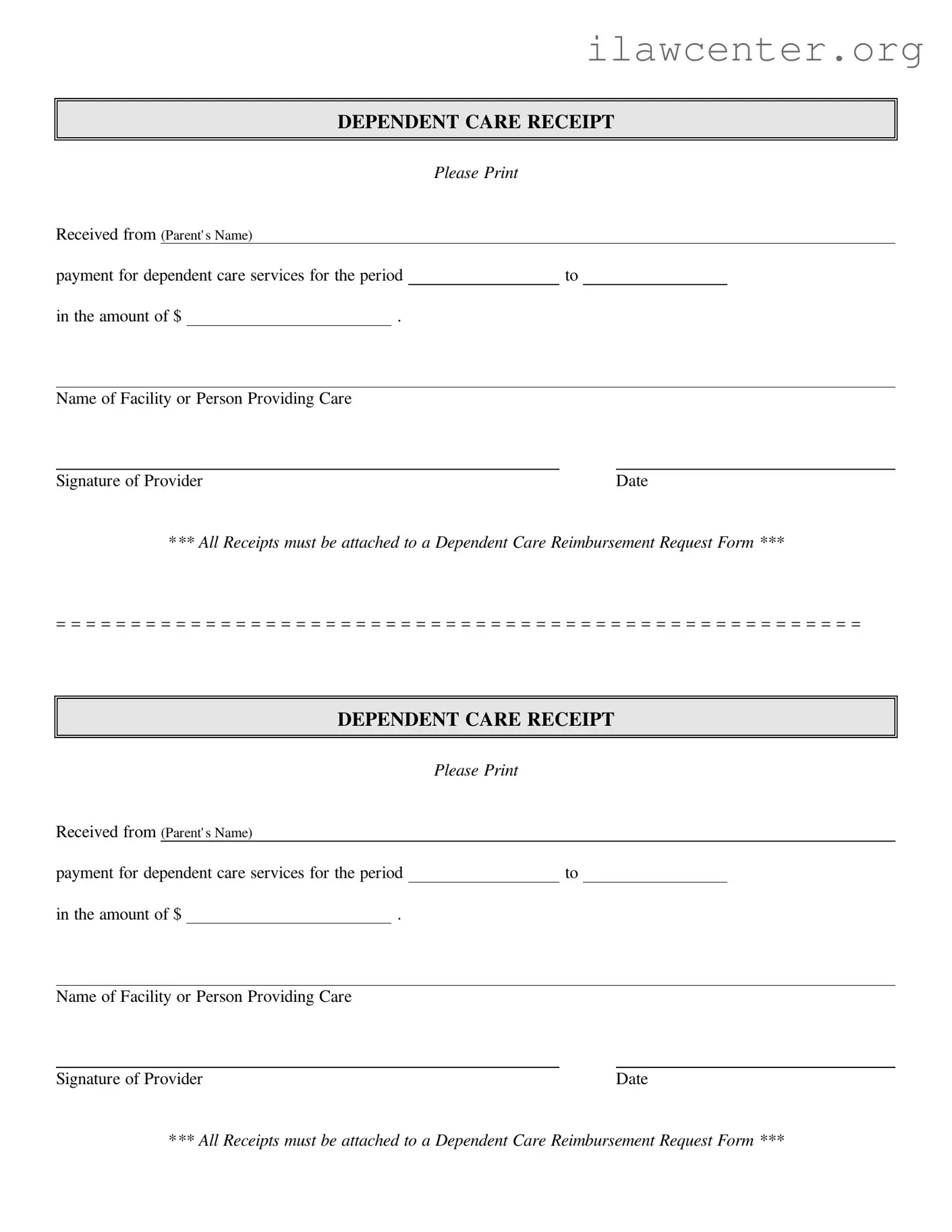
Dependent Care Receipt Preview

DEPENDENT CARE RECEIPT
Please Print
Received from (Parent' s Name)
payment for dependent care services for the period to
in the amount of $ .
Name of Facility or Person Providing Care
Signature of Provider Date
*** All Receipts must be attached to a Dependent Care Reimbursement Request Form ***
= = = = = = = = = = = = = = = = = = = = = = = = = = = = = = = = = = = = = = = = = = = = = = = = = = = = = =
DEPENDENT CARE RECEIPT
Please Print
Received from (Parent' s Name)
payment for dependent care services for the period to
in the amount of $ .
Name of Facility or Person Providing Care
Signature of Provider Date
*** All Receipts must be attached to a Dependent Care Reimbursement Request Form ***

File Properties

Fact Name Description
Purpose The Dependent Care Receipt form is used to document payments made for dependent care services.
Required Information It must include the parent's name, payment amount, service period, and provider details.
Provider Signature The form requires the signature of the care provider to validate the receipt.
Attachment Requirement All receipts must be attached to a Dependent Care Reimbursement Request Form for processing.
Tax Implications This form is crucial for claiming tax credits related to dependent care expenses.
State-Specific Forms Some states may have specific versions or additional requirements for this form.
Governing Laws IRS Publication 503 outlines the tax rules for dependent care expenses.
Period of Service The form should clearly state the period for which care was provided to ensure accuracy.
Payment Amount The amount paid for services must be clearly indicated to avoid discrepancies.
Use of Form Employers may require this form to reimburse employees for dependent care expenses.

Instructions on Utilizing Dependent Care Receipt

Filling out the Dependent Care Receipt form is a straightforward process. Once completed, this form will serve as proof of payment for dependent care services. Make sure to keep a copy for your records before submitting it along with the Dependent Care Reimbursement Request Form.

  1. Print the form: Obtain a copy of the Dependent Care Receipt form, either digitally or on paper.
  2. Fill in your name: In the section labeled "Received from (Parent's Name)," write your full name clearly.
  3. Specify the payment amount: In the space for "in the amount of $," enter the total amount you paid for the dependent care services.
  4. Indicate the care period: Write the start and end dates of the care period in the designated area.
  5. Provide the caregiver's information: Enter the name of the facility or person providing the care in the "Name of Facility or Person Providing Care" section.
  6. Get the provider's signature: Ask the caregiver to sign the form in the "Signature of Provider" section.
  7. Date the receipt: The caregiver should also fill in the date on which the receipt is signed.
  8. Attach the receipt: Ensure that this completed receipt is attached to your Dependent Care Reimbursement Request Form before submission.

Important Facts about Dependent Care Receipt

What is the Dependent Care Receipt form used for?

The Dependent Care Receipt form is a crucial document for parents seeking reimbursement for child care services. It serves as proof of payment for dependent care, allowing parents to submit claims for expenses incurred while they work or look for work. This form must be filled out by the care provider and submitted alongside a Dependent Care Reimbursement Request Form.

Who needs to fill out the Dependent Care Receipt form?

Both the parent and the care provider play roles in completing this form. The parent must provide their name and details about the payment, while the care provider must sign and date the form to confirm receipt of payment for services rendered. This collaboration ensures that all necessary information is accurately documented.

What information is required on the form?

To complete the Dependent Care Receipt form, you will need to include the parent’s name, the amount paid, the name of the facility or individual providing care, and the period during which care was provided. The care provider must also provide their signature and the date on which the payment was received. Each detail is essential for a smooth reimbursement process.

How do I submit the Dependent Care Receipt?

Once the form is filled out, it must be attached to a Dependent Care Reimbursement Request Form. After ensuring all documents are complete, submit them to your employer’s benefits department or the designated reimbursement processor. Keep copies of everything for your records, as this will help if any issues arise during processing.

Is there a deadline for submitting the form?

Yes, there is typically a deadline for submitting the Dependent Care Receipt form along with the reimbursement request. This deadline can vary depending on your employer’s policies. It is vital to check with your HR department to ensure you submit your request on time to avoid missing out on reimbursement.

What happens if the form is incomplete?

If the Dependent Care Receipt form is incomplete, it may lead to delays in processing your reimbursement request. Missing information can result in the request being returned or denied. To prevent this, double-check that all required fields are filled out accurately before submission.

Can I use this form for multiple care providers?

Yes, you can use the Dependent Care Receipt form for multiple care providers, but each provider must complete their own form. Each receipt should detail the specific services they provided and the amount paid. This ensures clarity and helps streamline the reimbursement process for each individual provider.

What if I lose the Dependent Care Receipt form?

If you lose the Dependent Care Receipt form, contact your care provider to request a duplicate. It is essential to have this documentation for your records and for reimbursement purposes. If a duplicate cannot be obtained, consult your HR department for guidance on how to proceed.
Common mistakes

Filling out the Dependent Care Receipt form can seem straightforward, but many people make common mistakes that can lead to delays in reimbursement or even denial of claims. One frequent error is failing to provide the correct dates for the care period. It’s essential to clearly indicate the start and end dates of the services provided. Omitting this information or entering incorrect dates can create confusion and may result in your request being processed incorrectly.

Another common mistake is not including the provider's signature. The form requires the signature of the person or facility providing the care. Without this crucial step, the receipt may be considered invalid. Make sure to ask for a signature at the time of payment to avoid any issues later on.

Additionally, many people overlook the importance of accurately stating the amount paid for services. This figure should reflect the total cost incurred for dependent care during the specified period. If this amount is missing or incorrect, it can lead to complications in the reimbursement process. Double-check your calculations to ensure accuracy.

Lastly, it’s vital to remember that all receipts must be attached to a Dependent Care Reimbursement Request Form. Some individuals forget this step entirely, leading to unnecessary delays. Ensure that you have all necessary documentation in order before submitting your request to streamline the process and avoid any hiccups.

Documents used along the form

The Dependent Care Receipt form is an essential document for parents seeking reimbursement for childcare expenses. However, several other forms and documents are often used in conjunction with it to ensure a smooth reimbursement process. Below is a list of these important documents, each serving a specific purpose.

  • Dependent Care Reimbursement Request Form: This form is required to formally request reimbursement for dependent care expenses. It includes details about the care provided and the total amount being claimed.
  • Provider Information Form: This document collects essential information about the childcare provider, including their name, address, and tax identification number. It helps verify the legitimacy of the provider.
  • Childcare Provider Agreement: This agreement outlines the terms of service between the parent and the childcare provider. It may include details about fees, hours of operation, and care expectations.
  • Tax Form W-10: This form is used by parents to obtain the provider's taxpayer identification number, which is necessary for tax reporting purposes. It ensures compliance with IRS regulations.
  • Proof of Payment: This document serves as evidence that payment has been made to the childcare provider. It can include canceled checks, bank statements, or electronic payment confirmations.
  • Child’s Birth Certificate: A copy of the child’s birth certificate may be requested to confirm the relationship between the parent and the child receiving care. This helps establish eligibility for reimbursement.
  • Dependent Care Flexible Spending Account (FSA) Enrollment Form: This form is necessary for parents who wish to use pre-tax dollars to pay for dependent care expenses. It details the amount elected for the FSA.
  • Annual Dependent Care Tax Credit Form: This form is used to claim the tax credit for dependent care expenses when filing taxes. It summarizes the eligible expenses incurred throughout the year.

Understanding these accompanying forms can streamline the reimbursement process for dependent care expenses. Each document plays a vital role in ensuring compliance and facilitating timely payments.

Similar forms

The Dependent Care Receipt form is an essential document for parents seeking reimbursement for child care expenses. It shares similarities with several other forms commonly used in similar contexts. Here are four documents that resemble the Dependent Care Receipt form:

  • Child Care Expense Reimbursement Form: This form is specifically designed for parents to request reimbursement for child care costs. Like the Dependent Care Receipt, it requires details about the care provider and the amount spent, ensuring clarity and accountability in the reimbursement process.
  • Dependent Care Flexible Spending Account (FSA) Claim Form: This document allows employees to claim expenses related to dependent care under a flexible spending account. It includes sections for provider information and payment amounts, mirroring the structure of the Dependent Care Receipt in its purpose to facilitate reimbursement for care expenses.
  • Tax Form 2441 (Child and Dependent Care Expenses): This IRS form is used when filing taxes to claim deductions for child and dependent care expenses. Similar to the Dependent Care Receipt, it requires detailed information about the care provider and the amount paid, ensuring that parents can substantiate their claims for tax benefits.
  • Child Care Provider Agreement: This document outlines the terms of care between parents and providers. While its primary function differs, it often includes similar information such as the provider's name and the services rendered, establishing a formal record of the care arrangement, much like the receipt.

Dos and Don'ts

When filling out the Dependent Care Receipt form, it is important to follow specific guidelines to ensure accuracy and compliance. Here are nine things you should and shouldn't do:

  • Do print clearly and legibly to avoid any confusion.
  • Do include the full name of the parent submitting the form.
  • Do specify the exact period for which the dependent care services were provided.
  • Do indicate the total amount paid for the services.
  • Do ensure the provider's signature is included for validation.
  • Don't leave any fields blank; fill in all required information.
  • Don't forget to attach all relevant receipts to the Dependent Care Reimbursement Request Form.
  • Don't use abbreviations that may confuse the reader.
  • Don't submit the form without reviewing it for errors.

Misconceptions

Here are eight common misconceptions about the Dependent Care Receipt form:

  • Only licensed facilities can provide care. Many people believe that only licensed daycare centers can be reimbursed. In reality, care can be provided by individuals, as long as they meet the necessary criteria.
  • Receipts are optional. Some think that receipts aren't required. However, all receipts must be attached to the Dependent Care Reimbursement Request Form to process claims.
  • Care must be for children under 5 years old. This is not true. The form can be used for care of dependents under the age of 13, as well as for dependents with disabilities of any age.
  • Payments to family members are not eligible. Many assume that payments to relatives are ineligible. In fact, payments to family members can qualify, provided they are not your spouse and the care meets other requirements.
  • The form is only for full-time care. Some believe it only applies to full-time daycare. Part-time care can also be reimbursed, as long as it meets the necessary guidelines.
  • Signature from the provider is not needed. It's a common misconception that a signature is unnecessary. A signature from the care provider is essential for validation of the receipt.
  • There is no deadline for submission. Many think they can submit receipts anytime. There are usually specific deadlines for submitting reimbursement requests, so it's important to check those dates.
  • Only one receipt is needed for multiple children. Some people believe one receipt can cover multiple children. Each child typically requires a separate receipt to ensure accurate processing.

Key takeaways

Here are key takeaways for filling out and using the Dependent Care Receipt form:

  • Complete all required fields: Ensure that you fill in the parent's name, payment amount, period of care, and the name of the care provider.
  • Signature is essential: The provider must sign the receipt. This validates the receipt and confirms the care was provided.
  • Attach receipts: All receipts must be attached to a Dependent Care Reimbursement Request Form to process your claim.
  • Print clearly: Use clear and legible handwriting to avoid any confusion or delays in processing.
  • Keep copies: Always keep a copy of the completed receipt for your records before submitting it.
  • Check for accuracy: Review all information for accuracy to prevent any issues with reimbursement.
  • Submit on time: Ensure that you submit the form and receipts within the designated timeframe for reimbursement.
  • Contact support if needed: If you have questions, reach out for assistance to clarify any uncertainties regarding the form.