

Deposit Receipt PDF Template

Deposit Receipt PDF Template

The Deposit Receipt form serves as a crucial document in real estate transactions, acknowledging the receipt of a deposit made by a buyer. This form not only provides proof of the transaction but also outlines the terms and conditions surrounding the deposit. Understanding its importance can help ensure a smooth process in your property dealings, so consider filling out the form by clicking the button below.

Article Guide

The Deposit Receipt form plays a crucial role in the world of real estate transactions, serving as a vital document that helps establish trust between buyers and sellers. This form is typically used when a buyer makes an earnest money deposit to demonstrate their serious intent to purchase a property. It outlines essential details such as the amount of the deposit, the property address, and the names of the parties involved. Additionally, it often includes terms related to the deposit's handling, specifying how and when the funds will be applied to the purchase price or returned if the deal falls through. Understanding the nuances of the Deposit Receipt form is essential for anyone navigating the real estate landscape, whether you’re a first-time homebuyer, an experienced investor, or a real estate agent. By grasping its significance and components, you can better protect your interests and ensure a smoother transaction process.

Deposit Receipt Preview

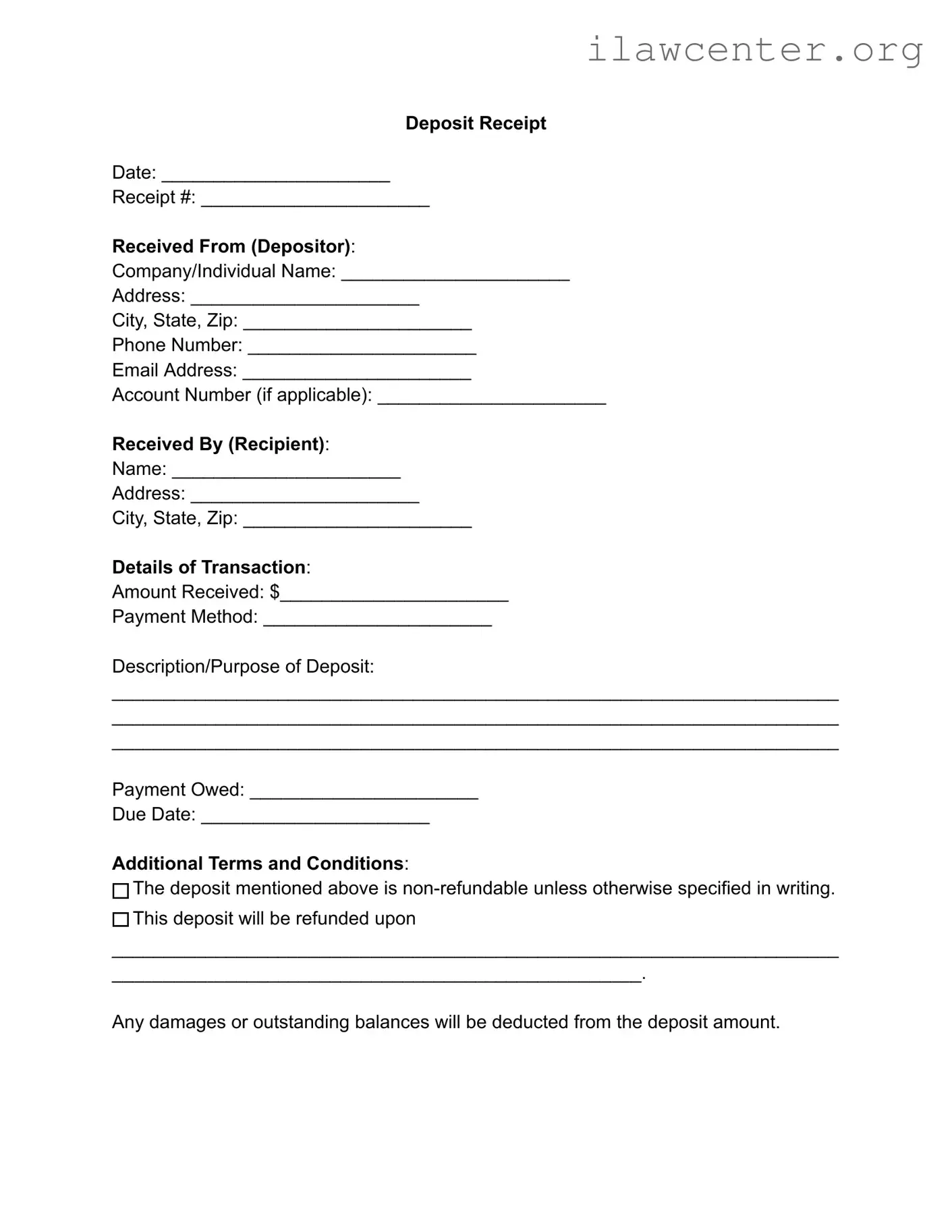
Deposit Receipt
Date: ______________________
Receipt #:
______________________
Received From (Depositor):
Company/Individual Name: ______________________
Address: ______________________
City, State, Zip: ______________________
Phone Number: ______________________
Email Address: ______________________
Account Number (if applicable): ______________________
Received By (Recipient):
Name: ______________________
Address: ______________________
City, State, Zip: ______________________
Details of Transaction:
Amount Received: $______________________
Payment Method: ______________________
Description/Purpose of Deposit:
______________________________________________________________________
______________________________________________________________________
______________________________________________________________________
Payment Owed: ______________________
Due Date: ______________________
Additional Terms and Conditions:
The deposit mentioned above is non-refundable unless otherwise specified in writing.
This deposit will be refunded upon
______________________________________________________________________
___________________________________________________.
Any damages or outstanding balances will be deducted from the deposit amount.
Acknowledgment:
This receipt acknowledges that the Recipient obtained the deposit mentioned above
from the Depositor in the amount of $___________ on ______________ for the
purpose of _______________ . The parties understand and agree to the terms and
conditions outlined in this Deposit Receipt.
Recipient's Signature: _______________________ Date: ____________
Depositor's Signature: _______________________ Date: ____________

File Properties

Fact Name Details
Purpose The Deposit Receipt form is used to acknowledge the receipt of a deposit made in connection with a real estate transaction.
Parties Involved This form typically involves the buyer, seller, and the real estate agent or broker facilitating the transaction.
Legal Requirement In many states, providing a written receipt for a deposit is a legal requirement to protect both the buyer and seller.
Governing Law (California) In California, the Deposit Receipt form is governed by the California Civil Code, specifically sections related to real estate transactions.
Governing Law (New York) In New York, the form is subject to the New York Real Property Law, which outlines the obligations of parties in real estate transactions.
Contents of the Form The form generally includes details such as the amount of the deposit, the parties' names, and the terms of the sale.
Importance of Clarity Clear terms in the Deposit Receipt help prevent misunderstandings and disputes between the parties involved in the transaction.

Instructions on Utilizing Deposit Receipt

Once you have the Deposit Receipt form in hand, it’s time to fill it out accurately. Completing this form is a straightforward process that helps ensure all necessary details are recorded properly. Follow these steps to complete your form efficiently.

  1. Begin by entering the date of the deposit at the top of the form.
  2. Fill in the name of the person or entity making the deposit.
  3. Provide the address of the individual or organization listed in the previous step.
  4. Indicate the amount being deposited. Be sure to write it clearly, including cents.
  5. Specify the method of payment (e.g., cash, check, electronic transfer) in the designated section.
  6. Include any relevant transaction or reference number if applicable.
  7. Sign and date the form at the bottom to confirm that all information is accurate.

After completing the form, make sure to keep a copy for your records. This will be useful for tracking your deposit and resolving any potential issues in the future.

Important Facts about Deposit Receipt

What is a Deposit Receipt form?

A Deposit Receipt form is a document that confirms the receipt of a deposit made by an individual or organization. It serves as proof of payment and outlines the details of the transaction, including the amount deposited, the date of the deposit, and the purpose of the payment. This form is essential for both the payer and the recipient to maintain accurate records of financial transactions.

Who needs to use the Deposit Receipt form?

The Deposit Receipt form is typically used by businesses, landlords, and service providers who receive deposits from clients or customers. Individuals making deposits for services, rentals, or purchases may also use this form to ensure they have a record of their payment. It is beneficial for anyone who wants to keep clear documentation of financial exchanges.

How do I fill out a Deposit Receipt form?

To complete a Deposit Receipt form, you should include several key pieces of information. Start by entering the date of the deposit. Next, specify the name of the individual or organization making the deposit. Clearly indicate the amount deposited and provide a brief description of the purpose of the deposit. Finally, both the payer and the recipient should sign the form to validate the transaction.

Is a Deposit Receipt form legally binding?

While a Deposit Receipt form serves as proof of payment, it may not be considered a legally binding contract on its own. However, it can support claims or disputes regarding the transaction. To ensure that your interests are protected, it is advisable to include clear terms and conditions related to the deposit in a separate agreement if necessary.

What should I do if I lose my Deposit Receipt form?

If you lose your Deposit Receipt form, it is important to act quickly. Contact the recipient of the deposit to request a duplicate receipt. Provide them with details such as the date of the deposit and the amount paid to help them locate your transaction in their records. Maintaining a backup of important documents is always a good practice to avoid such situations.

Common mistakes

Filling out a Deposit Receipt form may seem straightforward, but many individuals encounter pitfalls that can lead to complications. One common mistake is failing to provide accurate information. When a person enters incorrect names, addresses, or amounts, it can create confusion and delay the processing of the deposit. Accuracy is essential, as even a small error can have significant consequences.

Another frequent error involves neglecting to sign the form. A signature is often a required element that validates the transaction. Without it, the deposit may not be considered official, which could lead to disputes or the inability to retrieve funds later. Always ensure that the form is signed before submission.

Some individuals overlook the importance of including the date. The date serves as a critical reference point for both parties involved in the transaction. Omitting it can lead to misunderstandings about when the deposit was made, potentially impacting deadlines or agreements.

Additionally, many people fail to read the instructions carefully. Each Deposit Receipt form may have specific requirements that need to be met. Ignoring these guidelines can result in incomplete submissions. Taking the time to understand the form can save time and prevent errors.

Another mistake is not keeping a copy of the completed form. Individuals often submit the form and forget to retain a record of the transaction. Keeping a copy can be invaluable for future reference, especially if any issues arise regarding the deposit.

In some cases, individuals provide insufficient payment details. It is crucial to specify the method of payment clearly, whether it is a check, cash, or electronic transfer. Ambiguity in payment methods can lead to complications in processing the deposit.

People also sometimes fail to double-check the amount being deposited. Miscalculating the deposit amount can lead to discrepancies that may require additional communication and correction. Verifying the amount before submission is a simple yet effective way to avoid this mistake.

Another oversight is not updating personal information. If there have been recent changes to contact details or addresses, it is essential to reflect those changes on the form. Outdated information can hinder communication and lead to delays in processing.

Lastly, individuals may neglect to follow up after submitting the form. Checking in with the relevant parties can ensure that the deposit was received and processed correctly. Proactive communication can prevent future issues and provide peace of mind.

Documents used along the form

The Deposit Receipt form is commonly used in real estate transactions to acknowledge the receipt of a deposit from a buyer. Along with this form, several other documents are often utilized to ensure that the transaction proceeds smoothly. Below are five key forms and documents that are frequently associated with the Deposit Receipt form.

  • Purchase Agreement: This document outlines the terms and conditions of the sale, including the purchase price, property details, and any contingencies. It serves as a binding contract between the buyer and seller.
  • Seller's Disclosure Statement: This form requires the seller to disclose any known issues or defects with the property. It helps buyers make informed decisions and can protect sellers from future liability.
  • Title Report: A title report provides information about the property’s ownership history and any liens or encumbrances. It ensures that the buyer is aware of any potential issues before completing the purchase.
  • Financing Addendum: This document outlines the specifics of the buyer's financing arrangements, including loan type and terms. It clarifies how the buyer plans to fund the purchase and any conditions related to financing.
  • Closing Disclosure: This form is provided to the buyer and seller before closing. It details all costs associated with the transaction, including loan fees, taxes, and other closing costs, ensuring transparency in the financial aspects of the sale.

Understanding these documents is crucial for anyone involved in a real estate transaction. They help clarify responsibilities and protect the interests of both buyers and sellers throughout the process.

Similar forms

  • Purchase Agreement: This document outlines the terms of the sale, including price and conditions, similar to how a Deposit Receipt confirms the buyer's intent and the agreed-upon deposit.
  • Lease Agreement: Like the Deposit Receipt, a lease agreement serves as a commitment between parties, detailing the terms of rental and the security deposit required.
  • Offer to Purchase: An offer to purchase indicates a buyer's intent to buy a property, much like a Deposit Receipt, which reflects a buyer's commitment and earnest money.
  • Escrow Agreement: This document involves holding funds during a transaction, similar to how a Deposit Receipt secures the buyer's deposit until closing.
  • Real Estate Sales Contract: This comprehensive document outlines the entire transaction, akin to the Deposit Receipt, which captures initial financial commitments and intent.
  • Letter of Intent: A letter of intent expresses a party's intention to enter into a formal agreement, paralleling the Deposit Receipt's role in indicating a buyer's serious interest.
  • Financing Agreement: This document details the terms of financing for a purchase, much like a Deposit Receipt, which often includes information about how the deposit will be handled in relation to financing.

Dos and Don'ts

When filling out the Deposit Receipt form, attention to detail is crucial. Here are five key actions to consider, both what to do and what to avoid.

Things You Should Do:

  • Double-check all information for accuracy before submission.
  • Use clear and legible handwriting if filling out the form by hand.
  • Include all required signatures to validate the deposit.
  • Keep a copy of the completed form for your records.
  • Ensure that the date is correctly filled in to avoid any confusion.

Things You Shouldn't Do:

  • Do not leave any required fields blank.
  • Avoid using abbreviations that may cause misunderstandings.
  • Do not submit the form without reviewing it thoroughly.
  • Refrain from altering any information after the form has been signed.
  • Do not forget to check for any additional instructions that may accompany the form.

Misconceptions

Understanding the Deposit Receipt form is essential for both buyers and sellers in real estate transactions. However, several misconceptions often arise regarding this document. Below are nine common misconceptions along with clarifications.

  1. The Deposit Receipt is the same as a purchase agreement.

    This is incorrect. While both documents are related to the sale of property, the Deposit Receipt serves as a confirmation of the deposit made, whereas the purchase agreement outlines the terms of the sale.

  2. Only buyers need to sign the Deposit Receipt.

    In reality, both the buyer and seller typically sign the Deposit Receipt to acknowledge the deposit and the terms associated with it.

  3. A Deposit Receipt guarantees the sale will go through.

    This is a misconception. The Deposit Receipt confirms the deposit but does not guarantee that the sale will be finalized. Other conditions must be met for the transaction to complete.

  4. The Deposit Receipt cannot be modified once signed.

    While changes can be challenging, it is possible to amend the Deposit Receipt if both parties agree to the modifications in writing.

  5. Only cash deposits are accepted on the Deposit Receipt.

    This is not true. Deposits can be made in various forms, including checks or electronic transfers, as long as both parties agree on the method.

  6. The Deposit Receipt does not need to be kept after the sale.

    It is advisable to retain the Deposit Receipt for record-keeping purposes, as it may be needed for future reference or disputes.

  7. The amount of the deposit is fixed and cannot be negotiated.

    This is misleading. The deposit amount can be negotiated between the buyer and seller and is often based on local market practices.

  8. Once a Deposit Receipt is signed, the buyer loses their earnest money if they back out.

    This depends on the circumstances of the cancellation. Buyers may be entitled to a refund of their earnest money if they withdraw for valid reasons outlined in the agreement.

  9. The Deposit Receipt is only important for the buyer.

    In fact, the Deposit Receipt is important for both parties, as it provides documentation of the deposit and the terms agreed upon, protecting the interests of everyone involved.

Key takeaways

When filling out and using the Deposit Receipt form, it’s important to keep several key points in mind. Here are five essential takeaways:

  • Accuracy is crucial. Ensure all information entered is correct to avoid delays in processing your deposit.
  • Keep a copy. Always retain a copy of the completed Deposit Receipt for your records. This serves as proof of your transaction.
  • Understand the terms. Familiarize yourself with the terms and conditions associated with the deposit to avoid misunderstandings later.
  • Submit promptly. Timely submission of the form can prevent issues with your deposit and ensure it is processed quickly.
  • Contact information matters. Provide accurate contact details in case the processing team needs to reach you for any clarifications.

By keeping these points in mind, you can navigate the process of using the Deposit Receipt form more effectively.