Disciplinary Action PDF Template

Disciplinary Action PDF Template

The Disciplinary Action Form is a crucial document used by employers to formally address employee violations and outline the consequences of such actions. This form helps ensure that all parties involved understand the nature of the violation, the warnings issued, and the necessary steps moving forward. To take the next step in addressing any disciplinary concerns, please fill out the form by clicking the button below.

Article Guide

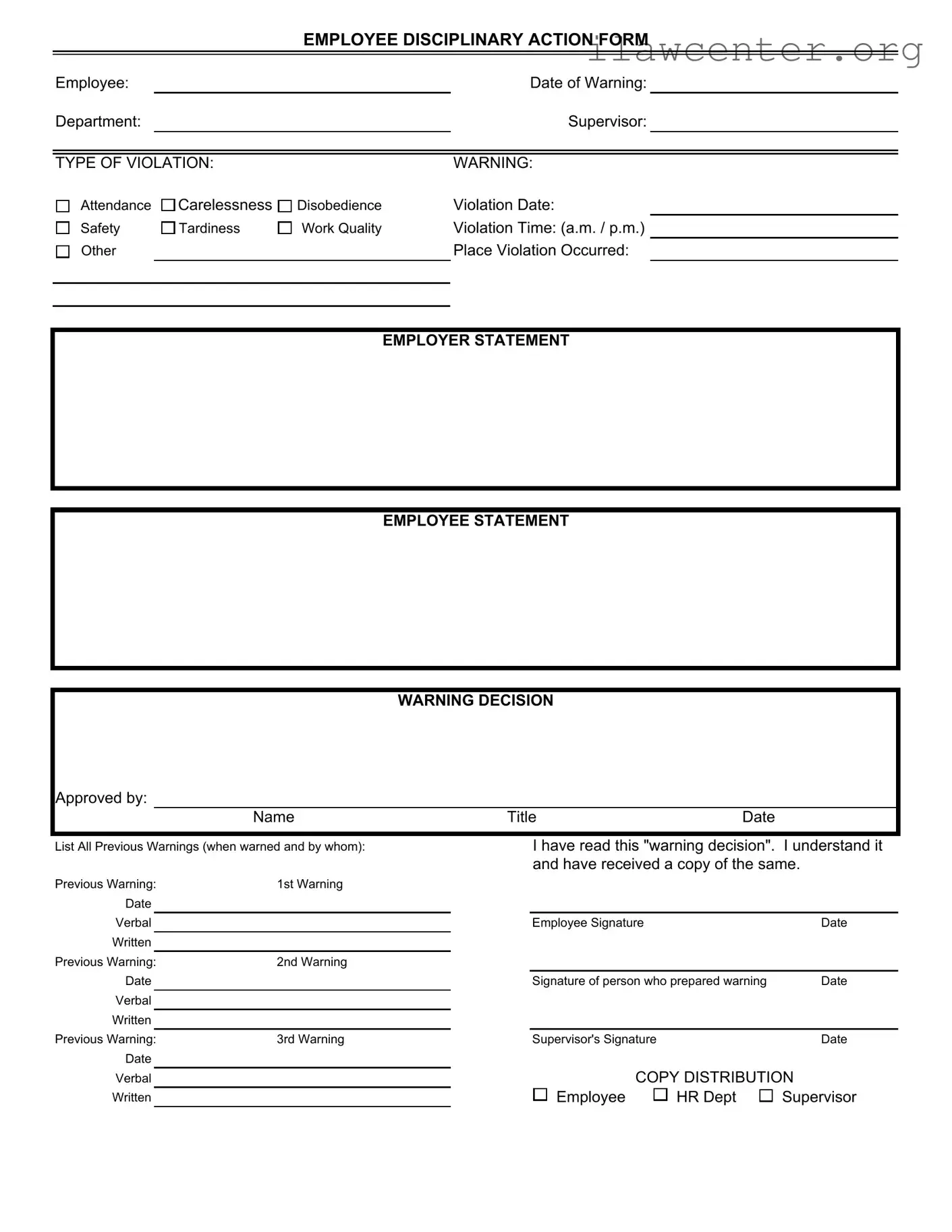
The Disciplinary Action form serves as a crucial tool within the workplace, designed to document instances of employee misconduct or performance issues. This form captures essential details, including the employee's name, the date of the warning, and the department in which the employee works. It outlines the type of violation, which may range from attendance issues and carelessness to safety violations and tardiness. Each warning is meticulously recorded, specifying the date and time of the infraction, as well as the location where it occurred. Furthermore, the form includes sections for both employer and employee statements, allowing for a balanced perspective on the situation. The decision regarding the warning is formally approved by a supervisor, ensuring accountability within the disciplinary process. A comprehensive history of previous warnings is also documented, providing context for the current action. Employees are required to acknowledge their understanding of the warning decision by signing the form, which is then distributed to relevant parties, including the employee, the Human Resources department, and the supervisor. This structured approach not only promotes transparency but also fosters a fair and consistent disciplinary process within the organization.

Disciplinary Action Preview

Employee: Date of Warning:
Department: Supervisor:
TYPE OF VIOLATION: WARNING:
Attendance
Carelessness
Disobedience Violation Date:
Safety Tardiness Work Quality Violation Time: (a.m. / p.m.)
Other Place Violation Occurred:
Approved by:
Date
List All Previous Warnings (when warned and by whom):
Previous Warning: 1st Warning
Date
Verbal Employee Signature Date
Written
Previous Warning: 2nd Warning
Date Signature of person who prepared warning Date
Verbal
Written
Previous Warning: 3rd Warning Supervisor's Signature Date
Date
Verbal
Written
Employee HR Dept
EMPLOYEE DISCIPLINARY ACTION FORM
EMPLOYEE STATEMENT
EMPLOYER STATEMENT
Supervisor
WARNING DECISION
Name Title
COPY DISTRIBUTION
I have read this "warning decision". I understand it
and have received a copy of the same.

File Properties

Fact Name Description
Employee Information The form requires details about the employee, including their name and department.
Date of Warning The date when the disciplinary action is issued must be clearly stated.
Type of Violation Violations can include attendance issues, carelessness, safety breaches, tardiness, or other specified infractions.
Warning Details The form includes specific details about the violation, including the date, time, and place it occurred.
Employer Statement There is a section for the employer to provide a statement regarding the warning.
Employee Statement Employees can provide their own statement, acknowledging the warning and its implications.
Previous Warnings The form requires a record of all previous warnings, including dates and who issued them.
Signature Requirement Both the employee and the supervisor must sign the form to confirm acknowledgment and understanding.
Distribution of Copies Copies of the completed form are distributed to the employee, HR department, and supervisor.

Instructions on Utilizing Disciplinary Action

Completing the Disciplinary Action form is an important step in addressing workplace violations. This process ensures that all relevant information is documented accurately. Following these steps will help ensure that the form is filled out correctly and completely.

  1. Begin by entering the employee's name in the designated field.
  2. Next, fill in the date of the warning to document when the disciplinary action is being taken.
  3. Indicate the department where the employee works.
  4. Provide the name of the supervisor responsible for the warning.
  5. Select the type of violation from the provided options: Attendance, Carelessness, Safety, Tardiness, or Other.
  6. If applicable, enter the violation date to specify when the violation occurred.
  7. Record the violation time using either a.m. or p.m.
  8. Document the place where the violation occurred.
  9. In the employer statement section, provide a detailed account of the incident and the reasons for the disciplinary action.
  10. In the employee statement section, allow the employee to provide their perspective on the situation.
  11. Obtain the approval of the warning decision by entering the name, title, and date of the approving authority.
  12. List all previous warnings, including the dates and who issued them, in the designated area.
  13. Ensure the employee signs the form to acknowledge that they have read and understood the warning decision.
  14. Collect the signatures of the supervisor and the person who prepared the warning.
  15. Distribute copies of the completed form to the employee, HR department, and supervisor.

Important Facts about Disciplinary Action

What is the purpose of the Disciplinary Action form?

The Disciplinary Action form serves as an official record of employee violations and the corresponding disciplinary actions taken. It aims to ensure transparency and consistency in handling employee behavior, while also providing a clear path for improvement.

What types of violations are documented on the form?

The form includes various types of violations such as attendance issues, carelessness, safety breaches, tardiness, and other infractions. Each category allows supervisors to specify the nature of the employee's misconduct.

Who completes the Disciplinary Action form?

What happens after the form is filled out?

Once the form is completed, it requires approval from a higher authority, such as a department head or HR representative. After approval, copies are distributed to the employee, HR department, and the supervisor for record-keeping.

How does the warning decision process work?

The warning decision is documented on the form and includes the name and title of the person approving the action. This ensures that there is accountability in the disciplinary process and that all parties are aware of the decision made.

What should an employee do if they disagree with the warning?

If an employee disagrees with the warning, they should express their concerns in the employee statement section of the form. Open communication with their supervisor is encouraged to resolve misunderstandings and address the issue directly.

How are previous warnings recorded on the form?

The form includes a section to list all previous warnings, detailing when and by whom the employee was warned. This history is crucial for tracking patterns of behavior and determining appropriate disciplinary actions moving forward.

Can the form be used for both verbal and written warnings?

Yes, the Disciplinary Action form accommodates both verbal and written warnings. Supervisors can indicate the type of warning given, which helps to maintain clarity in the disciplinary process.

Who receives copies of the Disciplinary Action form?

Copies of the completed form are distributed to the employee, the HR department, and the supervisor. This ensures that all relevant parties have access to the information and can refer back to it if needed.

Common mistakes

When filling out the Disciplinary Action form, many individuals make critical mistakes that can lead to confusion and complications down the line. One common error is failing to provide complete information about the employee. It's essential to include the employee's full name, department, and the date of the warning. Incomplete details can hinder the process and may result in misunderstandings.

Another frequent mistake is not clearly identifying the type of violation. The form includes several categories, such as attendance, carelessness, and safety. Selecting the wrong category can misrepresent the issue at hand. It's vital to accurately assess the situation and choose the appropriate type of violation to ensure that the disciplinary action is justified.

People often overlook the importance of documenting the specifics of the violation. Providing the date, time, and place where the violation occurred is crucial. Without this information, the context may be lost, making it difficult to address the issue effectively. Clear documentation helps in maintaining transparency and accountability.

Additionally, some individuals fail to include previous warnings in the form. Listing prior warnings demonstrates a pattern of behavior and can provide context for the current disciplinary action. Omitting this information may weaken the case for further action and could lead to disputes later on.

Another common mistake is neglecting to gather signatures. Both the employee and the supervisor must sign the form to acknowledge the warning and the decision made. Without these signatures, the form may not be considered valid, which can complicate future disciplinary actions.

It's also important to ensure that the employer's and employee's statements are clear and concise. Vague language can lead to misinterpretation. Each party should articulate their perspective in a straightforward manner to avoid confusion and ensure that all sides are understood.

Finally, individuals sometimes forget to distribute copies of the completed form appropriately. The employee, HR department, and supervisor should all receive a copy. Failing to do so can create gaps in communication and may lead to discrepancies regarding the disciplinary action taken. Proper distribution is essential for maintaining accurate records and ensuring everyone is on the same page.

Documents used along the form

When addressing employee conduct, a Disciplinary Action form is often accompanied by several other important documents. Each of these forms serves a specific purpose and helps ensure that the disciplinary process is fair, transparent, and well-documented. Below is a list of commonly used forms that complement the Disciplinary Action form.

  • Employee Warning Notice: This document outlines the specific behavior that led to the warning. It details the violation and provides context for the disciplinary action taken.
  • Incident Report: Used to document the details of a specific incident that prompted the disciplinary action. This report includes facts about what occurred, when, and who was involved.
  • Performance Improvement Plan (PIP): A structured plan designed to address performance issues. It sets clear expectations and timelines for improvement.
  • Attendance Record: A log that tracks an employee's attendance, including absences and tardiness. This record can help substantiate claims related to attendance violations.
  • Employee Acknowledgment Form: A form that confirms the employee has received and understood the disciplinary action and any accompanying documents.
  • HR Investigation Report: This report summarizes the findings from any investigations conducted regarding the employee's behavior or performance issues.
  • Final Warning Notice: A serious warning issued before termination. It outlines the consequences of continued violations and gives the employee one last chance to improve.
  • Termination Letter: If the disciplinary action results in termination, this letter formally communicates the decision and the reasons behind it.

Utilizing these documents alongside the Disciplinary Action form helps create a comprehensive approach to managing employee conduct. Proper documentation not only protects the rights of the employee but also ensures that the employer maintains a fair and consistent disciplinary process.

Similar forms

The Disciplinary Action form serves as an important document in the employee management process. Several other documents share similarities with this form, each playing a role in documenting employee performance and behavior. Below are six documents that are comparable to the Disciplinary Action form:

  • Performance Improvement Plan (PIP): Like the Disciplinary Action form, a PIP outlines specific areas where an employee needs to improve. It details the expectations and provides a timeline for achieving those improvements.
  • Incident Report: This document captures specific incidents that may warrant disciplinary action. It includes details about what occurred, similar to how the Disciplinary Action form records the type of violation.
  • Employee Evaluation: Evaluations assess an employee's overall performance. They often highlight strengths and weaknesses, much like the Disciplinary Action form identifies areas of concern.
  • Termination Notice: If an employee's behavior does not improve, a termination notice may follow. This document formally ends the employment relationship and often references prior disciplinary actions, similar to the warnings listed on the Disciplinary Action form.
  • Grievance Form: Employees may use this form to report issues they face in the workplace. It serves as a record of complaints, akin to how the Disciplinary Action form documents violations and employee responses.
  • Attendance Record: This document tracks an employee's attendance patterns. It can serve as a basis for disciplinary actions related to attendance, just as the Disciplinary Action form addresses attendance violations specifically.

Dos and Don'ts

When filling out the Disciplinary Action form, it is crucial to approach the task with care and attention to detail. Here are some guidelines to follow:

  • Do ensure accuracy. Verify all information before submission to avoid misunderstandings.
  • Do be clear and concise. Use straightforward language to describe the violation and the circumstances surrounding it.
  • Do include all relevant details. Provide specific dates, times, and locations to support your statements.
  • Do keep a copy for your records. Retain a copy of the completed form for future reference.

Conversely, there are also several pitfalls to avoid when completing this form:

  • Don't use ambiguous language. Avoid vague terms that could lead to confusion about the nature of the violation.
  • Don't omit previous warnings. Failing to list prior warnings can undermine the credibility of the current action.
  • Don't rush the process. Take your time to ensure that every detail is accurately captured.
  • Don't forget to obtain signatures. Ensure that all required signatures are collected before finalizing the form.

Misconceptions

Misconceptions about the Disciplinary Action form can lead to confusion for both employees and employers. Here are five common misunderstandings:

  • It only applies to serious violations. Many believe that the Disciplinary Action form is reserved for severe misconduct. In reality, it can be used for various issues, including attendance and tardiness, which may seem minor but can accumulate over time.
  • Once a warning is issued, termination is imminent. Some employees think that receiving a warning automatically means they will be fired soon. However, a warning is often a chance for improvement. It allows employees to correct their behavior before more severe actions are taken.
  • The form is only for employee misconduct. It's a common belief that the Disciplinary Action form is solely for employee violations. However, it can also document employer actions and decisions, ensuring transparency and accountability on both sides.
  • All warnings are the same. Many assume that all warnings carry the same weight. In fact, the form allows for different types of warnings—verbal and written. Each type serves a different purpose and has varying implications for the employee's record.
  • Employees cannot dispute the warnings. Some employees feel that once a warning is issued, they have no recourse. This is not true. Employees have the right to provide their statements and can discuss their concerns with management.

Key takeaways

Filling out and using the Disciplinary Action form is an important process in managing employee behavior. Here are some key takeaways to consider:

  • Be Clear and Specific: Clearly identify the type of violation. Whether it’s attendance, safety, or work quality, specificity helps in understanding the issue.
  • Document Everything: Record all relevant details, including the date, time, and place of the violation. This documentation is crucial for transparency.
  • Include Both Statements: Ensure that both the employer and employee have the opportunity to provide their statements. This promotes fairness and clarity.
  • List Previous Warnings: Include a comprehensive history of prior warnings. This context can help in assessing the severity of the current violation.
  • Signatures Matter: Obtain signatures from both the employee and the supervisor. This confirms that the employee has received and understood the warning.
  • Distribute Copies Wisely: After completing the form, distribute copies to the employee, HR department, and supervisor. Proper distribution ensures everyone is informed.

By following these guidelines, the disciplinary process can be more effective and fair for all parties involved.