Fillable Divorce Settlement Agreement Document

Fillable Divorce Settlement Agreement Document

A Divorce Settlement Agreement form is a legal document that outlines the terms agreed upon by both parties during a divorce. This agreement covers various aspects, including asset division, child custody, and support obligations. Completing this form is a crucial step in finalizing the divorce process, so be sure to fill it out by clicking the button below.

Article Guide

Going through a divorce can be one of the most challenging experiences in a person's life, and navigating the legal landscape often adds to the stress. A Divorce Settlement Agreement form plays a crucial role in this process, as it outlines the terms and conditions agreed upon by both parties. This document addresses several key aspects of the divorce, including the division of assets and debts, child custody arrangements, and spousal support obligations. Each section of the form requires careful consideration, as it impacts not only the immediate future but also long-term financial stability and familial relationships. By clearly detailing the rights and responsibilities of each spouse, the agreement aims to minimize disputes and foster a smoother transition into post-marital life. Understanding the intricacies of this form can empower individuals to make informed decisions, ultimately leading to a more amicable resolution.

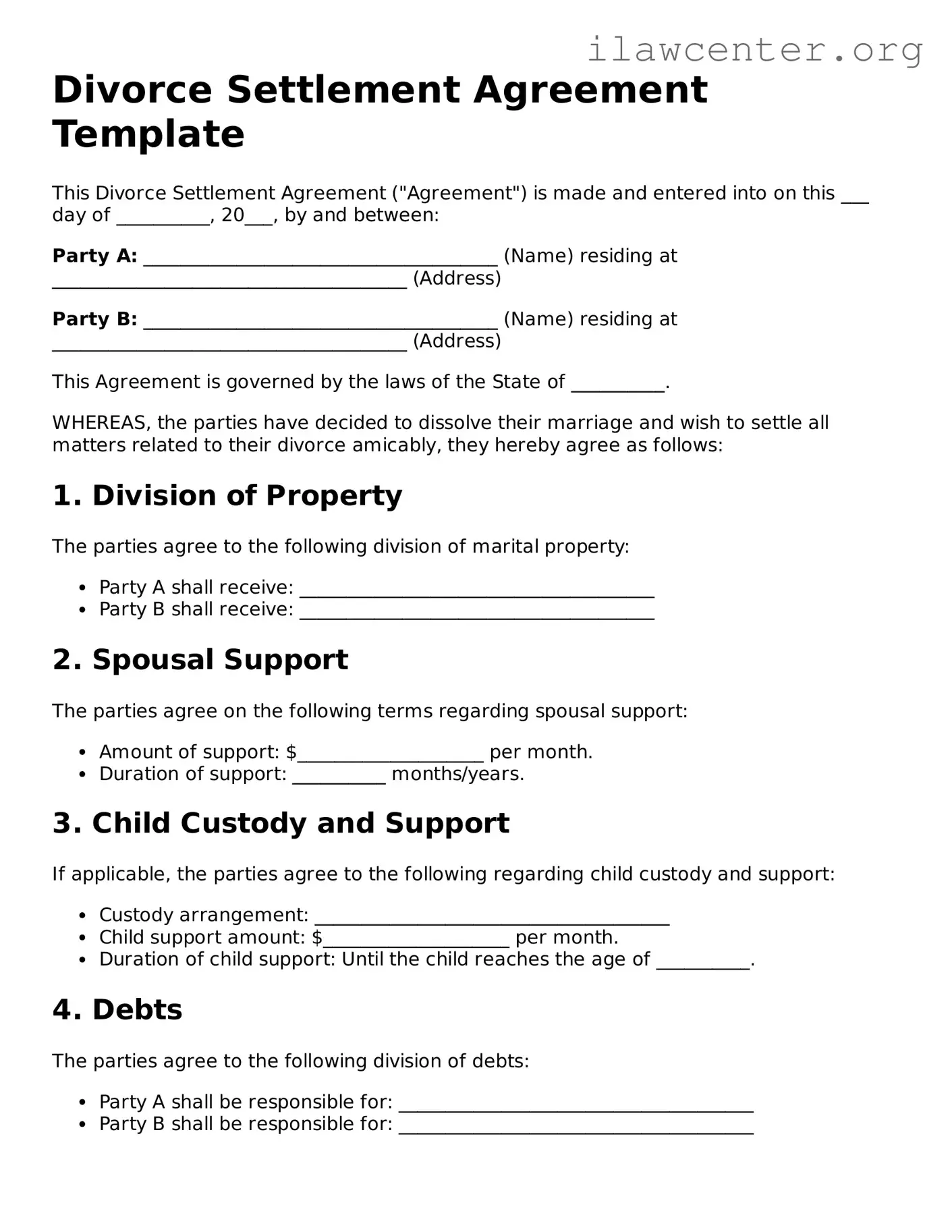
Divorce Settlement Agreement Preview

Divorce Settlement Agreement Template

This Divorce Settlement Agreement ("Agreement") is made and entered into on this ___ day of __________, 20___, by and between:

Party A: ______________________________________ (Name) residing at ______________________________________ (Address)

Party B: ______________________________________ (Name) residing at ______________________________________ (Address)

This Agreement is governed by the laws of the State of __________.

WHEREAS, the parties have decided to dissolve their marriage and wish to settle all matters related to their divorce amicably, they hereby agree as follows:

1. Division of Property

The parties agree to the following division of marital property:

  • Party A shall receive: ______________________________________
  • Party B shall receive: ______________________________________

2. Spousal Support

The parties agree on the following terms regarding spousal support:

  • Amount of support: $____________________ per month.
  • Duration of support: __________ months/years.

3. Child Custody and Support

If applicable, the parties agree to the following regarding child custody and support:

  • Custody arrangement: ______________________________________
  • Child support amount: $____________________ per month.
  • Duration of child support: Until the child reaches the age of __________.

4. Debts

The parties agree to the following division of debts:

  • Party A shall be responsible for: ______________________________________
  • Party B shall be responsible for: ______________________________________

5. Miscellaneous

The parties agree to the following additional terms:

  • This Agreement constitutes the entire understanding between the parties.
  • Any modifications must be in writing and signed by both parties.

IN WITNESS WHEREOF, the parties hereto have executed this Divorce Settlement Agreement as of the date first above written.

______________________________
Party A Signature

______________________________
Party B Signature

______________________________
Date

PDF Form Characteristics

Fact Name Description
Definition A Divorce Settlement Agreement is a legally binding document that outlines the terms agreed upon by both spouses regarding the division of assets, debts, and other relevant matters during a divorce.
Governing Law The laws governing Divorce Settlement Agreements vary by state. For example, in California, the Family Code applies, while in New York, the Domestic Relations Law is relevant.
Mutual Agreement Both parties must mutually agree to the terms outlined in the settlement agreement for it to be valid and enforceable.
Mandatory Disclosure In many states, both spouses are required to provide full disclosure of their financial situations, including income, assets, and debts.
Child Custody and Support If children are involved, the agreement must address custody arrangements and child support obligations.
Spousal Support The agreement may include terms for spousal support (alimony), detailing the amount and duration of payments.
Finalization Once signed by both parties, the agreement must be submitted to the court for approval, at which point it becomes part of the final divorce decree.

Instructions on Utilizing Divorce Settlement Agreement

Completing the Divorce Settlement Agreement form is an important step in finalizing your divorce. This form outlines the terms of your separation and ensures that both parties agree on key issues. Follow the steps below to fill out the form accurately and thoroughly.

  1. Gather necessary information: Collect all relevant details about your marriage, including names, addresses, and dates of marriage and separation.
  2. Identify the parties: Clearly write the full names of both spouses in the designated sections of the form.
  3. State the date of separation: Enter the date when you and your spouse officially separated.
  4. Outline property division: List all assets and debts acquired during the marriage. Specify how these will be divided between both parties.
  5. Detail child custody arrangements: If applicable, describe the custody agreement for any children, including visitation rights and decision-making responsibilities.
  6. Specify child support: Indicate the amount of child support to be paid, along with the frequency and duration of payments.
  7. Include spousal support: If applicable, state whether spousal support will be provided, the amount, and the duration of payments.
  8. Review the agreement: Carefully read through the entire document to ensure all information is accurate and complete.
  9. Sign the document: Both parties must sign the agreement in the designated areas, indicating their consent to the terms.
  10. Make copies: Create copies of the signed agreement for both parties and any relevant legal representatives.

Once you have completed the form, you will need to submit it to the appropriate court. This will help ensure that your divorce is finalized according to the terms you've agreed upon.

Important Facts about Divorce Settlement Agreement

What is a Divorce Settlement Agreement?

A Divorce Settlement Agreement is a legally binding document that outlines the terms of a divorce between two parties. This agreement typically addresses key issues such as the division of assets and debts, child custody arrangements, child support, and spousal support. By detailing these terms, the agreement helps to clarify each party's rights and responsibilities following the divorce, reducing the likelihood of future disputes.

Why is a Divorce Settlement Agreement important?

This agreement is crucial because it provides a clear framework for how both parties will handle their financial and parental responsibilities after the marriage ends. Having a well-drafted settlement can prevent misunderstandings and conflicts down the line. It also serves as a reference point for enforcement of the terms agreed upon, ensuring that both parties adhere to their commitments.

How do I create a Divorce Settlement Agreement?

Creating a Divorce Settlement Agreement typically involves several steps. First, both parties should gather all relevant financial documents, including income statements, bank statements, and property deeds. Next, they should openly discuss and negotiate the terms of the agreement, considering factors like asset division and child custody. It is often advisable to consult with a legal professional to ensure that the agreement complies with state laws and adequately protects both parties' interests.

Can I modify a Divorce Settlement Agreement after it is signed?

Yes, a Divorce Settlement Agreement can be modified after it has been signed, but only under certain circumstances. Both parties must agree to the changes, and the modifications should be documented in writing. Common reasons for modification include significant changes in income, relocation, or changes in the needs of children. If the parties cannot agree on modifications, it may be necessary to return to court for a judge's decision.

What happens if one party does not comply with the Divorce Settlement Agreement?

If one party fails to comply with the terms of the Divorce Settlement Agreement, the other party has several options. They may seek enforcement through the court system. This could involve filing a motion for contempt, which asks the court to enforce the agreement. The court may impose penalties, including fines or changes to custody arrangements, to ensure compliance. It is important to keep detailed records of any non-compliance to support enforcement actions.

Is a Divorce Settlement Agreement the same as a divorce decree?

No, a Divorce Settlement Agreement and a divorce decree are not the same, although they are related. The settlement agreement is the document that outlines the terms agreed upon by both parties, while the divorce decree is the final order issued by the court that officially ends the marriage. The court typically reviews the settlement agreement before issuing the decree to ensure that it is fair and in compliance with state laws.

Common mistakes

Filling out a Divorce Settlement Agreement form can be a daunting task. Many people make mistakes that can lead to complications down the road. Here are seven common mistakes to watch out for.

First, some individuals fail to fully disclose all assets and debts. It’s crucial to list everything, from bank accounts to retirement funds. Omitting any significant item can lead to disputes later on. Transparency is key in ensuring a fair settlement.

Second, people often overlook the importance of precise language. Vague terms can create confusion. For example, stating "I will take care of the bills" is unclear. Instead, specify which bills are being addressed and how they will be managed.

Another mistake is not considering tax implications. Certain settlements can affect your tax situation, especially when it comes to alimony or division of retirement accounts. Consulting a tax professional can help clarify these issues.

Fourth, many forget to address future expenses, such as children’s education or medical costs. These expenses can add up quickly. Planning for them in the agreement can prevent future financial strain.

Additionally, people sometimes rush through the process without seeking legal advice. While it may seem straightforward, having a lawyer review the agreement can help identify potential pitfalls. This step is especially important if the divorce is contentious.

Lastly, some individuals neglect to keep copies of the signed agreement. This document is vital for future reference. Losing it can lead to misunderstandings and complications in enforcing the terms.

By being aware of these common mistakes, individuals can navigate the Divorce Settlement Agreement process more effectively. Taking the time to ensure accuracy and clarity can save a lot of trouble in the long run.

Documents used along the form

When navigating the process of divorce, several forms and documents are often used in conjunction with the Divorce Settlement Agreement. Each document serves a specific purpose and helps to clarify the terms of the divorce, ensuring that both parties understand their rights and responsibilities. Below is a list of commonly used documents in this context.

  • Petition for Divorce: This document initiates the divorce process. It outlines the reasons for the divorce and requests the court to dissolve the marriage.
  • Response to Petition: The other spouse must file this document to respond to the divorce petition. It allows them to agree or disagree with the claims made in the petition.
  • Financial Affidavit: This form provides a detailed account of each spouse's financial situation, including income, expenses, assets, and debts. It is crucial for determining support obligations and property division.
  • Child Custody Agreement: If children are involved, this document outlines the arrangements for custody and visitation. It addresses where the children will live and how parenting responsibilities will be shared.
  • Child Support Agreement: This form specifies the financial support one parent will provide for the children. It includes the amount, frequency, and duration of payments.
  • Property Settlement Agreement: This document details how marital property and debts will be divided between the spouses. It ensures clarity on who receives what after the divorce.
  • Health Insurance Agreement: This form addresses how health insurance coverage will be handled post-divorce, including who will remain on the policy and how premiums will be paid.
  • Alimony Agreement: If applicable, this document outlines any spousal support payments, including the amount, duration, and conditions under which it may change.
  • Final Judgment of Divorce: This is the court's official order that finalizes the divorce. It incorporates the terms agreed upon in the Divorce Settlement Agreement and other related documents.

These documents work together to provide a comprehensive framework for the divorce process. Each plays a vital role in ensuring that all aspects of the separation are addressed, allowing both parties to move forward with clarity and understanding.

Similar forms

  • Separation Agreement: This document outlines the terms agreed upon by both parties while living separately. Like a Divorce Settlement Agreement, it covers issues such as property division, child custody, and support obligations.
  • Child Custody Agreement: This focuses specifically on the arrangements for children after a divorce. Similar to a Divorce Settlement Agreement, it addresses custody, visitation rights, and child support, ensuring both parents have a clear understanding of their responsibilities.
  • Property Settlement Agreement: This document details how assets and debts will be divided between spouses. It parallels the Divorce Settlement Agreement by providing a comprehensive outline of financial arrangements post-divorce.
  • Marital Settlement Agreement: This is a broader term that encompasses all agreements made during a divorce process. It shares similarities with the Divorce Settlement Agreement by including terms about asset division, spousal support, and other essential matters.
  • Final Judgment of Divorce: This is the court's official order that finalizes the divorce. It is similar to a Divorce Settlement Agreement because it incorporates the agreed-upon terms and ensures they are legally binding.

Dos and Don'ts

When filling out the Divorce Settlement Agreement form, it's important to approach the process carefully. Here are some guidelines to consider:

  • Do read the entire form before starting. Understanding what is required can help you avoid mistakes.
  • Do provide accurate and complete information. This includes your personal details, financial information, and any agreements made.
  • Do consult with a legal professional if you have questions. They can provide guidance tailored to your situation.
  • Don't rush through the process. Taking your time can prevent errors that may complicate your settlement.
  • Don't leave any sections blank unless instructed. Missing information can delay the approval of your agreement.
  • Don't ignore deadlines. Timely submission of the form is crucial to ensure your divorce proceeds smoothly.

Misconceptions

When dealing with a Divorce Settlement Agreement form, several misconceptions may arise. Understanding these can help individuals navigate the process more effectively. Here are four common misconceptions:

  • All agreements must be approved by a judge. Many people believe that every Divorce Settlement Agreement requires judicial approval. While it is true that some agreements must be submitted to a court for approval, not all settlements need this step, especially if both parties agree outside of court.
  • Divorce Settlement Agreements are permanent and cannot be changed. Some individuals think that once a Divorce Settlement Agreement is signed, it cannot be modified. In reality, agreements can be revisited and altered if both parties consent and the changes are documented properly.
  • Only lawyers can prepare a Divorce Settlement Agreement. There is a common belief that only attorneys can draft these documents. However, individuals can prepare their own agreements or seek assistance from legal document preparers, who can help ensure that the necessary elements are included.
  • All assets and debts must be divided equally. Many assume that assets and debts in a divorce must be split 50/50. While equitable distribution is a common approach, the division can vary based on various factors, including the length of the marriage and individual contributions.

Key takeaways

Filling out and utilizing a Divorce Settlement Agreement form is a significant step in the divorce process. Understanding its components and implications can lead to a smoother transition for all parties involved. Here are some key takeaways to consider:

  • Clarity is Essential: Ensure that all terms are clearly defined. Ambiguities can lead to misunderstandings later on.
  • Include All Relevant Details: Address key aspects such as asset division, child custody, and support obligations. Omitting details can create complications in the future.
  • Review Thoroughly: Before finalizing the agreement, both parties should carefully review the document. This helps to confirm that all terms are acceptable and accurately represented.
  • Legal Advice is Recommended: While it is possible to fill out the form independently, seeking legal counsel can provide insights and ensure that rights are protected.

By keeping these points in mind, individuals can navigate the complexities of a Divorce Settlement Agreement more effectively.