Driver Time Record PDF Template

Driver Time Record PDF Template

The Driver Time Record form is a vital document used by drivers to log their working hours and driving activities. It is particularly important for those operating within a specified radius from their headquarters, ensuring compliance with regulations regarding work hours and rest periods. For drivers who meet certain criteria, this form simplifies the reporting process and helps maintain accurate records.

To ensure you are compliant, fill out the form by clicking the button below.

Article Guide

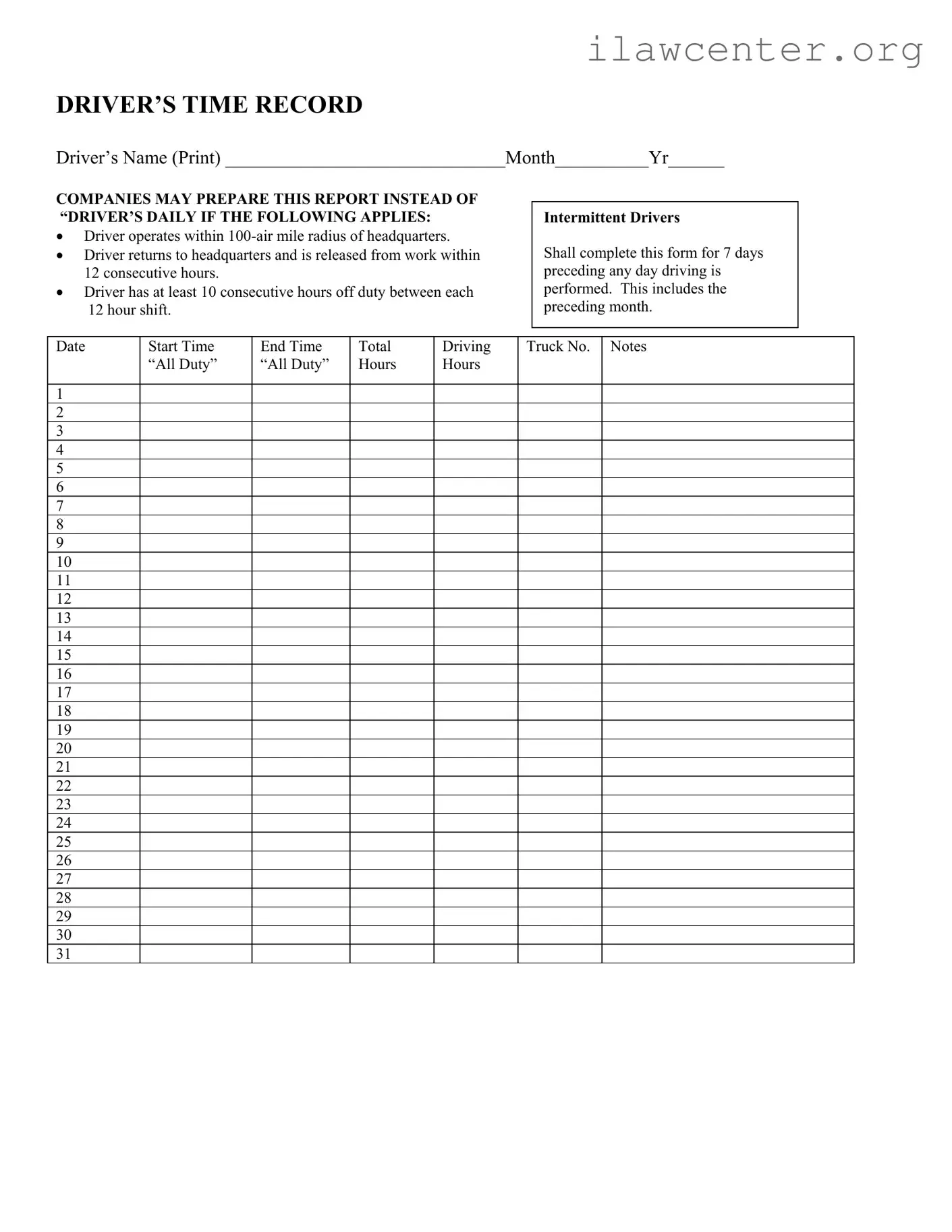
The Driver Time Record form is an essential tool for tracking the hours worked by drivers, ensuring compliance with regulations while promoting safety on the road. This form is designed for drivers who operate within a 100-air mile radius of their headquarters and return home within 12 consecutive hours. To qualify for this streamlined reporting method, drivers must also have at least 10 consecutive hours off duty between each 12-hour shift. Intermittent drivers are required to complete this form for the seven days leading up to any day they perform driving duties, which includes documentation from the preceding month. The form captures crucial details such as the driver's name, date, start and end times, total driving hours, truck number, and any relevant notes. By maintaining accurate records, drivers and their companies can ensure adherence to regulations while enhancing operational efficiency.

Driver Time Record Preview

DRIVER’S TIME RECORD
Driver’s Name (Print) ______________________________Month__________Yr______
COMPANIES MAY PREPARE THIS REPORT INSTEAD OF
“DRIVER’S DAILY IF THE FOLLOWING APPLIES:
Driver operates within 100-air mile radius of headquarters.
Driver returns to headquarters and is released from work within
12 consecutive hours.
Driver has at least 10 consecutive hours off duty between each
12 hour shift.
Date Start Time
“All Duty”
End Time
“All Duty”
Total
Hours
Driving
Hours
Truck No. Notes
1
2
3
4
5
6
7
8
9
10
11
12
13
14
15
16
17
18
19
20
21
22
23
24
25
26
27
28
29
30
31
Intermittent Drivers
Shall complete this form for 7 days
preceding any day driving is
performed. This includes the
preceding month.

File Properties

Fact Name Description
Purpose The Driver Time Record form is used to track a driver's hours of service, ensuring compliance with federal regulations.
Eligibility This form can be used by drivers who operate within a 100-air mile radius of their headquarters and return within 12 consecutive hours.
Off-Duty Requirement Drivers must have at least 10 consecutive hours off duty between each 12-hour shift to qualify for using this form.
Intermittent Drivers Drivers who do not drive every day must complete this form for the 7 days leading up to any day they perform driving duties.
Record Keeping The form requires drivers to log their start time, end time, total driving hours, and any relevant notes for each day.
Federal Regulations This form is governed by the Federal Motor Carrier Safety Administration (FMCSA) regulations, specifically 49 CFR Part 395.
State-Specific Forms Some states may have specific requirements or forms that align with FMCSA regulations, so it's essential to check state laws.

Instructions on Utilizing Driver Time Record

Once the Driver Time Record form is filled out, it will be submitted for review and processing. Ensure that all required information is accurate and complete to avoid any delays.

  1. Begin by printing your name clearly in the designated space labeled "Driver's Name."
  2. Fill in the month and year in the spaces provided.
  3. If applicable, confirm that your driving meets the specified criteria for using this form instead of the "Driver's Daily." These criteria include operating within a 100-air mile radius, returning to headquarters within 12 consecutive hours, and having at least 10 consecutive hours off duty between shifts.
  4. For intermittent drivers, ensure you are completing this form for the 7 days preceding any driving performed, including the previous month.
  5. In the table provided, record the date for each day you drove.
  6. Next, enter your start time and end time for each driving session in the appropriate columns.
  7. Calculate the total driving hours for each day and write this in the "Total Driving Hours" column.
  8. List the truck number used for each driving session in the "Truck No." column.
  9. Finally, add any relevant notes in the "Notes" section, if necessary.

Important Facts about Driver Time Record

What is the Driver Time Record form used for?

The Driver Time Record form is designed to help drivers document their working hours, especially when they operate within a 100-air mile radius of their headquarters. It ensures compliance with regulations regarding driving time and rest periods. By keeping accurate records, drivers can maintain their safety and that of others on the road.

Who needs to fill out the Driver Time Record form?

This form must be completed by drivers who operate within the specified 100-air mile radius and meet certain criteria. If a driver returns to headquarters and is released from work within 12 consecutive hours, they are required to use this form. Additionally, intermittent drivers should fill it out for the seven days leading up to any driving day.

What information is required on the form?

The form requires several key pieces of information, including the driver's name, the month and year, and detailed records of driving times. Each entry should include the date, start time, end time, total driving hours, truck number, and any relevant notes. This comprehensive documentation helps ensure clarity and accountability.

What does "intermittent drivers" mean?

Intermittent drivers are those who do not drive on a regular or daily basis. They may have varying schedules and only drive occasionally. For these drivers, it's essential to complete the Driver Time Record form for the seven days leading up to any day they perform driving duties, including the preceding month, to maintain accurate records.

How do I calculate total driving hours?

Total driving hours can be calculated by subtracting the start time from the end time for each driving session. It’s important to ensure that these calculations are accurate, as they contribute to compliance with driving regulations and help prevent fatigue-related incidents.

What should I do if I forget to fill out the form?

If you forget to complete the Driver Time Record form, it is crucial to do so as soon as possible. Try to reconstruct your driving hours based on memory or any other available records. Accurate reporting is important for safety and compliance, so make it a priority to complete the form even if it is after the fact.

Can companies create their own version of this form?

Yes, companies may prepare their own version of the Driver Time Record form, provided they adhere to the necessary guidelines. The form must still capture all required information to ensure compliance with regulations. Customization can help streamline processes while ensuring that all relevant details are documented.

What happens if I don’t keep accurate records?

Failing to maintain accurate records can lead to serious consequences, including potential fines and penalties. Moreover, it can compromise safety, as it may lead to fatigue and overworking. Keeping precise and timely records is essential not only for legal compliance but also for the well-being of drivers and others on the road.

Common mistakes

Filling out the Driver Time Record form can seem straightforward, but many people make common mistakes that can lead to issues down the line. One frequent error is not providing complete information. For instance, leaving out the driver’s name or the month and year can cause delays in processing the form. Always ensure that every field is filled out accurately.

Another mistake involves the time entries. Some drivers forget to record both the start and end times for their shifts. This oversight can result in incorrect total driving hours, which may raise questions during audits. Double-checking these entries before submission can save a lot of hassle.

Many drivers also miscalculate their total driving hours. It’s essential to add up the hours correctly to reflect the actual driving time. Inaccurate totals can lead to violations of regulations and potential penalties. A simple review of the math can help catch these errors.

Additionally, some drivers fail to note the truck number. This information is crucial for tracking purposes and helps ensure that the right vehicle is associated with the recorded hours. Omitting this detail can complicate matters if any issues arise regarding vehicle compliance.

Another common mistake is not including notes for unusual circumstances. If there were delays or breaks that affected driving time, it’s important to document these. Providing context can help clarify any discrepancies that might come up later.

Some drivers overlook the requirement for intermittent drivers to complete the form for the preceding seven days. This can lead to confusion about compliance with regulations. Keeping a consistent record will ensure that all driving days are accounted for.

Lastly, many individuals forget to sign the form. A signature is often required to validate the information provided. Without it, the form may be considered incomplete, leading to further complications.

By avoiding these common mistakes, drivers can ensure that their time records are accurate and compliant with regulations. Taking the time to review the form before submission can prevent future issues and facilitate smoother operations.

Documents used along the form

When managing driver records, several forms and documents complement the Driver Time Record form. Each of these documents serves a specific purpose in ensuring compliance with regulations and maintaining accurate records of driving activities. Understanding these forms can help streamline operations and promote safety within the transportation industry.

  • Driver Qualification File (DQF): This file contains important information about a driver's qualifications, including their driving history, medical certifications, and background checks. It ensures that all drivers meet the necessary standards to operate commercial vehicles safely.
  • Vehicle Inspection Report (VIR): This report documents the condition of a vehicle before and after use. It includes details about any mechanical issues or damages that may affect safety and compliance. Regular inspections help prevent accidents and maintain the vehicle's reliability.
  • Bill of Lading (BOL): This document serves as a receipt for goods being transported. It outlines the details of the shipment, including the origin, destination, and contents. The BOL is essential for tracking shipments and ensuring that all parties are aware of the cargo being transported.
  • Accident Report Form: In the unfortunate event of an accident, this form is used to document the incident. It captures details such as the date, time, location, and parties involved. Accurate reporting is crucial for insurance claims and legal purposes.
  • Hours of Service (HOS) Log: This log tracks a driver's working hours to ensure compliance with federal regulations regarding driving time and rest periods. It helps prevent driver fatigue and promotes safety on the roads.

In summary, these documents work together with the Driver Time Record form to create a comprehensive framework for managing driver activities and ensuring safety. Proper record-keeping not only complies with legal requirements but also enhances operational efficiency and accountability within the transportation sector.

Similar forms

The Driver Time Record form shares similarities with several other documents used in the transportation and logistics industry. Here are six of those documents and how they relate to the Driver Time Record:

  • Driver's Daily Log: This document tracks a driver's hours of service, including driving time and rest periods. Like the Driver Time Record, it ensures compliance with regulations regarding driving limits and rest requirements.
  • Vehicle Inspection Report: This report records the condition of the vehicle before and after trips. Both documents are essential for safety and compliance, helping to ensure that vehicles are roadworthy and drivers are fit for duty.
  • Trip Sheet: A trip sheet details the specifics of a journey, including routes taken and fuel usage. Similar to the Driver Time Record, it helps in tracking the operational aspects of driving and can be used for expense reporting.
  • Hours of Service (HOS) Compliance Report: This report verifies that drivers adhere to federal regulations regarding driving hours. It aligns with the Driver Time Record's purpose of documenting driving hours and ensuring legal compliance.
  • Payroll Time Sheet: This document records hours worked for payroll purposes. Both the Driver Time Record and the Payroll Time Sheet are used to calculate compensation based on hours worked, ensuring accurate payment for services rendered.
  • Incident Report: An incident report documents any accidents or incidents involving the vehicle. While the Driver Time Record focuses on hours worked, both documents contribute to overall safety and compliance within the transportation industry.

Dos and Don'ts

When filling out the Driver Time Record form, follow these guidelines to ensure accuracy and compliance.

  • Do print your name clearly at the top of the form.
  • Do accurately record the start and end times for each driving session.
  • Do ensure you have at least 10 consecutive hours off duty between shifts.
  • Do use the correct truck number for each entry.
  • Do double-check your total driving hours for accuracy.
  • Don't leave any sections of the form blank.
  • Don't forget to include notes for any unusual circumstances.
  • Don't use abbreviations or unclear terms in your notes.
  • Don't submit the form without verifying all information is correct.
  • Don't disregard the requirement for intermittent drivers to complete the form for the 7 days preceding any driving.

Misconceptions

Misconceptions about the Driver Time Record form can lead to confusion among drivers and companies alike. Understanding these misconceptions is essential for compliance and effective record-keeping. Below is a list of common misunderstandings.

  1. Only long-haul drivers need to fill out the form. Many believe that only drivers who travel long distances are required to complete the Driver Time Record. However, intermittent drivers who operate within a 100-air mile radius must also use this form.
  2. The form is optional for all drivers. Some assume that filling out the Driver Time Record is not mandatory. In fact, it is required for drivers who meet specific criteria, such as those returning to headquarters within 12 consecutive hours.
  3. Any time can be recorded as driving time. It is a misconception that all hours spent in a truck count as driving time. Only the actual driving hours should be recorded, along with any other relevant duties performed during that time.
  4. The form can be filled out after the driving is completed. Some drivers think they can complete the record at their convenience. It is crucial to fill out the form accurately and contemporaneously to ensure compliance.
  5. Drivers do not need to track their time if they are off duty. There is a belief that off-duty time does not need to be recorded. However, drivers must still document their off-duty hours to ensure they meet the required 10 consecutive hours off between shifts.
  6. All companies use the same format for the form. Some assume that the Driver Time Record form must look the same for all companies. In reality, companies may prepare this report in their own format, as long as it captures the necessary information.
  7. Notes section is optional and can be ignored. Many drivers think the notes section is not important. However, providing additional context can be crucial for understanding the driving hours and any unusual circumstances.
  8. The form is only for tracking hours. Some believe that the Driver Time Record is solely for logging hours. While tracking time is important, it also serves as a compliance tool to ensure that drivers adhere to regulations.
  9. Submitting the form is the driver’s responsibility only. There is a misconception that only the driver is responsible for submitting the form. In fact, companies also share the responsibility to ensure that records are maintained and submitted correctly.
  10. Once submitted, the form cannot be amended. Some drivers think that once the form is submitted, it cannot be changed. However, if errors are identified, it is essential to correct them as soon as possible to maintain accurate records.

By addressing these misconceptions, drivers and companies can better understand the importance of the Driver Time Record form and ensure compliance with regulations.

Key takeaways

Filling out and using the Driver Time Record form is essential for maintaining accurate records. Here are key takeaways to keep in mind:

  • The form requires the driver’s name, month, and year to ensure proper identification.
  • It is specifically designed for drivers operating within a 100-air mile radius of their headquarters.
  • Drivers must return to headquarters and be released from work within 12 consecutive hours.
  • At least 10 consecutive hours off duty is mandatory between each 12-hour shift.
  • Intermittent drivers must complete this form for the 7 days preceding any day they drive.
  • Records from the preceding month should also be included for intermittent drivers.
  • Each day’s entry includes sections for date, start time, end time, total driving hours, truck number, and notes.
  • Accurate documentation of "All Duty" hours is crucial for compliance and safety.
  • Ensure that all sections of the form are filled out completely to avoid any discrepancies.