Dwc 83 PDF Template

Dwc 83 PDF Template

The DWC 83 form is a declaration used in Texas to establish the independent contractor relationship between a hiring contractor and an independent contractor. This form outlines the rights and responsibilities of both parties, ensuring that the independent contractor does not receive workers' compensation coverage from the hiring contractor. Understanding and properly completing this form is crucial for compliance with Texas workers' compensation laws.

Ready to fill out the DWC 83 form? Click the button below!

Article Guide

The DWC 83 form is an essential document for those involved in the construction and building industries in Texas, particularly when it comes to defining the relationship between hiring contractors and independent contractors. This form serves two primary purposes: it allows parties to affirm their independent contractor status and establishes the terms under which workers' compensation coverage is provided. By signing this form, both the hiring contractor and the independent contractor agree that the latter meets the qualifications outlined in the Texas Workers' Compensation Act. This includes stipulations that the independent contractor is compensated per job rather than hourly, has the freedom to hire helpers, and can work for multiple contractors simultaneously. Additionally, the DWC 83 form clarifies that independent contractors and their employees will not be entitled to workers' compensation coverage from the hiring contractor, which can significantly impact insurance premiums and liability. It is crucial for both parties to understand the implications of this declaration, as it remains effective for all hiring agreements executed within a year unless a new agreement states otherwise. Proper completion and timely filing of the form with the Texas Department of Insurance and the hiring contractor's insurance carrier are mandatory, ensuring compliance with state regulations and protecting the interests of all parties involved.

Dwc 83 Preview

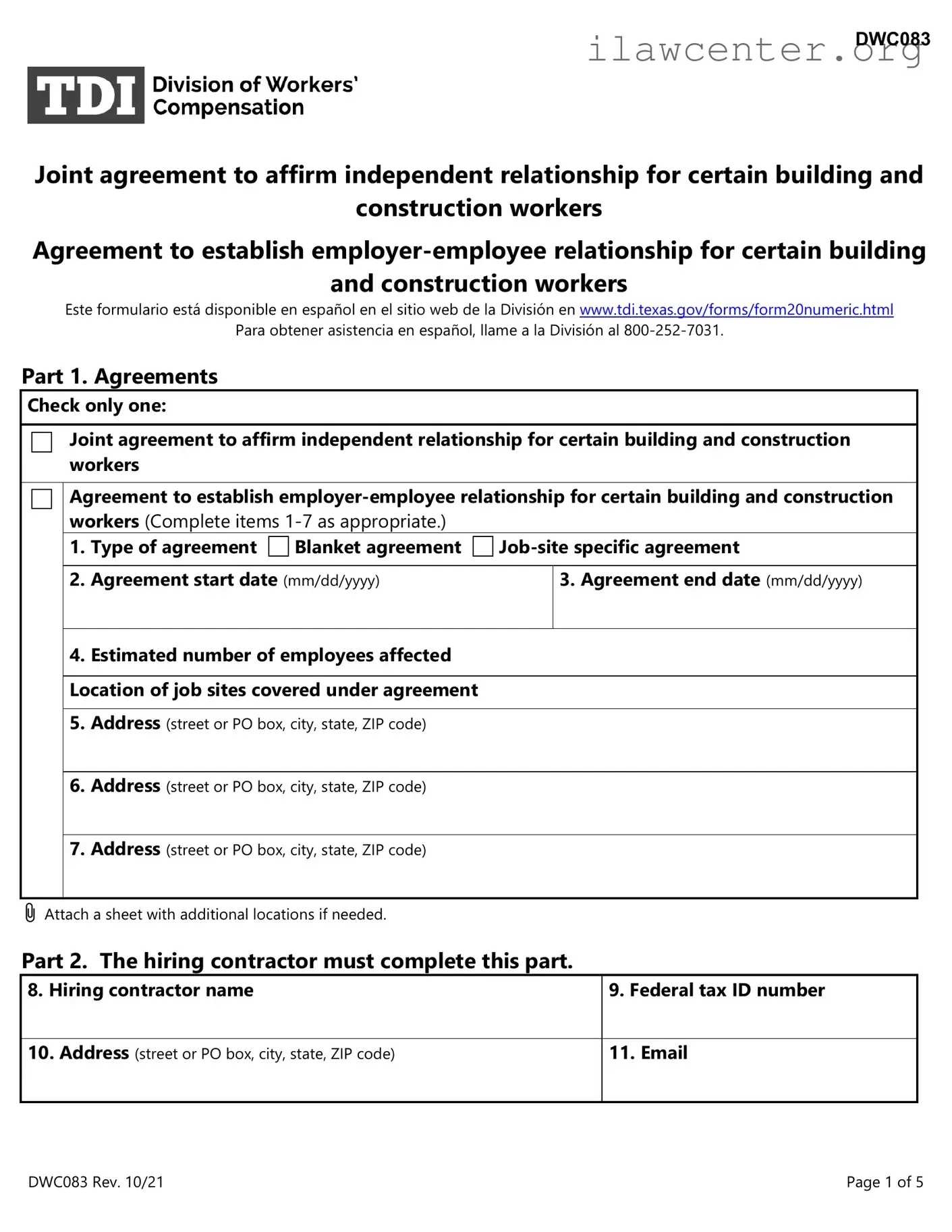
Job-site specific agreement
3. Agreement end date (mm/dd/yyyy)

DWC083

Joint agreement to affirm independent relationship for certain building and

construction workers

Agreement to establish employer-employee relationship for certain building

and construction workers

Este formulario está disponible en español en el sitio web de la División en www.tdi.texas.gov/forms/form20numeric.html

Para obtener asistencia en español, llame a la División al 800-252-7031.

Part 1. Agreements

Check only one:

Joint agreement to affirm independent relationship for certain building and construction workers

Agreement to establish employer-employee relationship for certain building and construction workers (Complete items 1-7 as appropriate.)

1. Type of agreement Blanket agreement

2. Agreement start date (mm/dd/yyyy)

4.Estimated number of employees affected Location of job sites covered under agreement

5.Address (street or PO box, city, state, ZIP code)

6.Address (street or PO box, city, state, ZIP code)

7.Address (street or PO box, city, state, ZIP code)

📎📎 Attach a sheet with additional locations if needed.

Part 2. The hiring contractor must complete this part.

8. Hiring contractor name

9. Federal tax ID number

10. Address (street or PO box, city, state, ZIP code)

11. Email

DWC083 Rev. 10/21

Page 1 of 5

DWC083

12.Hiring contractor's affirmations Check only one:

Joint agreement to affirm independent relationship for certain building and construction workers

I declare that the independent contractor meets the qualifications under Texas Labor Code Section 406.141, and the independent contractor is not an employee of the hiring contractor. The independent contractor and the independent contractor's employees are not entitled to workers' compensation insurance coverage from the hiring contractor. The hiring contractor's workers' compensation insurance carrier will not require the hiring contractor to pay premiums to cover the independent contractor or the independent contractor's employees, helpers, or subcontractors. Once this agreement is signed, the subcontractor and the subcontractor's employees will not be entitled to workers' compensation coverage from the hiring contractor unless a subsequent written agreement is signed, and filed according to division rules, expressly stating that this agreement does not apply.

Agreement to establish employer-employee relationship for certain building and construction workers

I will

withhold

not withhold the cost of workers' compensation insurance coverage from the

independent contractor's price. I agree that the hiring contractor will purchase workers' compensation

insurance coverage for the independent contractor and the independent contractor's employees.

I agree that I am the employer of the independent contractor for the purpose of providing workers’ compensation insurance coverage, and no other purpose.

13. Signature of hiring contractor

14. Date of signature (mm/dd/yyyy)

Part 3. The independent contractor must complete this part.

15. Independent contractor name

16.

Federal tax ID number


17. Address (street or PO box, city, state, ZIP code)

18.

Email


DWC083 Rev. 10/21

Page 2 of 5

DWC083

19.Independent contractor's affirmations Check only one:

Joint agreement to affirm independent relationship for certain building and construction workers

I declare that I meet the qualifications under Texas Labor Code Section 406.141, and I am not an employee of the hiring contractor. My employees and I are not entitled to workers' compensation insurance coverage from the hiring contractor. The hiring contractor's workers' compensation insurance carrier will not require the hiring contractor to pay premiums to cover me, my employees, helpers, or subcontractors.

Agreement to establish employer-employee relationship for certain building and construction workers

I agree that the hiring contractor employs the independent contractor for the purpose of providing workers’ compensation insurance coverage, and no other purpose.

20. Signature of independent contractor

21. Date of signature (mm/dd/yyyy)

DWC083 Rev. 10/21

Page 3 of 5

DWC083

FAQ

Joint agreement to affirm independent relationship for certain building and construction workers

Agreement to establish employer-employee relationship for certain building and construction workers

Who may use this agreement?

Texas Labor Code Section 406.145 allows certain building and construction workers, specifically, hiring contractors and independent contractors, to agree that the independent contractor is not an employee of the hiring contractor, and the hiring contractor is not responsible for workers' compensation insurance coverage for the independent contractor.

Texas Labor Code Section 406.144 allows certain building and construction workers, specifically, hiring contractors and independent contractors, to agree on who will provide workers' compensation insurance coverage to the subcontractor and the employees of the subcontractor.

Who is an independent contractor?

Texas Labor Code Section 406.141(2) defines an independent contractor as a person who contracts to perform work or provide a service for the benefit of another, and who is:

paid by the job, not by the hour or some other time-measured basis;

free to hire as many helpers as desired and determine what to pay each helper; and

free to work for other contractors or send helpers to work for other contractors, while under contract with the hiring employer.

How do I know if I should sign this agreement?

You may want to talk to an attorney if you are not sure if all parties meet the requirements to enter into these agreements.

When does the agreement take effect?

The agreement takes effect the date both parties have signed it or on the start date of the agreement, whichever is later.

How long is the joint agreement to affirm an independent relationship in effect?

Texas Labor Code Section 406.145 states that the agreement to affirm an independent relationship applies to all hiring agreements the hiring contractor and the independent contractor make until the first anniversary of the date the hiring contractor filed the agreement with their workers' compensation insurance carrier. The agreement does not apply to a new hiring agreement if the new agreement states this agreement does not apply.

The hiring contractor and independent contractor must notify the hiring contractor's workers' compensation insurance carrier in writing within 10 days after the date they make a hiring agreement that does not apply to this agreement.

The subcontractor and the subcontractor's employees are not entitled to workers' compensation coverage from the hiring contractor once this agreement is signed. The hiring contractor and independent contractor must make a new written agreement to establish an employer-employee relationship and provide workers' compensation insurance coverage. The new written agreement must state that this agreement does not apply. The hiring contractor and independent contractor can use DWC Form-084, Exception to Application of a Joint Agreement to Affirm Independent Relationship for Certain building and Construction Workers. Find our forms at www.tdi.texas.gov/forms/form20numeric.html.

Where should I send this agreement?

DWC083 Rev. 10/21

Page 4 of 5

DWC083

The hiring contractor must file a legible and complete copy of this agreement with their workers’ compensation insurance carrier within 10 days after signing the agreement. The hiring contractor must keep the original. The independent contractor should also keep a copy. If the hiring contractor changes workers' compensation insurance carriers during the effective dates of the agreement, the hiring contractor should file this form with their new insurance carrier.

You may file this form with Texas Department of Insurance, Division of Workers' Compensation (DWC) under Labor Code Section 406.145.

Note: With few exceptions, you are entitled to:

be informed about the information DWC collects about you;

receive and review the information (Government Code Sections 552.021 and 552.023); and

have DWC correct information that is incorrect (Government Code Section 559.004). 

For more information, contact DWCLegalServices@tdi.texas.gov or go to the Corrections Procedure section at www.tdi.texas.gov.

DWC083 Rev. 10/21

Page 5 of 5

File Properties

Fact Name Fact Details
Form Purpose The DWC 83 form is used to establish an independent contractor relationship for certain building and construction workers in Texas.
Governing Law This form is governed by the Texas Workers' Compensation Act, specifically Texas Labor Code, Section 406.141.
Independent Contractor Definition An independent contractor is defined as someone who is paid by the job, can hire helpers, and can work for other contractors.
Workers' Compensation Coverage Independent contractors and their employees are not entitled to workers' compensation coverage from the hiring contractor.
Effective Date The declaration takes effect upon receipt by the Texas Department of Insurance, Division of Workers' Compensation.
Notification Requirement If a hiring agreement is made that does not apply, both parties must notify the Texas Department of Insurance within 10 days.
Filing Requirements The form must be filed with both the Texas Department of Insurance and the hiring contractor's workers' compensation insurance carrier within 10 days.
Copies Required Four copies of the DWC 83 form must be completed and retained by both the hiring contractor and the independent contractor.

Instructions on Utilizing Dwc 83

Filling out the DWC 83 form is an important step for establishing the relationship between a Hiring Contractor and an Independent Contractor in Texas. This form needs to be completed accurately to ensure compliance with the Texas Workers' Compensation Act. Below are the steps to guide you through the process of filling out the form.

  1. Begin by entering the name and address of the Hiring Contractor at the top of the form.
  2. Next, provide the name and address of the Independent Contractor.
  3. Check the appropriate box that indicates whether you are affirming an independent relationship or establishing an employer-employee relationship.
  4. For the independent relationship, declare that the Independent Contractor meets the qualifications under Texas Labor Code, Section 406.141.
  5. Specify the term of the agreement by filling in the start and end dates in the designated fields.
  6. Indicate the location of each affected job site or state if this is a blanket agreement.
  7. Estimate the number of employees affected by this agreement and write that number in the provided space.
  8. Have the Hiring Contractor sign and date the form, providing their printed name and address as well.
  9. Have the Independent Contractor sign and date the form, also providing their printed name and address.
  10. Make sure to create four copies of the completed form.
  11. File the original form with the Texas Department of Insurance, Division of Workers’ Compensation, and send copies to the Hiring Contractor's workers’ compensation insurance carrier within 10 days of signing.
  12. Retain a copy of the agreement for both the Hiring Contractor and the Independent Contractor for their records.

Important Facts about Dwc 83

What is the DWC 83 form?

The DWC 83 form is a document used in Texas to establish the relationship between a hiring contractor and an independent contractor in the context of workers' compensation. It outlines whether the independent contractor qualifies as such under Texas law, and it specifies the terms regarding workers' compensation coverage for both parties involved.

Who needs to fill out the DWC 83 form?

The DWC 83 form must be completed by both the hiring contractor and the independent contractor. This is essential for those engaged in building and construction work who want to clarify their independent relationship and ensure proper handling of workers' compensation insurance matters.

What are the qualifications for an independent contractor under Texas law?

According to the Texas Workers' Compensation Act, an independent contractor is someone who is paid by the job, has the freedom to hire helpers and determine their pay, and can work for other contractors simultaneously. These qualifications are crucial for establishing the independent contractor status in the DWC 83 form.

What happens after the DWC 83 form is signed?

Once the DWC 83 form is signed, the independent contractor and their employees are not entitled to workers' compensation coverage from the hiring contractor unless a new written agreement states otherwise. This declaration applies to all hiring agreements executed within a year after filing the form, unless a different agreement is made.

How should the DWC 83 form be submitted?

The completed DWC 83 form must be filed with both the Texas Department of Insurance, Division of Workers' Compensation, and the hiring contractor's workers' compensation insurance carrier. This submission should occur within 10 days of signing the agreement. It is important to deliver the form personally or send it via registered or certified mail.

What if the hiring contractor's insurance carrier changes?

If the hiring contractor's workers' compensation insurance carrier changes during the effective period of coverage, it is advisable for the hiring contractor to file the DWC 83 form with the new insurance carrier. This ensures that all parties are aware of the coverage terms and maintains compliance with Texas regulations.

Do both parties need to keep copies of the DWC 83 form?

Yes, both the hiring contractor and the independent contractor should retain a copy of the DWC 83 form. Keeping a copy is important for future reference and to ensure that both parties are aware of their rights and responsibilities under the agreement.

Common mistakes

Filling out the DWC 83 form can be a straightforward process, but there are common mistakes that individuals often make. Understanding these pitfalls can help ensure that the form is completed correctly and efficiently. One frequent error is failing to check the appropriate box that indicates the type of agreement being entered into. This step is crucial because it sets the framework for the entire agreement. Without this initial selection, the form may be considered incomplete.

Another mistake is not providing accurate information about the parties involved. It is essential to include the correct names, addresses, and Federal Tax I.D. numbers of both the Hiring Contractor and the Independent Contractor. Missing or incorrect details can lead to delays or complications in processing the form. Additionally, individuals sometimes forget to sign and date the form. Signatures are not merely formalities; they signify that both parties agree to the terms laid out in the document.

Many people also overlook the section that requires a description of the job site or the nature of the work being performed. This information is vital for establishing the context of the agreement. If this section is left blank or filled out inaccurately, it can lead to misunderstandings regarding the scope of the work and the applicability of workers’ compensation coverage.

Another common oversight is not filing the form within the required timeframe. The DWC 83 must be filed with the Texas Department of Insurance and the workers’ compensation insurance carrier within 10 days of execution. Missing this deadline can result in complications, including the potential loss of coverage. Furthermore, individuals sometimes neglect to keep copies of the completed form for their records. Retaining copies is important for future reference and for confirming that the agreement was properly executed.

Lastly, individuals may fail to notify the Texas Department of Insurance if a new hiring agreement is made that does not apply to the initial declaration. This notification must occur within 10 days of the new agreement. Ignoring this requirement can lead to legal complications and misunderstandings about coverage. By being aware of these common mistakes, individuals can better navigate the process of completing the DWC 83 form and ensure compliance with Texas workers' compensation laws.

Documents used along the form

The DWC 83 form is an important document in Texas for establishing the independent contractor status of workers in the construction industry. However, it is often accompanied by other forms and documents that further clarify the relationships and responsibilities between the hiring contractor and the independent contractor. Here are six commonly used forms that complement the DWC 83:

  • Notice of Declaration: This document is signed by both the hiring contractor and the independent contractor to confirm that the independent contractor qualifies as such under Texas law. It outlines that the independent contractor will not receive workers' compensation coverage from the hiring contractor.
  • Agreement to Establish Employer-Employee Relationship: This agreement states that the hiring contractor will provide workers' compensation insurance for the independent contractor and their employees. It clarifies the employer-employee relationship specifically for workers' compensation purposes.
  • Independent Contractor Agreement: This contract details the terms of the working relationship, including the scope of work, payment terms, and responsibilities. It helps protect both parties by clearly outlining expectations.
  • Certificate of Insurance: This document verifies that the independent contractor carries their own insurance coverage. It provides proof of coverage to the hiring contractor and can be essential for compliance purposes.
  • Tax Identification Form: This form is used to provide the hiring contractor with the independent contractor's tax identification number. It is crucial for tax reporting and ensures that payments are reported correctly to the IRS.
  • Workers' Compensation Coverage Election Form: This form allows the independent contractor to elect whether or not to opt into the workers' compensation system. It’s an important decision that can affect their rights and benefits.

These forms and documents work together to create a clear framework for the relationship between hiring contractors and independent contractors. Understanding each one can help ensure compliance with Texas laws and protect the interests of all parties involved.

Similar forms

The DWC 83 form serves a specific purpose in the context of Texas workers' compensation law. However, several other documents share similarities with it. Each of these documents addresses the relationship between contractors and workers, particularly in terms of liability and insurance coverage. Below is a list of documents that are similar to the DWC 83 form:

  • Independent Contractor Agreement: This document outlines the terms of the relationship between a hiring party and an independent contractor, specifying the nature of work and payment terms. Like the DWC 83, it emphasizes that the contractor is not an employee.
  • Workers' Compensation Exemption Form: This form allows certain independent contractors to opt out of workers' compensation coverage. It parallels the DWC 83 in clarifying that the contractor does not receive such coverage from the hiring party.
  • Subcontractor Agreement: This agreement details the terms under which a subcontractor will work for a primary contractor. It shares similarities with the DWC 83 in establishing the independent status of the subcontractor.
  • Notice of Intent to Hire Independent Contractor: This document informs relevant parties of the hiring of an independent contractor. It is similar to the DWC 83 as it also addresses the independent status and the lack of employee benefits.
  • Certificate of Insurance: This document proves that a contractor has the necessary insurance coverage. It relates to the DWC 83 by ensuring that all parties are aware of liability and coverage issues.
  • Agreement to Waive Workers' Compensation Coverage: This form allows parties to formally waive workers' compensation coverage for independent contractors. It aligns with the DWC 83 in affirming that the contractor will not be covered under the hiring party's policy.
  • Employer-Employee Relationship Agreement: This document outlines the terms under which a contractor may be treated as an employee for specific purposes. It contrasts with the DWC 83 but highlights the complexities of contractor relationships.

Understanding these documents can help clarify the rights and responsibilities of all parties involved in a contractor relationship, ensuring compliance with Texas workers' compensation laws.

Dos and Don'ts

When filling out the DWC 83 form, it is essential to follow specific guidelines to ensure accuracy and compliance. Below is a list of things you should and shouldn't do:

  • Do read the entire form carefully before starting.
  • Do ensure that all parties involved meet the requirements for independent contractor status.
  • Do check the appropriate box indicating the statement that applies to your situation.
  • Do provide accurate and complete information regarding the term dates of the agreement.
  • Do file the form with the Texas Department of Insurance and the insurance carrier within 10 days of execution.
  • Don't leave any sections blank; fill in all required fields.
  • Don't submit the form without signatures from both the Hiring Contractor and the Independent Contractor.
  • Don't forget to keep copies of the signed agreement for your records.
  • Don't ignore the instructions regarding personal delivery or certified mail for submission.
  • Don't assume that verbal agreements are sufficient; everything must be documented in writing.

Misconceptions

Understanding the DWC 83 form is essential for both hiring contractors and independent contractors in Texas. However, several misconceptions can lead to confusion. Here are eight common misunderstandings about the DWC 83 form:

  • Misconception 1: The DWC 83 form is only for construction workers.
  • This form applies to a broader range of independent contractors, not just those in construction. It is relevant for any independent contractor who meets the qualifications outlined in the Texas Workers' Compensation Act.

  • Misconception 2: Signing the DWC 83 form guarantees workers' compensation coverage.
  • Signing this form does not guarantee coverage. Instead, it clarifies the relationship between the hiring contractor and the independent contractor regarding workers' compensation. The hiring contractor may choose to provide coverage, but it is not mandatory.

  • Misconception 3: The DWC 83 form is optional for all independent contractors.
  • While the form is not required for every independent contractor, it is essential for those who want to clarify their status and ensure they are not classified as employees for workers' compensation purposes.

  • Misconception 4: Once the DWC 83 form is filed, it cannot be changed.
  • Changes can be made if new hiring agreements are established. However, any new agreements must be communicated to the Texas Department of Insurance and the workers' compensation insurance carrier.

  • Misconception 5: The DWC 83 form only protects the hiring contractor.
  • While the form does provide protections for hiring contractors, it also benefits independent contractors by clarifying their status and ensuring they are not treated as employees.

  • Misconception 6: Filing the DWC 83 form is a one-time process.
  • The form must be filed for each new hiring agreement. It is valid for one year but must be refiled if new agreements are made that do not fall under the original declaration.

  • Misconception 7: The DWC 83 form is not legally binding.
  • This form is legally binding once signed and filed appropriately. It establishes the relationship and responsibilities between the parties involved.

  • Misconception 8: All independent contractors are automatically exempt from workers' compensation.
  • Not all independent contractors are exempt. The DWC 83 form specifically outlines the criteria that must be met for an independent contractor to be considered exempt from workers' compensation coverage.

Key takeaways

Filling out and using the DWC 83 form is an essential process for establishing the relationship between a hiring contractor and an independent contractor in Texas. Here are some key takeaways to keep in mind:

  • Understand the Definition: Familiarize yourself with the definition of an independent contractor as outlined in the Texas Workers' Compensation Act. This includes being paid by the job, having the freedom to hire helpers, and being able to work for multiple contractors.
  • Joint Agreement: Both the hiring contractor and the independent contractor must sign the form to declare their agreement. This declaration confirms that the independent contractor does not qualify as an employee under Texas law.
  • Workers' Compensation Coverage: The agreement states that the independent contractor and their employees are not entitled to workers' compensation coverage from the hiring contractor. This is a crucial point to understand before signing.
  • Effectiveness of the Declaration: The declaration takes effect once it is received by the Texas Department of Insurance, Division of Workers' Compensation. It applies to all hiring agreements executed during the year following the filing.
  • Notification Requirement: If a hiring agreement is made that does not fall under the declaration, both parties must notify the Texas Department of Insurance and the workers' compensation insurance carrier within 10 days.
  • Filing Process: Four copies of the completed form must be filed with the Texas Department of Insurance and the hiring contractor's insurance carrier within 10 days. Ensure that the original is submitted by personal delivery or registered mail.

By following these key points, both hiring contractors and independent contractors can navigate the DWC 83 form process more effectively, ensuring compliance and clarity in their working relationship.