Eco Map PDF Template

Eco Map PDF Template

The Eco Map form is a visual tool used to depict the relationships and resources surrounding an individual or family. It helps identify support systems, community connections, and potential areas for growth or improvement. To gain insights into your environment, consider filling out the form by clicking the button below.

Article Guide

The Eco Map form serves as a vital tool for understanding the complex web of relationships and resources surrounding an individual or family. It visually represents connections to various systems, including family, friends, community services, and institutions. By mapping these relationships, the Eco Map highlights both supportive and challenging dynamics, offering insights into how these connections impact a person's well-being. This form encourages users to reflect on their social environment, identify strengths, and recognize areas needing improvement. It is particularly useful in social work, counseling, and educational settings, where understanding a person's ecosystem can lead to more effective interventions. Through this structured approach, individuals can gain clarity about their support networks and the resources available to them, ultimately fostering a greater sense of agency and empowerment.

Eco Map Preview

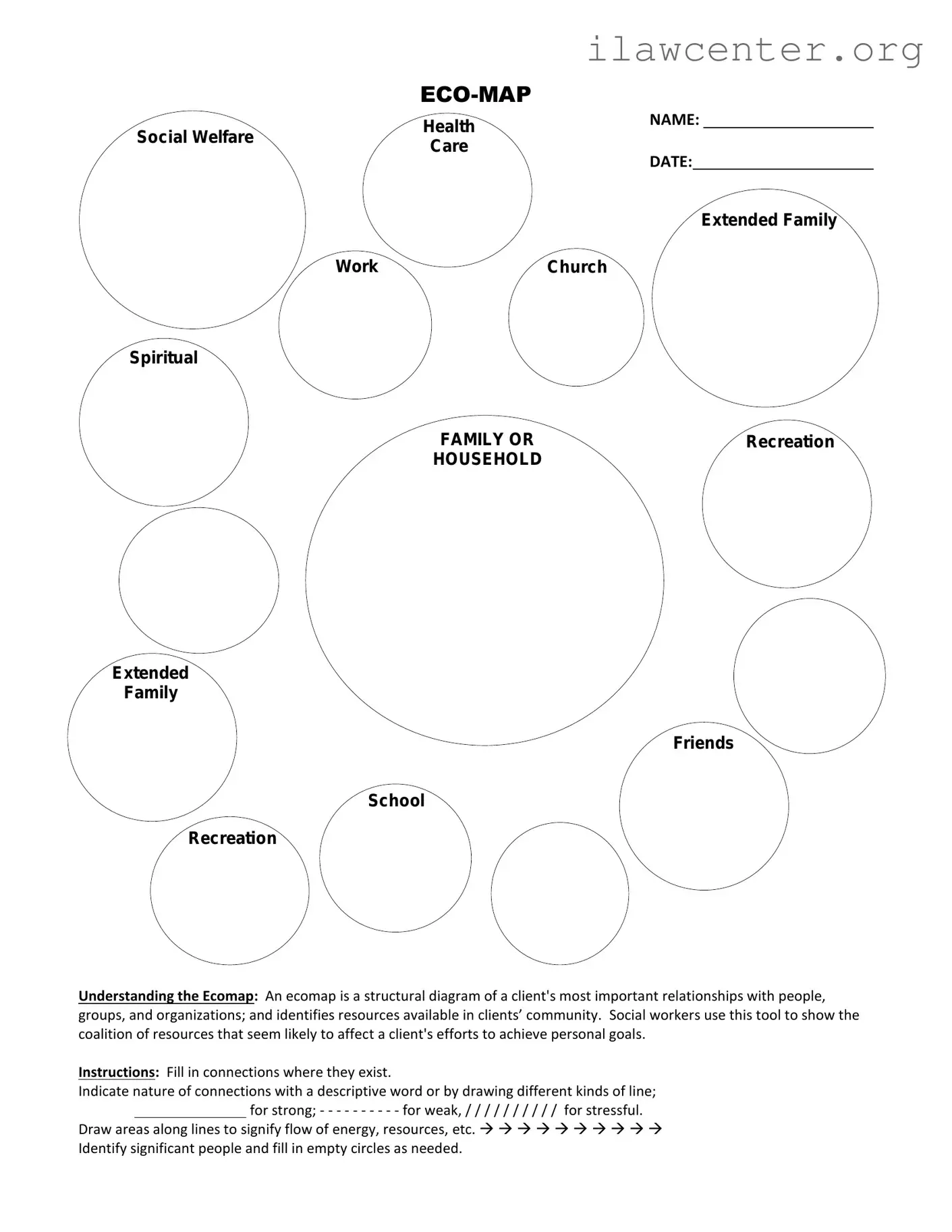
ECO-MAP
NAME:
DATE:
Understanding the Ecomap: An ecomap is a structural diagram of a client's most important relationships with people,
groups, and organizations; and identifies resources available in clients’ community. Social workers use this tool to show the
coalition of resources that seem likely to affect a client's efforts to achieve personal goals.
Instructions: Fill in connections where they exist.
Indicate nature of connections with a descriptive word or by drawing different kinds of line;
for strong; - - - - - - - - - - for weak, / / / / / / / / / / for stressful.
Draw areas along lines to signify flow of energy, resources, etc.
Identify significant people and fill in empty circles as needed.
Health
Care
Social Welfare
Extended Family
Work
Church
Spiritual
Recreation
Extended
Family
Recreation
School
FAMILY OR
HOUSEHOLD
Eco-Map
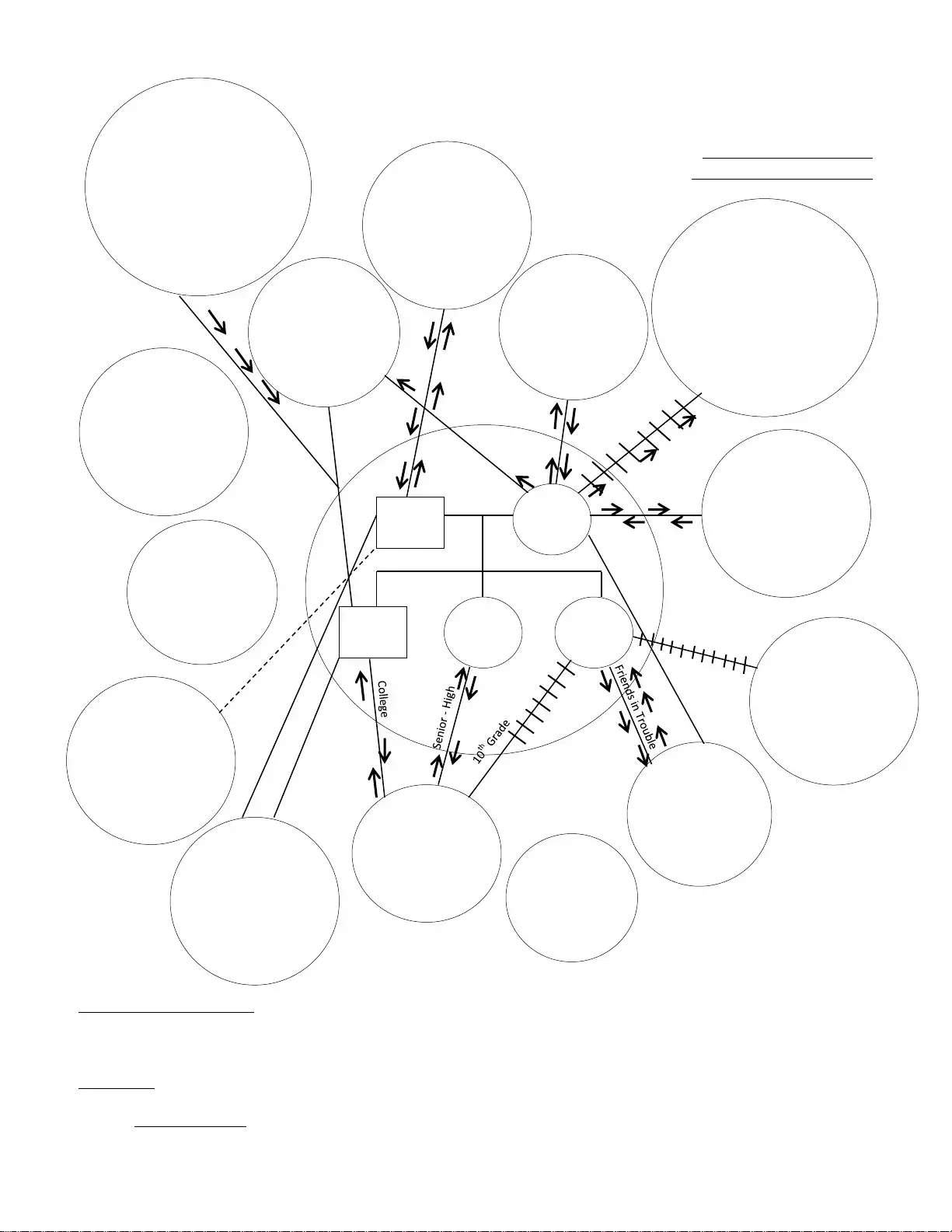
SAMPLE
NAME:
DATE:
Understanding the Ecomap: An ecomap is a structural diagram of a client's most important relationships with people,
groups, and organizations; and identifies resources available in clients’ community. Social workers use this tool to show the
coalition of resources that seem likely to affect a client's efforts to achieve personal goals.
Instructions: Fill in connections where they exist.
Indicate nature of connections with a descriptive word or by drawing different kinds of line;
for strong; - - - - - - - - - - for weak, / / / / / / / / / / for stressful.
Draw areas along lines to signify flow of energy, resources, etc.
Identify significant people and fill in empty circles as needed.
Health
Care
Social Welfare
Extended Family
Work
Church
Spiritual
Recreation
Extended
Family
Recreation
School
Friends
Both part time
City Hospital Clinic
John MS for 10
years
Birth’s mother
demanding I’ll
need financial &
emotional support
Family has been referred
to counseling around
Joan.
Medicare and A Disabled
Court &
Probation Officer
(Mia Thompson)
Beth involved in
gardening &
garden club.
Joan popular with
“rough crowd”
Father’s in
Arkansas very
little contact
John very
involved in
sports.
Father used to be
FAMILY OR
HOUSEHOLD
JOHN
42
BETH
40
JOHN
19
GWEN
17
JOAN
15

File Properties

Fact Name Description
Purpose The Eco Map form is designed to visually represent the connections and relationships within a community or ecosystem.
Usage This form is commonly used by social workers, community planners, and researchers to assess environmental and social factors.
Components The Eco Map typically includes elements such as family members, social supports, and community resources.
Customization Users can tailor the Eco Map to fit specific needs, including adding or removing elements based on the context.
State-Specific Forms Some states have specific guidelines for the Eco Map, governed by local laws related to social services and community planning.
Benefits The Eco Map enhances understanding of relationships and can identify areas needing support or intervention.

Instructions on Utilizing Eco Map

Filling out the Eco Map form is a straightforward process that allows you to organize and visualize your support system. By following these steps, you can effectively complete the form and move on to the next stage of your assessment.

  1. Gather all necessary information about your personal and social connections.
  2. Begin with your name and contact information at the top of the form.
  3. Identify and list your family members, including their relationships to you.
  4. Next, note your friends and close acquaintances, indicating their roles in your life.
  5. Include any professional contacts, such as therapists or doctors, along with their contact details.
  6. Assess community resources you utilize, like local organizations or support groups.
  7. Review the completed sections to ensure accuracy and completeness.
  8. Finally, sign and date the form at the bottom before submitting it.

Important Facts about Eco Map

What is an Eco Map form?

An Eco Map form is a visual tool used to represent the various relationships and connections a person has with their environment. It helps individuals and professionals understand social networks, support systems, and resources available to a person or family. This form is particularly useful in fields like social work, counseling, and education.

Who can benefit from using an Eco Map?

Anyone can benefit from using an Eco Map, but it is especially helpful for individuals or families facing challenges. Social workers, therapists, educators, and healthcare providers often use it to assess a client’s support system. By visualizing connections, they can identify strengths and areas that may need improvement.

How do I fill out an Eco Map form?

To fill out an Eco Map, start by placing the individual or family at the center of the map. Then, draw circles around them to represent different people, organizations, or resources in their life. Use lines to connect these circles, indicating the nature of the relationships—strong, weak, or stressful. Label each connection to clarify the type of support or interaction.

What types of relationships should I include?

Include a variety of relationships, such as family members, friends, coworkers, community organizations, and healthcare providers. Consider both positive and negative relationships. This comprehensive view will provide a clearer picture of the support system and potential challenges the individual faces.

Is there a specific format for the Eco Map?

There is no strict format for an Eco Map. It can be created on paper, a whiteboard, or using digital tools. The key is to ensure that it is clear and easy to understand. You can use different colors or shapes to represent different types of relationships, making it visually appealing and informative.

How can an Eco Map help in therapy or counseling?

An Eco Map can facilitate discussions in therapy or counseling sessions. It helps clients visualize their support systems and identify areas where they may feel isolated or overwhelmed. By understanding these dynamics, therapists can tailor their approach to better meet the client's needs and encourage positive changes.

Can I update my Eco Map over time?

Absolutely! An Eco Map is a dynamic tool. As relationships and circumstances change, it’s important to update the map to reflect the current situation. Regularly revisiting the Eco Map can help individuals recognize growth, shifts in support, and areas that may need attention.

Are there any limitations to using an Eco Map?

While Eco Maps are valuable, they do have limitations. They may not capture all nuances of relationships or the emotional aspects involved. Additionally, some individuals may find it challenging to accurately depict their connections. It’s essential to use the Eco Map as a starting point for deeper conversations rather than a definitive assessment.

Can I use an Eco Map for group settings?

Yes, Eco Maps can be used in group settings as well. For example, a family Eco Map can illustrate the relationships within the family unit, while a community Eco Map can show how various organizations interact with each other. This broader perspective can help identify community resources and collaborative opportunities.

Where can I find a template for an Eco Map?

Templates for Eco Maps can be found online through various educational and professional resources. Many social work and counseling organizations provide downloadable templates. You can also create your own using drawing software or simply on paper, allowing for customization to fit your specific needs.

Common mistakes

Filling out the Eco Map form can be a bit tricky. Many people make common mistakes that can lead to confusion or incomplete information. One frequent error is not including all relevant relationships. It’s important to capture every connection, whether it’s family, friends, or community resources. Missing even one can skew the overall picture.

Another mistake is failing to use clear labels for each relationship. When people use vague terms or abbreviations, it can create misunderstandings later. Clear and specific labels help everyone involved to understand the context of each connection.

Some individuals overlook the importance of indicating the strength of each relationship. The Eco Map is designed to show not just who is connected, but how strong those connections are. Neglecting to do this can make it difficult to assess support systems accurately.

Many also forget to update their Eco Map regularly. Relationships can change over time, and it’s essential to reflect those changes. An outdated map may not accurately represent current support systems or resources.

In addition, people sometimes draw connections inaccurately. Lines should clearly indicate the nature of the relationship, whether it’s supportive, stressful, or somewhere in between. Misrepresenting these connections can lead to misunderstandings about the dynamics at play.

Some individuals skip the section for community resources. These can be vital for support and should not be overlooked. Including local services, organizations, or groups can provide additional layers of support.

Another common mistake is not being honest about the quality of relationships. It’s easy to want to present a positive picture, but being truthful about the strengths and weaknesses of connections can lead to better support and understanding.

People often forget to consider their own needs when filling out the Eco Map. It’s important to identify what support is needed and how existing relationships can fulfill those needs. Ignoring personal needs can lead to a map that doesn’t serve its purpose.

Some individuals may rush through the process, leading to incomplete forms. Taking the time to thoughtfully consider each relationship and connection is crucial. A rushed map can miss important details that are key to understanding one’s support system.

Finally, many forget to review their Eco Map after completion. A final check can catch any mistakes or omissions. This step is essential to ensure that the form accurately represents the individual’s social environment.

Documents used along the form

The Eco Map form is a valuable tool for visualizing the various relationships and resources surrounding an individual or family. However, it is often used alongside other important documents that provide a more comprehensive understanding of a person's situation. Below is a list of five forms and documents that are commonly utilized in conjunction with the Eco Map form.

  • Genogram: This diagram represents family relationships and medical histories. It helps identify patterns and dynamics within family structures, providing context that complements the Eco Map.
  • Assessment Form: This document gathers detailed information about an individual's needs, strengths, and challenges. It serves as a foundational tool for understanding the person’s circumstances and guides further action.
  • Service Plan: This plan outlines specific goals and the services required to meet those goals. It is often developed based on insights gained from the Eco Map and other assessments.
  • Referral Form: This document is used to connect individuals with additional resources or services. It ensures that clients receive the support they need based on the relationships identified in the Eco Map.
  • Progress Notes: These notes track the ongoing development and changes in an individual’s situation. They provide updates on the effectiveness of interventions and can highlight shifts in relationships or resources.

Using these documents in tandem with the Eco Map form enhances understanding and support for individuals and families. Together, they create a more holistic view of a person's environment and needs, enabling better-informed decisions and interventions.

Similar forms

The Eco Map form is a useful tool for visualizing relationships and resources in a person's life. Here are seven documents that share similarities with the Eco Map form:

  • Genogram: Like the Eco Map, a genogram provides a visual representation of family relationships. It highlights connections and patterns within a family tree, helping to understand dynamics and history.
  • SWOT Analysis: This document outlines strengths, weaknesses, opportunities, and threats. Similar to the Eco Map, it helps individuals assess their environment and relationships, focusing on both internal and external factors.
  • Life Map: A life map visually depicts significant events and relationships throughout a person's life. It shares the Eco Map's goal of illustrating connections and influences that shape an individual's experiences.
  • Social Network Diagram: This diagram illustrates a person's social connections, much like the Eco Map. It emphasizes the importance of social support and resources available to an individual.
  • Resource Map: A resource map identifies available resources in a community or environment. It parallels the Eco Map by showcasing how various resources can support an individual’s needs and goals.
  • Mind Map: A mind map organizes thoughts and ideas visually. While it may differ in purpose, it shares the Eco Map's visual approach to exploring relationships and connections between concepts.
  • Personal Development Plan: This document outlines goals and strategies for personal growth. Like the Eco Map, it emphasizes the importance of relationships and support systems in achieving those goals.

Each of these documents offers a unique perspective on relationships and resources, making them valuable tools for personal and professional development.

Dos and Don'ts

When filling out the Eco Map form, it's essential to approach the task thoughtfully. Here are seven guidelines to follow, ensuring a smooth and efficient process.

  • Do read the instructions carefully before starting. Understanding the requirements will save time and reduce errors.
  • Do provide accurate information. Double-check details to ensure they reflect your current situation.
  • Do use clear and concise language. This helps others understand your responses without confusion.
  • Do keep your information organized. Use headings and bullet points if applicable to enhance clarity.
  • Don't leave any mandatory fields blank. Omitting required information can delay processing.
  • Don't use jargon or overly technical terms. Simplicity aids comprehension for everyone involved.
  • Don't rush through the form. Take your time to ensure that all details are correctly filled out.

By adhering to these guidelines, you can effectively complete the Eco Map form, making the process more efficient for yourself and others.

Misconceptions

The Eco Map form is a valuable tool used for visualizing and assessing the relationships and resources available to individuals or families. However, several misconceptions often arise regarding its purpose and application. Here is a list of common misunderstandings:

  1. The Eco Map is only for social workers. Many believe that only social workers can use the Eco Map. In reality, anyone involved in community support, including educators and healthcare professionals, can benefit from this tool.
  2. It is a one-time assessment. Some think the Eco Map is a static document created once and never revisited. In truth, it should be updated regularly to reflect changes in relationships and resources.
  3. The Eco Map only focuses on negative relationships. A common misconception is that the Eco Map emphasizes only negative or problematic relationships. However, it also highlights positive connections and support systems.
  4. Completing the Eco Map is a lengthy process. Many assume that filling out the Eco Map takes a significant amount of time. While it requires thoughtfulness, it can often be completed in a relatively short period.
  5. The Eco Map is purely a personal tool. Some individuals view the Eco Map as a personal exercise that does not involve others. In fact, collaboration with family members or support networks can enhance its effectiveness.
  6. It is only useful for individuals in crisis. There is a belief that the Eco Map is only relevant for those facing crises. However, it can be beneficial for anyone looking to understand their support systems and improve their overall well-being.
  7. The Eco Map cannot be used in different contexts. Some think the Eco Map is limited to specific environments, like social services. It is versatile and can be adapted for various contexts, including education and healthcare.
  8. Creating an Eco Map requires specialized training. Many believe that only trained professionals can create an Eco Map. In reality, anyone can learn to use this tool with a basic understanding of its components.
  9. The Eco Map is only a visual representation. While it is true that the Eco Map is a visual tool, it also serves as a discussion starter, encouraging deeper conversations about relationships and resources.

Addressing these misconceptions can help individuals and professionals better utilize the Eco Map form, enhancing its effectiveness in fostering understanding and support within communities.

Key takeaways

When filling out and using the Eco Map form, keep the following key takeaways in mind:

  • Understand the Purpose: The Eco Map is designed to visualize relationships and resources in a person's life. It helps identify support systems and areas needing improvement.
  • Identify Key Relationships: List important people and organizations that play a role in your life. This can include family, friends, coworkers, and community services.
  • Use Symbols Effectively: Different symbols can represent the nature of each relationship. For example, solid lines may indicate strong connections, while dashed lines can signify weaker ties.
  • Assess Your Support System: Evaluate the quality and quantity of your connections. Are there gaps? Are there individuals or resources that you could reach out to for support?
  • Keep It Updated: Relationships and resources change over time. Regularly revisiting and updating your Eco Map can provide ongoing insights into your support network.
  • Utilize It for Planning: Use the Eco Map as a tool for personal development. It can help you strategize on how to strengthen connections or seek new resources.