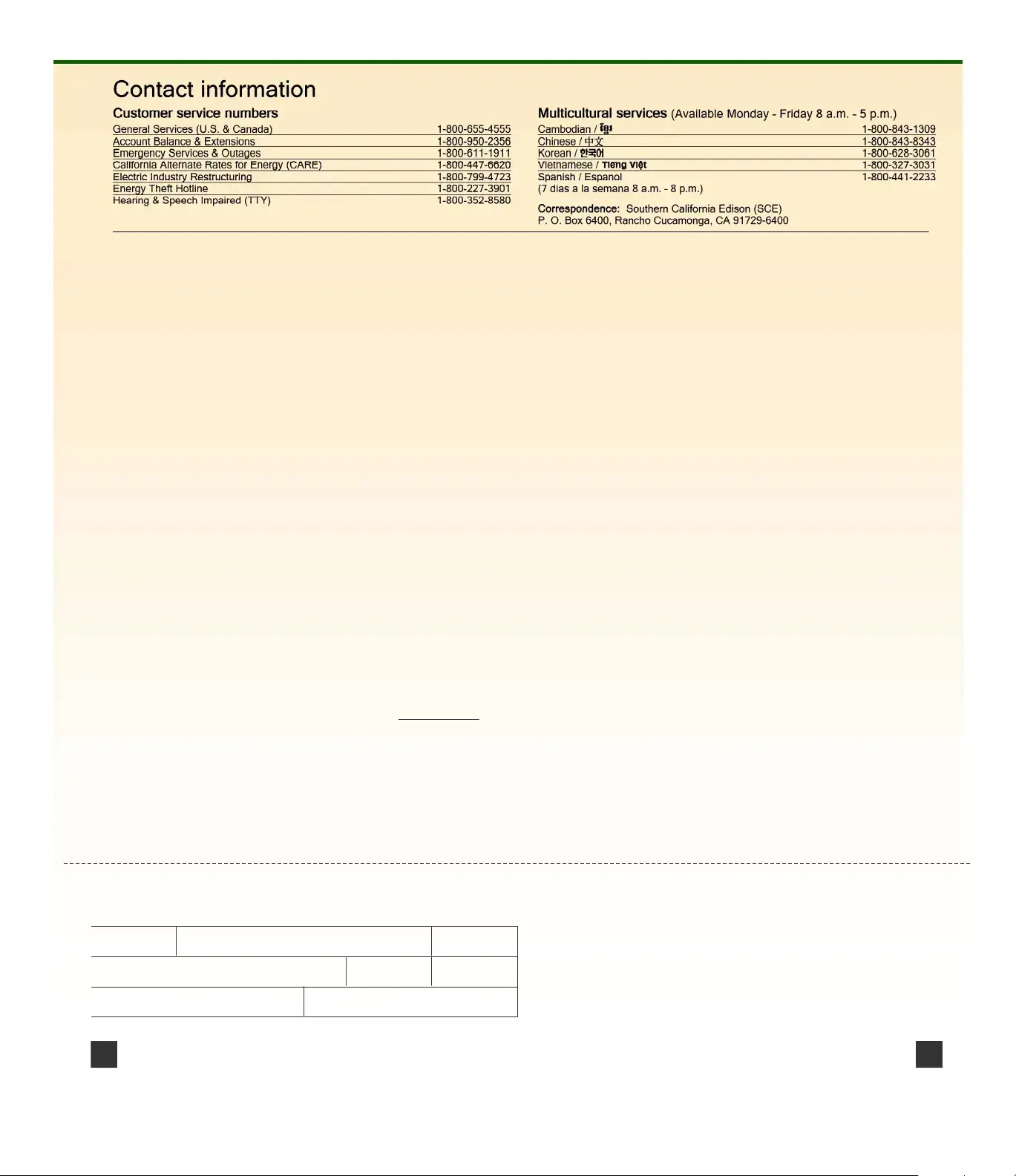
Edison Electricity Bill PDF Template

Edison Electricity Bill PDF Template

The Edison Electricity Bill form is a document that outlines your electricity usage and charges from Southern California Edison (SCE). It provides important details such as your account summary, payment options, and information regarding rotating outages. Understanding this form is essential for managing your electricity expenses effectively.

To begin the process of filling out your Edison Electricity Bill form, please click the button below.

Article Guide

The Edison Electricity Bill form provides essential information regarding a customer's electricity usage and payment obligations. This document includes details such as the customer account number, service account number, and the date the bill was prepared. It highlights the balance from the previous bill, any payments received, and the total amount due by a specified date. Users can find a summary of their electricity consumption, including total kilowatt-hours (kWh) used during the billing period, peak demand, and average daily usage. The bill also outlines the various charges incurred, including delivery charges, energy costs, and additional fees. Important notices about rotating outages and payment options are included, ensuring customers are informed about potential service interruptions and how to pay their bills. Additionally, the form provides guidance on disputing charges and details regarding late payment fees, making it a comprehensive resource for managing electricity accounts.

Edison Electricity Bill Preview

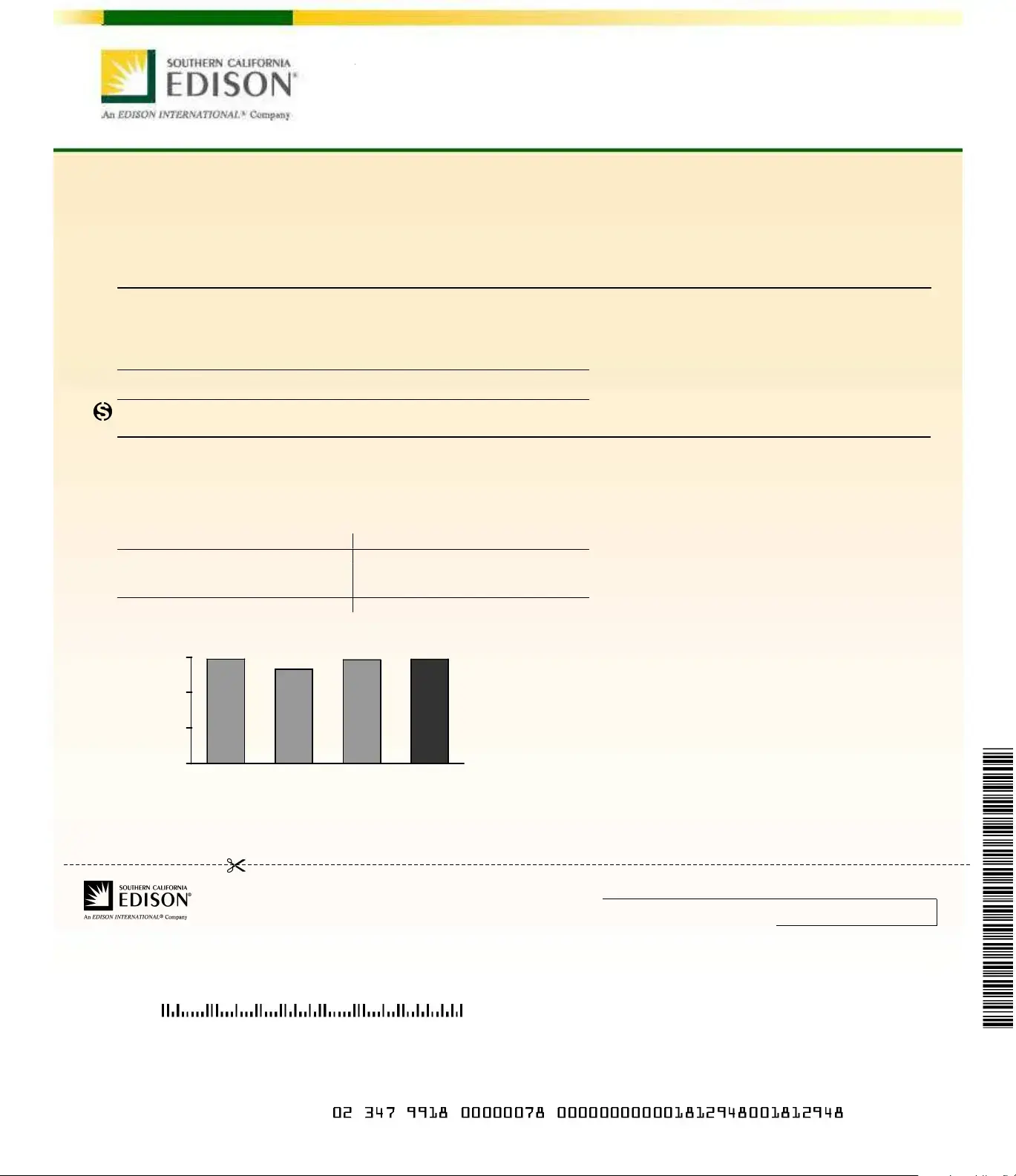
P.O. Box 300
Rosemead, CA
91772-0001
Customer account 2-00-000-0000
Amount enclosed $
TOU-8 DA NON-CON
ATTN: ACCOUNTS PAYABLE
54321 ANYWHERE ST
CLAREMONT, CA 91711-4617
P.O. BOX 300
ROSEMEAD, CA 91772-0001
call 1-800-799-4723, 24 hrs a day, 7 days a week
2-00-000-0000
3-000-0000-00
Date bill prepared: May 2 '08 54321 ANYWHERE ST
CLARMONT, CA 91711
Group N001
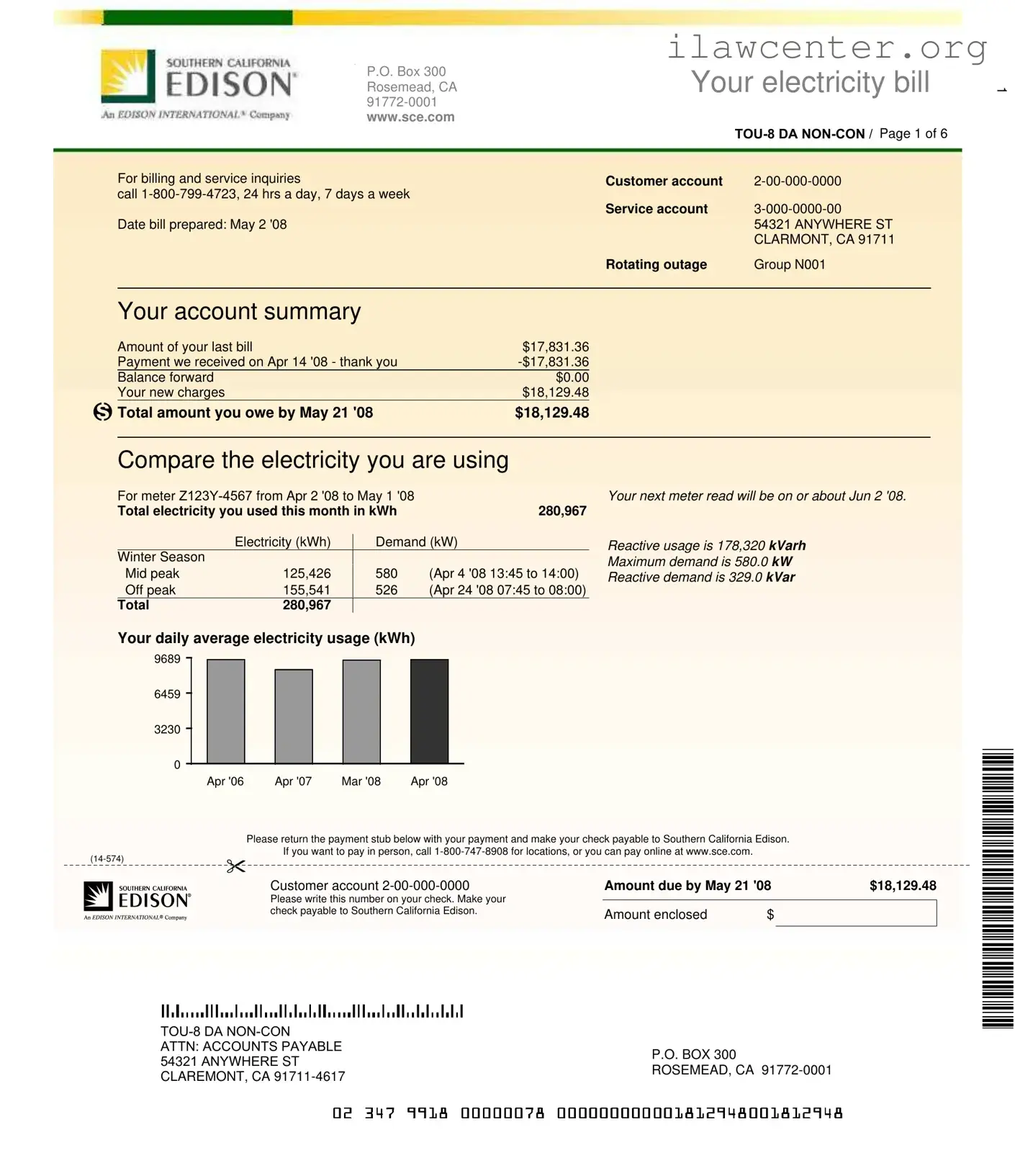
Amount of your last bill $17,831.36
Payment we received on Apr 14 '08 - thank you -$17,831.36
$0.00
Your new charges $18,129.48
For meter Z123Y-4567 from Apr 2 '08 to May 1 '08
Winter Season
Mid peak 125,426
Off peak 155,541
580 (Apr 4 '08 13:45 to 14:00)
526 (Apr 24 '08 07:45 to 08:00)
Page 1 of 6
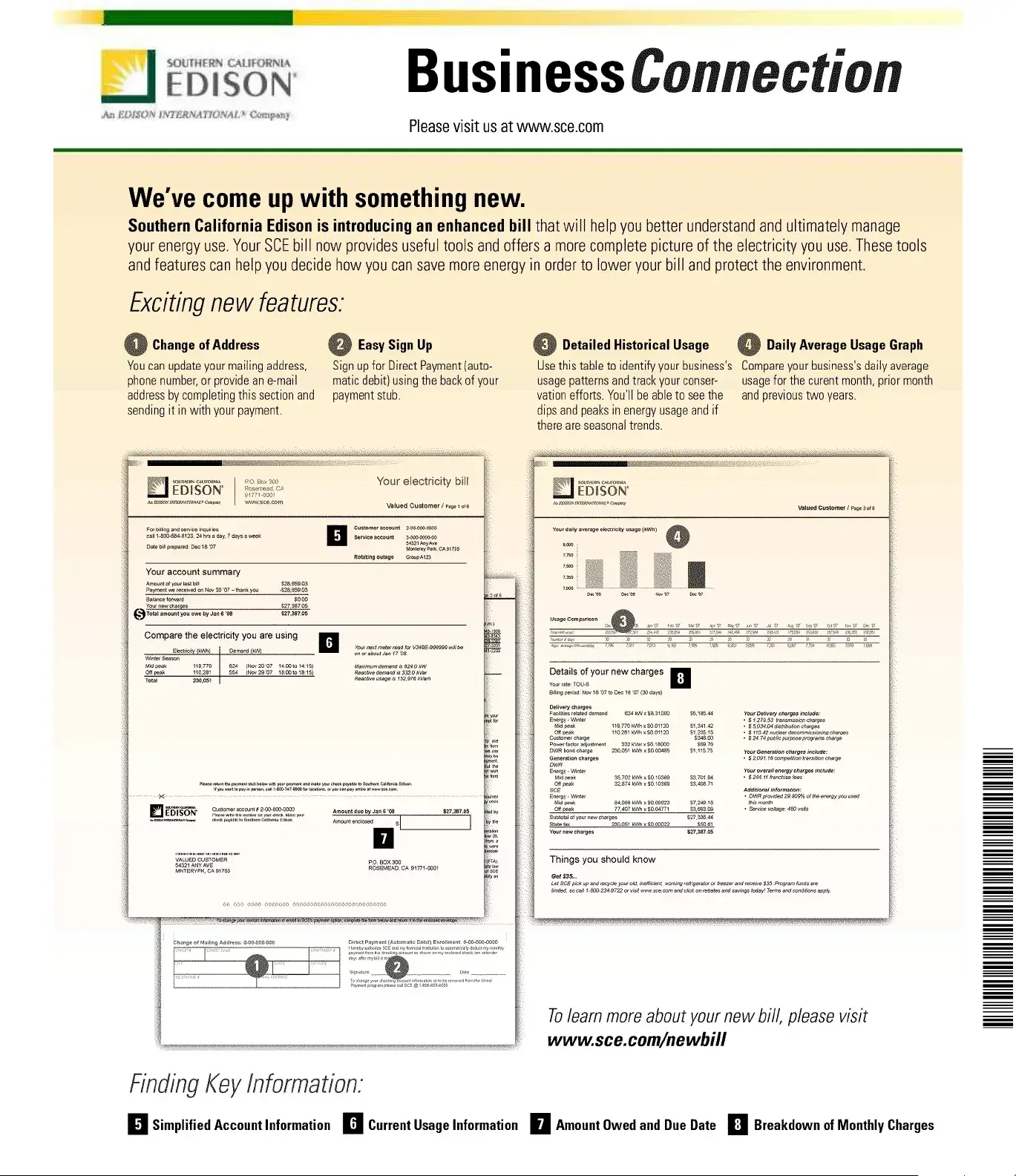
1
Your electricity bill
Please write this number on your check. Make your
check payable to Southern California Edison.
(14-574)
0
3230
6459
9689
Apr '06 Apr '07 Mar '08 Apr '08
www.sce.com
TOU-8 DA NON-CON /
Amount due by May 21 '08 $18,129.48
Customer account
Service account
280,967
Total 280,967
Please return the payment stub below with your payment and make your check payable to Southern California Edison.
If you want to pay in person, call 1-800-747-8908 for locations, or you can pay online at www.sce.com.
Total amount you owe by May 21 '08 $18,129.48
Your next meter read will be on or about Jun 2 '08.
Reactive usage is 178,320
Maximum demand is 580.0
Reactive demand is 329.0
kVarh
kW
kVar
For billing and service inquiries
Rotating outage
Your account summary
Balance forward
Compare the electricity you are using
Total electricity you used this month in kWh
Electricity (kWh) Demand (kW)
Your daily average electricity usage (kWh)
·
·
·
·
Important information
Change of Mailing Address: 2-00-000-0000
Page 2 of 6
Direct Payment (Automatic Debit) Enrollment: 2-00-000-0000
A rotating outage is a controlled electric outage that lasts approximately one hour for
a group of circuits, which is used during electric system emergency conditions to
avoid widespread or uncontrolled blackouts. Each SCE customer is assigned a
rotating outage group, shown on the upper part of the SCE bill. If your rotating outage
group begins with the letters A, M, R, S, or X, you are subject to rotating outages. If it
begins with N or Exempt, you are not. Your rotating outage group may change at any
time. For more information, and to see which rotating outage groups are likely to be
called in the event of a system emergency, visit www.sce.com or call (800) 655-4555.
You can pay your bill by:
Mail
In person at an authorized payment location
By telephone
Online at www.sce.com
You may call us for electronic payment options, to make payment arrangements, or
for information on agencies to assist you in bill payment.
Your bill was prepared on May 2, 2008. Your bill is due when you receive it and
becomes past due 19 days after the date the bill was prepared. You will have 15 days
at your new address to pay a bill from a prior address before your service will be
terminated. SCE does not terminate residential service for non-payment of bills for
other classes of service. Termination of electric service requires a reconnection
charge. A field assignment charge may appear on your next bill if SCE visits your
premises because of non- payment. If you are a residential customer, and claim an
inability to pay and payment arrangements have not been extended to you by SCE
pursuant to SCE's filed tariffs, you may contact the California Public Utilities
Commission (CPUC).
If you think your bill is incorrect, call us and speak with a customer service
representative, or if necessary, with a manager. If you feel unsatisfied with the result
of such discussion(s), contact the CPUC, Consumer Affairs Branch by mail at: 505
Van Ness, Room 2003, San Francisco, CA 94102; or at: , (800)
649-7570, TTY: (800) 924-9599. Include a copy of your bill, why you believe SCE did
not follow its rules and rates, and a check or money order made out to the CPUC for
the disputed amount. You must pay the disputed amount, or send it to the CPUC,
before the past-due date to avoid disconnection. The CPUC accepts payment only for
matters relating directly to bill accuracy. While the CPUC is investigating your
complaint, you must pay any new SCE bills that become due.
SCE's rules and rates are available in full at www.sce.com or upon request.
A late payment charge of .9% will be applied to the total unpaid balance on your
account if full payment is not received by the due date on this bill (except for CARE
rate and state agency accounts).
When you provide a check as payment, you authorize us either to use information
from your check to make a one-time electronic fund transfer from your account or to
process the payment as a check transaction. When we use information from your
check to make an electronic fund transfer, funds may be withdrawn from your account
as soon as the same day we receive your payment. You will not receive your check
back from your financial institution, but the transaction will appear on your financial
institution statement. If you do not wish to authorize an electronic fund transfer,
please call the 800 number on the front of your bill.
I hereby authorize SCE and my financial institution to automatically deduct my
monthly payment from the checking account as shown on my enclosed check, ten
calendar days after my bill is mailed.
To change your checking account information or to be removed from the Direct
Payment program please call SCE @ 1-800-655-4555.
Signature _____________________________ Date _______________
STREET # STREET NAME APARTMENT #
CITY STATE ZIP CODE
TELEPHONE # E-MAIL ADDRES
TOU-8 DA NON-CON /
To change your contact information or enroll in SCE's payment option, complete the form below and return it in the enclosed envelope.
Rotating Outages
Options for Paying Your Bill
Past-Due Bills
Disputed Bills
Rules and Rates
Late Payment Charge (LPC)
Electronic Fund Transfers (EFT)
www.cpuc.ca.gov
Details of your new charges
21,625 x $0.00903
103,801 x $0.01009
26,817 x $0.00903
128,724 x $0.01009
329 x $0.18000
Your rate: TOU-8 (Direct Access)
Billing period: Apr 2 '08 to May 1 '08 (29 days)
Facilities rel demand 580 kW x $9.90000 x 5/29 days $990.00
Facilities rel demand 580 kW x $10.77000 x 24/29 days $5,169.60
Energy-Winter
Mid peak kWh $195.27
Mid peak kWh $1,047.35
Off peak kWh $242.16
Off peak kWh $1,298.83
Customer charge $71.55
Customer charge $379.07
Power factor adj kVar $59.22
DA CRS DWR bond 280,967 kWh x $0.00477 $1,340.21
PCIA 232,524 kWh x $0.00107 $248.80
PCIA 48,443 kWh x -$0.00391 -$189.41
DA CRS UC 48,443 kWh x $0.02001 $969.34
DA CRS UC 232,524 kWh x $0.01780 $4,138.93
CTC 48,443 kWh x $0.00613 $296.96
CTC 232,524 kWh x $0.00336 $781.28
Revenue cycle services credit -$15.46
Generation Municipal Surcharge $160.64
$17,184.34
Claremont UUT $17,184.34 x 5.50000 % $945.1
N Page 3 of 6
3
Apr '06 Apr '07 May '07 Jun '07 Jul '07 Aug '07 Sep '07 Oct '07 Nov '07 Dec '07 Jan '08 Feb '08 Mar '08 Apr '08
Total kWh used
Appx. average kWh
used/day
280,051 253,570 296,684 301,623 291,224 299,149 319,281 326,623 307,974 291,764 284,592 310,392 287,883 280,967
29 29 30 29 32 29 30 32 31 33 29 32 30 29
9,656 8,743 9,889 10,400 9,100 10,315 10,642 10,206 9,934 8,841 9,813 9,699 9,596 9,688
·
·
·
·
·
·
·
·
TOU-8 DA NON-CON/
$18,129.48
Additional information:
$1,209.91 transmission charges
$6,404.84 distribution charges
$165.29 nuclear decommissioning
charges
$1,605.58 public purpose programs
charge
$152.02 franchise fees
Percentage of energy provided by
DWR used to calculate GMS factor
this month: 26.513%
Service voltage: 480 volts
Generation Municipal Surcharge
(GMS) factor: 0.008930
Usage comparison
Number of days
Delivery charges
Direct Access cost responsibility surcharge
Other charges or credits
Subtotal of SCE charges
Your new charges
Your Delivery charges include:
Your overall energy charges include:
Page 4 of 6
Page 5 of 6
3
May 2008
Page 6 of 6

File Properties

Fact Name Details
Billing Address P.O. Box 300, Rosemead, CA 91772-0001
Customer Support For billing inquiries, call 1-800-799-4723, available 24/7.
Payment Due Date Total amount due by May 21, 2008.
Rotating Outages Group N001 indicates your assigned rotating outage group.
Payment Options Payments can be made by mail, in person, by phone, or online.
Late Payment Charge A late fee of 0.9% applies if payment is not received by the due date.
Disputed Bills Contact the CPUC if you believe your bill is incorrect.
Electronic Fund Transfers Payments may be processed as electronic transfers unless opted out.
Governing Law California Public Utilities Code governs utility services and billing.

Instructions on Utilizing Edison Electricity Bill

Completing the Edison Electricity Bill form is straightforward. Follow these steps to ensure all necessary information is accurately filled out. This will help in processing your payment or any changes you wish to make regarding your account.

  1. Locate the form and ensure you have the correct version for your billing period.
  2. Fill in your customer account number found on the top of the bill.
  3. Write the amount due in the designated area.
  4. Indicate the amount enclosed if you are sending a payment.
  5. Make your check payable to Southern California Edison.
  6. Fill in your name and address in the designated fields if there is a change of address.
  7. Provide your telephone number and email address if applicable.
  8. Sign and date the form where indicated.
  9. Detach the payment stub from the bottom of the bill.
  10. Return the payment stub along with your payment in the enclosed envelope.

Important Facts about Edison Electricity Bill

What is the Edison Electricity Bill form?

The Edison Electricity Bill form is a document that provides detailed information about your electricity usage and charges for a specific billing period. It includes your account summary, previous balance, new charges, and payment due date. The form is essential for understanding how much electricity you have used and what you owe to Southern California Edison (SCE).

How can I pay my electricity bill?

You have several options for paying your Edison Electricity bill. You can pay by mail using the payment stub included with your bill. Alternatively, you can pay in person at an authorized payment location, by telephone, or online at www.sce.com. If you need assistance with payment options or arrangements, you can call SCE's customer service for help.

What should I do if I believe my bill is incorrect?

If you think your bill is incorrect, it’s important to act quickly. First, call SCE to discuss your concerns with a customer service representative. If you are not satisfied with the outcome, you can escalate the issue to the California Public Utilities Commission (CPUC). Make sure to include a copy of your bill and an explanation of why you believe there is an error when you contact the CPUC.

What happens if my bill is past due?

Your bill becomes past due 19 days after the date it was prepared. If you do not pay your bill on time, you may incur a late payment charge. SCE may also take steps to terminate your service if you do not pay. However, residential customers have certain protections, and you may be able to set up payment arrangements if you are unable to pay.

What are rotating outages, and how do they affect me?

Rotating outages are controlled power outages that last about one hour and are implemented during electric system emergencies. Each SCE customer is assigned to a rotating outage group. If your group starts with the letters A, M, R, S, or X, you may be subject to these outages. If it starts with N or is marked as exempt, you are not affected. For more information, you can visit SCE's website or call their customer service.

Common mistakes

Filling out the Edison Electricity Bill form can be straightforward, but some common mistakes can lead to confusion or delays. One frequent error is not double-checking the customer account number. This number is crucial for processing your payment. If it is incorrect, your payment may not be applied to your account, causing unnecessary complications.

Another common mistake is overlooking the due date. The bill clearly states when payment is due. Failing to pay on time can result in late fees or even service disconnection. It's essential to mark the due date on your calendar to avoid this issue.

Many people also forget to include the payment stub when mailing their payment. This stub helps ensure that your payment is processed correctly. Without it, there could be delays in applying your payment to your account.

Inaccurate payment amounts are another mistake to watch out for. Some individuals may miscalculate the total amount due. It is important to review the charges carefully and ensure that the amount you write on your check matches the total indicated on the bill.

Providing an incorrect address is also a common error. If you have moved recently, ensure that your new address is written clearly on the form. This will help avoid any issues with service or future bills.

Additionally, not signing the payment authorization can lead to problems. If you are enrolling in the Direct Payment program, your signature is required. Without it, your request cannot be processed.

Lastly, failing to keep a copy of your bill for your records can create issues later. It is wise to retain a copy of your bill and any correspondence related to it. This documentation can be helpful if you need to dispute a charge or verify payment.

Documents used along the form

When managing your electricity account with Southern California Edison, several forms and documents may be necessary in addition to the Edison Electricity Bill form. Each of these documents serves a specific purpose and can help you navigate billing, payments, and service inquiries more effectively.

  • Payment Stub: This is a portion of your bill that you return with your payment. It includes your account information and the amount due, ensuring that your payment is processed correctly.
  • Change of Mailing Address Form: Use this form to update your address with Southern California Edison. This ensures that future bills and communications are sent to the correct location.
  • Direct Payment Enrollment Form: This form allows you to authorize automatic deductions from your bank account for your monthly bill. It simplifies the payment process by ensuring timely payments without manual intervention.
  • Dispute Resolution Form: If you believe your bill is incorrect, this form can be used to formally dispute charges. It helps document your concerns and initiate a review by customer service or regulatory bodies.
  • Payment Arrangement Request Form: If you are unable to pay your bill on time, this form allows you to request a payment plan. It’s essential for managing financial difficulties while maintaining your service.
  • Customer Service Inquiry Form: Use this form to ask questions or raise issues regarding your service. It helps facilitate communication with customer service representatives for prompt assistance.

Understanding these documents can enhance your experience with Southern California Edison and help you manage your electricity account more effectively. Ensure that you have the necessary forms on hand to address any billing or service-related issues promptly.

Similar forms

  • Water Bill: Like the Edison Electricity Bill, a water bill provides a summary of water usage, charges incurred, and payment due dates. It typically includes details about previous payments and any outstanding balance, ensuring customers can easily track their water consumption and billing history.
  • Gas Bill: Similar to the electricity bill, a gas bill outlines the amount of gas used during a specific period, the associated costs, and the total amount due. It often includes a comparison of usage over previous months, helping customers understand their consumption patterns.
  • Credit Card Statement: A credit card statement provides a summary of transactions over a billing cycle, including payments received and outstanding balances. Like the electricity bill, it features important dates and payment options, allowing users to manage their finances effectively.
  • Insurance Premium Invoice: This document details the amount due for insurance coverage, similar to how an electricity bill outlines charges for energy use. It includes payment deadlines and options, ensuring policyholders are aware of their financial obligations.
  • Mortgage Statement: A mortgage statement summarizes the principal and interest due on a home loan, akin to how an electricity bill presents energy charges. It also provides information on previous payments and any remaining balance, helping homeowners stay informed about their financial commitments.
  • Cell Phone Bill: This document outlines the usage of cellular services, including call minutes, data, and text messages, along with the associated costs. Like the electricity bill, it shows previous payments and the total amount due, facilitating easy management of monthly expenses.
  • Property Tax Bill: A property tax bill informs homeowners about the taxes owed on their property, similar to how an electricity bill details energy charges. It includes payment deadlines and any applicable penalties for late payments, ensuring property owners remain compliant with tax obligations.

Dos and Don'ts

When filling out the Edison Electricity Bill form, it is important to follow certain guidelines to ensure accuracy and efficiency. Below are some helpful tips on what to do and what to avoid.

  • Do: Double-check your account number before submitting.
  • Do: Include your payment stub with your payment.
  • Do: Pay your bill by the due date to avoid late fees.
  • Do: Contact customer service if you have questions or concerns.
  • Don't: Leave any sections of the form blank.
  • Don't: Forget to sign your check if paying by mail.
  • Don't: Ignore the due date on your bill.
  • Don't: Use a check that does not have sufficient funds.

Misconceptions

  • Misconception 1: The bill only shows the current month's charges.
  • This is incorrect. The bill provides a summary of the last bill, payments received, and the balance forward. It also includes a detailed breakdown of charges for the billing period.

  • Misconception 2: Rotating outages affect all customers.
  • Not all customers are affected. Only those in specific rotating outage groups, indicated on the bill, will experience outages during emergencies.

  • Misconception 3: You can pay your bill only by mail.
  • This is false. Customers can pay their bills through various methods, including online, by phone, or in person at authorized locations.

  • Misconception 4: If you dispute a bill, you can stop payment without consequences.
  • Disputing a bill does not exempt you from paying the amount due. You must pay the disputed amount to avoid disconnection.

  • Misconception 5: Late payment charges apply only to residential customers.
  • All customers may incur late payment charges if they do not pay their bills by the due date, except for specific programs like CARE rate accounts.

  • Misconception 6: The bill is due immediately upon receipt.
  • The bill is due 19 days after the preparation date. Customers have time to pay without penalties during this period.

  • Misconception 7: You will receive a paper check back if you pay by check.
  • When paying by check, customers authorize an electronic transfer. They will not receive the physical check back, but the transaction will appear on their bank statement.

  • Misconception 8: The bill does not provide historical usage data.
  • The bill includes a comparison of electricity usage over previous months and years, helping customers understand their consumption trends.

  • Misconception 9: The charges are fixed and do not change.
  • Charges can vary based on usage, time of day, and other factors. The bill details the breakdown of these variable charges.

  • Misconception 10: All customers are subject to the same rates.
  • Rates can differ based on the customer's service plan. The bill clearly states the rate plan applicable to each customer.

Key takeaways

When filling out and using the Edison Electricity Bill form, consider the following key takeaways:

  • Understand Your Account Information: Your customer account number and service account number are crucial for any inquiries or payments.
  • Know Your Due Date: Payments are due by the specified date on the bill to avoid late fees and service interruptions.
  • Review Your Usage: Compare your current electricity usage with past months to identify any significant changes or trends.
  • Payment Options: You can pay your bill via mail, in person, by phone, or online. Choose the method that works best for you.
  • Dispute Process: If you believe your bill is incorrect, contact customer service. If unresolved, escalate the issue to the California Public Utilities Commission (CPUC).
  • Rotating Outages: Be aware of your rotating outage group, as it determines your susceptibility to controlled outages during emergencies.
  • Late Payment Charges: A late fee will apply if payment is not received by the due date, so ensure timely payment to avoid additional costs.
  • Electronic Fund Transfers: If you pay by check, you may be authorizing an electronic fund transfer. Understand this process to manage your finances effectively.