
Emotional Support Animal Letter PDF Template

Emotional Support Animal Letter PDF Template

The Emotional Support Animal Letter is a document written by a licensed mental health professional that certifies an individual's need for an emotional support animal. This letter serves to provide legal protection and access rights for individuals who benefit from the companionship of their animal. If you believe you could benefit from this support, consider filling out the form by clicking the button below.

Article Guide

In recent years, the concept of emotional support animals (ESAs) has gained significant attention, especially as people increasingly recognize the importance of mental health and emotional well-being. An Emotional Support Animal Letter serves as a crucial document that legitimizes the bond between an individual and their animal companion, allowing for certain legal protections and accommodations. This letter is typically written by a licensed mental health professional and outlines the individual’s need for an ESA due to a diagnosed emotional or psychological condition. It often includes essential details such as the professional's credentials, the specific condition being treated, and the recommendation for the animal’s presence. Furthermore, this letter can play a vital role in housing situations, where it may exempt the individual from pet restrictions, and in travel scenarios, where it can facilitate the process of bringing the ESA on flights. Understanding the key elements of the Emotional Support Animal Letter is essential for those seeking to navigate the complexities of emotional support and the rights associated with having an ESA.

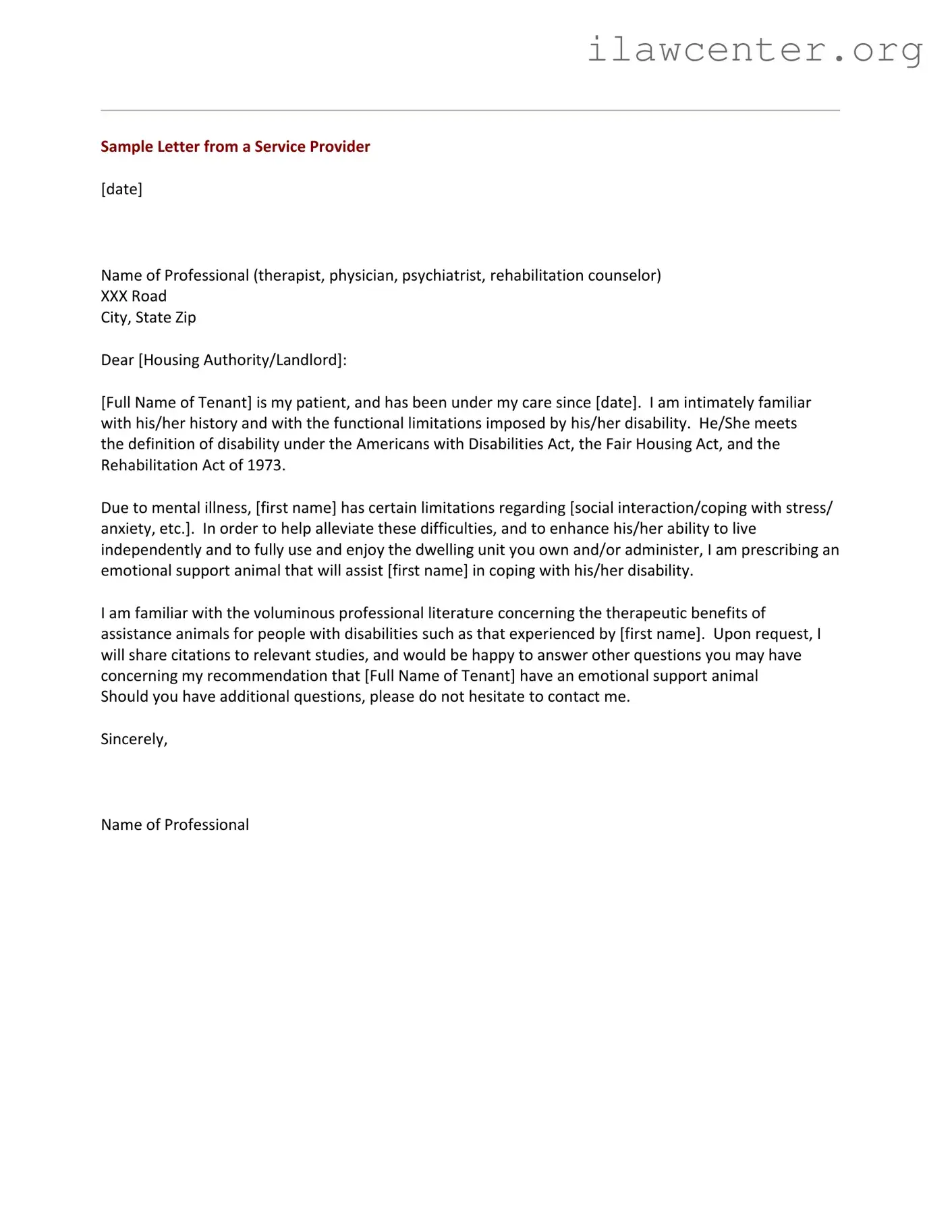
Emotional Support Animal Letter Preview

Sample Letter from a Service Provider
[date]
Name of Professional (therapist, physician, psychiatrist, rehabilitation counselor)
XXX Road
City, State Zip
Dear [Housing Authority/Landlord]:
[Full Name of Tenant] is my patient, and has been under my care since [date]. I am intimately familiar
with his/her history and with the functional limitations imposed by his/her disability. He/She meets
the definition of disability under the Americans with Disabilities Act, the Fair Housing Act, and the
Rehabilitation Act of 1973.
Due to mental illness, [first name] has certain limitations regarding [social interaction/coping with stress/
anxiety, etc.]. In order to help alleviate these difficulties, and to enhance his/her ability to live
independently and to fully use and enjoy the dwelling unit you own and/or administer, I am prescribing an
emotional support animal that will assist [first name] in coping with his/her disability.
I am familiar with the voluminous professional literature concerning the therapeutic benefits of
assistance animals for people with disabilities such as that experienced by [first name]. Upon request, I
will share citations to relevant studies, and would be happy to answer other questions you may have
concerning my recommendation that [Full Name of Tenant] have an emotional support animal
Should you have additional questions, please do not hesitate to contact me.
Sincerely,
Name of Professional

File Properties

Fact Name Description
Definition An Emotional Support Animal (ESA) letter is a document from a licensed mental health professional that states an individual requires an ESA for their mental health.
Legal Protection Under the Fair Housing Act, individuals with ESAs are allowed to live with their animals in housing that typically prohibits pets.
State-Specific Laws Some states have specific laws regarding ESAs. For instance, California has the Unruh Civil Rights Act, which protects ESA rights.
Professional Requirements The letter must be written by a licensed mental health professional, such as a psychologist or psychiatrist, to be valid.
Validity Period ESA letters typically remain valid for one year but may vary based on the issuing professional’s discretion.
Housing vs. Travel ESA letters provide housing rights but do not guarantee access to airplanes, as airlines have different regulations regarding emotional support animals.
Documentation Individuals should keep a copy of their ESA letter and any related documentation for housing or travel purposes.
Misuse Consequences Using an ESA letter fraudulently can lead to legal repercussions, including fines and loss of housing rights.

Instructions on Utilizing Emotional Support Animal Letter

Completing the Emotional Support Animal Letter form is an important step for individuals seeking to obtain the necessary documentation for their emotional support animal. This process requires careful attention to detail and accurate information to ensure that all requirements are met. Follow the steps outlined below to fill out the form correctly.

  1. Begin by gathering all necessary personal information, including your full name, address, and contact details.
  2. Next, provide information about your emotional support animal, including its name, breed, and age.
  3. Indicate the specific emotional or psychological condition that necessitates the support of your animal. Be clear and concise.
  4. Include any relevant medical history or documentation that supports your need for an emotional support animal.
  5. Ensure you have the signature of a licensed mental health professional who can attest to your condition and the need for the animal.
  6. Review the form thoroughly to check for any errors or missing information.
  7. Once satisfied, submit the completed form according to the specified instructions, whether that be via email, mail, or in person.

Important Facts about Emotional Support Animal Letter

What is an Emotional Support Animal (ESA) Letter?

An Emotional Support Animal Letter is a document written by a licensed mental health professional. This letter verifies that an individual has a mental health condition and that an emotional support animal is necessary for their well-being. The letter serves as a recommendation for the animal's presence in various settings, including housing and travel, where pets might not typically be allowed. It is important to note that an ESA letter does not grant the same rights as a service animal, which is trained to perform specific tasks for individuals with disabilities.

Who can write an ESA Letter?

Only licensed mental health professionals, such as psychologists, psychiatrists, or licensed clinical social workers, can issue an ESA letter. These professionals must be familiar with the individual's mental health history and current condition. It is crucial for the letter to be authentic and contain specific information, including the professional's license details and a statement about the necessity of the emotional support animal for the individual's mental health treatment.

What information should be included in an ESA Letter?

An effective ESA letter should include several key elements. First, it must clearly state that the individual has a diagnosed mental health condition. Second, the letter should explain how the emotional support animal alleviates symptoms related to that condition. Additionally, the letter should contain the mental health professional's contact information, license number, and the date the letter was issued. This information is essential for landlords or airlines to verify the legitimacy of the letter.

How can I obtain an ESA Letter?

Common mistakes

Filling out an Emotional Support Animal (ESA) Letter form can be a straightforward process, but many individuals make common mistakes that can complicate their situation. One frequent error is providing incomplete or inaccurate personal information. When a person fails to include their full name, address, or contact information, it can lead to delays or even rejection of the letter. Ensuring that all details are correct and complete is crucial for the letter to be valid.

Another mistake often seen is neglecting to include the necessary documentation from a licensed mental health professional. An ESA letter must be signed and dated by a qualified therapist, psychologist, or psychiatrist. If someone submits a letter without the appropriate credentials or signature, it may not be recognized by housing providers or airlines. Therefore, it is essential to ensure that the letter is issued by someone who is legally able to prescribe emotional support animals.

Some individuals also overlook the importance of specificity in their letters. A vague letter that does not clearly state the individual’s need for an emotional support animal may be insufficient. The letter should outline the individual’s mental health condition and how the animal alleviates symptoms. Without this clarity, the letter may not fulfill its intended purpose, and the individual may face challenges in securing their ESA.

Additionally, people sometimes fail to understand the difference between an emotional support animal and a service animal. While both provide comfort, they serve different functions. An ESA does not have the same legal rights as a service animal, which is trained to perform specific tasks for individuals with disabilities. Misrepresenting an ESA as a service animal can lead to legal repercussions and undermine the legitimacy of the ESA letter.

Lastly, some individuals ignore the expiration date of the ESA letter. Many mental health professionals issue letters that are only valid for a specific period, often one year. If someone attempts to use an expired letter, they may encounter problems when trying to access housing or travel accommodations. It is wise to keep track of the letter's validity and renew it as necessary to avoid any disruptions.

Documents used along the form

When seeking to establish the need for an emotional support animal (ESA), several documents often accompany the Emotional Support Animal Letter. These forms help clarify the relationship between the individual and their ESA, ensuring that rights are respected and needs are met. Below is a list of common documents that may be required.

  • Prescription for Emotional Support Animal: This document is typically issued by a licensed mental health professional. It outlines the individual's mental health condition and the therapeutic benefits of having an ESA.
  • Verification of Disability: A letter or form confirming the individual’s qualifying disability may be necessary. This document helps to establish eligibility for ESA accommodations under the Fair Housing Act or other relevant laws.
  • Housing Provider's Request for ESA Documentation: Some landlords or housing providers may have their own forms to request documentation. Completing this form ensures that all required information is provided in a clear format.
  • Animal Health Certificate: A certificate from a veterinarian may be required to demonstrate that the ESA is healthy and up-to-date on vaccinations. This helps to ensure the safety of both the animal and the community.
  • Pet Registration Form: Some housing complexes or airlines may require a registration form for the ESA. This document often includes details about the animal, such as breed, size, and any specific needs.
  • Emergency Contact Information: Providing a form with emergency contact details is essential. This ensures that someone can be reached if the individual is unable to care for the ESA in an emergency.
  • Behavioral Assessment Form: A behavioral assessment may be requested to evaluate the animal’s temperament. This helps to confirm that the ESA can coexist peacefully with others in shared living spaces.
  • Service Animal vs. Emotional Support Animal Clarification: This document explains the differences between service animals and emotional support animals. It can be useful in discussions with landlords or airlines to clarify rights and responsibilities.
  • Training Certificate (if applicable): If the ESA has undergone any training, a certificate may be provided. While not required for ESAs, it can demonstrate the animal's good behavior and readiness for public spaces.

Having the right documentation can significantly ease the process of obtaining and keeping an emotional support animal. Each document plays a vital role in ensuring that both the individual and their ESA are protected and supported in their living environment.

Similar forms

The Emotional Support Animal (ESA) Letter serves a specific purpose in providing individuals with the necessary documentation to support their need for an emotional support animal. Several other documents share similarities with the ESA Letter, each serving distinct but related functions. Below is a list of six documents that are comparable to the ESA Letter:

  • Service Animal Certification: Like the ESA Letter, this document confirms the need for a service animal, which is specifically trained to perform tasks for individuals with disabilities. However, it differs in that service animals are granted broader access rights under the Americans with Disabilities Act (ADA).
  • Therapy Animal Letter: This letter is issued by a mental health professional, similar to the ESA Letter, but it pertains to therapy animals that provide comfort and support in therapeutic settings rather than living with the individual.
  • Disability Verification Letter: This document verifies an individual's disability and is often required for housing or travel accommodations. It shares the need for professional endorsement, much like the ESA Letter, but does not specifically mention the need for an animal.
  • Pet Deposit Waiver Letter: This letter can be used to request a waiver for pet deposits in housing situations. While it aligns with the ESA Letter in advocating for the presence of an animal, it is more focused on financial considerations rather than emotional support.
  • Housing Accommodation Request: This document requests specific accommodations for individuals with disabilities, including the presence of an ESA. It parallels the ESA Letter by emphasizing the need for support but may cover a broader range of accommodations.
  • Letter of Recommendation for an ESA: This letter, often written by a therapist or counselor, recommends the individual have an emotional support animal. It shares the same intent as the ESA Letter but may not carry the same legal weight or specificity.

Each of these documents plays a unique role in supporting individuals with disabilities, yet they all share a common goal: to ensure that individuals receive the necessary support and accommodations they require.

Dos and Don'ts

When filling out the Emotional Support Animal Letter form, it is important to be thorough and accurate. Here are some guidelines to help you navigate this process effectively.

  • Do: Provide accurate and truthful information about your mental health condition.
  • Do: Ensure your letter is signed by a licensed mental health professional.
  • Don't: Use vague or generic language in your letter.
  • Don't: Forget to include your contact information for verification purposes.

Following these guidelines can help ensure that your application is processed smoothly. Take your time and double-check your information before submitting the form.

Misconceptions

  • Misconception 1: An Emotional Support Animal (ESA) letter is the same as a service animal certification.
  • ESA letters and service animal certifications serve different purposes. Service animals are trained to perform specific tasks for individuals with disabilities, while ESAs provide comfort and emotional support but do not require specialized training.

  • Misconception 2: Any pet can qualify as an emotional support animal.
  • Not all pets can be classified as emotional support animals. An ESA must be prescribed by a licensed mental health professional based on the individual's emotional or psychological needs.

  • Misconception 3: An ESA letter is a lifetime document.
  • ESA letters typically have an expiration date and may need to be renewed periodically. This ensures that the individual's need for emotional support is still valid and that the mental health professional's assessment is current.

  • Misconception 4: Landlords cannot deny housing to individuals with an ESA.
  • While the Fair Housing Act provides certain protections for individuals with ESAs, landlords may still have the right to deny housing under specific circumstances, such as if the animal poses a direct threat or if the property has a no-pets policy that is legally permissible.

  • Misconception 5: An ESA letter can be obtained online without a consultation.
  • Legitimate ESA letters should be issued following a consultation with a licensed mental health professional. Obtaining a letter without such an evaluation may not be valid or recognized by housing providers or airlines.

  • Misconception 6: ESAs are allowed in all public places like service animals.
  • ESAs do not have the same access rights as service animals. While service animals can accompany their handlers in most public places, ESAs are generally restricted to their owner’s home or designated housing situations.

Key takeaways

When considering the Emotional Support Animal (ESA) Letter form, it is important to understand the key aspects that guide its completion and use. Here are ten essential takeaways:

  1. Eligibility: Only individuals with a diagnosed mental health condition can qualify for an ESA letter.
  2. Professional Requirement: The letter must be written by a licensed mental health professional, such as a psychologist or psychiatrist.
  3. Specific Language: The letter should clearly state that the animal is necessary for the individual’s mental health and well-being.
  4. Format Matters: Ensure the letter is printed on the professional’s letterhead, including their contact information and license number.
  5. Recent Documentation: The letter should be dated within the last year to ensure it reflects current needs.
  6. Housing Rights: An ESA letter can help individuals secure housing accommodations that allow their animal, even in no-pet policies.
  7. Travel Considerations: Some airlines accept ESA letters, but policies vary, so check with the airline before traveling.
  8. Limitations: An ESA letter does not grant the same access rights as a service animal; public access rights are limited.
  9. Renewal Needs: Regularly review and renew the letter as needed, especially if there are changes in mental health status.
  10. Documentation Storage: Keep a copy of the ESA letter handy, as it may be required for housing or travel purposes.

Understanding these key points can help individuals navigate the process of obtaining and utilizing an Emotional Support Animal Letter effectively.