Fillable Employee Loan Agreement Document

Fillable Employee Loan Agreement Document

An Employee Loan Agreement form is a document that outlines the terms and conditions under which an employer lends money to an employee. This agreement helps protect both parties by clearly stating the repayment schedule, interest rates, and any other relevant details. If you’re ready to take the next step, fill out the form by clicking the button below.

Article Guide

The Employee Loan Agreement form serves as a crucial document in the employer-employee relationship, particularly when financial assistance is involved. This form outlines the terms under which an employer provides a loan to an employee, ensuring that both parties have a clear understanding of their rights and obligations. Key aspects of the agreement include the loan amount, interest rate, repayment schedule, and any potential penalties for late payments. Additionally, it often stipulates the circumstances under which the loan may be forgiven or converted into a grant. By detailing these elements, the form not only protects the employer's interests but also provides the employee with transparency regarding the financial assistance they are receiving. Furthermore, it may include clauses addressing confidentiality and the consequences of default, ensuring that all potential scenarios are considered. Overall, the Employee Loan Agreement form is an essential tool for fostering trust and accountability in the workplace while facilitating financial support for employees in need.

Employee Loan Agreement Preview

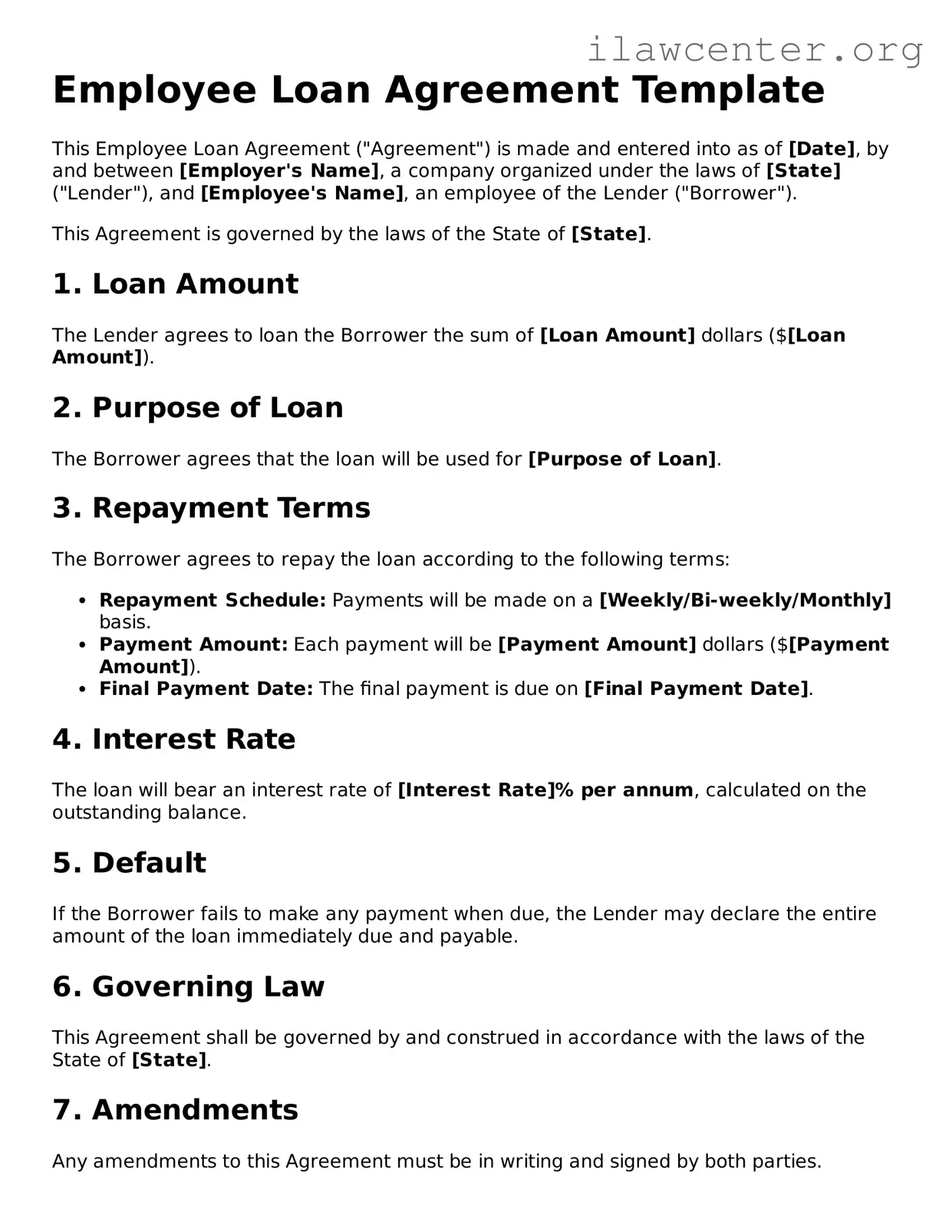
Employee Loan Agreement Template

This Employee Loan Agreement ("Agreement") is made and entered into as of [Date], by and between [Employer's Name], a company organized under the laws of [State] ("Lender"), and [Employee's Name], an employee of the Lender ("Borrower").

This Agreement is governed by the laws of the State of [State].

1. Loan Amount

The Lender agrees to loan the Borrower the sum of [Loan Amount] dollars ($[Loan Amount]).

2. Purpose of Loan

The Borrower agrees that the loan will be used for [Purpose of Loan].

3. Repayment Terms

The Borrower agrees to repay the loan according to the following terms:

  • Repayment Schedule: Payments will be made on a [Weekly/Bi-weekly/Monthly] basis.
  • Payment Amount: Each payment will be [Payment Amount] dollars ($[Payment Amount]).
  • Final Payment Date: The final payment is due on [Final Payment Date].

4. Interest Rate

The loan will bear an interest rate of [Interest Rate]% per annum, calculated on the outstanding balance.

5. Default

If the Borrower fails to make any payment when due, the Lender may declare the entire amount of the loan immediately due and payable.

6. Governing Law

This Agreement shall be governed by and construed in accordance with the laws of the State of [State].

7. Amendments

Any amendments to this Agreement must be in writing and signed by both parties.

8. Signatures

By signing below, both parties agree to the terms outlined in this Employee Loan Agreement.

Employer's Signature: ______________________ Date: _______________

Employee's Signature: ______________________ Date: _______________

PDF Form Characteristics

Fact Name Description
Purpose An Employee Loan Agreement form outlines the terms under which an employer lends money to an employee.
Repayment Terms The form specifies how and when the employee must repay the loan, including interest rates if applicable.
State-Specific Laws Each state may have its own laws governing employee loans, such as California's Labor Code Section 2802.
Confidentiality Typically, the agreement includes a confidentiality clause to protect the financial information of both parties.
Default Consequences The form outlines what happens if the employee fails to repay the loan, including possible deductions from wages.

Instructions on Utilizing Employee Loan Agreement

Completing the Employee Loan Agreement form is a straightforward process that requires attention to detail. Ensure that all information is accurate and complete before submitting the form. Follow these steps to fill out the form correctly.

  1. Begin by entering the date at the top of the form.
  2. Fill in the employee's full name in the designated space.
  3. Provide the employee's job title and department.
  4. Enter the amount of the loan being requested.
  5. Specify the purpose of the loan in the appropriate section.
  6. Indicate the repayment terms, including the repayment period and frequency of payments.
  7. Include any applicable interest rate for the loan.
  8. Provide the employee's signature and date at the bottom of the form.
  9. Have the employer or authorized representative sign and date the form as well.
  10. Review the completed form for accuracy before submission.

Once all steps are completed, the form is ready for submission to the appropriate department for processing. Ensure that both parties retain a copy for their records.

Important Facts about Employee Loan Agreement

What is an Employee Loan Agreement?

An Employee Loan Agreement is a formal document that outlines the terms and conditions under which an employer provides a loan to an employee. This agreement specifies the loan amount, repayment schedule, interest rates (if applicable), and any other relevant terms. It serves to protect both the employer and the employee by ensuring clarity and mutual understanding regarding the loan arrangement.

Who can apply for an Employee Loan?

What information is required to complete the form?

Are there any fees associated with the loan?

What happens if an employee cannot repay the loan?

Is the loan amount taxable?

Can the Employee Loan Agreement be modified after it is signed?

Where can employees get assistance with the Employee Loan Agreement?

Common mistakes

Filling out an Employee Loan Agreement form can seem straightforward, but many people make common mistakes that can lead to complications later on. One frequent error is providing incorrect personal information. This includes misspellings of names, wrong addresses, or incorrect Social Security numbers. Such inaccuracies can delay the processing of the loan and create issues with repayment.

Another mistake is failing to read the terms of the agreement carefully. Some individuals may overlook important details regarding interest rates, repayment schedules, or potential penalties for late payments. Understanding these terms is crucial, as they directly affect the financial obligations of the employee.

Many people also forget to include all necessary documentation. The Employee Loan Agreement may require supporting documents like proof of income or employment verification. Omitting these can result in delays or even denial of the loan request.

Additionally, some individuals do not consider their ability to repay the loan before signing. It’s essential to assess personal finances honestly. Taking on a loan without a clear repayment plan can lead to financial strain and stress.

Another common error is neglecting to ask questions. If there is any confusion about the agreement, it’s important to seek clarification. Ignoring uncertainties can lead to misunderstandings that may affect the loan terms.

Lastly, people often forget to keep a copy of the signed agreement. This document serves as a record of the terms agreed upon and is vital for future reference. Without it, resolving disputes or clarifying terms can become challenging.

Documents used along the form

An Employee Loan Agreement is a crucial document for outlining the terms of a loan between an employer and an employee. To ensure clarity and protect the interests of both parties, several other forms and documents are often used in conjunction with this agreement. Below is a list of commonly associated documents.

  • Promissory Note: This document serves as a written promise from the employee to repay the loan. It includes details such as the loan amount, interest rate, repayment schedule, and consequences for defaulting on the loan.
  • Payroll Deduction Authorization: This form allows the employer to automatically deduct loan repayments from the employee's paycheck. It outlines the amount to be deducted and the frequency of deductions.
  • Loan Repayment Schedule: This document details the timeline for repayment. It includes specific dates, amounts due, and any applicable interest calculations, ensuring both parties are aware of their obligations.
  • Loan Agreement Amendment: If any terms of the original loan agreement need to be changed, this document formalizes those changes. It is essential for maintaining clear communication and agreement between the employer and employee.

Using these documents together with the Employee Loan Agreement can help prevent misunderstandings and ensure a smooth loan process. Each document plays a vital role in protecting both parties and clarifying expectations.

Similar forms

  • Promissory Note: This document outlines the borrower's promise to repay a loan. Like the Employee Loan Agreement, it specifies the loan amount, interest rate, and repayment terms.

  • Loan Application: A loan application is submitted by the employee to request funds. It collects personal and financial information, similar to the Employee Loan Agreement, which requires details about the loan purpose and repayment plan.

  • Repayment Schedule: This document details the timeline for loan repayments. It complements the Employee Loan Agreement by providing a clear structure for when payments are due and how much is owed at each interval.

  • Security Agreement: If the loan is secured by collateral, this document outlines the terms. It is similar to the Employee Loan Agreement in that it protects the lender's interests while detailing the obligations of the borrower.

  • Loan Disclosure Statement: This statement provides essential information about the loan's terms and costs. Like the Employee Loan Agreement, it ensures transparency and helps the borrower understand their financial commitment.

Dos and Don'ts

When filling out the Employee Loan Agreement form, it's important to follow specific guidelines to ensure accuracy and compliance. Below is a list of things you should and shouldn't do.

  • Do read the entire form carefully before filling it out.
  • Do provide accurate and up-to-date personal information.
  • Do double-check all numbers and calculations.
  • Do sign and date the form where indicated.
  • Don't leave any required fields blank.
  • Don't use incorrect or outdated information.
  • Don't forget to keep a copy of the completed form for your records.

Following these guidelines will help ensure that the process goes smoothly and that all necessary information is accurately submitted.

Misconceptions

There are several misconceptions about the Employee Loan Agreement form that can lead to confusion. Understanding these can help both employers and employees navigate the loan process more effectively.

  • Misconception 1: The Employee Loan Agreement is the same as a standard loan.
  • This is not accurate. An Employee Loan Agreement is specifically tailored for loans between an employer and an employee, often with unique terms and conditions that differ from traditional loans.

  • Misconception 2: Employees must accept the loan if offered.
  • Employees are not obligated to accept a loan. The agreement is voluntary, and employees can choose whether or not to participate.

  • Misconception 3: The terms of the loan are fixed and cannot be negotiated.
  • While some terms may be standard, many aspects of the agreement can be negotiated. Employees should feel empowered to discuss the terms with their employer.

  • Misconception 4: The Employee Loan Agreement does not require any documentation.
  • This is incorrect. Proper documentation is essential. Both parties should keep a signed copy of the agreement to ensure clarity and accountability.

  • Misconception 5: There are no tax implications for the employee.
  • In some cases, loans may have tax consequences. It is advisable for employees to consult a tax professional to understand any potential liabilities.

Key takeaways

When filling out and using the Employee Loan Agreement form, keep the following key points in mind:

  1. Clearly Define the Loan Amount: Specify the exact amount being loaned to avoid confusion later.
  2. Outline the Purpose: State the reason for the loan to establish context and accountability.
  3. Set Repayment Terms: Include the repayment schedule, detailing when payments are due and how much will be paid each time.
  4. Interest Rates: If applicable, clearly state the interest rate and how it will be calculated.
  5. Consequences of Default: Explain what happens if the employee fails to repay the loan as agreed.
  6. Confidentiality: Include a clause to protect the privacy of both the employer and the employee regarding the loan details.
  7. Signatures Required: Ensure both parties sign the agreement to make it legally binding.
  8. Keep Copies: Both the employer and employee should retain a copy of the signed agreement for their records.
  9. Review Local Laws: Check state and federal regulations regarding employee loans to ensure compliance.
  10. Consider Tax Implications: Be aware of any tax consequences that may arise from providing or receiving an employee loan.

Following these takeaways will help ensure that the Employee Loan Agreement is clear, fair, and legally sound.