Fillable Employment Verification Document

Fillable Employment Verification Document

The Employment Verification form is a document used by employers to confirm an individual's employment status and history. This form provides essential information that can help verify a candidate's qualifications and work experience. For a smooth hiring process, consider filling out the form by clicking the button below.

Article Guide

When navigating the job market, one crucial aspect that often comes into play is the Employment Verification form. This document serves as a vital link between employers and potential hires, providing a clear picture of an applicant's work history and credentials. Typically, it requests information such as job titles, dates of employment, and reasons for leaving previous positions. Employers use this form to confirm the accuracy of the information provided by candidates, ensuring that they make informed hiring decisions. Additionally, the form may include sections for verifying salary history and eligibility for rehire, which can significantly influence an applicant's prospects. Understanding the nuances of this form can empower job seekers and help them present their qualifications effectively, while also giving employers the tools they need to assess candidates thoroughly and fairly.

Employment Verification Preview

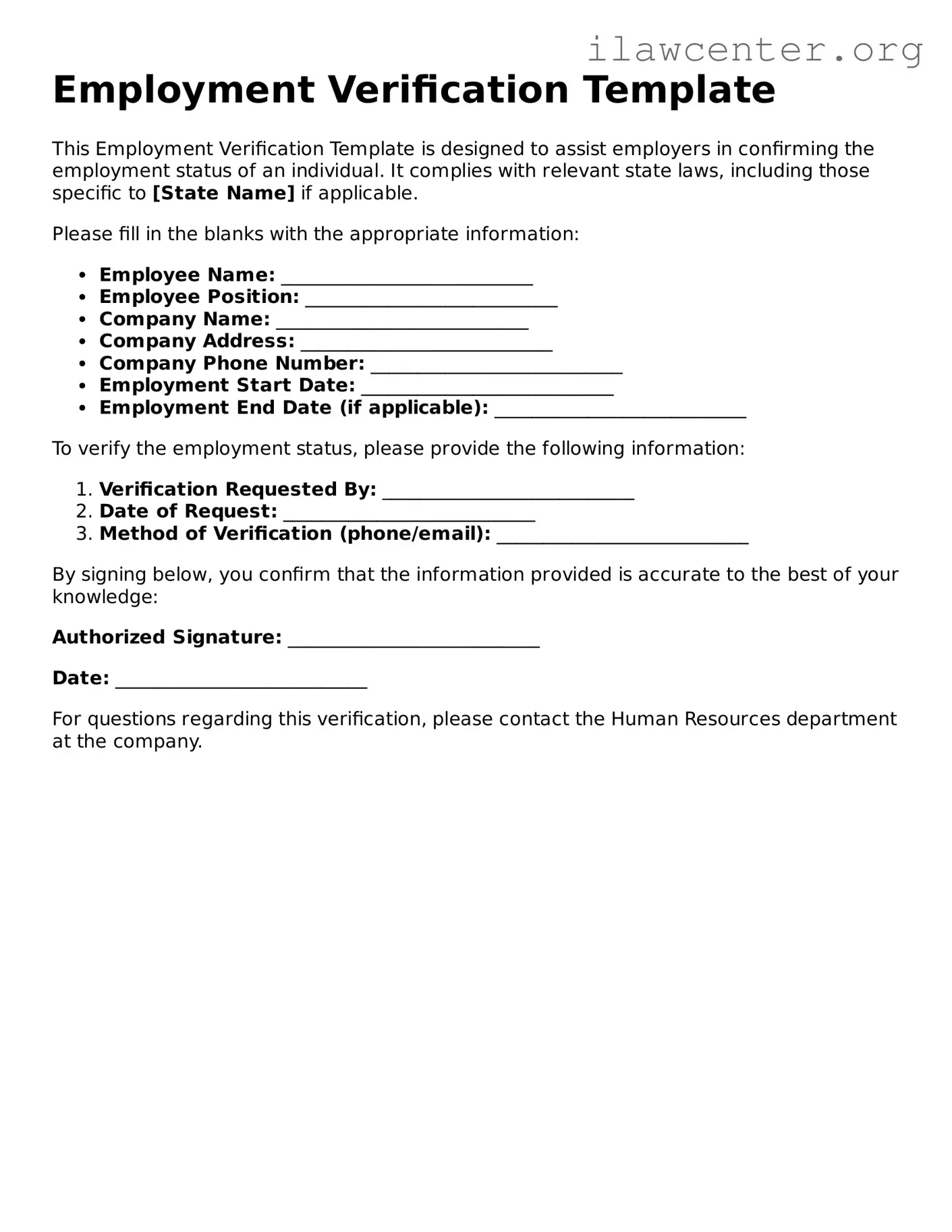
Employment Verification Template

This Employment Verification Template is designed to assist employers in confirming the employment status of an individual. It complies with relevant state laws, including those specific to [State Name] if applicable.

Please fill in the blanks with the appropriate information:

  • Employee Name: ___________________________
  • Employee Position: ___________________________
  • Company Name: ___________________________
  • Company Address: ___________________________
  • Company Phone Number: ___________________________
  • Employment Start Date: ___________________________
  • Employment End Date (if applicable): ___________________________

To verify the employment status, please provide the following information:

  1. Verification Requested By: ___________________________
  2. Date of Request: ___________________________
  3. Method of Verification (phone/email): ___________________________

By signing below, you confirm that the information provided is accurate to the best of your knowledge:

Authorized Signature: ___________________________

Date: ___________________________

For questions regarding this verification, please contact the Human Resources department at the company.

PDF Form Characteristics

Fact Name Details
Purpose The Employment Verification form is used to confirm an individual's employment status and details, such as job title and duration of employment.
Common Use This form is often requested by landlords, lenders, and other entities needing to verify income or employment for various purposes.
Information Required Typically, the form requests information such as the employee's name, position, salary, and the employer's contact details.
Signature Requirement The employee usually must sign the form to authorize the release of their employment information.
State-Specific Forms Some states may have their own specific requirements for employment verification forms, governed by state labor laws.
Confidentiality Employers are generally required to handle the information provided on the form with confidentiality, adhering to privacy laws.
Validity Period There is no universal validity period for the Employment Verification form; however, it is advisable to obtain a current verification for accuracy.

Instructions on Utilizing Employment Verification

Filling out the Employment Verification form is straightforward. Once completed, this form will be submitted to your employer or the relevant organization to confirm your employment details. Follow the steps below to ensure you fill it out correctly.

  1. Start with your personal information. Enter your full name, address, and contact number at the top of the form.
  2. Provide your job title. This should reflect your current position within the company.
  3. Fill in the name of your employer. Make sure to include the full name of the organization.
  4. Enter the dates of your employment. Specify the start date and, if applicable, the end date.
  5. List your job responsibilities. Briefly describe your main duties in the role.
  6. Sign and date the form at the bottom. Your signature confirms that the information provided is accurate.

After completing these steps, review the form for any errors. Once you are satisfied, submit it to the designated recipient. This will help facilitate the verification process smoothly.

Important Facts about Employment Verification

What is an Employment Verification form?

An Employment Verification form is a document used to confirm an individual's employment status. Employers or third parties may request this form to verify job title, dates of employment, and salary information. It serves as proof of employment for various purposes, such as applying for loans, renting an apartment, or confirming eligibility for benefits.

Who typically requests an Employment Verification form?

Employers, landlords, and financial institutions commonly request an Employment Verification form. When applying for a new job, prospective employers may also ask for this verification to ensure that candidates have the necessary work history and qualifications.

How do I complete an Employment Verification form?

To complete the form, provide your personal information, including your name, job title, and dates of employment. If you are the employer filling out the form, include details such as the employee's role, salary, and employment duration. Be sure to sign and date the form to validate the information provided.

Can I refuse to provide my Employment Verification form?

While you can refuse to provide the form, it may affect your ability to secure a new job, rental agreement, or loan. Many employers and institutions require this verification as part of their standard procedures. If you have concerns about privacy, discuss them with the requesting party.

Is there a fee for obtaining an Employment Verification form?

Typically, there is no fee for obtaining an Employment Verification form from your current or former employer. However, if you use a third-party service for verification, they may charge a fee. Always check with the specific entity requesting the verification for any potential costs.

How long does it take to receive an Employment Verification?

The time it takes to receive an Employment Verification can vary. Some employers may provide it immediately, while others may take several days or even weeks. If you need it urgently, consider following up with your employer or the HR department to expedite the process.

What if my employer does not respond to the Employment Verification request?

If your employer does not respond, you can follow up with them directly. It’s helpful to provide a reminder or ask if there are any issues with the request. If the employer continues to be unresponsive, consider alternative methods of verification, such as pay stubs or tax documents.

Can I request my own Employment Verification?

Yes, you can request your own Employment Verification from your employer. This is often done when you need to provide proof of employment for personal reasons. Contact your HR department or supervisor to initiate the request.

What information is typically included in an Employment Verification form?

An Employment Verification form generally includes the employee's name, job title, employment dates, salary information, and sometimes the reason for leaving. It may also include the employer's contact information and a signature to confirm the accuracy of the details.
Common mistakes

Filling out an Employment Verification form is a critical step in many job applications. However, applicants often make mistakes that can delay the process or even jeopardize their chances of getting hired. Understanding these common pitfalls can help you submit a flawless form.

One frequent error is providing inaccurate information. Whether it’s a wrong job title, incorrect dates of employment, or an erroneous salary figure, inaccuracies can raise red flags for employers. Always double-check your entries against your records to ensure everything is correct.

Another mistake is neglecting to include all relevant employment history. Some applicants may omit part-time jobs or freelance work, thinking they are not significant. However, every experience counts. Include all relevant positions to give a complete picture of your work history.

Many people also fail to obtain proper authorization from their previous employers before submitting the form. This can lead to delays or refusals from former employers to verify your employment. Always seek permission and inform your past employers that they might receive a verification request.

Additionally, applicants often overlook the importance of clear and legible handwriting when filling out the form by hand. Illegible writing can lead to misunderstandings or errors in processing your information. If possible, type out the form to avoid this issue.

Some individuals forget to sign and date the form. A missing signature can render the entire form invalid. Always ensure that you complete this final step before submission to avoid unnecessary complications.

Another common error is failing to provide contact information for previous employers. If an employer cannot reach your past workplace for verification, they may assume you are hiding something. Always include accurate contact details to facilitate the verification process.

Lastly, applicants sometimes submit the form without reviewing it thoroughly. Rushing through the process can lead to overlooked mistakes. Take the time to review your form carefully, ensuring that all information is accurate and complete before submission.

By being aware of these common mistakes, you can improve your chances of a smooth employment verification process. Take your time, double-check your work, and ensure that you present yourself as a reliable candidate.

Documents used along the form

When seeking employment verification, several other forms and documents may accompany the Employment Verification form. Each of these documents serves a unique purpose in the verification process, ensuring that both the employer and the employee have the necessary information to confirm employment status and related details.

  • Job Offer Letter: This document outlines the terms of employment, including job title, salary, and start date. It serves as proof of the job offer extended to the employee.
  • Pay Stubs: Recent pay stubs provide evidence of income and employment duration. They are often used to verify salary details during the hiring process.
  • W-2 Forms: These forms summarize an employee's annual wages and the taxes withheld. They are essential for verifying income and employment history for tax purposes.
  • Tax Returns: Personal tax returns can offer insight into an individual’s financial history and are sometimes requested to confirm income levels.
  • Employment History Form: This document lists previous employers, job titles, and dates of employment. It helps to provide a comprehensive view of the candidate's work background.
  • Reference Letters: Letters from previous employers or colleagues can provide insights into an individual’s work ethic and performance, complementing the verification process.
  • Background Check Consent Form: This form grants permission for a background check, which may include verification of employment history, criminal records, and other relevant information.
  • Resume or CV: A resume or curriculum vitae provides a summary of the candidate’s skills, experiences, and qualifications, often used alongside the Employment Verification form.
  • Offer Acceptance Letter: This letter confirms that the candidate has accepted the job offer, detailing the agreed-upon terms and conditions.

These documents collectively help to create a clear picture of an individual's employment status and history. They ensure that the verification process is thorough and accurate, benefiting both employers and employees alike.

Similar forms

The Employment Verification form is an important document used to confirm a person's employment status. Several other documents serve similar purposes, each with its own specific focus. Here are four documents that are similar to the Employment Verification form:

  • Pay Stubs: These documents provide proof of income and employment. They typically show the employee's earnings over a specific period, confirming that they are actively employed and receiving a paycheck.
  • W-2 Forms: Issued by employers, W-2 forms summarize an employee's annual wages and the taxes withheld. They are often used to verify employment and income for loan applications and tax purposes.
  • Employment Letters: These letters, often provided by employers, confirm a person's job title, employment dates, and sometimes salary. They serve as official proof of employment and can be required for various applications.
  • Reference Letters: While not exclusively for employment verification, reference letters from previous employers can attest to a person's work history and character. They are often used during job applications to validate an applicant's experience and reliability.

Dos and Don'ts

When filling out an Employment Verification form, it’s important to ensure that the information you provide is accurate and complete. Here’s a helpful list of things you should and shouldn’t do.

  • Do double-check your personal information for accuracy.
  • Do provide clear and concise details about your job title and responsibilities.
  • Do include the correct dates of employment.
  • Do ensure that your contact information is up-to-date.
  • Don’t leave any sections blank; if a section doesn’t apply, indicate that clearly.
  • Don’t provide false information; honesty is crucial for this document.

By following these guidelines, you can help ensure that your Employment Verification form is filled out correctly and efficiently. This can make the process smoother for both you and your employer.

Misconceptions

Employment verification is an essential process for both employers and employees. However, several misconceptions can lead to confusion. Here are seven common misconceptions about the Employment Verification form:

  1. It's only for new hires. Many believe that employment verification is only necessary for new employees. In reality, it can also be required for promotions, loan applications, or background checks.
  2. Only the HR department can complete it. While HR typically handles employment verification, managers or supervisors can also provide necessary information about an employee's role and performance.
  3. It guarantees employment. Some individuals think that completing an employment verification form guarantees job security. However, it merely confirms employment status and does not protect against termination.
  4. It is a lengthy process. Many assume that obtaining employment verification takes a lot of time. In fact, the process can be quick, often completed within a few days if all information is readily available.
  5. It's only needed for full-time positions. Some believe that only full-time employees require verification. Part-time, temporary, and contract workers may also need verification for various purposes.
  6. Employers can disclose any information. There is a misconception that employers can freely share any details about an employee. However, laws protect certain information, and employers must adhere to privacy regulations.
  7. Once completed, it cannot be updated. Many think that once an employment verification form is filled out, it cannot be modified. In truth, updates can be made to reflect changes in employment status or job responsibilities.

Understanding these misconceptions can help both employees and employers navigate the employment verification process more effectively. Clear communication and accurate information are key to ensuring a smooth verification experience.

Key takeaways

When filling out and using the Employment Verification form, it is essential to keep a few key points in mind. Understanding these takeaways can help ensure that the process runs smoothly and efficiently.

  • Accuracy is Crucial: Ensure that all information provided is correct. Mistakes can lead to delays or issues with employment verification.
  • Complete All Sections: Fill out every section of the form. Incomplete forms may not be accepted, causing further complications.
  • Use Clear Language: When providing information, use clear and concise language. This helps the reviewer understand your employment history without confusion.
  • Provide Necessary Documentation: Attach any required documents that support your employment verification. This may include pay stubs, tax forms, or offer letters.
  • Follow Submission Guidelines: Adhere to the specific submission guidelines outlined by the requesting party. This includes deadlines and preferred methods of delivery.

By keeping these takeaways in mind, you can navigate the Employment Verification process more effectively.