Estimate PDF Template

Estimate PDF Template

The Estimate form is a crucial document used to outline the anticipated costs associated with a project or service. It helps clients understand potential expenses before making a commitment, ensuring transparency and informed decision-making. Ready to get started? Fill out the form by clicking the button below.

Article Guide

The Estimate form plays a crucial role in various sectors, serving as a foundational document that outlines projected costs for services or projects. This form is essential for both businesses and clients, providing a clear and organized way to communicate financial expectations before any work begins. Typically, the Estimate form includes details such as the scope of work, itemized costs, timelines, and any conditions or assumptions that may affect the final price. By offering transparency, it helps prevent misunderstandings and ensures that all parties are on the same page. Additionally, it can serve as a reference point for future negotiations or modifications, making it a vital tool in project management and client relations. Understanding how to properly utilize this form can lead to better decision-making and more successful outcomes in various business transactions.

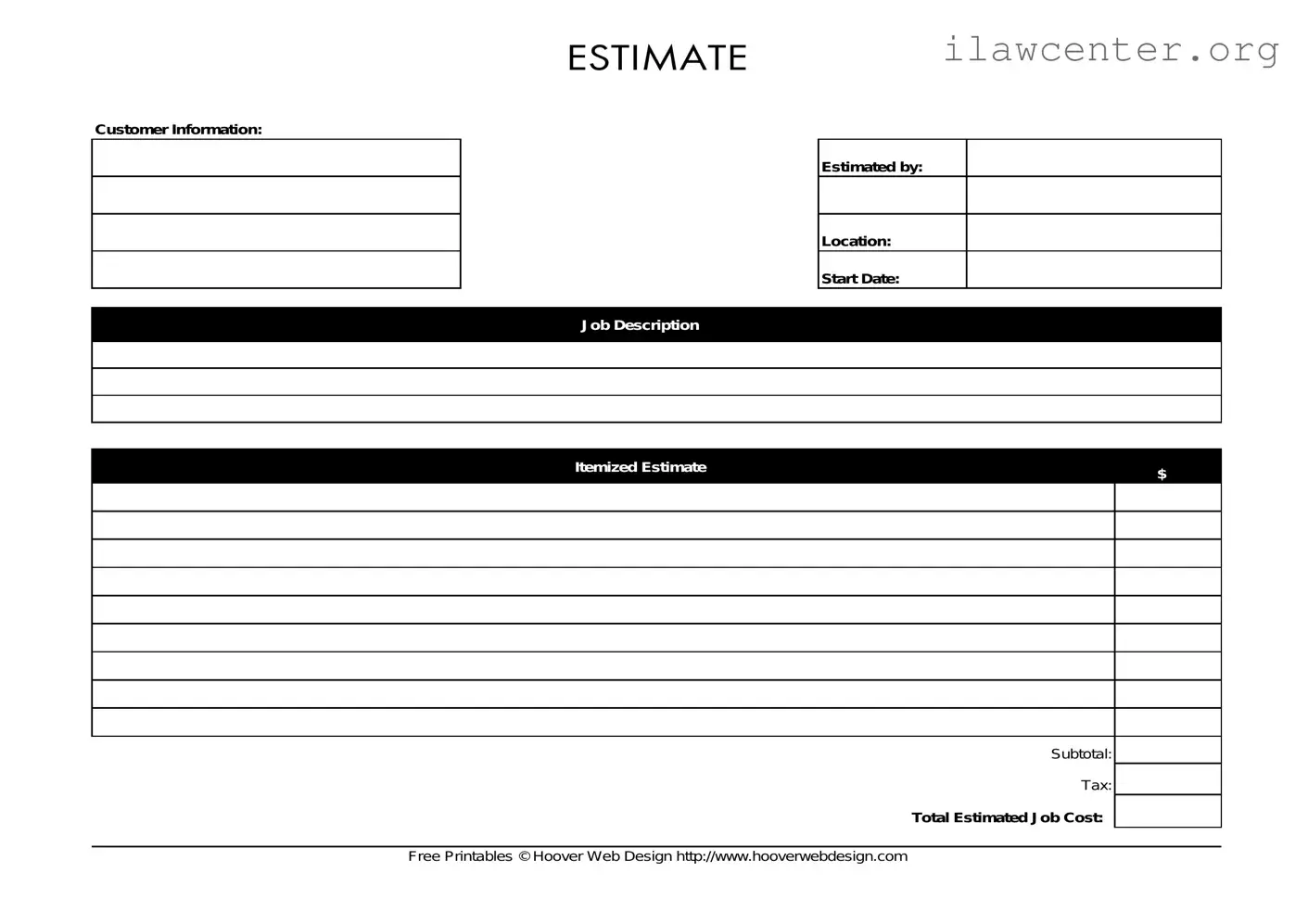
Estimate Preview

ESTIMATE
Customer Information:
Estimated by:
Location:
Start Date:
Job Description
Itemized Estimate
$
Subtotal:
Tax:
Total Estimated Job Cost:
Free Printables © Hoover Web Design http://www.hooverwebdesign.com

File Properties

Fact Name Details
Purpose The Estimate form is used to provide a detailed projection of costs for a project or service.
State-Specific Forms Different states may have specific requirements for Estimate forms, including format and content.
Governing Laws In California, for example, the governing law is found in the California Civil Code, Section 1582.
Importance Accurate estimates help in budgeting and can prevent disputes between parties involved.

Instructions on Utilizing Estimate

After completing the Estimate form, you will have a clear overview of the costs associated with your project. This document will help you communicate effectively with service providers and ensure transparency in pricing. Follow the steps below to fill out the form accurately.

  1. Begin by entering your name and contact information at the top of the form.
  2. Provide the date on which you are filling out the form.
  3. Specify the project or service for which you are requesting an estimate.
  4. List the items or services you need, including a brief description of each.
  5. Indicate the quantity of each item or service required.
  6. Fill in the estimated cost for each item or service.
  7. Add any additional notes or special requests in the designated section.
  8. Review the information for accuracy before submitting the form.

Important Facts about Estimate

What is an Estimate form?

An Estimate form is a document used to provide a detailed breakdown of the anticipated costs for a project or service. It helps both the provider and the client understand the expected expenses before work begins. This form can include labor, materials, and other associated costs.

Why should I use an Estimate form?

Using an Estimate form can help prevent misunderstandings between you and your client. It sets clear expectations about costs and can serve as a reference point throughout the project. This transparency can enhance trust and satisfaction for both parties.

What information is typically included in an Estimate form?

An Estimate form usually includes the project's scope, itemized costs, labor rates, estimated completion time, and any terms or conditions. Additional details, such as payment schedules or deposit requirements, can also be included to clarify the agreement.

Is an Estimate form legally binding?

Generally, an Estimate form is not legally binding unless both parties sign it and agree to the terms outlined. However, it can serve as a reference for what was discussed and agreed upon. Always clarify if you intend for the estimate to be a formal contract.

How can I create an Estimate form?

You can create an Estimate form by using templates available online or by drafting your own. Make sure to include all relevant details and ensure clarity in your language. There are also software tools that can help streamline the process.

Can I modify an Estimate form after it has been given to a client?

Yes, you can modify an Estimate form after it has been provided. However, it is important to communicate any changes to the client and obtain their agreement. Keeping both parties informed will help maintain trust and avoid disputes.

What should I do if a client disputes the estimate?

If a client disputes the estimate, review the details of the form with them. Discuss the costs and clarify any misunderstandings. Open communication can often resolve issues. If necessary, consider negotiating terms that are acceptable to both parties.

How long is an Estimate form valid?

The validity of an Estimate form can vary. Typically, it remains valid for a specific period, which should be stated on the form. Common timeframes range from 30 to 90 days. After this period, costs may change, and a new estimate may be required.
Common mistakes

Filling out an estimate form can seem straightforward, but many people make common mistakes that can lead to confusion or delays. One frequent error is providing incomplete information. When details are missing, it can hinder the process and result in inaccurate estimates. Always ensure that every section of the form is filled out completely. Double-checking the information can save time and prevent potential misunderstandings.

Another common mistake is miscalculating numbers. Whether it’s the cost of materials or labor hours, errors in calculations can lead to significant discrepancies in the final estimate. It’s essential to take your time and verify each figure. Utilizing a calculator or spreadsheet can help ensure accuracy and clarity.

Many individuals also fail to read the instructions thoroughly. Each estimate form may have specific requirements or guidelines that must be followed. Ignoring these can lead to mistakes that may delay the processing of your estimate. Take a moment to carefully review any instructions provided before you start filling out the form.

Additionally, people often neglect to include necessary documentation. Supporting documents, such as previous estimates or project details, can be crucial for a complete estimate. If these documents are not included, it may result in an incomplete submission. Always check to see if any attachments are required before submitting your form.

Lastly, not following up after submission is a mistake that can lead to missed opportunities. Once the estimate form is submitted, it’s wise to check in to ensure it has been received and is being processed. This proactive approach can help address any issues early on and keep the project moving forward.

Documents used along the form

When working with an Estimate form, several other documents may be necessary to ensure a smooth process. Each of these documents serves a unique purpose and helps to clarify expectations between parties. Below is a list of commonly used forms and documents that often accompany the Estimate form.

  • Proposal: This document outlines the details of the project, including scope, timelines, and costs. It acts as a formal offer to the client, providing a clear understanding of what to expect.
  • Contract: Once the proposal is accepted, a contract is created to solidify the agreement between the parties. It includes terms and conditions, responsibilities, and any legal obligations.
  • Invoice: After services are rendered, an invoice is issued to request payment. This document details the work completed, costs incurred, and payment terms.
  • Change Order: If there are modifications to the original project scope, a change order is necessary. This document captures any adjustments in costs or timelines due to the changes requested by the client.
  • Work Order: This form is used to initiate the work based on the estimate. It provides specific instructions and details about the tasks to be performed.
  • Receipt: After payment is made, a receipt is issued as proof of transaction. It confirms that the client has fulfilled their payment obligation.

These documents, when used alongside the Estimate form, help create a clear and organized workflow. They ensure that all parties are on the same page and that expectations are managed effectively throughout the process.

Similar forms

The Estimate form serves as a crucial document in various contexts, particularly in construction, service industries, and project management. Its purpose is to provide a preliminary assessment of costs associated with a project or service. Here are seven documents that share similarities with the Estimate form:

  • Quote: A quote provides a fixed price for specific services or products, similar to an estimate but often more detailed and binding.
  • Proposal: A proposal outlines a plan for a project, including costs, timelines, and scope, much like an estimate but with a broader focus on project execution.
  • Invoice: An invoice details the final costs after services have been rendered, while an estimate provides a projected cost beforehand.
  • Bid: A bid is a formal offer to undertake a project at a specified price, akin to an estimate but typically submitted in competitive situations.
  • Change Order: A change order documents alterations to the original scope of work and associated costs, similar to an estimate in its focus on project financials.
  • Budget: A budget outlines expected expenses for a project, like an estimate, but is often more comprehensive and includes multiple cost categories.
  • Cost Analysis: A cost analysis evaluates the financial implications of a project, similar to an estimate but usually involves a more detailed breakdown of expenses.

Dos and Don'ts

When filling out an Estimate form, it is important to ensure accuracy and clarity. Here are five things to keep in mind:

  • Do: Read the instructions carefully before starting. Understanding the requirements can prevent mistakes.
  • Do: Provide accurate and detailed information. This helps in obtaining a precise estimate.
  • Do: Double-check your entries for errors. A quick review can save time later.
  • Do: Use clear and legible handwriting or type your responses. Clarity is key for processing.
  • Do: Submit the form by the deadline. Timeliness is often crucial for estimates.
  • Don't: Rush through the form. Taking your time can reduce errors.
  • Don't: Leave any required fields blank. Incomplete forms may be rejected.
  • Don't: Use abbreviations or slang. Stick to standard language for better understanding.
  • Don't: Ignore the privacy policy. Ensure that personal information is handled appropriately.
  • Don't: Forget to keep a copy for your records. Having a reference can be helpful later.

Misconceptions

Many people have misunderstandings about the Estimate form. Here are nine common misconceptions, along with clarifications to help you understand this important document.

  1. All estimates are legally binding.

    Estimates are typically not legally binding. They provide a rough idea of costs but can change based on various factors.

  2. Estimates include all potential costs.

    Estimates usually cover the main expenses but may not account for unforeseen costs or additional services.

  3. Once an estimate is given, it cannot be changed.

    Estimates can be revised as new information becomes available or if project requirements change.

  4. All estimates are created equal.

    Different businesses may use different methods for creating estimates, leading to variations in accuracy and detail.

  5. You must accept the estimate to proceed.

    Accepting an estimate is not mandatory. You can choose to negotiate or seek other options.

  6. Estimates are only for large projects.

    Estimates can be useful for projects of any size, helping to clarify costs and expectations.

  7. Estimates are only for contractors.

    Various industries use estimates, including service providers, retailers, and freelancers.

  8. All estimates require a deposit.

    While some businesses may ask for a deposit, many do not require one before providing services.

  9. Estimates guarantee satisfaction.

    While estimates help set expectations, they do not guarantee satisfaction with the final product or service.

Understanding these misconceptions can help you navigate the estimate process more effectively. Always ask questions and seek clarification when needed.

Key takeaways

Filling out and using the Estimate form can be straightforward if you keep a few key points in mind. Here are some essential takeaways to help guide you through the process:

  • Accuracy is crucial. Ensure that all information provided is correct. Mistakes can lead to delays or misunderstandings.
  • Be detailed. Include as much relevant information as possible. The more details you provide, the better the estimate will reflect your needs.
  • Review before submission. Always double-check your entries. A thorough review can help catch any errors before they become an issue.
  • Understand the terms. Familiarize yourself with any specific terms or conditions related to the estimate. This knowledge will help you navigate the process more effectively.
  • Keep a copy. After filling out the form, retain a copy for your records. This can be useful for future reference or if any questions arise.

By following these guidelines, you can ensure that your experience with the Estimate form is smooth and efficient.