Fillable Family (Friends) Personal Loan Agreement Document

Fillable Family (Friends) Personal Loan Agreement Document

The Family (Friends) Personal Loan Agreement form is a document that outlines the terms and conditions of a loan between friends or family members. This agreement helps ensure clarity and understanding between the parties involved, reducing the potential for misunderstandings. To establish a formal record of the loan, consider filling out the form by clicking the button below.

Article Guide

When it comes to borrowing money from family or friends, having a clear understanding and agreement is essential to maintain healthy relationships. The Family (Friends) Personal Loan Agreement form serves as a helpful tool for both parties involved in the transaction. This document outlines key details such as the loan amount, repayment terms, interest rates, and the timeline for repayment. It also specifies the responsibilities of the borrower and lender, ensuring that everyone knows what to expect. By putting these terms in writing, misunderstandings can be minimized, and trust can be preserved. The form can include provisions for late payments, collateral, and any other specific conditions that the parties agree upon. Ultimately, this agreement not only protects the lender's investment but also provides the borrower with a structured plan to manage their financial obligation.

Family (Friends) Personal Loan Agreement Preview

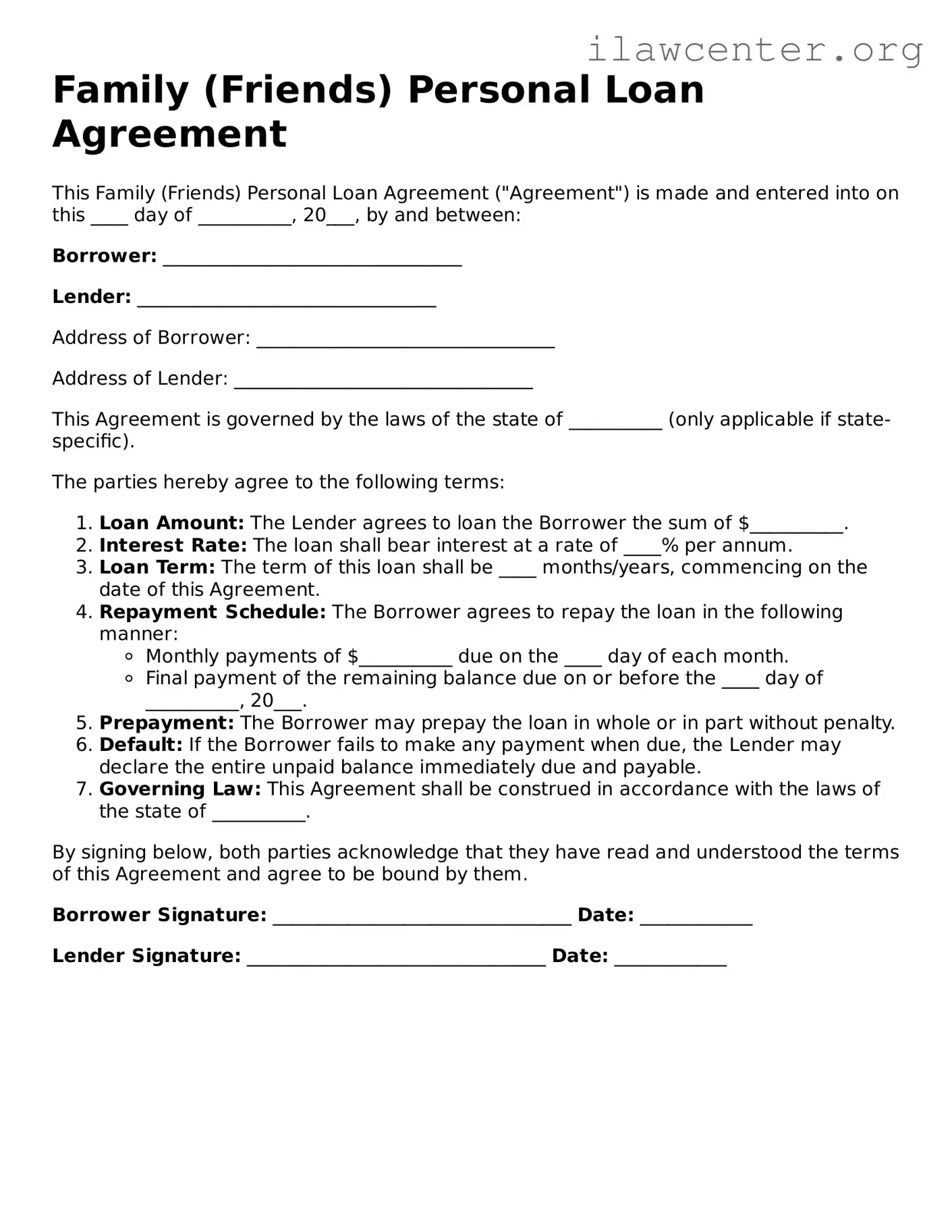
Family (Friends) Personal Loan Agreement

This Family (Friends) Personal Loan Agreement ("Agreement") is made and entered into on this ____ day of __________, 20___, by and between:

Borrower: ________________________________

Lender: ________________________________

Address of Borrower: ________________________________

Address of Lender: ________________________________

This Agreement is governed by the laws of the state of __________ (only applicable if state-specific).

The parties hereby agree to the following terms:

  1. Loan Amount: The Lender agrees to loan the Borrower the sum of $__________.
  2. Interest Rate: The loan shall bear interest at a rate of ____% per annum.
  3. Loan Term: The term of this loan shall be ____ months/years, commencing on the date of this Agreement.
  4. Repayment Schedule: The Borrower agrees to repay the loan in the following manner:
    • Monthly payments of $__________ due on the ____ day of each month.
    • Final payment of the remaining balance due on or before the ____ day of __________, 20___.
  5. Prepayment: The Borrower may prepay the loan in whole or in part without penalty.
  6. Default: If the Borrower fails to make any payment when due, the Lender may declare the entire unpaid balance immediately due and payable.
  7. Governing Law: This Agreement shall be construed in accordance with the laws of the state of __________.

By signing below, both parties acknowledge that they have read and understood the terms of this Agreement and agree to be bound by them.

Borrower Signature: ________________________________ Date: ____________

Lender Signature: ________________________________ Date: ____________

PDF Form Characteristics

Fact Name Description
Purpose A Family (Friends) Personal Loan Agreement form is used to outline the terms of a loan between friends or family members.
Loan Amount The form specifies the amount of money being loaned, ensuring both parties are clear on the financial commitment.
Interest Rate The agreement may include an interest rate, which can be set at zero or a specified percentage, depending on the arrangement.
Repayment Terms It outlines how and when the borrower will repay the loan, including any payment schedules or due dates.
State-Specific Laws Each state may have specific laws governing personal loans, which should be referenced in the agreement.
Signatures Both parties must sign the agreement to confirm their acceptance of the terms, making it legally binding.
Dispute Resolution The form may include a section on how disputes will be resolved, such as mediation or arbitration, to avoid court involvement.

Instructions on Utilizing Family (Friends) Personal Loan Agreement

Completing the Family (Friends) Personal Loan Agreement form requires careful attention to detail. Each section of the form must be filled out accurately to ensure clarity and understanding between the parties involved. Following the steps outlined below will help in completing the form correctly.

  1. Begin by entering the date at the top of the form.
  2. Provide the full name of the lender, including any middle initials.
  3. Enter the lender's address, including street, city, state, and zip code.
  4. List the full name of the borrower, ensuring to include any middle initials.
  5. Fill in the borrower’s address, including street, city, state, and zip code.
  6. Specify the total amount of the loan in numeric and written form.
  7. Indicate the interest rate, if applicable, and whether it is fixed or variable.
  8. State the repayment terms, including the number of installments and the due date for each payment.
  9. Include any late fees or penalties for missed payments, if applicable.
  10. Provide any additional terms or conditions that both parties agree upon.
  11. Both the lender and borrower should sign and date the form at the bottom.

Once the form is completed, it is advisable for both parties to keep a signed copy for their records. This ensures that all terms are clear and can be referred to in the future if needed.

Important Facts about Family (Friends) Personal Loan Agreement

What is a Family (Friends) Personal Loan Agreement?

A Family (Friends) Personal Loan Agreement is a written document that outlines the terms of a loan made between family members or friends. It serves to clarify the expectations of both the lender and the borrower, helping to prevent misunderstandings and potential conflicts in the future.

Why should I use a written agreement for a personal loan?

Using a written agreement provides a clear record of the loan terms, including the amount borrowed, interest rates, repayment schedule, and any other conditions. This can help protect both parties and provide legal recourse if issues arise. It also reinforces the seriousness of the transaction, even when dealing with loved ones.

What key elements should be included in the agreement?

The agreement should include the loan amount, interest rate (if applicable), repayment schedule, and due dates. Additionally, it should specify what happens in case of default, any collateral involved, and any fees or penalties. Both parties should sign and date the document to make it official.

Can I charge interest on a personal loan to family or friends?

Yes, you can charge interest on a personal loan. However, it’s essential to ensure that the interest rate complies with state usury laws, which regulate the maximum interest rates that can be charged. Charging a fair interest rate can help cover inflation and make the loan more formal.

What happens if the borrower cannot repay the loan?

If the borrower cannot repay the loan, the agreement should outline the consequences. This might include a grace period, renegotiation of terms, or even legal action if necessary. It’s crucial to discuss these scenarios upfront to avoid tension later on.

Is it necessary to notarize the agreement?

While notarization is not required for a personal loan agreement to be valid, it can add an extra layer of security. Having the agreement notarized can help prove its authenticity and may be beneficial if disputes arise in the future.

Can the terms of the loan be modified after the agreement is signed?

Yes, the terms can be modified, but any changes should be documented in writing and signed by both parties. This helps maintain clarity and ensures that both the lender and borrower are on the same page regarding the new terms.

What should I do if there is a dispute regarding the loan?

If a dispute arises, it’s best to address it directly and calmly with the other party. Review the agreement together to clarify misunderstandings. If the issue cannot be resolved amicably, consider mediation or legal advice as a last resort.

Can I use this agreement for loans between non-family members?

While the Family (Friends) Personal Loan Agreement is designed for loans between family and friends, it can be adapted for use between non-family members. However, it’s wise to ensure that both parties are comfortable with the terms and that the agreement reflects the nature of the relationship.

Where can I find a template for a Family (Friends) Personal Loan Agreement?

Templates for Family (Friends) Personal Loan Agreements can be found online through legal websites, or you can consult with a legal professional to create a customized agreement that meets your specific needs. Always ensure that the template complies with your state’s laws.
Common mistakes

When filling out a Family (Friends) Personal Loan Agreement form, many people overlook critical details that can lead to misunderstandings or disputes later on. One common mistake is failing to clearly define the loan amount. Without specifying how much money is being borrowed, both parties may have different expectations about the loan's terms.

Another frequent error is not including the repayment schedule. It's essential to outline when and how the borrower will repay the loan. This includes specifying the frequency of payments, such as weekly or monthly, and the due dates. Without this information, confusion can arise about when payments are expected.

People often neglect to document the interest rate, if applicable. While some personal loans between friends or family may be interest-free, others may involve a nominal rate. Not stating this clearly can lead to disagreements over the amount owed later on.

Additionally, some individuals forget to include the purpose of the loan. Stating why the money is being borrowed can help clarify the agreement and may even affect the willingness of the lender to provide the funds. It also serves as a reminder of the agreement's context.

Another mistake is not having both parties sign the agreement. A signature serves as a formal acknowledgment of the terms laid out in the document. Without signatures, it may be challenging to enforce the agreement if disputes arise.

People often skip the part about what happens in case of default. It's crucial to outline the consequences if the borrower fails to make payments. This can include late fees, additional interest, or even legal action. Clarifying these terms upfront can prevent misunderstandings later.

Many also overlook the importance of keeping a copy of the signed agreement. Both parties should retain a copy for their records. This ensures that everyone has access to the terms and can refer back to them if needed.

Some individuals mistakenly assume that a verbal agreement suffices. While a conversation may establish trust, a written document provides a clear record of the terms. Relying solely on verbal agreements can lead to significant issues down the line.

Finally, people sometimes fail to review the agreement thoroughly before signing. Taking the time to read through the document ensures that all terms are understood and agreed upon. Rushing through this process can result in overlooking important details.

Documents used along the form

When engaging in a personal loan agreement with family or friends, it’s important to have all necessary documentation in place. This not only protects both parties but also helps maintain clarity throughout the loan process. Below is a list of forms and documents that are often used alongside the Family (Friends) Personal Loan Agreement.

  • Promissory Note: This document outlines the borrower's promise to repay the loan. It specifies the loan amount, interest rate, repayment schedule, and any penalties for late payments.
  • Loan Repayment Schedule: This form details the timeline for repayments, including due dates and amounts. It serves as a helpful reference for both parties to track payments.
  • Personal Financial Statement: This document provides a snapshot of the borrower's financial situation. It includes assets, liabilities, income, and expenses, helping the lender assess the borrower's ability to repay the loan.
  • Letter of Intent: This informal document expresses the borrower's intention to repay the loan. It can help set expectations and clarify the purpose of the loan.
  • Collateral Agreement: If the loan is secured, this document outlines the collateral being offered. It details what will happen if the borrower defaults on the loan.
  • Amendment Agreement: Should any changes to the original loan terms be necessary, this document allows both parties to formally agree to those modifications.
  • Release of Liability: Once the loan is repaid, this document releases the borrower from any further obligations. It serves as proof that the loan has been fulfilled.

Having these documents prepared can help ensure a smooth lending process. Clear communication and proper documentation can prevent misunderstandings and strengthen relationships, even in financial matters.

Similar forms

The Family (Friends) Personal Loan Agreement form serves a specific purpose in documenting informal loans between friends or family members. It shares similarities with several other documents used in financial and personal agreements. Below is a list of nine documents that are comparable to the Family (Friends) Personal Loan Agreement form, along with explanations of their similarities:

  • Promissory Note: This is a written promise to pay back a loan. Like the Family Loan Agreement, it outlines the terms, including the amount borrowed and repayment schedule.
  • Loan Agreement: A more formal document that details the terms of a loan, including interest rates and repayment terms, similar to the Family Loan Agreement but often used in business transactions.
  • Lease Agreement: While primarily for rental situations, it also outlines obligations and terms between parties, akin to how a loan agreement specifies responsibilities for repayment.
  • Sales Contract: This document outlines the terms of a sale, including payment details. It shares similarities in structure and clarity with the Family Loan Agreement.
  • Co-Signing Agreement: This agreement involves a third party agreeing to take responsibility for a loan if the primary borrower defaults, similar in purpose to ensuring repayment in the Family Loan Agreement.
  • Debt Settlement Agreement: This document formalizes an agreement to settle a debt for less than the full amount owed, reflecting the importance of clear terms like those in a Family Loan Agreement.
  • Partnership Agreement: In business partnerships, this document outlines the terms of the partnership, including financial contributions, similar to how a loan agreement specifies financial obligations.
  • Service Agreement: This outlines the terms of service provided, including payment. Like a loan agreement, it sets clear expectations for both parties.
  • Gift Agreement: While it pertains to gifts rather than loans, this document can specify terms under which money is given, similar to how a Family Loan Agreement clarifies the expectations surrounding borrowed funds.

Understanding these documents can help clarify the terms of personal loans and ensure that all parties are aware of their rights and responsibilities.

Dos and Don'ts

When filling out a Family (Friends) Personal Loan Agreement form, it’s important to ensure clarity and accuracy. Here are some dos and don’ts to keep in mind:

  • Do clearly state the loan amount. Specify the exact amount being borrowed to avoid confusion.
  • Do outline the repayment terms. Include details on how and when the borrower will repay the loan.
  • Do include interest rates if applicable. If there is an interest rate, make sure to specify it in the agreement.
  • Do have both parties sign the agreement. Signatures from both the lender and borrower validate the document.
  • Don’t leave any sections blank. Ensure all fields are completed to prevent misunderstandings later.
  • Don’t use vague language. Be specific in your terms to avoid any potential disputes in the future.

Misconceptions

When it comes to borrowing money from family or friends, many people have misconceptions about the Family (Friends) Personal Loan Agreement form. Here are ten common misunderstandings that can lead to confusion:

  1. It’s just a casual agreement. Many believe that a personal loan between friends or family doesn’t need a formal agreement. However, having a written document helps clarify terms and expectations.
  2. Only large loans need documentation. Even small loans can benefit from a formal agreement. It ensures that both parties are on the same page, regardless of the amount.
  3. It’s unnecessary if there’s a verbal agreement. Verbal agreements can be easily forgotten or misinterpreted. A written agreement provides clear evidence of the terms.
  4. Once signed, it can't be changed. While the agreement is binding, both parties can agree to modify the terms later, as long as it’s documented.
  5. Only the lender needs to sign. Both the borrower and the lender should sign the agreement to ensure mutual understanding and commitment to the terms.
  6. It’s only for money loans. The agreement can also cover non-monetary loans, such as lending property or services, making it versatile.
  7. It’s not legally enforceable. A properly drafted agreement can be enforceable in court, providing legal protection for both parties.
  8. It’s only for family members. Friends can also use this form to document loans, ensuring clarity and reducing potential misunderstandings.
  9. It’s too complicated to fill out. The form is designed to be straightforward and user-friendly, making it accessible for anyone to complete.
  10. It’s only needed if there’s a dispute. Having an agreement in place can prevent disputes from arising in the first place by setting clear expectations.

Understanding these misconceptions can help individuals navigate personal loans among friends and family more effectively. Clear communication and documentation can strengthen relationships while avoiding potential pitfalls.

Key takeaways

When considering a Family (Friends) Personal Loan Agreement, it is essential to understand its components and implications. Below are key takeaways that can guide you through the process.

  • Clear Terms: Clearly outline the loan amount, interest rate, and repayment schedule. This helps avoid misunderstandings later.
  • Written Agreement: Always put the agreement in writing. A verbal agreement can lead to disputes and confusion.
  • Loan Purpose: Specify the purpose of the loan. This can help both parties understand the context and importance of the agreement.
  • Repayment Plan: Establish a realistic repayment plan. Consider the borrower's financial situation to ensure they can meet the obligations.
  • Interest Rate: Decide on a fair interest rate, if applicable. Charging a reasonable rate can make the loan feel more professional.
  • Default Clause: Include a clause that outlines what happens in case of default. This prepares both parties for potential issues.
  • Signatures: Ensure both parties sign the agreement. Signatures validate the commitment and can be important for legal purposes.
  • Record Keeping: Keep copies of the agreement and any payment records. This documentation can be vital if disputes arise.
  • Communication: Maintain open communication throughout the loan period. Regular check-ins can help address any issues before they escalate.