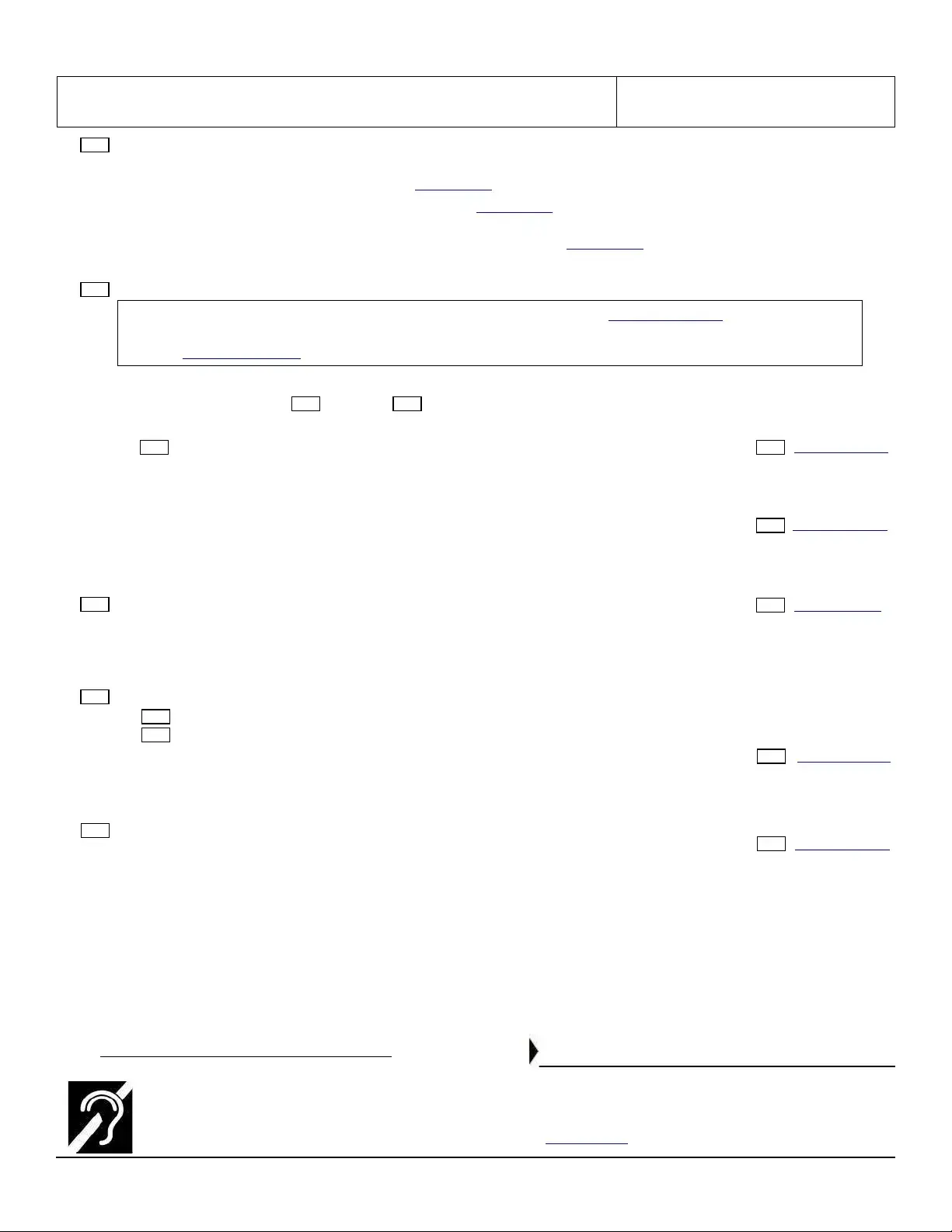
Fl 300 PDF Template

Fl 300 PDF Template

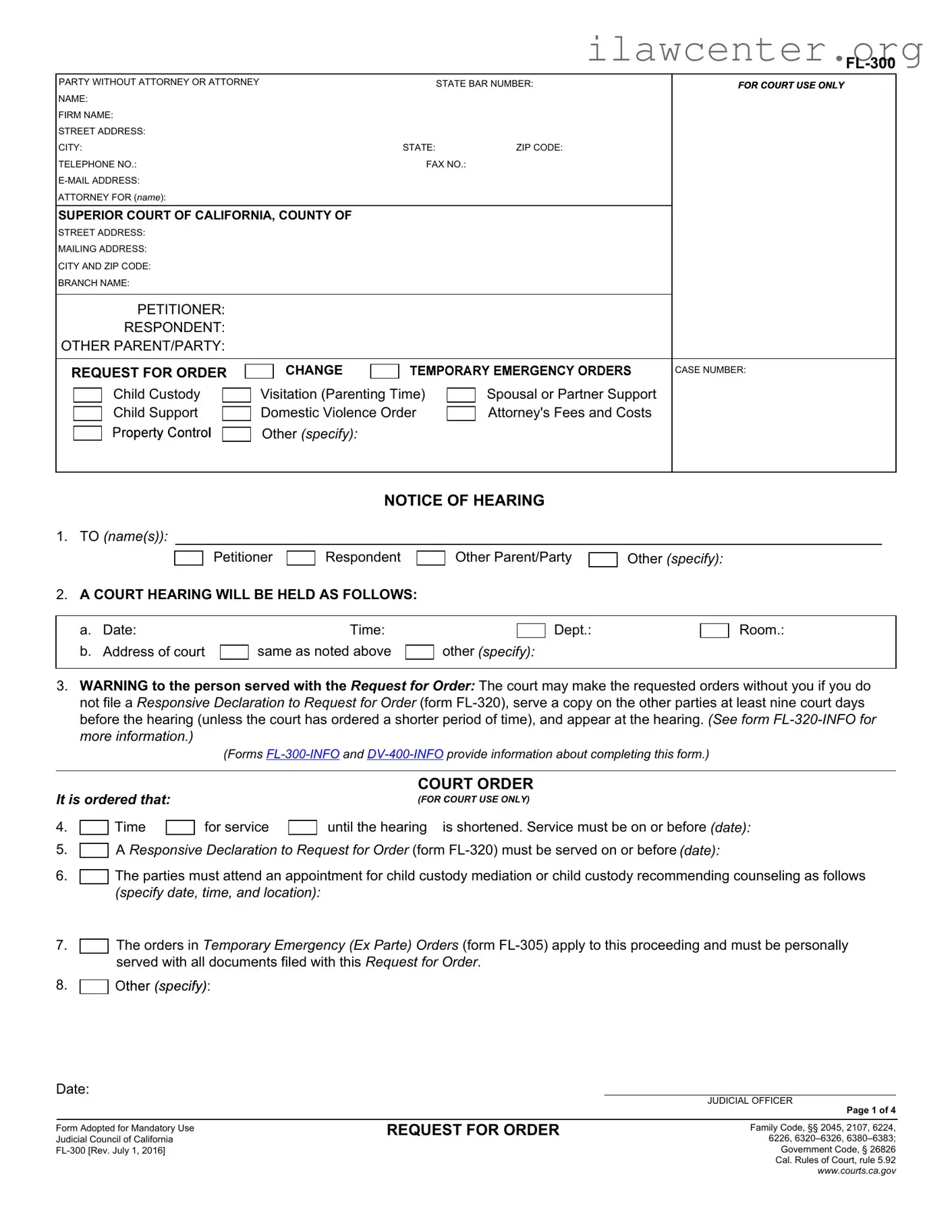
The FL-300 form is a legal document used in California to request a court order regarding family law matters such as child custody, child support, and spousal support. This form serves as a formal request to the court to make changes or establish orders that impact family dynamics. Understanding the FL-300 is crucial for anyone navigating the complexities of family law, and filling it out accurately is the first step in seeking legal relief.

Ready to take action? Fill out the form by clicking the button below.

Article Guide

The FL 300 form is a crucial document used in California family law proceedings. It serves as a Request for Order, allowing individuals to petition the court for various changes related to child custody, visitation, spousal support, child support, and more. This form requires detailed information about the petitioner, respondent, and any other involved parties. It outlines the specific orders being requested, such as modifications to existing custody arrangements or financial support obligations. Additionally, it includes important notices regarding court hearings, deadlines for filing responsive declarations, and the necessity for mediation appointments in custody cases. Understanding the contents and requirements of the FL 300 form is essential for anyone navigating family law matters in California, as it sets the stage for how disputes will be addressed in court.

Fl 300 Preview

WARNING to the person served with the Request for Order: The court may make the requested orders without you if you do
not file a Responsive Declaration to Request for Order (form FL-320), serve a copy on the other parties at least nine court days
before the hearing (unless the court has ordered a shorter period of time), and appear at the hearing. (See form FL-320-INFO for
more information.)
Form Adopted for Mandatory Use
Judicial Council of California
FL-300 [Rev. July 1, 2016]
7.
JUDICIAL OFFICER
COURT ORDER
(FOR COURT USE ONLY)
6.
A COURT HEARING WILL BE HELD AS FOLLOWS:
Time:Date:
Address of court (specify):
Page 1 of 4
REQUEST FOR ORDER
Family Code, §§ 2045, 2107, 6224,
6226, 6320–6326, 6380–6383;
Government Code, § 26826
Cal. Rules of Court, rule 5.92
www.courts.ca.gov
8.
2.
(date):
(date):
REQUEST FOR ORDER
CHANGE
Domestic Violence OrderChild Support
Child Custody
Attorney's Fees and Costs
Visitation (Parenting Time) Spousal or Partner Support
Other (specify):
FOR COURT USE ONLYFOR COURT USE ONLY
TELEPHONE NO.:
E-MAIL ADDRESS:
ATTORNEY FOR (name):
FAX NO.:
STATE: ZIP CODE:CITY:
STREET ADDRESS:
FIRM NAME:
NAME:
STATE BAR NUMBER:
SUPERIOR COURT OF CALIFORNIA, COUNTY OF
BRANCH NAME:
CITY AND ZIP CODE:
STREET ADDRESS:
MAILING ADDRESS:
PETITIONER:
RESPONDENT:
OTHER PARENT/PARTY:
CASE NUMBER:
FL-300
1.
a.
b. same as noted above
Dept.: Room.:
other
4.
A Responsive Declaration to Request for Order (form FL-320) must be served on or before
Time for service until the hearing is shortened. Service must be on or before
The parties must attend an appointment for child custody mediation or child custody recommending counseling as follows
(specify date, time, and location):
Date:
It is ordered that:
The orders in Temporary Emergency (Ex Parte) Orders (form FL-305) apply to this proceeding and must be personally
served with all documents filed with this Request for Order.
(Forms FL-300-INFO and DV-400-INFO provide information about completing this form.)
NOTICE OF HEARING
3.
5.
Other Parent/PartyRespondentPetitioner
TO (name(s)):
PARTY WITHOUT ATTORNEY OR ATTORNEY
Other (specify):
The visitation (parenting time) order was filed on
The order for legal or physical custody was filed on
(date):
(2)
.
. The court ordered (specify):
(1)
(date):
Attachment 2d.
visitation (parenting time).child custodyThis is a change from the current order for
The orders that I request are in the best interest of the children because (specify):
Attachment 2a.
a.
Form FL-311 Form FL-312
Form FL-341(D)
Form FL-341(C)
Form FL-341(E)
Form FL-305
(specify):
Other
(2)
As follows (specify):
Specified in the attached forms:
(1)
Attachment 2b.
visitation (parenting time) are:child custodyThe orders I request forb.
Child's Name Date of Birth
I request that the court make orders about the following children (specify):
c. Attachment 2c.
d.
REQUEST FOR ORDER
FL-300
Page 2 of 4
FL-300 [Rev. July 1, 2016]
REQUEST FOR ORDER
CASE NUMBER:
PETITIONER:
RESPONDENT:
OTHER PARENT/PARTY:
2.
CHILD CUSTODY
VISITATION (PARENTING TIME)
I request temporary emergency orders
The orders are from the following court or courts (specify county and state):
(specify):
(specify):
(specify):
(specify):
Case No. (if known):
Petitioner
Respondent Other Parent/Party (Attach a copy of the orders if you have one.)
a.
b.
c.
d.
Criminal: County/state
Family: County/state
Juvenile: County/state
Other: County/state
One or more domestic violence restraining/protective orders are now in effect between (specify):
1.
Note:
X
RESTRAINING ORDER INFORMATION
FL-300 [Rev. July 1, 2016]
Page 3 of 4
REQUEST FOR ORDER
4.
a. $
Amount requested (monthly):
The court should should make, change, or end the support orders because (specify):
I have completed and filed a current Income and Expense Declaration (
form FL-150) in support of my request.d.
e.
(date):
end the current support order filed onchangeb.
I want the court to
Attachment 4e.
The court ordered $
c.
This request is to modify (change) spousal or partner support after entry of a judgment.
I have completed and attached Spousal or Partner Support Declaration Attachment (form FL-157) or a declaration
that addresses the same factors covered in form FL-157.
(Note: An Earnings Assignment Order For Spousal or Partner Support (
form FL-435) may be issued.)
per month for support.
I have completed and filed with this Request for Order a current Income and Expense Declaration (
form FL-150) or I filed
a current Financial Statement (Simplified) (form FL-155) because I meet the requirements to file form FL-155.
c.
(date):
b.
d. The court should make or change the support orders because (specify):
Attachment 3d.
The court ordered child support as follows (specify):
Monthly amount ($) requested
(if not by guideline)
Child's name and age
a.
I request support for each child
based on the child support guideline.
Attachment 3a.
I request that the court order child support as follows:
(Note: An earnings assignment may be issued. See Income Withholding for Support (form FL-195)
FL-300
SPOUSAL OR DOMESTIC PARTNER SUPPORT
3.
CHILD SUPPORT
a.
control of the following property that we
The petitioner respondent other parent/party be given exclusive temporary use, possession, and
b.
and liens coming due while the order is in effect:
The petitioner respondent other parent/party be ordered to make the following payments on debts
own or are buying lease or rent (specify):
c. This is a change from the current order for property control filed on (date):
Specify in Attachment 5d the reasons why the court should make or change the property control orders. d.
For:Pay to: Amount: $ Due date:
Pay to: For: Amount: $ Due date:
5. PROPERTY CONTROL
I request temporary emergency orders
CASE NUMBER:
PETITIONER:
RESPONDENT:
OTHER PARENT/PARTY:
I want the court to change or end the orders because (specify):
The Restraining Order After Hearing (form DV-130) was filed on (date):
a.
endchange
I request that the court the personal conduct, stay-away, move-out orders, or other
protective orders made in Restraining Order After Hearing (form DV-130). (If you want to change the orders, complete 7c.)
b.
Attachment 7c.
I request that the court make the following changes to the restraining orders (specify):
c.
Attachment 7d.
d.
10.
I declare under penalty of perjury under the laws of the State of California that the information provided in this form and all attachments
is true and correct.
Page 4 of 4
FL-300 [Rev. July 1, 2016]
REQUEST FOR ORDER
Requests for Accommodations
Assistive listening systems, computer-assisted real-time captioning, or sign language interpreter services are available if
you ask at least five days before the proceeding. Contact the clerk's office or go to www.courts.ca.gov/forms for Request
for Accommodations by Persons With Disabilities and Response (
form MC-410). (Civ. Code, § 54.8.)
FACTS TO SUPPORT the orders I request are listed below. The facts that I write in support and attach to this request
cannot be longer than 10 pages, unless the court gives me permission.
The hearing date and service of the the Request for Order to be sooner.
I need the order because (specify):
b.
(number): court days before the hearing.To serve the Request for Order no less than
a.
c.
Attachment 9c.
Date:
(TYPE OR PRINT NAME)
(SIGNATURE OF APPLICANT)
OTHER ORDERS REQUESTED (specify):
8.
FL-300
7.
DOMESTIC VIOLENCE ORDER
Attachment 8.
6.
A current Income and Expense Declaration (form FL-150).
b.
A Supporting Declaration for Attorney's Fees and Costs Attachment (
form FL-158) or a declaration that addresses the
factors covered in that form.
c.
A Request for Attorney's Fees and Costs Attachment (
form FL-319) or a declaration that addresses the factors covered
in that form.
a.
I request attorney's fees and costs, which total (specify amount): $ . I filed the following to support my request:
ATTORNEY'S FEES AND COSTS
Do not use this form to ask for domestic violence restraining orders! Read form DV-505-INFO, How Do I Ask for a
Temporary Restraining Order, for forms and information you need to ask for domestic violence restraining orders.
Read
form DV-400-INFO, How to Change or End a Domestic Violence Restraining Order for more information.
TIME FOR SERVICE / TIME UNTIL HEARING
9.
I urgently need:
Attachment 10.
CASE NUMBER:
PETITIONER:
RESPONDENT:
OTHER PARENT/PARTY:

File Properties

Fact Name Details
Purpose of FL-300 The FL-300 form is used to request a court order in family law matters, such as child custody, support, and domestic violence issues.
Governing Laws This form is governed by California Family Code sections 2045, 2107, 6224, 6226, 6320–6326, 6380–6383, and Government Code section 26826.
Filing Requirements Parties must file the FL-300 form with the appropriate Superior Court in California, along with any necessary supporting documents.
Service of Process The person requesting the order must serve the FL-300 form on all other parties involved at least nine court days before the hearing.
Responsive Declaration If a party does not respond to the request using form FL-320, the court may grant the requested orders without their input.
Hearing Information The form includes sections to specify the date, time, and location of the court hearing related to the request for order.
Attachments Additional forms and declarations, such as FL-150 for income and expenses, may be required to support the requests made in the FL-300.

Instructions on Utilizing Fl 300

Filling out the FL-300 form is an essential step in initiating a request for court orders related to family law matters. After completing the form, you will need to file it with the court and serve it to the other parties involved in your case. This ensures that everyone is aware of the request and can respond accordingly.

  1. Obtain the FL-300 Form: Download the form from the California Courts website or visit your local court to get a physical copy.
  2. Fill in Your Information: At the top of the form, provide your name, address, and contact information. If you have an attorney, include their details as well.
  3. Identify the Court: Write the name and address of the Superior Court where you are filing your request.
  4. List the Parties: Indicate the names of the petitioner, respondent, and any other parent or party involved in the case.
  5. Specify the Case Number: Include the case number if you have one. If this is a new case, leave this section blank.
  6. Select the Type of Request: Check the box for the type of order you are requesting, such as child custody, support, or domestic violence orders.
  7. Provide Hearing Information: Fill in the names of the parties being served and the details of the court hearing, including the date, time, and location.
  8. Complete the Relevant Sections: Depending on your request, fill out the corresponding sections for child custody, child support, spousal support, or other orders.
  9. Attach Supporting Documents: Include any necessary attachments, such as income declarations or previous court orders, as specified in the form.
  10. Sign and Date the Form: At the bottom, sign and date the form to affirm that the information is true and correct.
  11. Make Copies: Before filing, make copies of the completed form and any attachments for your records and for the other parties.
  12. File the Form: Submit the original form and copies to the court clerk's office for filing.
  13. Serve the Other Parties: Ensure that all other parties involved receive a copy of the filed form and any attachments as required by law.

Important Facts about Fl 300

What is the FL-300 form used for?

The FL-300 form is a Request for Order used in family law cases in California. It allows individuals to ask the court for various types of orders, including child custody, visitation, spousal support, child support, and more. This form is essential for initiating requests for changes in existing court orders or for new orders altogether.

Who can file the FL-300 form?

Any party involved in a family law case, such as a petitioner, respondent, or other parent/party, can file the FL-300 form. It is important for the person filing to provide accurate information about themselves and the case.

How do I fill out the FL-300 form?

To fill out the FL-300 form, start by providing your name and contact information, as well as the details of the other parties involved. Specify the type of order you are requesting and include any relevant attachments, such as prior court orders or declarations. Be clear and concise in your explanations to support your requests.

What happens after I file the FL-300 form?

Once you file the FL-300 form, the court will schedule a hearing date. You must serve the other parties with a copy of the form and any attachments at least nine court days before the hearing. If you fail to do this, the court may proceed without your input.

What is the purpose of the notice of hearing section?

The notice of hearing section informs the parties involved about the date, time, and location of the court hearing. It is crucial for ensuring that all parties are aware of when they need to appear in court to present their case.

What is a Responsive Declaration to Request for Order (form FL-320)?

The FL-320 form is used by the other party to respond to the requests made in the FL-300 form. If you are served with the FL-300, you must file the FL-320 and serve it on the other parties before the hearing to ensure your voice is heard.

Can I request temporary orders using the FL-300 form?

Yes, you can request temporary orders using the FL-300 form. This is particularly important in urgent situations, such as when immediate changes to custody or support are needed. Be sure to clearly state the reasons for your request and provide supporting documentation.

What types of orders can I request with the FL-300 form?

You can request various types of orders, including but not limited to child custody and visitation, child support, spousal support, and attorney's fees. Each request should be clearly outlined in the form, and relevant evidence should be attached to support your claims.

Is there a deadline for serving the FL-300 form?

Yes, the FL-300 form must be served on the other parties at least nine court days before the scheduled hearing. If the court has ordered a shorter period, you must adhere to that timeline. Timely service is crucial for the court to consider your requests.

What should I do if I need accommodations for the hearing?

If you need accommodations, such as assistive listening devices or sign language interpreters, you should request these services at least five days before the hearing. Contact the clerk's office for the necessary forms and information on how to proceed.

Common mistakes

Filling out the FL-300 form, which is a Request for Order in family law cases, can be a daunting task. Many people make common mistakes that can lead to delays or complications in their cases. Understanding these pitfalls can help ensure that your form is completed correctly and efficiently.

One frequent error is failing to provide accurate contact information. It is essential to include your full name, address, and telephone number. Omitting any of these details can cause communication issues and may delay the processing of your request. Additionally, ensure that the information matches what is on file with the court to avoid confusion.

Another common mistake is not specifying the type of order being requested. The FL-300 form allows you to request various types of orders, such as child custody or spousal support. If you do not clearly indicate which order you are seeking, the court may not understand your request, leading to potential rejection or further questions.

Many people also overlook the importance of attaching necessary documents. If you are requesting changes to existing orders, you must include copies of those orders. Failing to provide supporting documents can hinder the court's ability to make informed decisions regarding your case.

Inaccurate dates can also create problems. When indicating previous court orders or filing dates, be precise. Errors in dates can lead to misunderstandings about the timeline of your case, which can complicate proceedings.

Another mistake is neglecting to sign and date the form. The court requires your signature to validate the request. An unsigned form will not be processed, and this can result in delays. Always double-check that you have signed and dated the document before submission.

Lastly, some individuals forget to review the form for completeness and clarity. Take the time to read through your completed form to ensure that all sections are filled out and that your requests are clearly stated. A well-organized and thorough submission can make a significant difference in how your case is handled.

Documents used along the form

The FL-300 form, known as the Request for Order, is commonly used in family law proceedings in California. When filing this form, several other documents may also be required or beneficial to support the request. Below is a list of these additional forms and documents, along with a brief description of each.

  • FL-320: Responsive Declaration to Request for Order - This form allows the respondent to respond to the requests made in the FL-300. It must be filed and served on the other parties before the hearing.
  • FL-305: Temporary Emergency (Ex Parte) Orders - This document is used to request immediate orders from the court in urgent situations, such as domestic violence or immediate child custody issues.
  • FL-150: Income and Expense Declaration - This form provides a detailed account of a party's financial situation. It is often required to support requests for child support, spousal support, or attorney's fees.
  • FL-155: Financial Statement (Simplified) - A shorter version of the Income and Expense Declaration, this form may be used if the party meets specific criteria, simplifying the financial disclosure process.
  • FL-319: Request for Attorney's Fees and Costs Attachment - This form is used to request attorney's fees and costs associated with the proceedings, detailing the reasons for the request.
  • DV-130: Restraining Order After Hearing - If there are existing restraining orders, this document outlines the terms of those orders and can be modified through the FL-300 process.

Understanding these accompanying forms is essential for anyone involved in family law matters. Properly completing and filing these documents can significantly impact the outcome of a case. Ensure all forms are filled out accurately and submitted in a timely manner to comply with court requirements.

Similar forms

The FL-300 form, known as the Request for Order, is an essential document used in family law cases in California. It serves as a formal request to the court for various types of orders, such as child custody or support. Here are six documents that are similar to the FL-300 form, along with explanations of how they are alike:

  • FL-320: Responsive Declaration to Request for Order - This form is used by the responding party to provide their side of the story regarding the requests made in the FL-300. It allows the respondent to formally respond to the requests and present their own arguments or evidence.
  • FL-305: Temporary Emergency (Ex Parte) Orders - Similar to the FL-300, this form is used to request immediate orders from the court in urgent situations. Both forms require the petitioner to outline their needs and provide supporting information, but FL-305 is specifically for emergency situations.
  • FL-150: Income and Expense Declaration - This document is often filed alongside the FL-300 to provide the court with a detailed overview of an individual's financial situation. Both forms require financial disclosures to support requests for child or spousal support.
  • FL-155: Financial Statement (Simplified) - Like the FL-150, this form provides financial information but is designed for simpler cases. It is used when a party seeks to modify support orders, similar to the requests made in the FL-300.
  • DV-130: Restraining Order After Hearing - This form is used to request or modify restraining orders related to domestic violence. Both the DV-130 and FL-300 involve requests for specific court orders, though the DV-130 is focused on safety and protection measures.
  • FL-319: Request for Attorney's Fees and Costs Attachment - This attachment is often submitted with the FL-300 when a party seeks reimbursement for legal fees. Both documents require a detailed explanation of the financial needs and justifications for the requests being made.

These forms share common purposes and structures, providing a means for individuals to communicate their needs and requests to the court effectively.

Dos and Don'ts

When filling out the FL-300 form, there are essential do's and don'ts to keep in mind. Following these guidelines can help ensure that your submission is complete and accurate.

  • Do read the instructions carefully before starting the form.
  • Do provide accurate and complete information for all required fields.
  • Do attach any necessary supporting documents as specified in the form.
  • Do double-check for spelling errors and ensure names and dates are correct.
  • Don't leave any sections blank unless instructed to do so.
  • Don't use the form for requests related to domestic violence restraining orders.

By adhering to these guidelines, you can facilitate a smoother process in your legal proceedings.

Misconceptions

Misconceptions about the FL-300 form can lead to confusion and mistakes in legal proceedings. Here are nine common misunderstandings:

  • The FL-300 form is only for child custody cases. Many believe this form is limited to child custody matters. In reality, it can be used for various requests, including spousal support, child support, and domestic violence orders.
  • You must have an attorney to file the FL-300. While having legal representation can be beneficial, individuals can file the FL-300 on their own. The form is designed for both parties with and without attorneys.
  • Filing the FL-300 guarantees a favorable outcome. Submitting this form does not ensure that the court will grant the requested orders. The court will consider the merits of the request and the evidence presented.
  • You can submit the FL-300 at any time. There are specific timelines for filing and serving the FL-300. It is crucial to adhere to these deadlines to avoid delays or dismissal of the request.
  • All requests on the FL-300 are heard immediately. Not all requests will be addressed right away. Some may require a hearing, which is scheduled based on the court's calendar and the urgency of the request.
  • You don’t need to provide evidence with the FL-300. Supporting evidence is often necessary. The court expects parties to include facts and documentation to justify their requests.
  • Only the petitioner can make changes to the FL-300. Both the petitioner and the respondent can file responsive declarations or requests to modify the orders requested in the FL-300.
  • Once filed, the FL-300 cannot be amended. It is possible to amend the FL-300 if additional information or changes are needed. However, this should be done carefully and within the court’s guidelines.
  • The FL-300 is a one-size-fits-all form. While it serves many purposes, the specifics of each case can vary widely. Parties should tailor their requests and supporting documents to reflect their unique circumstances.

Understanding these misconceptions can help individuals navigate the legal process more effectively and ensure that their requests are properly addressed by the court.

Key takeaways

When filling out and using the FL-300 form, consider the following key takeaways:

  • Identify the Parties: Clearly list the names of the petitioner, respondent, and any other parent or party involved in the case.
  • Specify the Request: Indicate the specific type of order you are requesting, such as child custody, spousal support, or domestic violence protection.
  • Notice of Hearing: Provide details about the court hearing, including the date, time, and location.
  • Responsive Declarations: Remember that the other party must file a Responsive Declaration (form FL-320) to contest your request.
  • Service Requirements: Ensure that all documents are served on the other parties within the required timeframe, typically at least nine court days before the hearing.
  • Emergency Orders: If applicable, include any temporary emergency orders (form FL-305) and ensure they are served with your request.
  • Child Support Information: Complete the child support section accurately, including the names and ages of children involved.
  • Attachments: Attach any necessary supporting documents, such as income declarations or previous orders, as specified in the form.
  • Truthfulness: Sign the form under penalty of perjury, affirming that all information provided is true and correct.