Fl Dr 312 PDF Template

Fl Dr 312 PDF Template

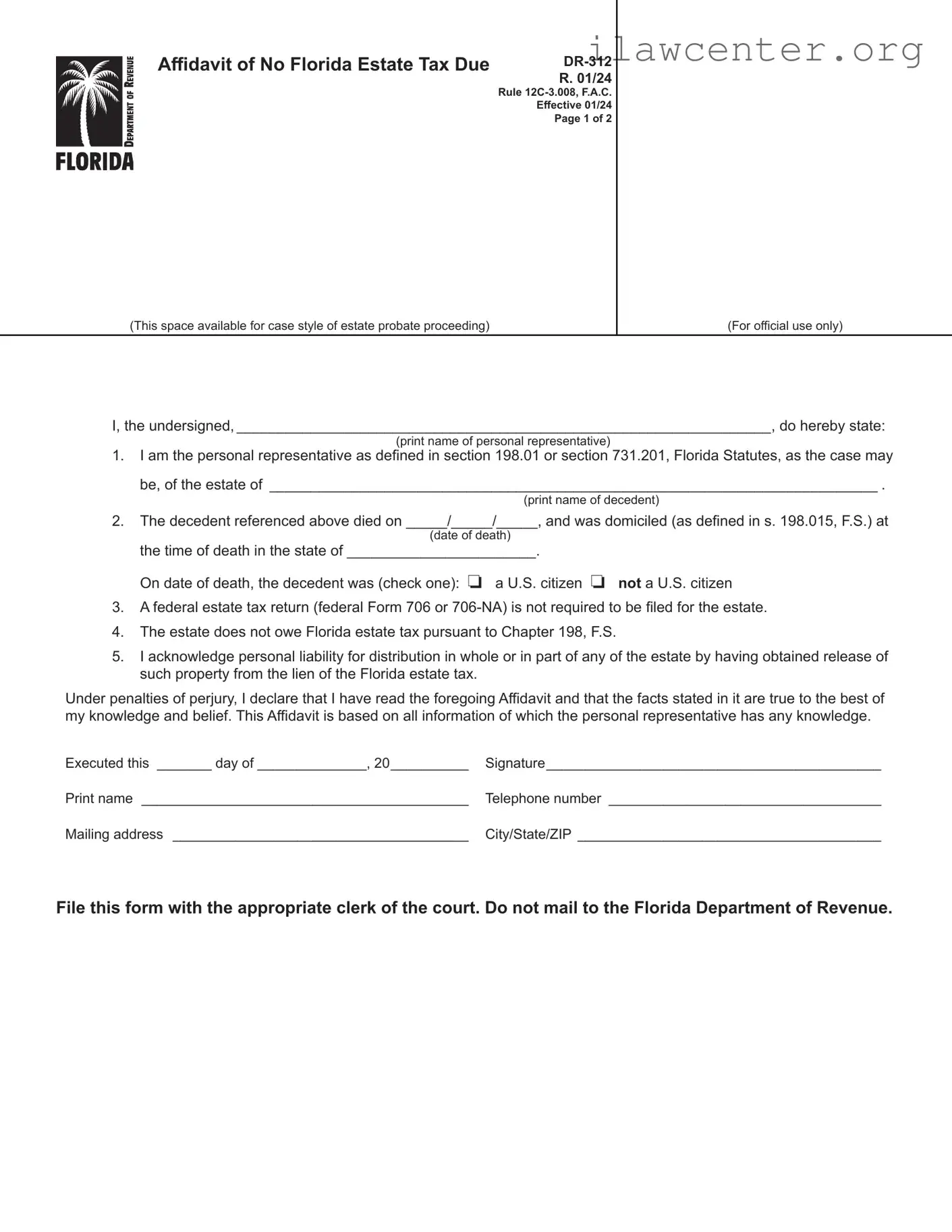
The Fl Dr 312 form, officially known as the Affidavit of No Florida Estate Tax Due, is a document used by personal representatives of estates to declare that no Florida estate tax is owed. This form is essential for estates that do not require the filing of a federal estate tax return. Completing the form accurately is crucial for ensuring the proper release of any estate tax liens.

To fill out the form, please click the button below.

Article Guide

The Florida Form DR-312, known as the Affidavit of No Florida Estate Tax Due, serves a crucial function for personal representatives managing the estates of deceased individuals. This form is specifically designed for estates that are not subject to Florida estate tax under Chapter 198 of the Florida Statutes, and it is also applicable when a federal estate tax return, such as Form 706 or 706-NA, is not required. By completing this affidavit, the personal representative affirms that the estate does not owe any Florida estate tax and acknowledges personal liability for any distributions made from the estate. The form must be filed with the appropriate clerk of the circuit court in the county where the decedent owned property, ensuring that it becomes part of the public record. Notably, the Florida Department of Revenue no longer issues Nontaxable Certificates for estates where the DR-312 has been properly filed. It is important for personal representatives to understand that this affidavit can be used as evidence of nonliability for Florida estate tax and effectively removes any existing tax lien from the estate. In addition to its legal implications, the form includes specific instructions and requirements that must be followed to ensure compliance with state regulations.

Fl Dr 312 Preview

A󰀩davit of No Florida Estate Tax Due
DR-312
R. 01/24
Rule 12C-3.008, F.A.C.
E󰀨ective 01/24
Page 1 of 2
(For o󰀩cial use only)(This space available for case style of estate probate proceeding)
I, the undersigned, _________________________________________________________________, do hereby state:
1. I am the personal representative as dened in section 198.01 or section 731.201, Florida Statutes, as the case may
be, of the estate of __________________________________________________________________________ .
2. The decedent referenced above died on _____/_____/_____, and was domiciled (as dened in s. 198.015, F.S.) at
the time of death in the state of _______________________.
On date of death, the decedent was (check one): o a U.S. citizen o not a U.S. citizen
3. A federal estate tax return (federal Form 706 or 706-NA) is not required to be led for the estate.
4. The estate does not owe Florida estate tax pursuant to Chapter 198, F.S.
5. I acknowledge personal liability for distribution in whole or in part of any of the estate by having obtained release of
such property from the lien of the Florida estate tax.
Under penalties of perjury, I declare that I have read the foregoing A󰀩davit and that the facts stated in it are true to the best of
my knowledge and belief. This A󰀩davit is based on all information of which the personal representative has any knowledge.
(print name of personal representative)
(print name of decedent)
(date of death)
Executed this _______ day of ______________, 20 __________ Signature ___________________________________________
Print name __________________________________________ Telephone number ___________________________________
Mailing address ______________________________________ City/State/ZIP _______________________________________
File this form with the appropriate clerk of the court. Do not mail to the Florida Department of Revenue.
Instructions for Completing Form DR-312
File this form with the appropriate clerk of the court if necessary. Do not mail to the Florida Department
of Revenue.
DR-312
R. 01/24
Page 2 of 2
General Information
If Florida estate tax is not due and a federal estate tax
return (federal Form 706 or 706-NA) is not required to be
led, the personal representatives of such estates may
complete Florida Form DR-312, Adavit of No Florida
Estate Tax Due. Note that the denition of “personal
representative” in Chapter 198, F.S., includes any
person who is in actual or constructive possession.
Therefore, this a󰀩davit may be used by “persons
in possession” of any property included in the
decedent’s gross estate.
Form DR-312 is admissible as evidence of nonliability
for Florida estate tax and will remove the Department’s
estate tax lien. The Florida Department of Revenue will
not issue Nontaxable Certicates for estates for which
the DR-312 has been duly led and no federal Form 706
or 706-NA is due.
The 3-inch by 3-inch space in the upper right corner of
the form is for the exclusive use of the clerk of the court.
Do not write, mark, or stamp in that space.
Where to File Form DR-312
Form DR-312 may be recorded directly with the clerk
of the circuit court in the county or counties where the
decedent owned property. Do not send this form to the
Florida Department of Revenue.
When to Use Form DR-312
Form DR-312 should be used when an estate is not
subject to Florida estate tax under Chapter 198, F.S., a
federal estate tax return (federal Form 706 or
706-NA) is not required to be led, and the
administrative proceedings commenced before
July 1, 2023.
NOTE: This form may NOT be used for estates that are
required to le federal form 706 or 706-NA.
Federal thresholds for ling federal Form 706 only:
(For informational purposes only. Please conrm with
Form 706 instructions.)
Date of Death
(year)
Dollar Threshold
for Filing Form 706
(value of gross estate)
2000 and 2001 $675,000
2002 and 2003 $1,000,000
2004 and 2005 $1,500,000
For 2006 and forward
go to the IRS website at
www.irs.gov to obtain
thresholds.
For thresholds for ling federal Form 706-NA
(nonresident alien decedent), contact your local Internal
Revenue Service o󰀩ce.
If an administration proceeding which commenced
before July 1, 2023 is pending for an estate, Form
DR-312 may be led in that proceeding. The case style
of the proceeding should be added in the large blank
space in the upper left portion of the DR-312. Form
DR-312 should be led with the clerk of the court and
duly recorded in the public records of the county or
counties where the decedent owned property.
Contact Us
Information and tutorials are available at oridarevenue.com/taxes/education.
Tax forms and brochures are available at oridarevenue.com/forms.
To speak with a Department of Revenue representative, call Taxpayer Services at 850-488-6800, Monday through
Friday, excluding holidays.
Reference Material
Rules are available at rules.org.
Rule Chapter 12C-3, Florida Administrative Code and Chapter 198, Florida Statutes.
Subscribe to Receive Email Alerts from the Department.
Subscribe to receive an email for ling due date reminders, Tax Information Publications (TIPs), or proposed rules.
Subscribe today at oridarevenue.com/dor/subscribe.

File Properties

Fact Name Description
Form Title The form is officially titled "Affidavit of No Florida Estate Tax Due DR-312".
Governing Law This form is governed by Chapter 198 of the Florida Statutes and Rule 12C-3.008 of the Florida Administrative Code.
Effective Date The current version of the form became effective in January 2021.
Purpose It is used to declare that an estate does not owe any Florida estate tax.
Filing Requirement This form must be filed with the clerk of the circuit court in the county where the decedent owned property.
Federal Tax Return A federal estate tax return (Form 706 or 706-NA) is not required for estates using this form.
Personal Representative The individual completing the form must be a personal representative as defined in Florida law.
Liability Acknowledgment The personal representative acknowledges liability for any distributions made from the estate.
Evidence of Nonliability Filing this form serves as evidence that the estate is not liable for Florida estate tax.
Restrictions on Use This form cannot be used for estates required to file federal Form 706 or 706-NA.

Instructions on Utilizing Fl Dr 312

After gathering the necessary information, proceed to fill out the Fl Dr 312 form carefully. Ensure that all details are accurate and complete to avoid any potential issues. Once completed, the form must be filed with the appropriate clerk of the court.

  1. Print your name in the designated space for the personal representative.
  2. In the next section, print the name of the decedent.
  3. Enter the date of death in the format MM/DD/YYYY.
  4. Specify the state where the decedent was domiciled at the time of death.
  5. Check the appropriate box to indicate if the decedent was a U.S. citizen or not.
  6. Confirm that a federal estate tax return is not required by stating "Yes" or "No" as appropriate.
  7. Indicate that the estate does not owe Florida estate tax pursuant to Chapter 198, F.S.
  8. Acknowledge personal liability for distribution of the estate by signing the form.
  9. Print your name again below your signature.
  10. Provide your telephone number.
  11. Fill in your mailing address, including city, state, and ZIP code.
  12. Leave the upper right corner of the form blank for the clerk of the court's use.
  13. Submit the completed form to the clerk of the circuit court in the county where the decedent owned property.

Important Facts about Fl Dr 312

What is the purpose of the FL DR 312 form?

The FL DR 312 form, also known as the Affidavit of No Florida Estate Tax Due, is used to declare that an estate is not subject to Florida estate tax. It serves as a formal statement from the personal representative of the estate, affirming that a federal estate tax return is not required and that the estate does not owe any Florida estate tax. This affidavit is crucial for removing any tax lien from the estate and can be used as evidence of nonliability for Florida estate tax.

Who is eligible to file the FL DR 312 form?

The form can be filed by the personal representative of the estate, which includes any individual who is in actual or constructive possession of the estate's property. This means that anyone who has control over the decedent's assets may complete and submit the form, provided that the estate is not subject to Florida estate tax and does not require a federal estate tax return.

When should the FL DR 312 form be filed?

The FL DR 312 form should be filed when it is confirmed that the estate is not liable for Florida estate tax under Chapter 198 of the Florida Statutes and when a federal estate tax return (Form 706 or 706-NA) is not required. It is important to note that this form cannot be used if the estate must file a federal estate tax return.

Where should the FL DR 312 form be submitted?

The completed FL DR 312 form must be filed directly with the clerk of the circuit court in the county or counties where the decedent owned property. It is essential to avoid sending this form to the Florida Department of Revenue, as it is not the appropriate recipient for this document.

What happens after the FL DR 312 form is filed?

Once the FL DR 312 form is filed and recorded with the clerk of the court, it serves as proof that the estate does not owe Florida estate tax. The Florida Department of Revenue will no longer issue Nontaxable Certificates for estates that have submitted this form, provided that no federal estate tax return is due. This filing helps clear any estate tax liens associated with the estate.

How can I get assistance with the FL DR 312 form?

If you have questions or need assistance regarding the FL DR 312 form, you can contact Taxpayer Services at the Florida Department of Revenue by calling 850-488-6800. They are available Monday through Friday, excluding holidays. Additionally, information and resources related to the form can be found on the Department’s website at floridarevenue.com.

Common mistakes

Filling out the FL DR-312 form can be straightforward, but many people make common mistakes that can lead to delays or complications. One frequent error is failing to provide the correct name of the decedent. The form requires the full name as it appears on legal documents. Omitting or misspelling this name can cause significant issues in processing.

Another common mistake is neglecting to specify the decedent's date of death. This date is crucial for establishing the timeline of the estate and determining tax obligations. Without it, the form may be considered incomplete, leading to rejection by the clerk of the court.

Many individuals also overlook the requirement to check the box indicating whether the decedent was a U.S. citizen. This detail is important for tax classification. Failing to check this box can lead to misunderstandings regarding the estate's tax status.

People often forget to sign the form. The signature is a declaration of the truthfulness of the information provided. Without it, the affidavit holds no legal weight, and the form cannot be filed.

Another mistake is providing an incorrect mailing address or telephone number. Accurate contact information is essential for any follow-up or clarification needed by the court. Inaccuracies can lead to delays in processing the form.

Some individuals do not file the form with the appropriate clerk of the court. It is critical to submit the FL DR-312 to the correct office based on where the decedent owned property. Sending it to the wrong location can result in significant delays.

Additionally, people sometimes fail to recognize that the form is not meant for estates that are required to file a federal estate tax return. Using this form incorrectly can lead to legal complications and potential penalties.

Lastly, many overlook the importance of reviewing the form for completeness before submission. Double-checking all entries can prevent minor errors from becoming major obstacles in the estate administration process.

Documents used along the form

The FL DR-312 form, known as the Affidavit of No Florida Estate Tax Due, is essential for personal representatives handling estates that do not owe Florida estate tax. Several other documents often accompany this form to ensure proper estate administration and compliance with legal requirements. Below is a list of these documents, along with a brief description of each.

  • Federal Form 706: This is the United States Estate (and Generation-Skipping Transfer) Tax Return. It is required for estates that exceed the federal estate tax exemption limit, detailing the value of the decedent's estate and any deductions.
  • Federal Form 706-NA: This form is specifically for non-resident aliens and is used to report estate taxes for estates that fall under U.S. jurisdiction but do not qualify for the same exemptions as U.S. citizens.
  • Last Will and Testament: This legal document outlines the decedent's wishes regarding the distribution of their assets and appointment of guardians for any minor children.
  • Letters of Administration: Issued by the court, this document grants the personal representative the authority to manage the estate and carry out the decedent's wishes as outlined in the will or according to state law if there is no will.
  • Inventory of Assets: This document lists all the assets owned by the decedent at the time of death, providing a clear picture of the estate's value for tax and distribution purposes.
  • Notice to Creditors: This is a formal notification to all potential creditors of the decedent's estate, informing them of the probate process and allowing them to make claims against the estate.
  • Estate Tax Return (if applicable): If the estate is subject to federal or state estate taxes, this return must be filed to report the estate's value and calculate any taxes owed.
  • Final Accounting: This document summarizes all financial transactions related to the estate, including income, expenses, and distributions to beneficiaries, ensuring transparency and accountability.

Each of these documents plays a vital role in the estate administration process. Properly preparing and filing them ensures compliance with legal requirements and helps facilitate the smooth transfer of assets to beneficiaries.

Similar forms

The Florida Form DR-312, known as the Affidavit of No Florida Estate Tax Due, serves a specific purpose in estate management. Several other documents share similarities with this form in terms of function and requirements. Here are seven such documents:

  • Federal Form 706: This form is used to report the estate tax for federal purposes. Like DR-312, it requires the personal representative to provide information about the decedent and the estate, but it is necessary when federal estate tax is due.
  • Federal Form 706-NA: This is the non-resident alien version of the federal estate tax return. It also requires detailed information about the estate and the decedent, similar to DR-312, but is specifically for non-U.S. citizens.
  • Florida Form DR-13: This is a "Notice of Election to Take a Family Allowance." It provides a way for the personal representative to request a family allowance for dependents of the decedent. Both forms require the personal representative to affirm their role and responsibilities.
  • Florida Form DR-1: This is the "Application for a Tax Deed." It allows for the application of a tax deed for properties that have been sold at a tax sale. Like DR-312, it involves the personal representative or an authorized individual affirming their right to act on behalf of the estate.
  • Florida Form DR-501: Known as the "Declaration of Domicile," this form is used to declare Florida as the legal residence of a decedent. It shares the need for personal identification and property details, similar to the requirements of DR-312.
  • Florida Form DR-315: This is the "Affidavit of No Florida Estate Tax Due for Decedents Dying on or after January 1, 2005." This form serves a similar purpose to DR-312, confirming that no estate tax is owed, but is specifically tailored for a different timeframe.
  • Florida Form DR-310: This is the "Notice of Administration." It informs interested parties about the administration of the estate. Both forms require the personal representative to provide information about the decedent and their estate, emphasizing the need for transparency in estate proceedings.

These documents, while serving different specific purposes, reflect similar themes of personal representation, responsibility, and the management of estate-related matters. Understanding these forms can help streamline the process of estate administration.

Dos and Don'ts

When filling out the FL DR-312 form, it's important to follow specific guidelines to ensure accuracy and compliance. Here’s a list of things to do and avoid:

  • Do clearly print the name of the personal representative in the designated area.
  • Do provide the full name of the decedent as it appears in legal documents.
  • Do check the appropriate box to indicate the decedent's citizenship status.
  • Do sign and date the affidavit to confirm the information is accurate.
  • Do file the form with the appropriate clerk of the court in the county where the decedent owned property.
  • Don't write or mark in the 3-inch by 3-inch space reserved for the clerk of the court.
  • Don't mail the form to the Florida Department of Revenue; it must be filed in person.
  • Don't use this form if a federal estate tax return is required.
  • Don't forget to include the case style of the estate probate proceeding if applicable.

Following these guidelines will help ensure that your form is processed smoothly and efficiently.

Misconceptions

Understanding the Fl Dr 312 form is crucial for personal representatives managing estates in Florida. However, several misconceptions can lead to confusion. Here are eight common misunderstandings:

  • The form is only for large estates. Many believe that the Fl Dr 312 form is only necessary for estates with significant assets. In reality, it applies to any estate that does not owe Florida estate tax.
  • You must file the form with the Florida Department of Revenue. Some think that the form should be mailed to the Department of Revenue. This is incorrect; it must be filed directly with the clerk of the circuit court.
  • The form is optional if no estate tax is due. A misconception exists that filing the form is optional. However, if no Florida estate tax is due, filing the form is necessary to remove any estate tax lien.
  • Only the decedent's heirs can file the form. Many assume that only heirs can complete the Fl Dr 312. In fact, any personal representative or person in possession of the estate can file it.
  • The form eliminates all tax liabilities. Some believe that filing the Fl Dr 312 absolves the estate of all tax liabilities. This is not true; it only addresses Florida estate tax.
  • Federal estate tax requirements do not affect the form. There is a common belief that federal estate tax obligations do not impact the use of the Fl Dr 312. However, if a federal estate tax return is required, the form cannot be used.
  • The form can be filed at any time. Some think that timing is flexible when filing the form. In reality, it should be filed promptly after the decedent’s passing, especially if an estate administration proceeding is pending.
  • Filing the form guarantees no future tax issues. Lastly, a misconception persists that filing the Fl Dr 312 guarantees that the estate will never face tax issues. While it addresses current liabilities, future changes in tax laws could affect the estate.

By clarifying these misconceptions, personal representatives can navigate the estate management process more effectively and ensure compliance with Florida law.

Key takeaways

  • Form Purpose: The Fl Dr 312 form, known as the Affidavit of No Florida Estate Tax Due, is used to confirm that an estate does not owe Florida estate tax.
  • Eligibility: This form is applicable only when a federal estate tax return (Form 706 or 706-NA) is not required, meaning the estate falls below certain value thresholds.
  • Personal Representative: The individual filling out the form must be the personal representative of the estate, as defined by Florida law.
  • Filing Location: Submit the completed form directly to the clerk of the circuit court in the county where the decedent owned property. Do not send it to the Florida Department of Revenue.
  • Liability Acknowledgment: By signing the form, the personal representative acknowledges personal liability for any distributions made from the estate.
  • Nonliability Evidence: Once filed, this affidavit serves as legal evidence that the estate is not liable for Florida estate tax and helps remove any associated tax liens.
  • Public Record: The form must be recorded in the public records of the county or counties where the decedent owned property, ensuring transparency and compliance.