Attorney-Verified  Affidavit of Gift Document for Florida

Attorney-Verified Affidavit of Gift Document for Florida

The Florida Affidavit of Gift form is a legal document used to formally declare the transfer of property or assets as a gift. This form helps ensure that the gift is properly documented, providing clarity and protection for both the giver and the recipient. If you’re ready to make a gift official, fill out the form by clicking the button below.

Article Guide

The Florida Affidavit of Gift form serves as a crucial instrument for individuals wishing to formally document the transfer of property or assets without the exchange of monetary compensation. This legal document is particularly significant in scenarios involving gifts of real estate or personal property, ensuring that the intent of the donor is clearly articulated and recognized. By utilizing this form, the donor affirms their intention to relinquish ownership rights, while the recipient acknowledges acceptance of the gift. The affidavit typically requires essential details, including the names and addresses of both parties, a description of the gifted property, and the date of the transfer. Furthermore, the form may necessitate notarization to validate the authenticity of the signatures involved, thereby enhancing its legal standing. Understanding the nuances of this form is vital for both donors and recipients, as it not only facilitates the smooth transfer of assets but also helps prevent potential disputes or misunderstandings in the future.

Florida Affidavit of Gift Preview

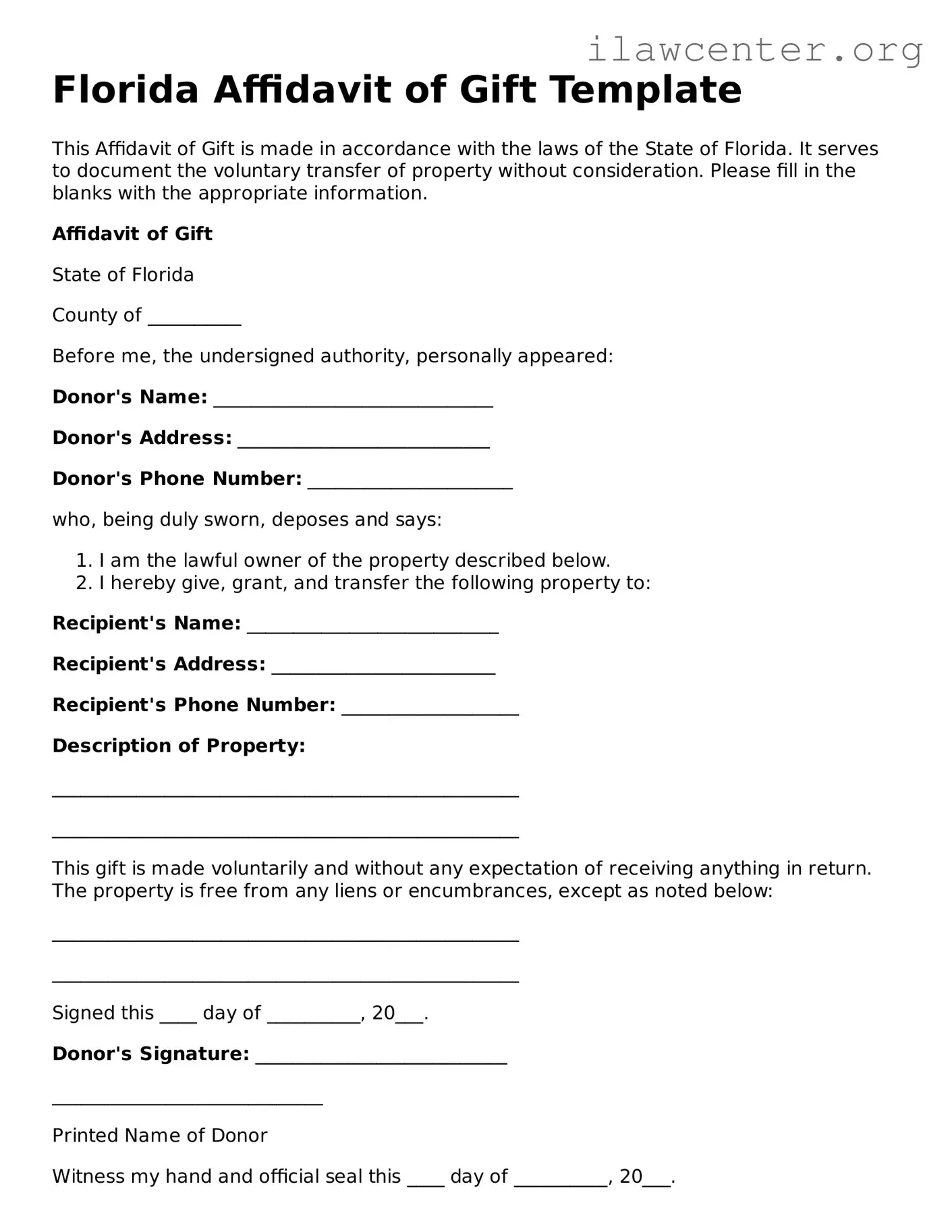
Florida Affidavit of Gift Template

This Affidavit of Gift is made in accordance with the laws of the State of Florida. It serves to document the voluntary transfer of property without consideration. Please fill in the blanks with the appropriate information.

Affidavit of Gift

State of Florida

County of __________

Before me, the undersigned authority, personally appeared:

Donor's Name: ______________________________

Donor's Address: ___________________________

Donor's Phone Number: ______________________

who, being duly sworn, deposes and says:

  1. I am the lawful owner of the property described below.
  2. I hereby give, grant, and transfer the following property to:

Recipient's Name: ___________________________

Recipient's Address: ________________________

Recipient's Phone Number: ___________________

Description of Property:

__________________________________________________

__________________________________________________

This gift is made voluntarily and without any expectation of receiving anything in return. The property is free from any liens or encumbrances, except as noted below:

__________________________________________________

__________________________________________________

Signed this ____ day of __________, 20___.

Donor's Signature: ___________________________

_____________________________

Printed Name of Donor

Witness my hand and official seal this ____ day of __________, 20___.

Notary Public Signature: ______________________

Notary Public Printed Name: __________________

My Commission Expires: ______________________

Seal:

PDF Form Characteristics

Fact Name Description
Purpose The Florida Affidavit of Gift form is used to document the transfer of property or assets as a gift.
Governing Law This form is governed by Florida Statutes, specifically Section 732.501 regarding gifts.
Notarization The form must be notarized to ensure its validity and authenticity.
Eligibility Any individual or entity can give a gift, provided they have the legal capacity to do so.
Recipient The recipient of the gift must be clearly identified in the affidavit.
Property Types The affidavit can be used for various types of property, including real estate, vehicles, and personal items.
Tax Implications Gifts may have tax implications; it is advisable to consult with a tax professional.
Revocation Once the affidavit is executed, the gift is generally irrevocable unless otherwise stated.
Filing Requirements While the affidavit does not need to be filed with any government office, keeping a copy for personal records is recommended.

Instructions on Utilizing Florida Affidavit of Gift

Once you have the Florida Affidavit of Gift form in hand, you will need to carefully complete it to ensure that all necessary information is accurately provided. This document will require specific details about the gift, the donor, and the recipient. Following the steps below will help you navigate the process smoothly.

  1. Begin by entering the date at the top of the form.
  2. Fill in the name of the donor, including their address and contact information.
  3. Provide the name of the recipient, along with their address and contact information.
  4. Clearly describe the gift being given. Include details such as the type of gift and its estimated value.
  5. Indicate any conditions or restrictions related to the gift, if applicable.
  6. Sign the form in the designated area to validate the affidavit.
  7. Have the form notarized to ensure its legal standing. This step typically requires both the donor and a notary public to be present.
  8. Make copies of the completed form for your records and for the recipient.

Once you have completed the form and ensured it is properly signed and notarized, you can proceed to deliver it to the recipient or keep it for your records, depending on your specific situation.

Important Facts about Florida Affidavit of Gift

What is the Florida Affidavit of Gift form?

The Florida Affidavit of Gift form is a legal document used to declare the transfer of property or assets as a gift. This form is often utilized when a person wishes to give property, such as real estate or personal belongings, to another individual without expecting anything in return. It serves as a formal record of the gift and can be important for tax purposes or to clarify ownership in the future.

Who needs to use the Affidavit of Gift form?

This form is typically used by individuals who are gifting property to family members, friends, or organizations. It is especially relevant in situations where the value of the gift exceeds a certain amount, as it helps to document the transaction and may be required for tax reporting. Donors who want to ensure that their intentions are clear and legally recognized should consider using this form.

What information is required on the form?

The Affidavit of Gift form generally requires specific information about both the donor and the recipient. This includes names, addresses, and contact information. Additionally, details about the property being gifted, such as its description and value, must be included. The form may also require signatures from both parties and witnesses to validate the transaction.

Is the Affidavit of Gift form legally binding?

Yes, once properly completed and signed, the Affidavit of Gift form is legally binding. It serves as evidence of the transfer of ownership from the donor to the recipient. However, it is important to ensure that all information is accurate and that the form complies with state laws to avoid any potential disputes in the future.

Do I need to file the Affidavit of Gift form with any government agency?

In Florida, the Affidavit of Gift form does not typically need to be filed with a government agency. However, it is advisable to keep a copy of the completed form for personal records. If the gift involves real estate, it may be necessary to record the transfer with the county property appraiser or recorder's office to ensure the change in ownership is officially recognized.

Common mistakes

Completing the Florida Affidavit of Gift form can be straightforward, but several common mistakes can lead to complications. One frequent error is failing to provide all required signatures. The form requires signatures from both the donor and the recipient. Omitting one can result in delays or rejection of the affidavit.

Another mistake involves incorrect or incomplete information. Each section of the form must be filled out accurately. Errors in names, addresses, or identification numbers can create issues with the processing of the affidavit. Double-checking all entries is essential to avoid these pitfalls.

Some individuals neglect to include the date of the gift. This date is crucial as it establishes when the transfer of ownership occurred. Without it, the affidavit may not hold up during legal scrutiny or for tax purposes.

Additionally, people often overlook the importance of notarization. The affidavit must be notarized to be considered valid. Failing to have the document notarized can render it ineffective, leading to further complications.

Another common oversight is not keeping a copy of the completed affidavit. Retaining a copy is vital for personal records and future reference. It serves as proof of the gift and can be useful if questions arise later.

Some individuals mistakenly assume that the affidavit is only necessary for large gifts. Regardless of the gift's value, the affidavit is required for any transfer of property to ensure proper documentation and compliance with state regulations.

People may also forget to check for any additional requirements specific to their situation. Depending on the nature of the gift, there may be local or state regulations that need to be addressed. Being aware of these can prevent future legal issues.

Another mistake is failing to consult with a professional when needed. While the form may seem simple, complex situations can arise. Seeking advice from a legal professional can provide clarity and ensure that the form is filled out correctly.

Lastly, procrastination can lead to errors. Waiting until the last minute to complete the affidavit may result in rushed decisions and mistakes. It is advisable to complete the form well in advance to allow for thorough review and corrections.

Documents used along the form

The Florida Affidavit of Gift form is an important document used to transfer ownership of property or assets without the exchange of money. When completing this process, several other forms and documents may be required to ensure everything is legally sound and properly recorded. Below is a list of commonly used documents that often accompany the Affidavit of Gift.

  • Title Transfer Form: This form is necessary for transferring the title of a vehicle or real estate. It provides the new owner with legal ownership rights.
  • Gift Tax Return (Form 709): If the value of the gift exceeds the annual exclusion limit, this federal form must be filed to report the gift to the IRS.
  • Bill of Sale: This document serves as proof of the transaction, detailing the items being gifted and confirming the transfer of ownership.
  • Warranty Deed: Often used in real estate transactions, this document guarantees that the property is free of any liens or encumbrances at the time of transfer.
  • Quitclaim Deed: This form allows the current owner to transfer their interest in a property to another party without making any guarantees about the title.
  • Power of Attorney: If the giver is unable to sign the Affidavit of Gift in person, a Power of Attorney can authorize someone else to act on their behalf.
  • Estate Planning Documents: These may include wills or trusts that outline how gifts are to be distributed among beneficiaries, ensuring clarity in the giver's intentions.
  • Identification Documents: Both the giver and the recipient may need to provide valid identification to verify their identities during the transaction.

Understanding these additional forms can help streamline the gifting process and ensure compliance with legal requirements. It is always wise to consult with a legal expert when navigating these documents to avoid any potential issues down the line.

Similar forms

The Affidavit of Gift form is a document that serves to confirm the transfer of a gift from one person to another. There are several other documents that share similarities with the Affidavit of Gift. Each of these documents also serves to establish ownership or transfer of property or assets. Below are eight documents that are similar to the Affidavit of Gift:

  • Bill of Sale: This document transfers ownership of tangible personal property from one party to another, similar to how an Affidavit of Gift transfers ownership of a gift.
  • Gift Deed: A legal document that conveys real property as a gift. Like the Affidavit of Gift, it requires the donor’s intention to give without expecting anything in return.
  • Trust Agreement: This document establishes a trust and outlines how assets will be managed and distributed. It can involve gifts and transfers of property, akin to the Affidavit of Gift.
  • Power of Attorney: This document allows one person to act on behalf of another. It can include the authority to make gifts, similar to the intentions expressed in an Affidavit of Gift.
  • Transfer on Death Deed: This allows a property owner to transfer real estate upon their death, similar to how an Affidavit of Gift facilitates the transfer of ownership during the owner’s lifetime.
  • Charitable Donation Receipt: This document acknowledges a gift made to a charity, confirming the transfer of ownership and similar to the purpose of the Affidavit of Gift.
  • Release of Claim: This document relinquishes a person's right to a claim, which can occur in the context of gifting property, much like the Affidavit of Gift.
  • Assignment of Interest: This document transfers rights or interests in a property or asset. It is similar to the Affidavit of Gift in that it formalizes the transfer process.

Dos and Don'ts

When filling out the Florida Affidavit of Gift form, it's important to follow certain guidelines to ensure accuracy and compliance. Here are seven things you should and shouldn't do:

  • Do read the form carefully before starting. Understanding each section will help avoid mistakes.
  • Don't leave any required fields blank. All necessary information must be provided.
  • Do provide accurate information. Double-check names, addresses, and other details.
  • Don't use abbreviations or nicknames. Use full legal names to avoid confusion.
  • Do sign and date the form. An unsigned affidavit is not valid.
  • Don't forget to have the affidavit notarized. This step is crucial for legal validity.
  • Do keep a copy for your records. Having documentation can be helpful in the future.

Misconceptions

The Florida Affidavit of Gift form is often misunderstood. Many people have misconceptions about its purpose, requirements, and implications. Here are five common misconceptions:

  1. It is only for large gifts.

    Many believe that the Affidavit of Gift is only necessary for substantial gifts. In reality, this form can be used for gifts of any value, as long as the giver wishes to document the transfer of ownership.

  2. Only family members can use this form.

    Some think that the Affidavit of Gift is restricted to family members. However, anyone can use this form to gift property or assets to another individual, regardless of their relationship.

  3. It must be notarized to be valid.

    While notarization can add an extra layer of authenticity, it is not a strict requirement for the Affidavit of Gift to be valid. The form can still be effective without a notary, as long as it is completed accurately and signed by the donor.

  4. It affects the recipient's taxes.

    Many people worry that using the Affidavit of Gift will create tax liabilities for the recipient. However, gifts under a certain value typically do not incur taxes for the recipient. It is essential to understand the tax implications, but the form itself does not trigger tax obligations.

  5. Once filed, it cannot be revoked.

    Some individuals believe that signing an Affidavit of Gift means they cannot change their mind. In fact, the donor retains the right to revoke the gift before it is officially accepted by the recipient, provided that the revocation is communicated clearly.

Understanding these misconceptions can help individuals navigate the process of gifting in Florida more effectively. Being informed ensures that both donors and recipients are aware of their rights and responsibilities.

Key takeaways

The Florida Affidavit of Gift form is an important document used to formalize the transfer of property or assets as a gift. Understanding how to fill it out and use it properly can help avoid potential legal issues. Here are key takeaways to consider:

  • Identify the Donor and Recipient: Clearly state the names and addresses of both the person giving the gift and the person receiving it.
  • Describe the Gift: Provide a detailed description of the property or assets being gifted. This may include real estate, vehicles, or personal belongings.
  • Value of the Gift: Indicate the fair market value of the gift at the time of transfer. This information is crucial for tax purposes.
  • Signatures Required: Both the donor and recipient must sign the affidavit. Their signatures should be notarized to ensure validity.
  • Use for Tax Exemptions: The affidavit can be used to claim tax exemptions on certain gifts, so keep it on file for future reference.
  • Consult with Professionals: It may be beneficial to consult with a tax advisor or attorney to understand the implications of gifting.
  • Keep Copies: Always retain copies of the completed affidavit for your records. This can be important for future transactions or disputes.
  • File Appropriately: Depending on the nature of the gift, consider filing the affidavit with the appropriate county office, especially for real estate gifts.