Attorney-Verified  Affidavit of Residency Document for Florida

Attorney-Verified Affidavit of Residency Document for Florida

The Florida Affidavit of Residency form is a legal document used to declare an individual's residency status in the state of Florida. This form is often required for various purposes, including enrollment in schools or obtaining certain benefits. Understanding how to complete this form accurately is essential for ensuring compliance with state regulations.

Ready to fill out the Florida Affidavit of Residency form? Click the button below to get started.

Article Guide

In the vibrant landscape of Florida, establishing residency is a crucial step for individuals seeking to access various benefits, including in-state tuition rates, voting rights, and eligibility for certain state programs. The Florida Affidavit of Residency form serves as a vital document in this process, enabling residents to declare their permanent address officially. This form is particularly important for students, military members, and those transitioning to new living situations. By completing the affidavit, individuals affirm their commitment to residing in Florida, providing essential information such as their name, address, and the duration of their residency. Additionally, the form may require the signature of a witness or notary, ensuring the legitimacy of the declaration. Understanding the nuances of this form can significantly impact one’s legal standing and access to state resources, making it imperative for Florida residents to familiarize themselves with its requirements and implications.

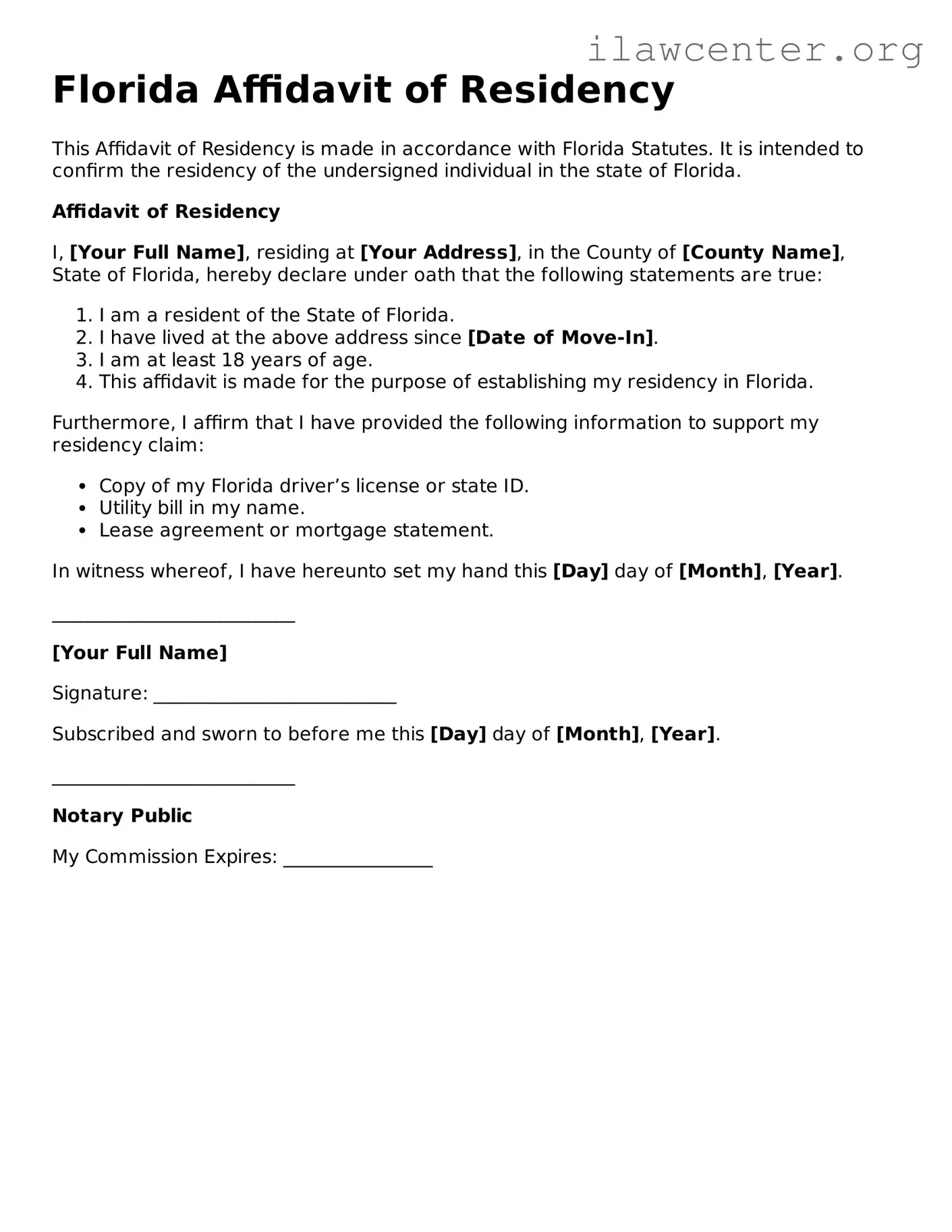
Florida Affidavit of Residency Preview

Florida Affidavit of Residency

This Affidavit of Residency is made in accordance with Florida Statutes. It is intended to confirm the residency of the undersigned individual in the state of Florida.

Affidavit of Residency

I, [Your Full Name], residing at [Your Address], in the County of [County Name], State of Florida, hereby declare under oath that the following statements are true:

  1. I am a resident of the State of Florida.
  2. I have lived at the above address since [Date of Move-In].
  3. I am at least 18 years of age.
  4. This affidavit is made for the purpose of establishing my residency in Florida.

Furthermore, I affirm that I have provided the following information to support my residency claim:

  • Copy of my Florida driver’s license or state ID.
  • Utility bill in my name.
  • Lease agreement or mortgage statement.

In witness whereof, I have hereunto set my hand this [Day] day of [Month], [Year].

__________________________

[Your Full Name]

Signature: __________________________

Subscribed and sworn to before me this [Day] day of [Month], [Year].

__________________________

Notary Public

My Commission Expires: ________________

PDF Form Characteristics

Fact Name Description
Purpose The Florida Affidavit of Residency form is used to declare an individual's residency status in the state of Florida, often for legal or administrative purposes.
Governing Law This form is governed by Florida Statutes, specifically under Title XLV, Chapter 92. This chapter outlines the requirements for residency declarations in various contexts.
Who Can Use It Any individual residing in Florida can complete this affidavit, whether for personal reasons, school enrollment, or other official matters.
Submission Process Once completed, the affidavit must be signed in the presence of a notary public and submitted to the relevant authority, such as a school or government office.

Instructions on Utilizing Florida Affidavit of Residency

Completing the Florida Affidavit of Residency form requires careful attention to detail. After filling out the form, you will need to submit it to the appropriate authority as instructed. Follow these steps to ensure accuracy and completeness.

  1. Begin by downloading the Florida Affidavit of Residency form from the official website or obtain a physical copy from your local office.
  2. Read the form carefully to understand all required sections before starting to fill it out.
  3. In the first section, provide your full name. Make sure to write it clearly and legibly.
  4. Enter your current address in the designated area. Include the street number, street name, city, state, and zip code.
  5. In the next section, indicate the length of time you have lived at this address. Be as accurate as possible.
  6. Provide your date of birth in the specified format. Ensure that the date is correct to avoid any issues.
  7. Sign and date the form at the bottom. Your signature confirms the information is true and accurate.
  8. If required, have the form notarized. This step may involve visiting a notary public.
  9. Make a copy of the completed form for your records before submission.
  10. Submit the form to the appropriate office or agency as directed, either in person or via mail.

Important Facts about Florida Affidavit of Residency

What is the Florida Affidavit of Residency form?

The Florida Affidavit of Residency form is a legal document used to confirm a person's residency in Florida. It is often required for various purposes, such as obtaining a driver's license, enrolling in school, or registering to vote. This form serves as a sworn statement, affirming that the individual resides at a specific address within the state.

Who needs to complete the Affidavit of Residency?

Individuals who need to prove their residency in Florida may need to complete this form. Common situations include new residents, students attending school in Florida, or anyone applying for services that require proof of residency. It is essential for those who may not have traditional documentation, such as utility bills or lease agreements, to verify their living situation.

How do I fill out the Affidavit of Residency form?

To fill out the Affidavit of Residency form, start by providing your personal information, including your name, current address, and contact details. You will also need to state the length of time you have lived at that address. After completing the form, you must sign it in front of a notary public, who will verify your identity and witness your signature.

Where can I obtain the Affidavit of Residency form?

The Affidavit of Residency form can typically be found online on official Florida government websites or at local government offices. You may also obtain it from the agency that requires it, such as the Department of Motor Vehicles (DMV) or your local school district. Make sure to use the most current version of the form to ensure compliance with any recent changes.

Is there a fee associated with the Affidavit of Residency?

What should I do if my residency status changes?

If your residency status changes, it is important to update your Affidavit of Residency. You should complete a new form reflecting your current address and circumstances. This is crucial to ensure that any services or benefits you receive are based on accurate and up-to-date information. Always keep a copy of the new affidavit for your records.

Common mistakes

Completing the Florida Affidavit of Residency form can be straightforward, but many individuals make common mistakes that can lead to delays or complications. Awareness of these pitfalls can help ensure a smooth process. Here are eight mistakes to watch out for.

One frequent error is failing to provide accurate personal information. It's essential to double-check that your name, address, and other identifying details are correct. Even a minor typo can cause significant issues, including the rejection of your affidavit.

Another common mistake is not signing the form. A signature is a crucial component of the affidavit. Without it, the document is incomplete and cannot be processed. Remember to sign in the designated area and ensure that your signature matches the name provided.

Some individuals overlook the requirement for witness signatures. Depending on the specific circumstances, you may need one or more witnesses to sign the affidavit. Be sure to check the requirements and have witnesses present when you complete the form.

In addition, many people forget to include the date when filling out the form. The date is important for establishing the timeline of residency. An affidavit without a date can raise questions about its validity.

Another mistake involves not providing supporting documentation. The affidavit often requires proof of residency, such as utility bills or lease agreements. Failing to include these documents can result in delays or rejection of your affidavit.

Some individuals also misinterpret the notarization requirement. If your affidavit needs to be notarized, ensure that you do this before submitting it. A notarized document carries more weight and is often necessary for legal purposes.

Moreover, many people neglect to review the form for completeness before submission. It's easy to miss a section or overlook a detail. Taking the time to review your affidavit can prevent unnecessary complications.

Finally, not keeping a copy of the submitted affidavit is a mistake that can lead to problems down the line. Always retain a copy for your records. This can be invaluable if questions arise regarding your residency status in the future.

Documents used along the form

The Florida Affidavit of Residency form is often accompanied by other important documents that help establish residency. These documents serve various purposes, from verifying identity to confirming address. Below are four common forms and documents that are frequently used alongside the Affidavit of Residency.

  • Proof of Identity: This document can include a driver's license, state ID, or passport. It verifies the individual's identity and is essential for many legal processes.
  • Utility Bill: A recent utility bill can serve as proof of residency. It typically shows the individual's name and address, confirming their residence in Florida.
  • Lease Agreement: A signed lease agreement outlines the terms of a rental arrangement. It provides evidence of residency and can be used to support claims made in the Affidavit of Residency.
  • Bank Statement: A bank statement that includes the individual's name and address can also serve as proof of residency. It is often used to validate the information provided in the Affidavit.

Gathering these documents can streamline the process of establishing residency in Florida. Each document plays a crucial role in supporting the claims made in the Affidavit of Residency, ensuring that all necessary information is available for review.

Similar forms

  • Lease Agreement: This document outlines the terms between a landlord and tenant, confirming where the tenant resides.
  • Utility Bill: A recent utility bill can serve as proof of residency, showing the individual's name and address.
  • Bank Statement: A bank statement that includes the person's name and address can help verify residency.
  • Government-Issued ID: A driver's license or state ID with the current address provides official proof of where someone lives.
  • Voter Registration: This document lists the individual's registered address, confirming their residency for voting purposes.
  • Tax Return: A tax return showing the individual's address can serve as evidence of residency for various legal matters.
  • Employment Records: Documents from an employer that include the employee's address can also verify residency.
  • Affidavit of Support: This form can be used to confirm residency, especially in immigration contexts, by stating where the individual resides.

Dos and Don'ts

When filling out the Florida Affidavit of Residency form, it is important to follow specific guidelines to ensure the process goes smoothly. Below is a list of things you should and shouldn't do.

  • Do provide accurate and truthful information.
  • Do ensure that all required fields are completed.
  • Do sign and date the affidavit in the designated areas.
  • Do keep a copy of the completed form for your records.
  • Do verify your residency status before submitting the form.
  • Don't leave any fields blank unless specified.
  • Don't use incorrect or outdated information.
  • Don't forget to have the affidavit notarized if required.
  • Don't submit the form without reviewing it for errors.
  • Don't ignore the deadlines for submission.

Misconceptions

Understanding the Florida Affidavit of Residency form is crucial for individuals seeking to establish their residency status in the state. However, several misconceptions exist about this document. Below is a list of eight common misconceptions, along with clarifications for each.

  • Misconception 1: The affidavit is only necessary for students.
  • This form is often associated with students, particularly those attending public schools or universities. However, it is also required for anyone seeking to prove residency for various legal and administrative purposes.

  • Misconception 2: The affidavit guarantees residency status.
  • Completing the affidavit does not automatically grant residency status. It serves as a declaration of residency, but additional documentation may be required to establish residency officially.

  • Misconception 3: Only homeowners can use the affidavit.
  • Renters can also complete the affidavit. The form is designed to accommodate various living situations, including those who lease or rent their homes.

  • Misconception 4: The affidavit must be notarized.
  • While notarization is a common practice for many legal documents, the Florida Affidavit of Residency does not necessarily require notarization unless specified by the entity requesting it.

  • Misconception 5: The affidavit is a one-time requirement.
  • Individuals may need to submit the affidavit multiple times, especially if they change their residency status or if the entity requesting it requires updated documentation.

  • Misconception 6: The affidavit is only for Florida residents.
  • While it is primarily used by individuals establishing residency in Florida, non-residents may also use the form to declare their intent to establish residency in the state.

  • Misconception 7: There is a standard format for the affidavit.
  • The affidavit may vary depending on the institution or agency requesting it. Individuals should always check for specific requirements before completing the form.

  • Misconception 8: The affidavit is sufficient for all legal purposes.
  • Although the affidavit serves as a useful document, it may not fulfill all legal requirements for residency in every context. Individuals should verify what additional documentation may be needed for specific situations.

Key takeaways

Filling out and using the Florida Affidavit of Residency form is a crucial step for individuals seeking to establish their residency in the state. Understanding the key aspects of this process can help ensure that you complete the form accurately and effectively.

  • Purpose of the Affidavit: The Florida Affidavit of Residency serves to confirm your residency status. It may be required for various legal and administrative purposes, such as obtaining a driver's license or registering to vote.
  • Eligibility Requirements: To use this form, you must be a legal resident of Florida. This typically means you have established a physical presence in the state and intend to make it your permanent home.
  • Accurate Information: It is vital to provide accurate and truthful information on the form. Any discrepancies or false statements can lead to legal consequences or denial of services.
  • Notarization: The affidavit must be signed in the presence of a notary public. This step adds an extra layer of verification to your claim of residency.
  • Documentation: Be prepared to provide supporting documents that prove your residency, such as utility bills, lease agreements, or bank statements. These documents can strengthen your affidavit and support your residency claim.

By keeping these key takeaways in mind, individuals can navigate the process of filling out and using the Florida Affidavit of Residency form with greater confidence and clarity.