Attorney-Verified  Cease and Desist Letter Document for Florida

Attorney-Verified Cease and Desist Letter Document for Florida

A Florida Cease and Desist Letter is a formal request to stop certain actions that may be harmful or unlawful. This letter serves as a warning, allowing the recipient a chance to correct their behavior before further legal action is taken. To take the next step, fill out the form by clicking the button below.

Article Guide

The Florida Cease and Desist Letter form serves as a crucial tool for individuals and businesses seeking to address unwanted actions or behaviors. This letter acts as a formal request to halt specific activities that may infringe upon rights or cause harm. It outlines the nature of the grievance, identifies the parties involved, and specifies the actions that need to cease. By providing clear details about the issue at hand, the letter establishes a record of the complaint and communicates the sender's intent to resolve the matter amicably. Furthermore, it often includes a deadline for compliance, emphasizing the urgency of the request. Understanding how to effectively utilize this form can empower individuals to protect their rights and interests without immediately resorting to legal action.

Florida Cease and Desist Letter Preview

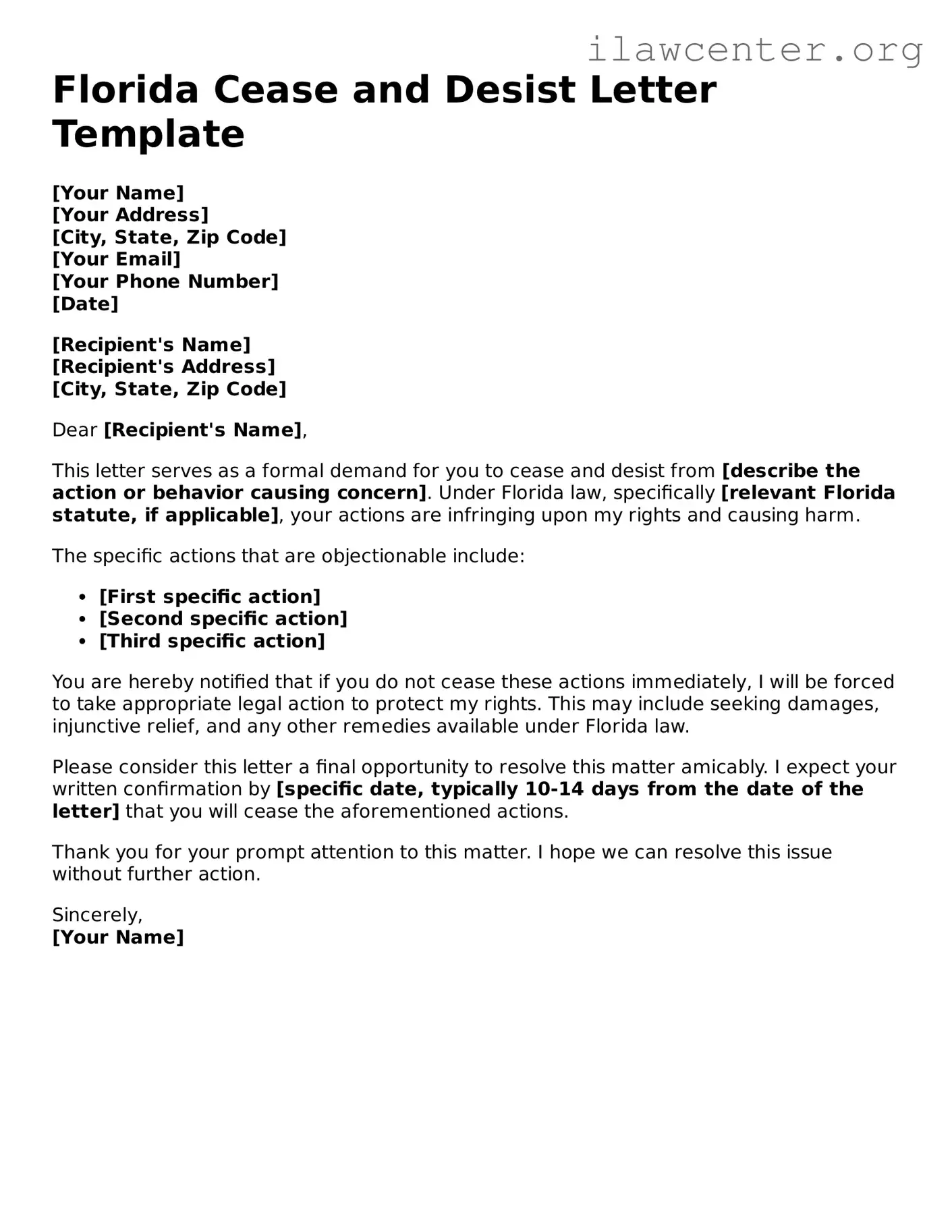
Florida Cease and Desist Letter Template

[Your Name]
[Your Address]
[City, State, Zip Code]
[Your Email]
[Your Phone Number]
[Date]

[Recipient's Name]
[Recipient's Address]
[City, State, Zip Code]

Dear [Recipient's Name],

This letter serves as a formal demand for you to cease and desist from [describe the action or behavior causing concern]. Under Florida law, specifically [relevant Florida statute, if applicable], your actions are infringing upon my rights and causing harm.

The specific actions that are objectionable include:

  • [First specific action]
  • [Second specific action]
  • [Third specific action]

You are hereby notified that if you do not cease these actions immediately, I will be forced to take appropriate legal action to protect my rights. This may include seeking damages, injunctive relief, and any other remedies available under Florida law.

Please consider this letter a final opportunity to resolve this matter amicably. I expect your written confirmation by [specific date, typically 10-14 days from the date of the letter] that you will cease the aforementioned actions.

Thank you for your prompt attention to this matter. I hope we can resolve this issue without further action.

Sincerely,
[Your Name]

PDF Form Characteristics

Fact Name Details
Definition A cease and desist letter is a formal request for an individual or organization to stop allegedly illegal activity.
Purpose The primary purpose is to inform the recipient of the alleged wrongdoing and to request that it cease immediately.
Governing Laws In Florida, cease and desist letters may be governed by various state laws, including those related to intellectual property and contract law.
Sender's Information The letter should clearly identify the sender, including name, address, and contact information.
Recipient's Information It is essential to include the recipient's name and address to ensure proper delivery and acknowledgment.
Allegations The letter must outline the specific actions that are considered unlawful or harmful, providing context for the request.
Response Timeframe Typically, the letter will specify a timeframe within which the recipient must respond or comply with the request.
Consequences of Non-Compliance The letter may indicate potential legal actions that could be pursued if the recipient fails to comply with the request.

Instructions on Utilizing Florida Cease and Desist Letter

After you have gathered the necessary information, you are ready to fill out the Florida Cease and Desist Letter form. This document is essential for formally requesting that someone stop a particular action that you believe is harmful or unlawful. Following these steps will help ensure that your letter is clear and effective.

  1. Identify the Sender: Write your name or the name of your organization at the top of the letter. Include your address, phone number, and email address.
  2. Identify the Recipient: Below your information, write the name of the person or entity you are addressing. Include their address as well.
  3. Date the Letter: Insert the date on which you are sending the letter.
  4. Subject Line: Write a brief subject line that states the purpose of the letter, such as "Cease and Desist Notice."
  5. State the Issue: Clearly explain the issue that has prompted you to send the letter. Be specific about the actions you want the recipient to stop.
  6. Provide Evidence: If applicable, include any evidence or examples that support your claim. This can help clarify your position.
  7. Request Action: Clearly state what you want the recipient to do. Use direct language to request that they cease the specified actions.
  8. Set a Deadline: Specify a reasonable timeframe within which you expect the recipient to comply with your request.
  9. Conclude the Letter: End with a polite but firm closing statement. You may wish to indicate that you will take further action if the recipient does not comply.
  10. Sign the Letter: Sign your name above your typed name. If the letter is from an organization, include the title of your position.

Once the letter is completed, it should be sent to the recipient via a method that provides proof of delivery, such as certified mail. This will ensure that you have a record of the correspondence should further action be necessary.

Important Facts about Florida Cease and Desist Letter

What is a Florida Cease and Desist Letter?

A Florida Cease and Desist Letter is a formal document that requests an individual or organization to stop engaging in certain activities. This letter is often used to address issues such as harassment, copyright infringement, or other unlawful actions. It serves as a warning before further legal action may be taken.

Who can use a Cease and Desist Letter in Florida?

Any individual or business that feels their rights are being violated can use a Cease and Desist Letter. This could include property owners, business owners, or anyone facing harassment or infringement of their rights. The letter can be an effective tool for resolving disputes without going to court.

What should be included in a Florida Cease and Desist Letter?

A well-crafted Cease and Desist Letter should include specific information. This typically involves the sender's name and address, the recipient's name and address, a clear description of the objectionable behavior, and a request for the recipient to stop the behavior. It may also outline potential legal consequences if the behavior continues.

Is a Cease and Desist Letter legally binding?

While a Cease and Desist Letter itself is not legally binding, it serves as a formal request. If the recipient fails to comply, the sender may choose to pursue legal action. The letter can be used as evidence in court to show that the sender attempted to resolve the issue amicably.

How should I deliver a Cease and Desist Letter?

Delivery of a Cease and Desist Letter can be done through various methods. Sending it via certified mail ensures that there is proof of delivery. Alternatively, you may choose to deliver it in person or send it via email, although email may not provide the same level of documentation.

Can I create my own Cease and Desist Letter?

Yes, you can create your own Cease and Desist Letter. However, it is important to ensure that it is clear, concise, and includes all necessary information. Many templates are available online, but customizing the letter to fit your specific situation is often beneficial.

What happens if the recipient ignores the Cease and Desist Letter?

If the recipient ignores the Cease and Desist Letter, the sender may consider taking further action. This could involve filing a lawsuit or seeking mediation. The letter serves as a documented attempt to resolve the issue before escalating it to the courts.

Can a Cease and Desist Letter be used for any type of dispute?

A Cease and Desist Letter can be used for various types of disputes, including intellectual property violations, harassment, defamation, and breach of contract. It is a versatile tool for addressing different legal issues without immediate recourse to litigation.

Do I need a lawyer to write a Cease and Desist Letter?

While it is not required to have a lawyer draft a Cease and Desist Letter, consulting with one can be beneficial. A lawyer can provide guidance on the content and tone of the letter, ensuring that it effectively communicates your position and complies with legal standards.

How effective is a Cease and Desist Letter?

The effectiveness of a Cease and Desist Letter can vary depending on the situation. In many cases, it prompts the recipient to stop the objectionable behavior. However, some individuals or businesses may not comply, necessitating further legal action. Overall, it can be an important first step in resolving disputes.

Common mistakes

When individuals attempt to fill out the Florida Cease and Desist Letter form, several common mistakes can lead to complications or ineffective communication. One frequent error is failing to clearly identify the recipient. It is essential to provide the full name and address of the person or entity that is being addressed. Without this information, the letter may not reach the intended party, rendering it ineffective.

Another mistake often made is not specifying the exact nature of the issue. A vague description can lead to misunderstandings. It is crucial to detail the actions or behaviors that are objectionable. By providing clear examples, the sender can better communicate their concerns and the desired outcome.

Additionally, some individuals neglect to include a deadline for compliance. A cease and desist letter should state a reasonable timeframe within which the recipient is expected to cease the specified actions. Without a deadline, the recipient may not take the letter seriously, leading to continued issues.

Moreover, failing to sign the letter can undermine its authority. A signature adds a personal touch and confirms that the letter is official. It is important for the sender to sign the document, as this step conveys seriousness and commitment to resolving the matter.

Lastly, many people overlook the importance of keeping a copy of the letter for their records. Documentation is vital in case further action is needed in the future. Retaining a copy ensures that the sender has proof of the communication and can refer back to it if necessary.

Documents used along the form

A Florida Cease and Desist Letter is an important document used to formally request that someone stop certain actions. When dealing with legal matters, several other forms and documents may be relevant to support your case or clarify the situation. Below is a list of additional documents that are often used alongside a Cease and Desist Letter.

  • Demand Letter: This document outlines a specific request for action, often related to a financial obligation or breach of contract. It serves as a formal notice before legal action is taken.
  • Affidavit: A written statement confirmed by oath, this document is often used to provide evidence or support claims made in legal proceedings.
  • Notice of Intent to Sue: This document informs the recipient of your intention to file a lawsuit if the issue is not resolved. It acts as a warning and can sometimes lead to a settlement.
  • Settlement Agreement: A legally binding contract that outlines the terms agreed upon by parties to resolve a dispute without going to court.
  • Response Letter: This letter is sent in reply to a Cease and Desist Letter, addressing the claims made and providing the recipient's perspective or defense.
  • Litigation Hold Notice: This document is used to preserve relevant documents and evidence when litigation is anticipated, ensuring that important information is not destroyed.
  • Release of Liability: A document that relinquishes one party from liability for certain actions or events, often used in agreements to settle disputes.

Understanding these documents can help you navigate legal situations more effectively. Each serves a unique purpose and can play a crucial role in resolving disputes or protecting your rights.

Similar forms

  • Demand Letter: A demand letter requests a specific action from the recipient, often related to a breach of contract or other legal obligation. Like a cease and desist letter, it outlines the sender's grievances and the desired resolution.
  • Warning Letter: A warning letter serves to inform the recipient of a potential issue, such as policy violations or misconduct. It shares similarities with a cease and desist letter in that it aims to prevent further action by notifying the recipient of the consequences of their behavior.
  • Notice of Violation: This document formally notifies an individual or entity of a violation of laws or regulations. Similar to a cease and desist letter, it often includes a request to correct the violation to avoid further legal action.
  • Settlement Letter: A settlement letter proposes a resolution to a dispute, often involving negotiations. It is similar to a cease and desist letter in that both documents seek to resolve issues before escalating to litigation.
  • Legal Complaint: A legal complaint initiates a lawsuit and outlines the plaintiff's claims against the defendant. While more formal and comprehensive than a cease and desist letter, both documents serve to address grievances and can lead to legal action if not resolved.
  • Non-Disclosure Agreement (NDA): An NDA protects confidential information between parties. While its purpose differs, both documents emphasize the importance of compliance and can serve as a basis for legal action if breached.

Dos and Don'ts

When filling out the Florida Cease and Desist Letter form, it's important to follow certain guidelines to ensure clarity and effectiveness. Here’s a list of things to do and avoid:

  • Do clearly identify the recipient. Include their full name and address.
  • Do state the specific behavior or action you want to cease. Be direct and precise.
  • Do provide a deadline for compliance. This encourages timely action.
  • Do keep a copy of the letter for your records. Documentation is key.
  • Do send the letter via certified mail. This ensures proof of delivery.
  • Don't use vague language. Ambiguity can lead to misunderstandings.
  • Don't include emotional language or threats. Stay professional and factual.
  • Don't forget to sign the letter. A signature adds legitimacy.
  • Don't make it overly complicated. Keep the letter straightforward.
  • Don't ignore local laws or regulations. Ensure compliance with Florida statutes.

Misconceptions

Understanding the Florida Cease and Desist Letter form is crucial for anyone considering its use. Here are ten common misconceptions that can lead to confusion:

  1. Cease and Desist Letters are legally binding. Many believe that sending a cease and desist letter automatically creates a legal obligation. In reality, it serves as a formal request but does not impose legal requirements unless acted upon in court.

  2. Only lawyers can draft these letters. While legal expertise can enhance the letter's effectiveness, individuals can draft their own cease and desist letters. Clarity and professionalism are key.

  3. They are only for copyright infringement. Cease and desist letters can address a variety of issues, including harassment, defamation, and contract violations, not just copyright issues.

  4. Sending one guarantees compliance. A cease and desist letter is a request, not a demand. The recipient may choose to ignore it, and further action may be necessary to enforce compliance.

  5. They can be sent anonymously. For a cease and desist letter to be effective, it should ideally be sent with identifiable information. Anonymity can undermine its seriousness.

  6. They must be notarized. Notarization is not a requirement for a cease and desist letter in Florida. However, having a witness can add credibility.

  7. They can only be sent in formal situations. Cease and desist letters can be used in informal disputes as well. They are a tool to communicate grievances effectively.

  8. There is a standard format for these letters. While there are common elements, the format can vary based on the situation. Tailoring the letter to the specific issue is important.

  9. They are only useful before a lawsuit. Cease and desist letters can also be effective after a dispute arises, as they may help to resolve issues without escalating to litigation.

  10. They can be ignored without consequences. Ignoring a cease and desist letter can lead to further legal action. It is often a precursor to more serious legal steps.

Understanding these misconceptions can help you navigate the use of a Florida Cease and Desist Letter more effectively. Take the time to ensure your communications are clear and appropriate for your situation.

Key takeaways

When filling out and using the Florida Cease and Desist Letter form, keep these key takeaways in mind:

  1. Understand the Purpose: A cease and desist letter is a formal request to stop illegal or harmful activities.
  2. Identify the Recipient: Clearly state the name and address of the individual or entity you are addressing.
  3. Be Specific: Describe the actions you want the recipient to stop. Provide details to avoid confusion.
  4. State Your Rights: Mention any legal rights or laws that support your request.
  5. Include a Deadline: Set a reasonable timeframe for the recipient to comply with your request.
  6. Keep a Copy: Retain a copy of the letter for your records. This may be important for future reference.
  7. Use Clear Language: Avoid legal jargon. Write in a straightforward manner that the recipient can easily understand.
  8. Consider Sending it via Certified Mail: This provides proof that the recipient received the letter.
  9. Consult an Attorney: If unsure about the content or legal implications, seek legal advice before sending.
  10. Follow Up: If the recipient does not comply, consider your next steps, which may include legal action.