Attorney-Verified  Divorce Settlement Agreement Document for Florida

Attorney-Verified Divorce Settlement Agreement Document for Florida

The Florida Divorce Settlement Agreement form is a crucial document that outlines the terms of a divorce, detailing how assets, debts, and responsibilities will be divided between spouses. This agreement serves as a roadmap for both parties, ensuring that everyone understands their rights and obligations after the marriage ends. Ready to take the next step? Fill out the form by clicking the button below!

Article Guide

When navigating the complexities of divorce in Florida, a Divorce Settlement Agreement form plays a crucial role in ensuring both parties reach a fair and amicable resolution. This document outlines the terms of the divorce, including the division of assets and debts, child custody arrangements, visitation rights, and spousal support. By clearly defining these aspects, the agreement helps to minimize future disputes and provides a roadmap for both parties moving forward. It's essential to address each component thoroughly, as this agreement will serve as the foundation for the final divorce decree. With a well-prepared form, individuals can focus on rebuilding their lives, knowing that their rights and responsibilities have been clearly established.

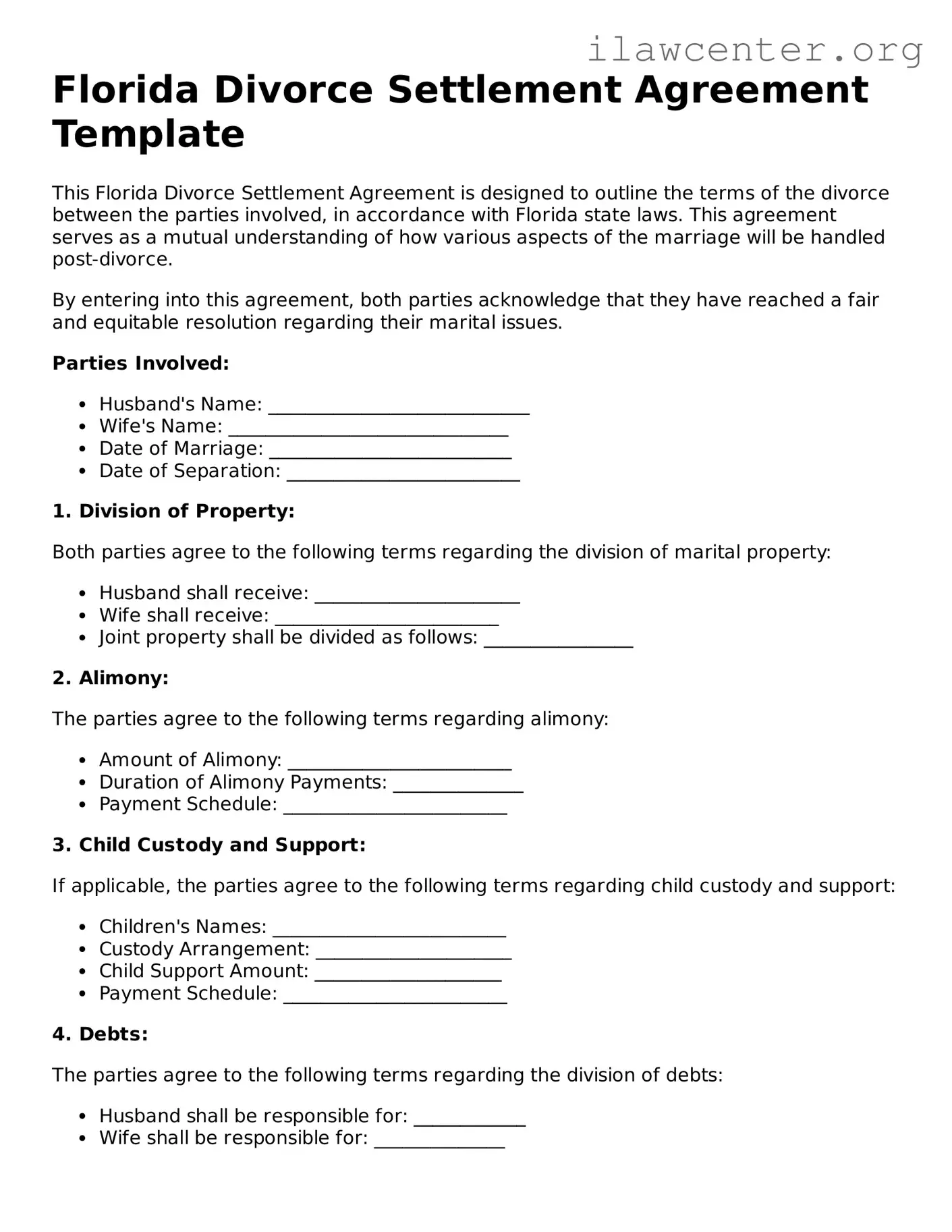
Florida Divorce Settlement Agreement Preview

Florida Divorce Settlement Agreement Template

This Florida Divorce Settlement Agreement is designed to outline the terms of the divorce between the parties involved, in accordance with Florida state laws. This agreement serves as a mutual understanding of how various aspects of the marriage will be handled post-divorce.

By entering into this agreement, both parties acknowledge that they have reached a fair and equitable resolution regarding their marital issues.

Parties Involved:

  • Husband's Name: ____________________________
  • Wife's Name: ______________________________
  • Date of Marriage: __________________________
  • Date of Separation: _________________________

1. Division of Property:

Both parties agree to the following terms regarding the division of marital property:

  • Husband shall receive: ______________________
  • Wife shall receive: ________________________
  • Joint property shall be divided as follows: ________________

2. Alimony:

The parties agree to the following terms regarding alimony:

  • Amount of Alimony: ________________________
  • Duration of Alimony Payments: ______________
  • Payment Schedule: ________________________

3. Child Custody and Support:

If applicable, the parties agree to the following terms regarding child custody and support:

  • Children's Names: _________________________
  • Custody Arrangement: _____________________
  • Child Support Amount: ____________________
  • Payment Schedule: ________________________

4. Debts:

The parties agree to the following terms regarding the division of debts:

  • Husband shall be responsible for: ____________
  • Wife shall be responsible for: ______________

5. Miscellaneous Provisions:

Both parties agree to the following additional terms:

  • Dispute Resolution Method: ________________
  • Governing Law: State of Florida

6. Signatures:

By signing below, both parties acknowledge that they understand and agree to the terms outlined in this Divorce Settlement Agreement.

__________________________ Husband's Signature Date: ______________

__________________________ Wife's Signature Date: ______________

This agreement is intended to be a legally binding document. It is advisable for both parties to seek independent legal counsel before signing.

PDF Form Characteristics

Fact Name Description
Governing Law The Florida Divorce Settlement Agreement form is governed by Florida Statutes, specifically Chapter 61, which addresses dissolution of marriage.
Purpose This form is used to outline the terms of a divorce settlement between spouses, covering issues such as asset division, child custody, and support payments.
Mandatory Use In contested divorces, this form is often required by the court to ensure that both parties have agreed to the terms of the settlement.
Filing Requirement The completed agreement must be filed with the court as part of the divorce proceedings to be enforceable.
Signature Requirement Both parties must sign the agreement, indicating their acceptance of the terms outlined within it.
Modification Once filed, the terms of the agreement can be modified only by mutual consent of both parties or by court order.
Child Support Guidelines If children are involved, the agreement must adhere to Florida's child support guidelines, which calculate support based on income and needs.
Asset Disclosure Full disclosure of assets and liabilities is required from both parties to ensure fairness in the settlement.
Legal Counsel While not mandatory, it is advisable for both parties to seek legal counsel to understand their rights and obligations before signing the agreement.

Instructions on Utilizing Florida Divorce Settlement Agreement

Completing the Florida Divorce Settlement Agreement form is a crucial step in finalizing a divorce. After filling out the form, it will need to be submitted to the appropriate court for approval. Ensure all information is accurate and complete to avoid delays in the process.

  1. Obtain a copy of the Florida Divorce Settlement Agreement form from the appropriate court or online resources.
  2. Begin by filling in your full name and contact information at the top of the form.
  3. Enter your spouse's full name and contact information in the designated section.
  4. Provide details regarding the date of marriage and date of separation.
  5. List all assets and debts acquired during the marriage, including property, bank accounts, and loans.
  6. Specify how the assets and debts will be divided between you and your spouse.
  7. Include any agreements regarding alimony or spousal support, if applicable.
  8. Detail any arrangements for child custody, visitation, and child support if children are involved.
  9. Review the entire form for accuracy and completeness.
  10. Sign and date the form in the appropriate section.
  11. Have your spouse sign the form as well, if required.
  12. Make copies of the completed form for your records.
  13. Submit the form to the court along with any required filing fees.

Important Facts about Florida Divorce Settlement Agreement

What is a Florida Divorce Settlement Agreement?

A Florida Divorce Settlement Agreement is a legal document that outlines the terms of a divorce between two parties. It addresses key issues such as asset division, child custody, child support, and alimony. This agreement is essential as it helps both parties reach a mutual understanding and can be submitted to the court for approval, making it enforceable by law.

How do I create a Divorce Settlement Agreement in Florida?

To create a Divorce Settlement Agreement in Florida, both parties should first discuss and negotiate the terms they wish to include. It is advisable to consider all relevant aspects, such as property distribution, debts, and any arrangements regarding children. Once an agreement is reached, it should be documented in writing, signed by both parties, and submitted to the court for approval. Legal assistance can be beneficial to ensure that the agreement complies with Florida laws.

Is it necessary to have a lawyer for a Divorce Settlement Agreement?

While it is not legally required to have a lawyer to draft a Divorce Settlement Agreement, it is highly recommended. A lawyer can provide valuable guidance, help navigate complex legal issues, and ensure that the agreement is fair and complies with state laws. Having legal representation can also prevent future disputes and protect your rights throughout the divorce process.

What happens if my spouse and I cannot agree on the terms?

If you and your spouse cannot reach an agreement on the terms of the divorce, you may need to go through mediation or court proceedings. Mediation involves a neutral third party who helps facilitate discussions and negotiations. If mediation fails, the court will make decisions regarding asset division, custody, and support based on the evidence presented. It is important to approach this process with an open mind and a willingness to compromise.

Can a Divorce Settlement Agreement be modified after it is finalized?

Yes, a Divorce Settlement Agreement can be modified after it is finalized, but only under certain circumstances. Significant changes in circumstances, such as a job loss, relocation, or changes in the needs of children, may warrant a modification. Both parties must agree to the changes, and the modified agreement should be submitted to the court for approval to ensure it is legally binding.

How long does it take to finalize a Divorce Settlement Agreement in Florida?

The time it takes to finalize a Divorce Settlement Agreement in Florida can vary widely based on several factors. If both parties agree on the terms and have all necessary documentation ready, the process can be relatively quick, possibly taking a few weeks. However, if there are disputes or if mediation is required, it may take several months or longer. Being organized and proactive can help expedite the process.
Common mistakes

Filling out the Florida Divorce Settlement Agreement form can be a daunting task, and many individuals make common mistakes that can lead to complications down the line. One frequent error is failing to provide complete and accurate information. It's essential to include all relevant details about assets, debts, and any children involved. Missing or incorrect information can delay the process and may even result in legal issues later.

Another common mistake is not understanding the terms of the agreement. Many people sign the document without fully comprehending what they are agreeing to. It’s crucial to take the time to read through each section carefully and, if necessary, seek clarification from a legal professional. This ensures that all parties are on the same page and helps avoid misunderstandings.

Some individuals overlook the importance of including all assets and liabilities in the agreement. This includes not only major items like homes and vehicles but also bank accounts, retirement funds, and any debts. Failing to disclose all financial information can lead to disputes and may even affect the final outcome of the divorce.

Additionally, people often forget to address child custody and support arrangements adequately. It's vital to outline these terms clearly to avoid confusion later. If both parents cannot agree on custody, the court may need to intervene, which can lead to additional stress and complications.

Another mistake is neglecting to consider tax implications. Some individuals may not realize that certain financial decisions made during the divorce can have tax consequences. For example, dividing retirement accounts or selling a home may affect tax liabilities. Consulting with a financial advisor can help in making informed decisions.

People sometimes fail to include a plan for future modifications. Life circumstances can change, and it’s wise to have a clause in the agreement that outlines how modifications can be made to custody or support arrangements in the future. This foresight can save time and effort if changes are needed later.

Moreover, individuals may not seek legal advice before submitting the form. While it’s possible to fill out the form independently, having a lawyer review the agreement can provide peace of mind. A legal professional can spot potential issues and ensure that the agreement is fair and legally sound.

Many individuals also forget to sign and date the agreement properly. It may seem trivial, but missing signatures can render the document invalid. Double-checking that all necessary parties have signed and dated the form is a simple yet crucial step in the process.

Finally, people often underestimate the importance of keeping copies of the completed agreement. After the form is submitted, it’s essential to retain a copy for personal records. This can be helpful for future reference and ensures that all parties have access to the same information.

Documents used along the form

When navigating a divorce in Florida, several forms and documents may accompany the Divorce Settlement Agreement. Each of these documents serves a specific purpose and helps ensure that all aspects of the divorce are addressed. Below is a list of commonly used forms and documents in conjunction with the Divorce Settlement Agreement.

  • Petition for Dissolution of Marriage: This document initiates the divorce process. It outlines the reasons for the divorce and requests the court to dissolve the marriage.
  • Financial Affidavit: A detailed statement of each party’s financial situation, including income, expenses, assets, and liabilities. This document is crucial for equitable distribution of property and spousal support considerations.
  • Child Support Guidelines Worksheet: This form calculates the amount of child support based on the income of both parents and the needs of the child, ensuring compliance with state guidelines.
  • Parenting Plan: This document outlines the custody arrangement and visitation schedule for children. It addresses how decisions regarding the children will be made and the responsibilities of each parent.
  • Marital Settlement Agreement: Similar to the Divorce Settlement Agreement, this document details how marital assets and debts will be divided. It is often included in the final judgment of divorce.
  • Notice of Hearing: This form notifies all parties involved of the scheduled court hearing related to the divorce proceedings. It ensures that everyone is aware of when and where to appear.
  • Final Judgment of Dissolution of Marriage: This is the court's official order that finalizes the divorce. It incorporates the terms of the Divorce Settlement Agreement and any other relevant documents.
  • Certificate of Compliance with Mandatory Disclosure: This document confirms that both parties have provided all required financial disclosures as mandated by Florida law, ensuring transparency in the proceedings.

Each of these documents plays a vital role in the divorce process, helping to clarify issues and protect the rights of all parties involved. Ensuring that all necessary forms are completed accurately can facilitate a smoother and more efficient divorce experience.

Similar forms

  • Separation Agreement: Similar to a Divorce Settlement Agreement, a Separation Agreement outlines the terms of a couple's separation, including asset division and child custody arrangements. It is often used when couples decide to live apart but not yet divorce.
  • Child Custody Agreement: This document focuses specifically on the arrangements for children after a divorce. It details custody arrangements, visitation schedules, and child support, much like the custody provisions in a Divorce Settlement Agreement.
  • Property Settlement Agreement: This agreement specifically addresses the division of property and debts between spouses. It serves a similar purpose to the property division section of a Divorce Settlement Agreement.
  • Spousal Support Agreement: This document outlines the terms of spousal support or alimony. It is akin to the support provisions found in a Divorce Settlement Agreement.
  • Marital Settlement Agreement: This is a comprehensive document that resolves all issues related to the divorce, including property division, child custody, and support, similar to a Divorce Settlement Agreement.
  • Final Judgment of Divorce: This court order finalizes the divorce and incorporates the terms of the Divorce Settlement Agreement. It confirms the agreement's terms legally and is essential for enforcing the settlement.
  • Parenting Plan: This document outlines how parents will share responsibilities and make decisions regarding their children post-divorce. It aligns with the child-related provisions in a Divorce Settlement Agreement.

Dos and Don'ts

When filling out the Florida Divorce Settlement Agreement form, it is crucial to be thorough and accurate. Here are seven essential dos and don'ts to guide you through the process:

  • Do read the entire form carefully before starting.
  • Do provide complete and accurate information about your assets and liabilities.
  • Do consult with a legal professional if you have questions.
  • Do keep copies of all documents for your records.
  • Don't rush through the form; take your time to ensure accuracy.
  • Don't leave any sections blank; if a section does not apply, indicate that.
  • Don't ignore deadlines; submit the form on time to avoid complications.

Misconceptions

When it comes to the Florida Divorce Settlement Agreement form, there are several misconceptions that can lead to confusion and mistakes. Understanding the truth behind these common beliefs can help ensure a smoother divorce process.

  1. It’s only necessary if there are children involved. Many people believe that a settlement agreement is only required when children are part of the divorce. In reality, this form is crucial for all divorces, as it outlines the division of assets and debts, regardless of whether children are involved.
  2. Once signed, the agreement cannot be changed. Some individuals think that once they sign the settlement agreement, they are locked into those terms forever. However, modifications can be made if both parties agree and follow the proper legal procedures.
  3. It’s a simple form that doesn’t require legal assistance. While the form may seem straightforward, it’s wise to seek legal advice. An attorney can help ensure that your rights are protected and that the agreement is fair and comprehensive.
  4. All assets will be split 50/50. Many people assume that assets must be divided equally. In Florida, the division of property is based on equitable distribution, meaning that assets may be divided in a way that is fair but not necessarily equal.
  5. Only one spouse needs to sign the agreement. It’s a common misconception that only one party's signature is needed for the settlement to be valid. Both spouses must sign the agreement for it to be enforceable.
  6. The court automatically approves the agreement. Some believe that once they submit the settlement agreement, the court will automatically approve it. The court reviews the agreement to ensure it is fair and in compliance with the law before approval.
  7. Verbal agreements are sufficient. Many think that a verbal agreement is enough. However, for a divorce settlement to be legally binding, it must be documented in writing and signed by both parties.
  8. It only covers financial matters. While the settlement agreement does address financial issues, it can also cover other aspects, such as alimony and child custody arrangements, making it a comprehensive document.
  9. Filing the form is the last step in the divorce process. Some individuals believe that submitting the settlement agreement is the final step. In fact, there are often additional steps required, such as attending a final hearing where the court formally dissolves the marriage.

By understanding these misconceptions, you can approach the Florida Divorce Settlement Agreement with greater clarity and confidence. Taking the time to educate yourself on the process will help ensure that your interests are protected and that the agreement meets your needs.

Key takeaways

When filling out and using the Florida Divorce Settlement Agreement form, consider these key takeaways:

  1. Understand the Purpose: The agreement outlines how assets, debts, and responsibilities will be divided between both parties.
  2. Complete All Sections: Ensure every section of the form is filled out completely. Incomplete forms can lead to delays or complications.
  3. Be Honest and Transparent: Disclose all relevant financial information. Hiding assets can have serious legal consequences.
  4. Consider Legal Advice: Consulting with a legal professional can provide clarity and help protect your rights.
  5. Review for Accuracy: Double-check all entries for accuracy before submitting. Errors can complicate the divorce process.
  6. File Timely: Submit the completed agreement to the court as soon as possible to avoid unnecessary delays in your divorce proceedings.

These takeaways will help ensure a smoother process as you navigate your divorce settlement in Florida.