Attorney-Verified  Do Not Resuscitate Order Document for Florida

Attorney-Verified Do Not Resuscitate Order Document for Florida

A Florida Do Not Resuscitate Order (DNRO) form is a legal document that allows individuals to express their wishes regarding resuscitation efforts in the event of a medical emergency. By completing this form, you ensure that your preferences are respected and followed by healthcare providers. Take control of your healthcare decisions by filling out the form; click the button below to get started.

Article Guide

In the state of Florida, the Do Not Resuscitate Order (DNRO) form plays a crucial role in guiding medical decisions for individuals who wish to decline resuscitation efforts in the event of a medical emergency. This legally recognized document allows patients to express their preferences regarding life-sustaining treatments, particularly cardiopulmonary resuscitation (CPR). When properly completed and signed by a physician, the DNRO form ensures that healthcare providers respect the patient's wishes in critical situations. It is important for individuals to understand the significance of this form, as it not only facilitates communication between patients, families, and medical teams but also alleviates the emotional burden of making difficult decisions during emergencies. The DNRO is typically used by those with terminal illnesses or severe medical conditions, allowing them to maintain control over their end-of-life care. Understanding the nuances of this form, including how to obtain and complete it, can empower individuals to make informed choices that align with their values and preferences.

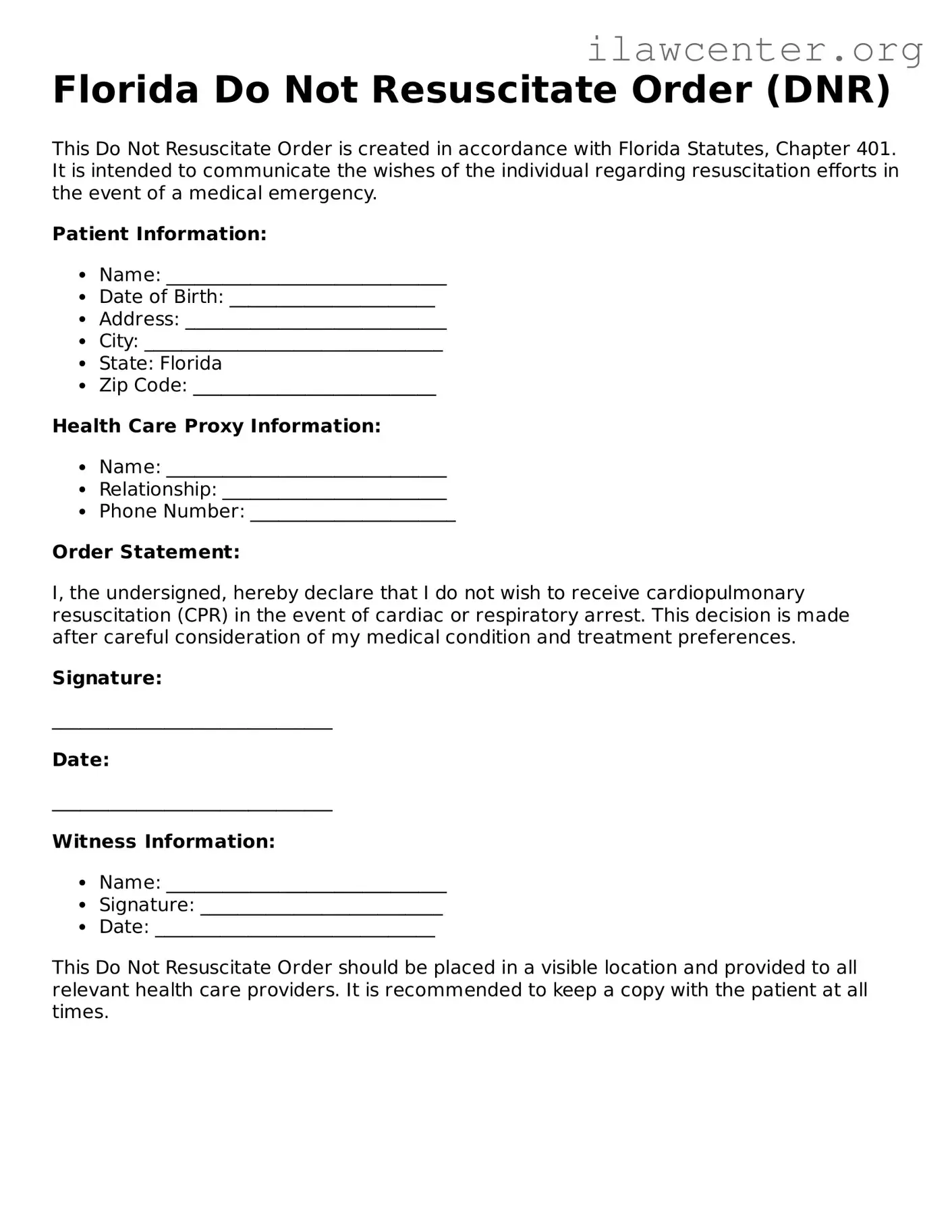
Florida Do Not Resuscitate Order Preview

Florida Do Not Resuscitate Order (DNR)

This Do Not Resuscitate Order is created in accordance with Florida Statutes, Chapter 401. It is intended to communicate the wishes of the individual regarding resuscitation efforts in the event of a medical emergency.

Patient Information:

  • Name: ______________________________
  • Date of Birth: ______________________
  • Address: ____________________________
  • City: ________________________________
  • State: Florida
  • Zip Code: __________________________

Health Care Proxy Information:

  • Name: ______________________________
  • Relationship: ________________________
  • Phone Number: ______________________

Order Statement:

I, the undersigned, hereby declare that I do not wish to receive cardiopulmonary resuscitation (CPR) in the event of cardiac or respiratory arrest. This decision is made after careful consideration of my medical condition and treatment preferences.

Signature:

______________________________

Date:

______________________________

Witness Information:

  • Name: ______________________________
  • Signature: __________________________
  • Date: ______________________________

This Do Not Resuscitate Order should be placed in a visible location and provided to all relevant health care providers. It is recommended to keep a copy with the patient at all times.

PDF Form Characteristics

Fact Name Description
Definition The Florida Do Not Resuscitate Order (DNRO) form allows individuals to refuse resuscitation in case of cardiac arrest or respiratory failure.
Governing Law The DNRO is governed by Florida Statutes, specifically Section 401.45.
Eligibility Any adult, or a minor with parental consent, can complete a DNRO form.
Signature Requirement The form must be signed by the patient or their legal representative, along with a physician’s signature.
Form Availability The DNRO form is available through various state health agencies and online resources.
Medical Record Once completed, the DNRO should be placed in the patient's medical record for easy access by healthcare providers.
Revocation The DNRO can be revoked at any time by the patient or their legal representative.
Emergency Services Emergency medical services must honor a valid DNRO form when presented at the scene.
Legal Protection Healthcare providers are protected from liability for following the DNRO, provided it is valid and properly executed.
Public Awareness Public education on the DNRO is encouraged to ensure that individuals understand their rights regarding resuscitation.

Instructions on Utilizing Florida Do Not Resuscitate Order

Filling out the Florida Do Not Resuscitate Order form requires careful consideration and attention to detail. Once completed, this form needs to be signed and dated by the appropriate parties to ensure it is legally valid. Below are the steps to guide you through the process of filling out the form.

  1. Obtain the Florida Do Not Resuscitate Order form. This can typically be found online or through healthcare providers.
  2. Begin by entering the patient’s full name at the top of the form.
  3. Provide the patient’s date of birth. This helps to clearly identify the individual.
  4. Indicate the patient’s address. This information is necessary for identification purposes.
  5. Next, check the appropriate box to indicate whether the patient is an adult or a minor.
  6. Review the section that outlines the patient’s medical condition. Make sure this accurately reflects their current health status.
  7. Have the patient or their legal representative sign the form. This signature is crucial for the document's validity.
  8. Date the form at the time of signing. This establishes when the order becomes effective.
  9. Ensure that a witness signs the form. This adds an extra layer of verification.
  10. Keep a copy of the completed form for personal records and provide copies to relevant healthcare providers.

Important Facts about Florida Do Not Resuscitate Order

What is a Florida Do Not Resuscitate Order (DNRO)?

A Florida Do Not Resuscitate Order is a legal document that allows a person to refuse cardiopulmonary resuscitation (CPR) and other life-saving measures in the event of a medical emergency. This order is intended for individuals who have a terminal condition or are in a state where resuscitation would not improve their quality of life.

Who can create a DNRO in Florida?

In Florida, any competent adult can create a Do Not Resuscitate Order. This includes individuals who are at least 18 years old and are capable of making informed decisions about their medical care. Additionally, a parent or legal guardian can create a DNRO for a minor child.

How is a DNRO completed and signed?

The DNRO must be completed using the official Florida Department of Health form. The individual must sign the form, and it should also be signed by a physician who is licensed in Florida. This physician must confirm that the individual has a terminal condition. Once signed, the form should be kept in a place where it can be easily accessed in case of a medical emergency.

Where should I keep my DNRO?

It is important to keep your DNRO in a visible and accessible location. Many people choose to keep it in their medical records or with their healthcare provider. Additionally, it can be helpful to inform family members and caregivers about its location so that they can present it in an emergency.

What happens if I change my mind about my DNRO?

If you decide to revoke or change your Do Not Resuscitate Order, you can do so at any time. Simply destroy the original form and inform your healthcare providers and family members about your decision. You may also want to create a new DNRO if you wish to establish different preferences for your medical care.

Will my DNRO be honored in a hospital or emergency situation?

Yes, a valid DNRO should be honored by healthcare providers in hospitals and emergency situations. Medical personnel are trained to recognize and respect these orders. However, it is crucial that the DNRO is properly completed and signed to ensure that it is legally binding.

Can I have a DNRO if I am not terminally ill?

A Do Not Resuscitate Order is generally intended for individuals with terminal conditions. However, if you have specific wishes regarding your medical treatment and end-of-life care, you may want to consider discussing these preferences with your healthcare provider. They can guide you on the best way to document your wishes, possibly through other advance directives.

Common mistakes

Filling out a Florida Do Not Resuscitate Order (DNRO) form is a serious task that requires careful attention. One common mistake people make is not consulting with a healthcare professional before completing the form. It’s essential to understand what a DNRO means for your medical care and how it aligns with your wishes. Without this guidance, individuals may inadvertently choose options that do not reflect their true intentions.

Another frequent error is failing to sign the form correctly. The DNRO must be signed by the patient or their legal representative. If the signature is missing or not properly dated, the form may not be valid. This oversight can lead to unwanted medical interventions during critical moments when clarity is crucial.

People also often overlook the importance of discussing their decision with family members. A DNRO can lead to confusion and conflict among loved ones if they are not aware of the patient’s wishes. Open conversations can help ensure that everyone understands the decision and can support it during challenging times.

Additionally, some individuals neglect to keep the DNRO form accessible. It’s not enough to fill it out; the form should be easily found by medical personnel in an emergency. Placing copies in obvious locations, like on the refrigerator or with medical records, can make a significant difference when every second counts.

Lastly, many forget to review and update their DNRO as circumstances change. Life events, such as a new diagnosis or changes in health status, may warrant a reassessment of one’s wishes regarding resuscitation. Regularly revisiting this document ensures that it accurately reflects current desires and medical realities.

Documents used along the form

When considering end-of-life care and medical decisions, the Florida Do Not Resuscitate (DNR) Order form is just one of several important documents that can guide healthcare providers and family members. Each of these documents serves a unique purpose, ensuring that individuals' wishes are respected and that they receive the type of care they desire. Below is a list of other commonly used forms and documents that complement the DNR Order.

  • Advance Directive: This document outlines an individual's preferences for medical treatment and care in situations where they may not be able to communicate their wishes. It often includes instructions about life-sustaining treatments and preferences for palliative care.
  • Living Will: A type of advance directive, a living will specifically details what medical treatments a person does or does not want if they become terminally ill or incapacitated. It focuses on end-of-life care decisions.
  • Healthcare Proxy: This form designates a person to make medical decisions on behalf of someone else if they are unable to do so. It ensures that a trusted individual can advocate for the patient's wishes.
  • Physician Orders for Life-Sustaining Treatment (POLST): This is a medical order that specifies what types of medical treatment a patient wishes to receive during a medical crisis. It is particularly useful for those with serious health conditions.
  • Do Not Intubate (DNI) Order: Similar to a DNR, a DNI order specifically states that a patient does not wish to be intubated or placed on a ventilator in the event of respiratory failure.
  • Patient Advocate Designation: This document allows an individual to appoint someone to make healthcare decisions on their behalf, ensuring that their values and preferences are honored.
  • Authorization for Release of Medical Records: This form allows individuals to grant permission for their healthcare providers to share medical information with designated persons, facilitating better communication among family members and caregivers.
  • Organ Donation Consent Form: This document expresses an individual's wishes regarding organ donation after death, ensuring that their intentions are known and respected.
  • Financial Power of Attorney: While not directly related to medical care, this document allows an individual to designate someone to manage their financial affairs if they become incapacitated, ensuring that their financial wishes are upheld.

Understanding these documents can empower individuals to take control of their healthcare decisions. Each form plays a crucial role in ensuring that personal values and preferences are honored, especially during critical moments. It's essential to consider these documents carefully and discuss them with family members and healthcare providers to ensure comprehensive planning for the future.

Similar forms

The Do Not Resuscitate (DNR) Order form is an important document in healthcare. It indicates a patient's wishes regarding resuscitation efforts in case of a medical emergency. Several other documents serve similar purposes in guiding medical decisions. Here’s a list of those documents:

  • Advance Directive: This document outlines a person's preferences for medical treatment in situations where they cannot communicate their wishes.
  • Living Will: A living will specifies what types of medical treatments a person does or does not want if they are terminally ill or incapacitated.
  • Health Care Proxy: This document designates someone to make healthcare decisions on behalf of a person if they are unable to do so themselves.
  • Power of Attorney for Healthcare: Similar to a health care proxy, this document gives someone the authority to make medical decisions for another person.
  • POLST (Physician Orders for Life-Sustaining Treatment): A POLST form translates a patient’s wishes regarding treatment into actionable medical orders, often used for those with serious illnesses.
  • Comfort Care Order: This document focuses on providing comfort and alleviating pain rather than pursuing aggressive treatments in end-of-life situations.
  • Do Not Intubate (DNI) Order: A DNI order specifically states that a patient should not be intubated if they stop breathing or their heart stops, similar to a DNR.
  • Medical Orders for Scope of Treatment (MOST): This form outlines a patient's preferences for various medical treatments and is often used in certain states.
  • End-of-Life Care Plan: This plan details the type of care a person wishes to receive as they approach the end of their life, focusing on comfort and quality of life.

Understanding these documents can help individuals make informed choices about their healthcare preferences and ensure their wishes are respected.

Dos and Don'ts

When considering a Florida Do Not Resuscitate (DNR) Order form, it's essential to approach the process with care and attention. Here’s a guide on what you should and shouldn’t do when filling out this important document.

  • Do consult with your healthcare provider before completing the form. They can provide valuable insights based on your health status.
  • Do ensure that you fully understand the implications of a DNR order. This decision should reflect your wishes regarding medical interventions.
  • Do discuss your decision with family members. Open communication can help avoid confusion and ensure that your wishes are respected.
  • Do sign and date the form in the presence of a witness. This step is crucial for the validity of the document.
  • Don’t rush through the process. Take your time to consider your options and the potential outcomes.
  • Don’t forget to keep copies of the signed form. Share these copies with your healthcare provider and loved ones.
  • Don’t assume that a verbal agreement is enough. A written and signed form is necessary for legal recognition.
  • Don’t neglect to review and update the form as your health situation changes. Your wishes may evolve over time.

By following these guidelines, you can ensure that your DNR order accurately reflects your wishes and is respected by healthcare providers. Your choices are important, and taking these steps can provide peace of mind for you and your loved ones.

Misconceptions

Understanding the Florida Do Not Resuscitate (DNR) Order form is crucial for patients and their families. Here are nine common misconceptions about this important document:

  1. Anyone can complete a DNR order. Only a licensed physician can sign a DNR order. Patients must discuss their wishes with their doctor to ensure proper documentation.
  2. A DNR order means no medical care. A DNR order specifically addresses resuscitation efforts. Other medical treatments, such as pain management and comfort care, continue to be provided.
  3. DNR orders are permanent. Patients can revoke a DNR order at any time. It’s important to communicate any changes to healthcare providers.
  4. All DNR orders are the same. DNR orders may vary by state and facility. It’s essential to use the correct form for Florida to ensure it is honored.
  5. A DNR order only applies in hospitals. A DNR order is valid in any healthcare setting, including at home, nursing homes, and during emergency medical services.
  6. DNR orders are only for terminally ill patients. Any patient can request a DNR order, regardless of their diagnosis. The decision is based on personal values and preferences.
  7. Healthcare providers will ignore a DNR order. Healthcare providers are legally obligated to honor a valid DNR order. It is crucial to ensure the order is properly documented and accessible.
  8. Family members can make DNR decisions without consent. Family members cannot impose a DNR order without the patient’s consent or legal authority. The patient’s wishes must always be respected.
  9. DNR orders are only for older adults. DNR orders can be relevant for individuals of any age who wish to make decisions about their resuscitation preferences.

By clarifying these misconceptions, patients and families can make informed decisions about their healthcare preferences.

Key takeaways

The Florida Do Not Resuscitate Order (DNRO) form is a crucial document for individuals who wish to express their preferences regarding resuscitation efforts in medical emergencies. Here are key takeaways to consider when filling out and using this form:

  • The DNRO must be completed and signed by a physician.
  • It is essential for the patient or their legal representative to understand the implications of the order.
  • The form should be readily accessible to medical personnel, ideally kept in a visible location at home or with medical records.
  • Patients can revoke the DNRO at any time, provided they communicate this decision clearly.
  • Family members should be informed about the existence of the DNRO and its contents.
  • It is advisable to review the DNRO periodically, especially after significant health changes.
  • Healthcare providers are required to honor the DNRO in all settings, including hospitals and emergency services.

Understanding these points can help ensure that the DNRO accurately reflects the individual's wishes and is effectively implemented when necessary.